Adolf Hitler Facsimile Signature: Bureaucracy, Authority and Terror on Paper
A signature normally records a personal act: someone took a pen and left a physical trace on the paper. An Adolf Hitler facsimile signature records almost the opposite. Hitler did not see the document, did not know the recipient and never touched the sheet. Yet his name is there, printed beneath the words Der Führer.
That is exactly what makes these documents historically interesting. Reproduced on award certificates, appointments and congratulatory documents, the Hitler facsimile turned a personal name into an instrument of administration. A Mother’s Cross certificate for a woman in a small German village, a War Merit Cross for a railway official and a police promotion issued from Führer Headquarters could all carry the same printed name.
They are not Hitler autographs, and they should never be sold or described as such. But dismissing them because the signature was reproduced misses what they show: how a dictatorship presented itself on paper, in the same years in which it abolished democracy, persecuted its opponents and minorities, waged a war of conquest and carried out the Holocaust.
What is an Adolf Hitler facsimile signature?
It is a printed or mechanically reproduced version of Hitler’s signature, applied to an official document instead of being written by hand. The document itself can still be entirely original to the period. The key distinction is:
Original document ≠ original handwritten signature.
A genuine 1941 award certificate can carry a genuine period facsimile. Both statements are true at the same time. A collector should therefore assess the document first: its recipient, date, purpose, issuing authority, other signatures, seals and condition. The facsimile is part of that story, not the whole of it.
How did one man’s signature become the signature of a state?
Hitler was appointed chancellor on 30 January 1933. The Enabling Act of March 1933 gave his government the power to enact laws without parliament. When President von Hindenburg died on 2 August 1934, a law passed the previous day merged the offices of president and chancellor, and Hitler took the title Führer und Reichskanzler, as the United States Holocaust Memorial Museum documents.
From then on, the “leader principle” (Führerprinzip) became the governing doctrine of the state, in the words of Germany’s Federal Agency for Civic Education. Authority was presented as flowing from one person. Hitler’s portrait hung in offices, streets and schools were renamed after him, and his name filled official language.
The printed signature belongs to that environment. That is why so many certificates carry exactly that heading, Der Führer und Reichskanzler, or later simply Der Führer, followed by the reproduced name. The recipient would never meet Hitler. The facsimile did the symbolic work.
Why use a facsimile instead of a handwritten signature?
The practical answer is scale. No head of state could personally sign every award, appointment and congratulatory certificate issued in his name. A reproduced signature solved that problem.
But the facsimile did more than save time. It let the document keep the appearance of a personal act. The recipient was placed in a direct, symbolic relationship with Hitler, while the real decision had passed through ministries, local offices and personnel departments. The regime could reproduce the presence of its leader on an industrial scale.
The facsimile even appears on decorations themselves. The reverse of the Mother’s Cross carries the date of its institution, 16 December 1938, followed by an engraved facsimile of Hitler’s signature, as the Australian War Memorial notes for the example in its collection.
Collector’s Note: A handwritten autograph is evidence of an individual act. A facsimile is evidence of a system. Both are worth studying, but they answer different questions.
Can a printed signature be a symbol of terror?
The phrase needs precision. A printed signature did not arrest, deport or murder anyone. A Mother’s Cross certificate is not an execution order, and a railway official who received a War Merit Cross should not be accused of crimes for which the document provides no evidence. Objects must be read for what they actually record.
Neither should these documents be detached from the system that produced them. In the first six years of the dictatorship alone, Jews in Germany were subjected to more than 400 decrees and regulations that progressively stripped them of their rights, according to the United States Holocaust Memorial Museum. The SS and police became instruments of repression, the concentration camps grew into a system of persecution and murder, and the regime went on to murder some six million European Jews and millions of other victims.
Hitler stood at the centre of that state. The same printed name appears on documents of extraordinary state violence and on certificates for motherhood, marriage anniversaries and professional service. That contrast is the point. Dictatorships do not live only in prisons and camps. They also live in offices, ceremonies, promotions and forms: the ordinary paper through which a regime shows what it rewards and what kind of society it wants.
How did the facsimile reach into family life?
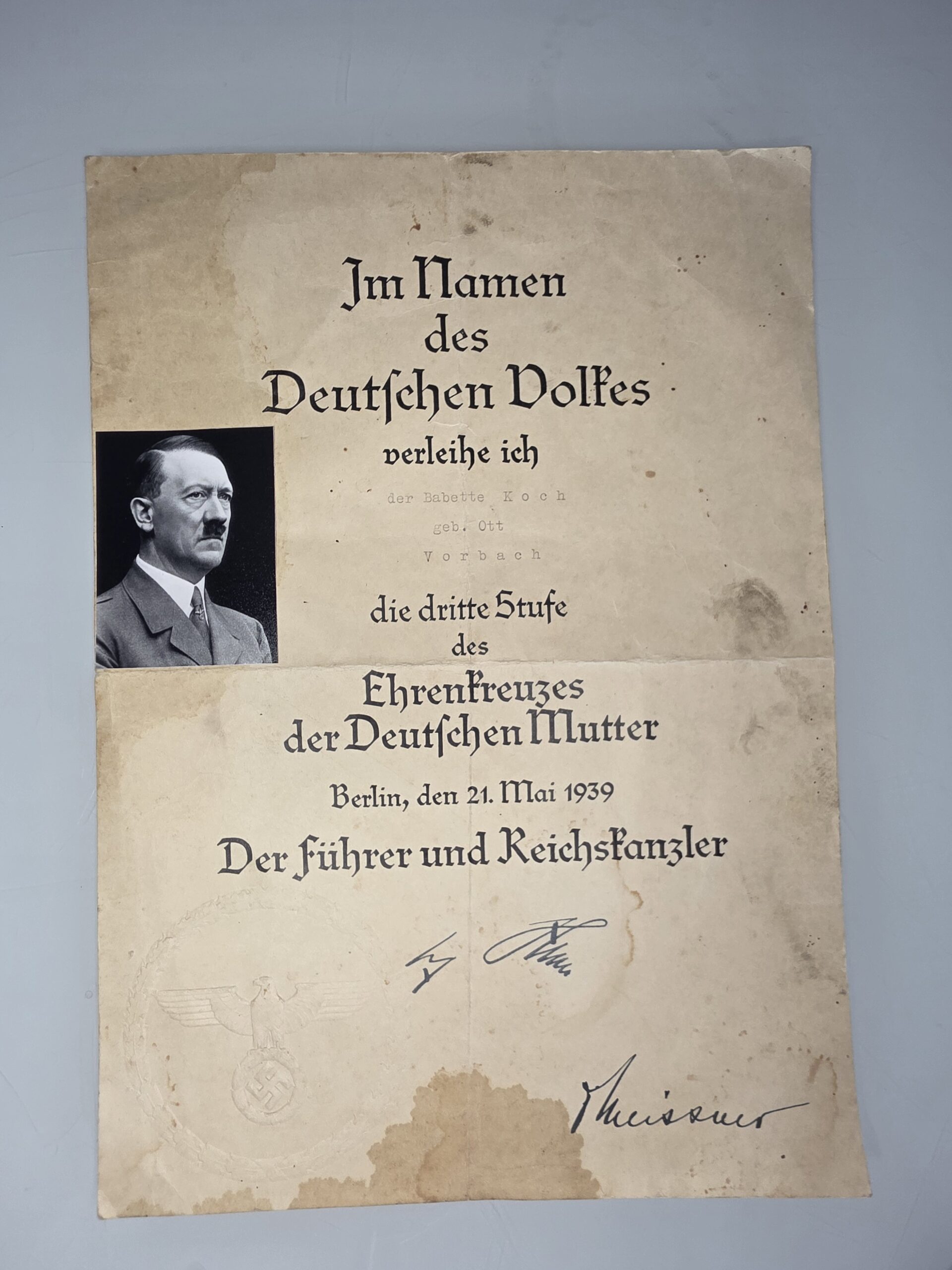
One revealing example in our collection is DOC165, a 1939 Mother’s Cross award document. Issued in Berlin on 21 May 1939, it confers the Ehrenkreuz der Deutschen Mutter, 3rd Class, on Babette Koch, née Ott, of Vorbach, with Hitler’s facsimile beneath Der Führer und Reichskanzler and a handwritten countersignature.
As an object, it is a named award certificate. Historically, it belongs to the regime’s effort to draw family and childbirth into its racial and population policy. Hitler did not sign it; he did not need to. The award was made in his name, and the printed signature tied a private family milestone to the ideology of the state.
The golden wedding certificate (DOC47), a congratulatory document of the late 1930s with Hitler’s facsimile above Der Führer und Reichskanzler, goes further still. It concerns nothing military or political at all, only a couple’s fiftieth anniversary. Yet the Führer’s printed name is there too. Its very ordinariness shows how normal the regime wanted its presence in private life to look.
Collector’s Note: The decoration tells you what was awarded. The certificate tells you to whom, when, where and under whose claimed authority. That is why named documents often say more than the medal alone.

DOC47: golden wedding certificate with the printed Hitler facsimile above “Der Führer und Reichskanzler”.
What happens when a printed Hitler sits beside a handwritten signature?
Some documents combine Hitler’s facsimile with the genuine signature of another senior figure, and they show the structure of authority with unusual clarity.
DOC151 is a promotion certificate issued from Führer Headquarters on 12 July 1943, appointing Major der Schutzpolizei a.D. Oskar Lehmann to the honorary rank of Oberstleutnant der Schutzpolizei. It carries Hitler’s printed facsimile and Heinrich Himmler’s handwritten signature. Only Himmler’s is an autograph. Hitler appears as the source of authority; Himmler, as Reichsführer-SS and Chief of the German Police, appears as the official who executed his part of the process.
DOC111 follows the same pattern in civil administration. Dated Berlin, 20 April 1938, it promotes Karl Passarge to Oberregierungsrat, with Hitler’s facsimile beneath Der Führer und Reichskanzler and the original ink signature of Joseph Goebbels.
Both documents should be read only for what they record: a police promotion and a civil-service appointment. But the pairing of a printed dictator and a handwritten minister makes the hierarchy of the Nazi state visible on a single sheet.

DOC151: Hitler’s printed facsimile beside Heinrich Himmler’s handwritten signature, Führer Headquarters, 12 July 1943.

DOC111: appointment of 20 April 1938 with Hitler’s facsimile and the original ink signature of Joseph Goebbels.
What does the facsimile show about wartime administration?
DOC164 awards the Kriegsverdienstkreuz 2. Klasse, the War Merit Cross 2nd Class, to Reichsbahnsekretär Eduard Weber of Oebisfelde. It was issued in Berlin on 30 January 1944, with Hitler’s facsimile beneath Der Führer and a handwritten countersignature.
The 1941 War Merit Cross document offers a direct comparison. Issued in Berlin on 1 September 1941, it confers the same award on Franz Plschockt of Hamburg, recorded as an auxiliary stoker (Aushilfsheizer).
Placed side by side, the two certificates show the same printed authority across different years, recipients and stages of the war. For an autograph collector, that repetition lowers rarity. For a historian, it raises significance, because repetition shows how a system worked. Neither document tells us what the recipient personally did, and it should not be stretched beyond its evidence. What it does give us is a person, an occupation, a place and a date inside the wartime award system.

DOC164: War Merit Cross 2nd Class document, Berlin, 30 January 1944, with Hitler facsimile beneath “Der Führer”.

War Merit Cross 2nd Class document, Berlin, 1 September 1941, for an auxiliary stoker from Hamburg.
How does a facsimile differ from an original Hitler autograph?
The distinction is clearest beside a genuinely handwritten signature. DOC14 is a formal award document dated Berlin, 1 May 1942, conferring the title Nationalsozialistischer Musterbetrieb (National Socialist model enterprise) on the Fenne coal mine of the Saargruben AG. Unlike the certificates above, its Hitler signature is catalogued as a certified original.
| Period facsimile | Handwritten autograph | |
|---|---|---|
| How it was made | Printed or mechanically reproduced | Written by hand, in ink |
| What it proves | That the document was issued in Hitler’s name | That Hitler physically signed this sheet |
| Where its interest lies | The document, recipient, date, issuing body and other signatures | The autograph itself, plus the document |
| Scarcity | Reproduced in large numbers | Far scarcer |
| Correct description | “Original document with period facsimile signature” | “Signed by Adolf Hitler” |
Two statements are easily confused in the market: “this is an original Hitler document” and “this document has an original Hitler signature”. The first can describe any genuine certificate issued under his government. The second claims that he signed it. A clear wording keeps both facts intact: Original 1941 German award document with period Adolf Hitler facsimile signature. Accuracy does not diminish the piece; it defines it. Our guide to facsimile signatures explains how the two are told apart in practice.

DOC14: award document of 1 May 1942 with a certified original, handwritten Hitler signature.
Why collect a Hitler facsimile document?
Because collectors do not collect ink alone; they collect objects. A certificate with a named recipient, an exact date, an unusual occupation, official seals, a handwritten countersignature and a clear historical context does not lose its interest because Hitler did not hold the pen. Often the facsimile is the least rare thing on the sheet. The value of a Hitler facsimile document usually rests on:
- Document type: an everyday certificate and a high-level appointment are different categories.
- Recipient: a named, researchable person or institution adds depth.
- Other signatures: a handwritten Himmler or Goebbels changes the autograph dimension entirely.
- Date: early, late or historically significant issues attract more interest.
- Completeness: original folder, envelope, medal or related papers.
- Provenance and condition: folds and age are normal; losses and restoration matter.
The right question is not “is a Hitler facsimile valuable?” but “what is the complete document?”. Our Autograph Value Guide sets out the wider factors.
How is a facsimile document authenticated?
With a handwritten autograph, the question is whether that person physically wrote the signature. With a facsimile document, the question changes: is this an original period document carrying the correct period reproduction?
Attention therefore shifts to the paper, printing method, typography, embossed seals, format, ageing, recipient details and consistency with documented examples. As a handwriting examiner, I look at the signature too, but here its job is to match the known printed form, not to show the movement of a living hand.
Contradictory wording such as “authentic Hitler autograph facsimile” should be avoided. “Original period document bearing an official facsimile of Adolf Hitler’s signature” says exactly what the object is. Our Authenticity & Provenance page explains how we document this distinction.
Why does the name so often overwhelm the document?
Objects connected with dictators carry a particular risk: the personality overwhelms the paper. A collector sees “Hitler” and stops reading. A better method is to set the name aside for a moment and ask:
- What is the document, and why was it issued?
- Who received it, and who actually signed it?
- Which institution produced it, and what did that institution do?
- What does the wording reveal, and how does it fit into the wider system?
Only then should the Hitler connection be put back into the picture. This keeps historical documents from turning into relics of a personality cult. It also explains a paradox: an autograph is valuable because Hitler signed only a finite number of documents, while the facsimile existed precisely to escape that limit. From an autograph perspective that makes it minor; from a historical one, mass reproduction is the whole point. The signature became almost a state emblem.
Why preserve these documents at all?
Because destroying evidence does not improve history. Regulations classified people, decrees removed rights, police files recorded arrests and railway paperwork organised transport. Awards and certificates rewarded the conduct the regime valued. Not every official was involved in every crime, and not every certificate records persecution. But paper was the language in which a modern state organised itself, and the Nazi state was no exception. Our guide to WW2 German documents looks at that paperwork in more detail.
A Hitler facsimile certificate can be preserved without any admiration for Hitler, just as a propaganda object can be studied without accepting the propaganda. Archives, museums and private collections keep such material because it lets later generations see how a dictatorship presented itself: as order, duty, family, merit and normality, while it abolished democracy and organised war and genocide. That uncomfortable contrast is why the printed signature deserves attention. It does not bring us closer to Hitler as a personality; it helps us understand the machinery around him. Our article on collecting Third Reich material responsibly sets out how we approach it.
Frequently Asked Questions
Is an Adolf Hitler facsimile signature an original autograph?
No. A facsimile is a reproduction of Hitler’s signature, not a signature he wrote by hand. The document carrying it may nevertheless be an original period document.
Can an original WWII document carry a facsimile Hitler signature?
Yes. Many original award certificates, appointments and congratulatory documents were issued with a printed or mechanically reproduced Hitler signature.
Why did official documents use Hitler facsimile signatures?
They allowed very large numbers of documents to carry the symbolic authority of the Führer without Hitler signing each one, while keeping the appearance of a personal act.
Is a facsimile Hitler document worth as much as a signed one?
Normally no. A genuine handwritten Hitler autograph belongs to a much scarcer category. A facsimile document is valued mainly as an original historical document: its type, recipient, date, other signatures, condition and context.
Does a Hitler facsimile prove that Hitler approved the individual document?
Not necessarily. The facsimile was part of an administrative issuing process and does not show that Hitler saw or handled the certificate.
How can I tell a facsimile from a handwritten Hitler signature?
By examining the signature together with the printing characteristics, ink behaviour, repeated forms, document type and comparison material. Our guide to facsimile signatures covers this in detail.
Does collecting Nazi-era documents mean supporting National Socialism?
No. Preservation and study are not endorsement. Context, purpose and presentation matter, and Autographs & Militaria keeps such material strictly as historical evidence.
Final Thoughts
A printed signature on an award certificate looks harmless, and that appearance is itself instructive. The Hitler facsimile sits where the regime’s ceremonial face met its machinery: the same printed name honoured mothers and railway officials and headed the orders of a state that waged war and committed genocide. Described accurately, as original documents with a reproduced signature, these papers are not relics of a man but evidence of how his dictatorship worked.
Historical Responsibility Notice
Adolf Hitler led a dictatorship responsible for political repression, a war of aggression, systematic racial persecution and the Holocaust. Autographs & Militaria preserves documents associated with Hitler and Nazi Germany exclusively as historical artefacts for collecting, documentation, education and research. Their preservation, study or sale does not represent admiration for Adolf Hitler, support for National Socialism or endorsement of the racist, antisemitic and totalitarian ideology of the Nazi regime.
References & Further Reading
- United States Holocaust Memorial Museum, Holocaust Encyclopedia: “Law on the Head of State of the German Reich”.
- United States Holocaust Memorial Museum, Holocaust Encyclopedia: “Anti-Jewish Legislation in Prewar Germany”.
- Bundeszentrale für politische Bildung: “Adolf Hitler – Führerkult im Nationalsozialismus”.
- Australian War Memorial: Cross of Honour of the German Mother, First Class (REL/15462).
- Autographs & Militaria: Facsimile Signature: Meaning, Value and How to Identify One.
About the Author: Juan García Nicolás
Juan García Nicolás is a historical collectibles researcher, qualified graphologist and handwriting examiner, and the editor of Autographs & Militaria. His work focuses on historical autographs, original documents, provenance and the interpretation of twentieth-century historical material.
WWII German Arbeitsbuch – Georg Ziegler Original Work Book
49,00 €
WWII German Wehrpass – Peter Bränd, Pionier Units 1939–44
Original price was: 129,00 €.99,00 €Current price is: 99,00 €.
Limited-Time OfferKriegsmarine Wehrpass – Original WWII German Military Book, 1943
Original price was: 129,00 €.99,00 €Current price is: 99,00 €.
Limited-Time OfferRudolf Hess Autograph – Signed NSDAP Wochenspruch Poster, 1938
Original price was: 1.600,00 €.1.490,00 €Current price is: 1.490,00 €.
Limited-Time Offer

About the Author: Juan García Nicolás

Authentication & certification
Have a signature or document you want examined? Independent analysis by a qualified graphologist and forensic handwriting examiner.
Research tools
What is my autograph worth?
Signed or facsimile?
Which German document do I have?
All Journal articles
From the collection
- Limited-Time Offer
German Document Archive 1911–1967 – DAF, University and Business Papers
Original price was: 249,00 €.199,00 €Current price is: 199,00 €.
Limited-Time Offer WWII German Wehrpass Group – 256th Infantry Division, Ostmedaille Entry, Original Medal & Death Letter
690,00 €
Matt Groening Homer Simpson Drawing – Original Signed Sketch with COA
Original price was: 500,00 €.440,00 €Current price is: 440,00 €.
Limited-Time Offer