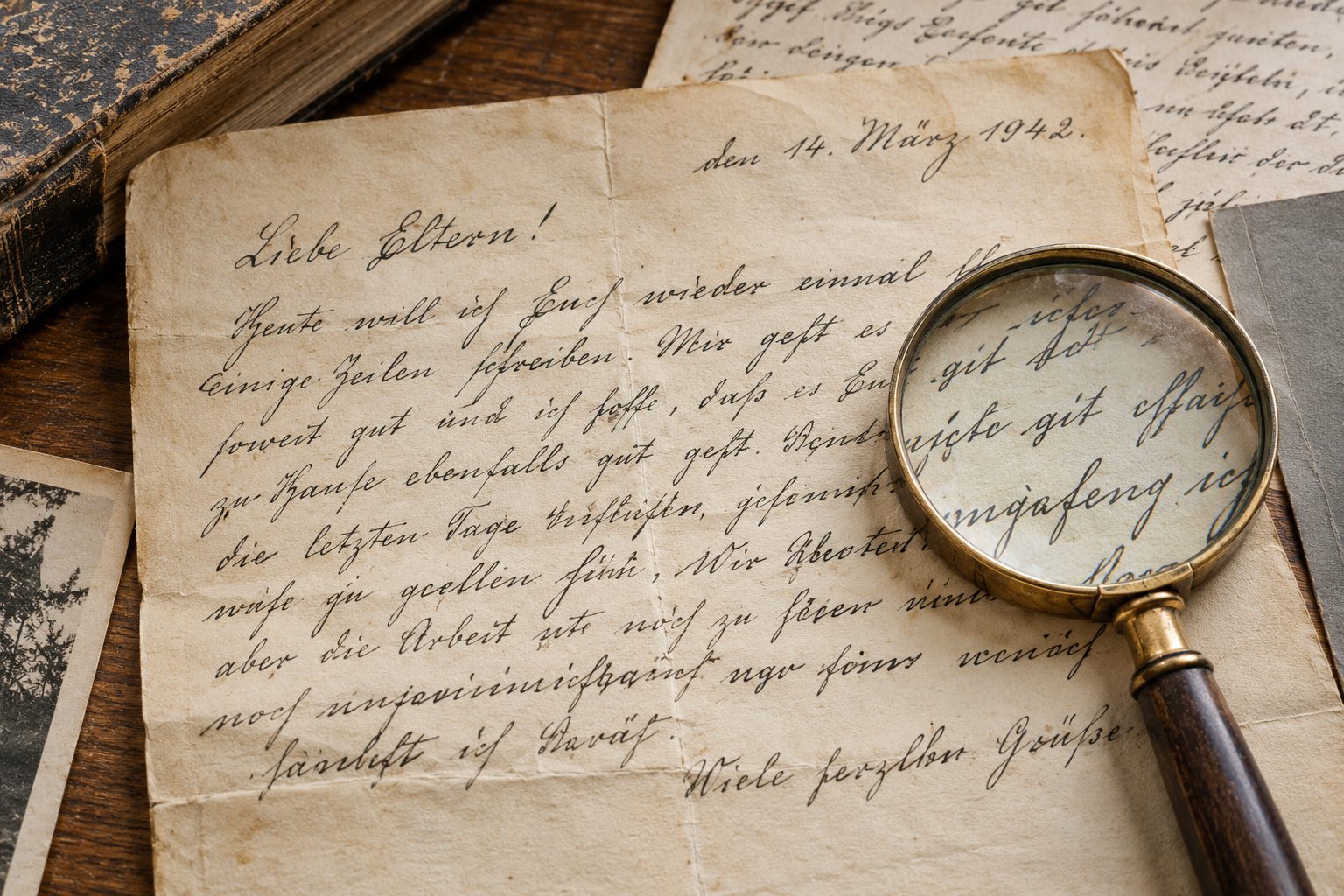
Sütterlin Alphabet: A Collector’s Guide to Reading Old German Handwriting and WWII Letters
A handwritten letter from Germany in 1938 can present a peculiar problem. The paper is intact, the ink is still dark and not a single line is damaged. Yet a modern German speaker may be unable to read it.
The problem is not the language. It is the handwriting.
For generations, German writers used forms of cursive that differ substantially from the Latin handwriting most of us learned at school. The two names collectors meet most often are Kurrent and Sütterlin. Learning the Sütterlin alphabet, and how it relates to the older Kurrent tradition, changes the way a historical document can be researched: letters that first look indecipherable begin to give up names, dates, places, family relationships and personal experience.
For anyone who collects handwritten correspondence, autographs and militaria, this matters. While its writing remains unread, a document tells us very little. Once accurately transcribed, it can become a genuine primary source.
In this guide I explain how to recognise old German handwriting, how to tell the scripts apart, how to approach difficult letters and how to keep a reliable record of what you read, using original pieces from our own collection as examples.

Original Wehrpass and Feldpost envelopes from DOC169: printed headings, official stamps and handwritten addresses side by side.
What is the Sütterlin alphabet?
The Sütterlin alphabet is a simplified German school handwriting created by the Berlin graphic artist Ludwig Sütterlin (1865–1917). In 1911 the Prussian Ministry of Education commissioned him to design a new script that would make learning to write easier for children. It was conceived as a starting script (Ausgangsschrift) from which each pupil would later develop a personal hand, rather than as a model to be copied for life.
Sütterlin did not invent German cursive. His script was a simplification of the much older German Kurrent tradition, with more upright, rounded and regular forms. That is why its letters can look so different from modern Latin handwriting, and why letters that seem recognisable in isolation become hard to identify once they are joined together.
For millions of Germans it was simply the handwriting they learned at school, and many continued to use it, or something close to it, for the rest of their lives. This is why it appears in such a wide range of material: family letters, diaries, postcards, administrative records and military correspondence.
Are Sütterlin, Kurrent and Fraktur the same thing?
No, and confusing them is one of the most common mistakes in document collecting. Archivists themselves point out that “Sütterlin” is often used, incorrectly, as a label for every form of old German cursive.
| Script | What it is | Where collectors meet it |
|---|---|---|
| Kurrent | The traditional German cursive, developed over centuries, usually slanted and pointed | Letters, administrative and church records, personal documents from the 18th century onwards |
| Sütterlin | A simplified, more upright school version of Kurrent (from 1911) | Correspondence of people schooled in Germany between the wars |
| Fraktur | A printed blackletter typeface, not handwriting | Books, newspapers, printed forms and certificates |
| Latin cursive | The Roman-based handwriting used across most of Europe | Used alongside German cursive, and the official school script from 1941 |
Kurrent: the older tradition
Kurrent developed over centuries and was widely used throughout German-speaking Europe. By the nineteenth century it was the normal hand for private correspondence, commerce and administration, typically written with a pointed pen that produced swelling and thinning strokes, sharp angles and a marked slant. A letter written in 1880 is therefore far more likely to be in Kurrent than in Sütterlin, which did not yet exist. Austria never adopted Sütterlin in its schools and continued to teach the traditional Kurrent.
Sütterlin: a simplified school hand
Introduced in Prussia from 1915, Sütterlin spread to schools in other German states during the 1920s. In 1935 a slightly modified, gently slanted version known as the Deutsche Volksschrift became part of the official curriculum, and it remained so until 1941. By the late 1930s, Sütterlin-influenced handwriting was a familiar part of German education.
Fraktur: printed, not handwritten
Fraktur presents a different problem. A 1930s newspaper printed in Fraktur may be hard for a modern reader, but the difficulty lies in historical printed letterforms, not in handwriting. Many of the documents I handle, such as a Wehrpass or an award certificate, combine both: printed headings in Fraktur or Antiqua and handwritten entries in cursive.
So the first question to ask of any document is simple: is this printed text, handwriting, or both? For an overview of the paperwork itself, see our WW2 German Documents Collector’s Guide.

A wartime envelope from DOC169, addressed in German cursive. The opening word, Herrn, shows the looped capital H and an e formed from two short strokes.
Why did Sütterlin disappear from German schools?
The history of German handwriting includes an unexpected reversal during the Nazi period. After years in which “German” scripts had been promoted as part of national identity, the regime abandoned them during the Second World War.
On 3 January 1941 Martin Bormann, writing “on behalf of the Führer”, circulated a confidential instruction declaring that blackletter type was not a “German” script at all. It falsely claimed that Fraktur derived from so-called “Schwabacher Jew-letters”, an antisemitic invention with no historical basis, and ordered that the Latin-based Antiqua be treated as the “normal script” (Normalschrift) for printing and official documents. The circular already announced that schools would teach only the normal script once this became practicable. A further circular from the Reich Ministry of Education on 1 September 1941 ended the teaching of German script handwriting, and the Latin-based Deutsche Normalschrift took its place.
The change was not instantaneous. Adults went on writing the way they had learned as children, and older officials, soldiers and civilians did not abandon their handwriting because a new standard had been decreed. Letters in Kurrent or Sütterlin-influenced hands therefore continued to be written throughout the war and long afterwards.
This matters when examining wartime correspondence. A German letter dated 1943 in an older script is not suspicious for that reason alone. The writer’s age, schooling and personal habits all matter. Script alone can neither date a document precisely nor establish its authenticity.
Why is old German handwriting so difficult to read?
The central difficulty lies in the shape of individual letters. Our eyes are trained on Latin forms, and Kurrent and Sütterlin use a different visual system. Some letters resemble their modern equivalents; others look like entirely different letters. A single word can dissolve into a row of near-identical vertical strokes, especially when the writing is fast, compressed or made with a worn nib. These are the traps I see most often.
The letters e, n, m and u
In German cursive the e is made from two short strokes and can look almost exactly like an n. Combined with m, n and u, a word can appear to be little more than a series of short vertical marks. The reader has to learn to see subtle differences in direction, joining strokes and letter endings.
Telling n from u
To prevent confusion, the lowercase u is usually written with a small curved mark above it (the u-Bogen). Historical handwriting, however, is rarely consistent: a hurried writer may make the mark faint, place it carelessly or leave it out altogether.
Long and round s
German cursive distinguishes a long s from a round s, used according to spelling conventions and the position of the letter within a word. A reader who does not know both forms can easily turn a familiar word into something unrecognisable.
Capital letters and the letter h
Capitals are often far more elaborate than lowercase letters, and names and places frequently begin with forms that defeat beginners. The lowercase h, with its long loop below the line, is another classic stumbling block. For this reason it is often easier to read a whole sentence than an isolated surname: context provides the clues.

A handwritten entry in German cursive from the DOC169 archive. The phrase ärztliche Behandlung (medical treatment) shows the looped h descending below the line and the two-stroke e.
Why must you transcribe before you translate?
This is probably the most important practical advice in this guide. A handwritten German document involves three separate tasks:
- Transcription: identifying the handwritten characters and reproducing the original German wording.
- Translation: expressing the meaning of that German text in another language.
- Historical interpretation: understanding what the text means in its original context.
They are not interchangeable. A translation can sound entirely convincing while resting on a faulty transcription, and a faulty transcription can change a name, a unit, a date or a place. Even a perfect translation can be historically misunderstood.
Take the ordinary closing Herzliche Grüße. A transcription keeps those German words. A translation might render them as “Warm regards”. Interpretation then asks who was writing, to whom, when and in what circumstances. The handwriting is the primary evidence; everything else depends on reading it accurately.
How do you read old German handwriting? A practical 7-step method
I recommend treating transcription as a series of small problems rather than trying to decipher a whole page at once.
Step 1: Examine the complete document
Before looking at individual letters, identify what kind of document it is: a private letter, a postcard, a military service record, a diary, a business paper or a certificate. This tells you what kind of language to expect. A family letter uses very different expressions from a military appointment.
Step 2: Identify the approximate script
Decide whether the hand resembles traditional Kurrent, standardised Sütterlin or Latin cursive. Not every document fits neatly: writers often mixed letterforms, or switched script depending on the context, for instance using Latin letters for names and foreign words.
Step 3: Find the easy words
Look for formulas that recur in correspondence and records, for example:
- Liebe Mutter – Dear Mother
- Mein lieber – My dear
- Viele Grüße – Many regards
- Herzliche Grüße – Warm regards
- geboren – born
- gestorben – died
Once you have read a few words, use their letterforms as a key to less familiar passages by the same writer.
Step 4: Identify dates and places
A recognisable date or place can establish the context of the entire document. Compare numerals, month names and place names with other information on the page, and be careful with historical spellings and unfamiliar geography.
Step 5: Compare repeated letters
This is often more effective than consulting an alphabet chart over and over. Writers tend to form the same letter in a distinctive way throughout a document; once you have identified it in a familiar word, other examples fall into place.
Step 6: Transcribe uncertain words conservatively
Never invent a word because it seems historically plausible. Record uncertainty openly, for example [illegible] or Müller [?]. A good transcription communicates the limits of the evidence.
Step 7: Translate only after checking the original
When the transcription is reasonably secure, begin translating, and keep the German text alongside the translation. This makes later corrections far easier.
Collector’s Note: If a single word refuses to resolve, leave it and come back later. After reading the rest of the page, your eye will have learned the writer’s habits, and the word often reads itself.
Why are names often the hardest part?
Identifying a historical name can be surprisingly difficult. Family names may be unfamiliar, may occur in several spellings or may resemble ordinary German words, and a cursive capital can be especially ambiguous. This becomes critical when researching military records, official correspondence and autographs.
If a surname is read wrongly, archive searches may produce nothing at all. Worse, a similar name may lead you to an unrelated person. The safest approach is to check the name against independent evidence:
- other pages in the same archive;
- addressed envelopes;
- official certificates and military personnel records;
- contemporary directories;
- repeated signatures or handwritten references.
A name should never be treated as certain simply because one reading produces an interesting historical connection.
How should you read WWII German Feldpost letters?
Wartime correspondence brings its own challenges. German Feldpost includes the letters, postcards and envelopes exchanged between service personnel and civilians. Some contain detailed descriptions; many are almost entirely personal, and most carry very little military information.
When I read a Feldpost letter, I start with these questions:
- Who wrote it, and who received it?
- What is the date?
- Where was the recipient?
- Does the envelope preserve a Feldpost number?
- Are any places or units named in the text?
- What historical conclusions can actually be supported?
A Feldpost number may help identify a unit when matched against suitable dated reference material. But a letter should not be taken as proof of participation in a particular battle merely because it uses military vocabulary.
Field conditions can also leave their mark on the writing itself: cramped space, cold hands, poor pens and fatigue all alter a familiar hand. I discuss how handwriting changes under strain in Escritura bajo presión (in Spanish). For unit identification and abbreviations, see our WWII German Military Abbreviations guide; the purpose of this guide is different: to recover the words the individual actually wrote.
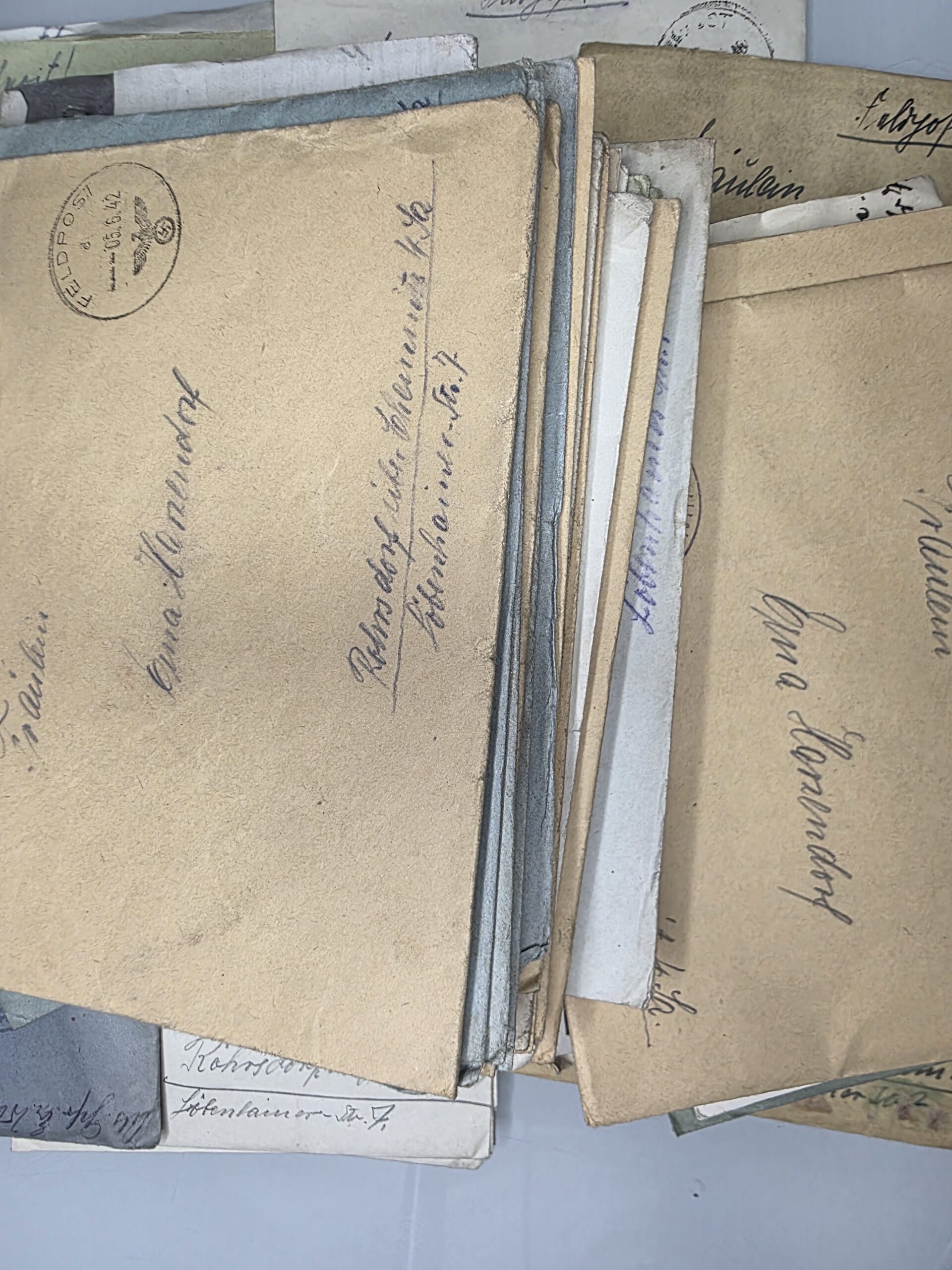
Part of the Feldpost group in DOC169, an archive combining a Heer Wehrpass, a WWI Militärpass and wartime correspondence dating mainly from 1940 to 1943.
From the collection: DOC169, Wehrpass archive with Feldpost and Militärpass
DOC169 shows why correspondence and military records are best researched together. Its handwritten envelopes and letters preserve the private side of a soldier’s war, while the Wehrpass and the earlier Militärpass record the administrative one. Names and addresses on the envelopes can confirm readings in the booklets, and the reverse.
Is a wartime letter the same as an official military record?
No. A military booklet and a private letter may concern the same person while serving entirely different purposes. The official document was written to record administrative facts: a unit, a rank, a transfer, an award. The private letter was written to communicate with another human being and may reveal feelings, daily routines or family relationships.
Neither replaces the other, and the strongest interpretation usually comes from comparing independent sources. At the same time, a private letter should not be turned into a biography without supporting evidence. There is an important difference between what the writer explicitly says and what a historian might infer. For the official side, see our German Wehrpass Guide and Wehrpass vs Soldbuch.
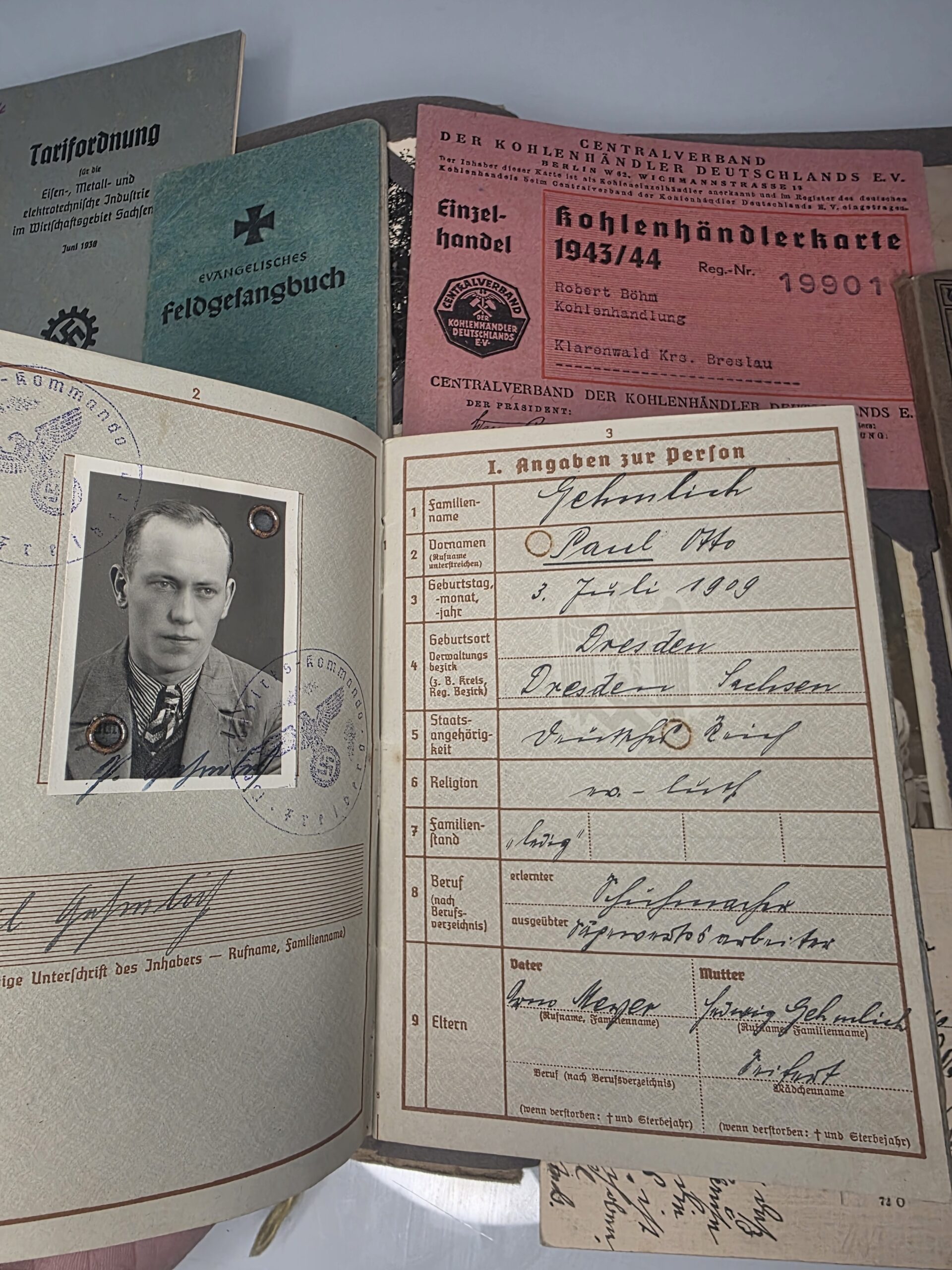
The personal page of the Wehrpass in DOC172, combining printed headings with handwritten entries.
From the collection: DOC172, Wehrpass group of a Gefreiter of the 256th Infantry Division
DOC172 is an original archive built around the Wehrpass of a Gefreiter who served with Infanterie-Regiment 456 of the 256th Infantry Division. The group includes the Wehrpass, photographs, an Ostmedaille of the type recorded in the booklet and later correspondence concerning his death.
It shows why the relationship between records should be preserved. A name read in one document may help interpret another; a photograph may provide context; a dated entry may fix the chronology. Even so, each document should first be read on its own, before its contents are combined into a wider narrative.
How do you read an old German signature?
Signatures present a different challenge from ordinary handwriting. In continuous writing, the reader benefits from complete words and sentences. A signature may be just a few hurried strokes, with highly personal letterforms, abbreviated first names, omitted letters or a flourish. Even an experienced reader of Kurrent can struggle with an unfamiliar signature.
For autograph collectors it is essential to keep two questions apart: what name appears to be written? and was the signature actually written by the person to whom it is attributed?
Recognising a name does not establish authorship. As a handwriting examiner, I approach authentication through a body of consistent features, never a single sign: comparison with authenticated signatures, line quality, movement, construction and pressure, together with the document itself and its provenance. Successful transcription must never be confused with authentication. I set out the full method in How to Authenticate a Signature on a Historical Document, and the question of when a collector needs a certificate and when a formal expert report is covered in Certificate of Authenticity or Forensic Handwriting Report?. Because no one signs exactly the same way twice, it also helps to understand the natural variation of a signature (in Spanish). For printed signatures, see Facsimile Signature: Meaning, Value and How to Identify One and our encyclopaedia entry Original Signature or Facsimile?; for the market side, see the Autograph Value Guide.
Did old German handwriting survive after 1945?
Yes. The end of school instruction in 1941 did not make the older scripts disappear from private life. People went on using the handwriting they had learned, so a letter written in 1952 may contain forms associated with an earlier period. Others had long since adopted Latin cursive, and many documents mix both.
This complicates any attempt to date an object from its handwriting alone. Script can suggest a writer’s schooling or generation, but it is not a reliable dating method without supporting evidence.

The 1952 letter catalogued as DOC146: written by a man born in 1885, yet predominantly in a fast Latin-based cursive rather than Kurrent or Sütterlin.
From the archive: Albert Kesselring’s letter of 3 July 1952
One of the letters that has passed through our collection is a handwritten letter dated 3 July 1952, catalogued as Albert Kesselring’s prison letter to his wife Liny (DOC146, now sold and kept in our archive). It is a useful reminder that handwriting research does not end in 1945, and that age is a poor guide to script.
Kesselring was born in 1885 and schooled long before Sütterlin existed, so one might expect Kurrent. Examined closely, however, the letter is written predominantly in a rapid Latin-based cursive. That is exactly why a document should never be labelled “Sütterlin” or “Kurrent” because of its date or its writer: only its actual letterforms can tell you which script it uses.
How should you use a Sütterlin alphabet chart?
An alphabet chart is genuinely useful, especially at the start. But it should be treated as a reference, not as a mechanical decoding key. A chart shows ideal school forms; real handwriting departs from them. Individual writers varied letter height, spacing, connections, pen pressure, slant, the construction of capitals and the use of abbreviations.
The most effective approach is to compare the chart with the document in front of you: start with recognisable words, identify their letters and then apply those patterns to the harder passages.
Use charts from reliable institutional sources. Small differences between characters are precisely what you need to study, and decorative or digitally generated “alphabets” circulating online frequently get them wrong. Good starting points are the FamilySearch German Paleography Seminar, a free series of lessons on recognising and writing Kurrent letters, key genealogical terms and common names, and the Bundesarchiv’s “Kurrent typewriter”, an online tool that shows how words look in German script.
Can AI and handwriting recognition read old German letters?
Digital technology has made historical transcription considerably easier. Handwritten text recognition can now identify words in historical manuscripts and turn them into searchable text.
The German Federal Archives demonstrated this on a large scale. In June 2024 the Bundesarchiv announced that around 10,000 files of the Reich Colonial Office (holding R 1001) had been made fully searchable using AI-based handwriting recognition. The holding was chosen partly because so much of it is handwritten in German Kurrent. It is a significant development for research.
It is not, however, proof that automatic transcription is always right. Older documents present difficult conditions: faded ink, unusual hands, damage, discolouration, overlapping writing, abbreviations and uncommon names. AI systems can also produce plausible-looking words that are simply not in the manuscript. Every important reading should be checked against the original image.
Collector’s Note: Using software to improve the readability of a photograph is not the same as letting software invent missing letters. Brightness, exposure and faithful enlargement can help. Reconstructed signatures, invented stamps and AI-generated versions of incomplete documents must never be presented as photographs of original objects, and the untouched image should always remain available for verification.
Illustrative image (digitally generated). It is not a historical document and its lettering should not be used as a reading reference.
How can historical context help, and when does it mislead?
Handwriting does not exist apart from the world that produced it. A family letter from 1914 uses different vocabulary from a military letter of 1944. Administrative records rely on standard formulas; private correspondence is full of regional words, family names, jokes and informal abbreviations. Knowing the context narrows the possible readings.
Context must never replace direct evidence, though. A researcher may know that a unit served on the Eastern Front; that does not justify reading an unclear place name in a letter as a particular Eastern European town. Context can support an interpretation. It should not decide the result in advance.
How should you record a transcription?
A reliable research archive keeps several separate records:
- Original image: the untouched photograph or scan of the document.
- Diplomatic transcription: preserving the original wording, spelling and relevant irregularities.
- Normalised German text: where useful, a version with modern spelling or expanded abbreviations.
- Translation: into English, Spanish or another language.
- Research notes: interpretation, references, uncertain readings and supporting evidence.
Keeping these apart lets future researchers see how a conclusion was reached, and prevents a correction to the translation from silently altering the record of the original wording. At Autographs & Militaria this matters whenever we catalogue named documents and archives; our guide How to Catalogue a Historical Collection explains how each object receives a permanent reference linked to its research material.
What are the most common mistakes when reading German documents?
- Assuming all old German handwriting is Sütterlin. Many documents are in Kurrent, Latin cursive or a mixture.
- Translating before transcribing. An attractive translation can hide a wrong reading of the original.
- Guessing personal names. An uncertain surname can lead to a false identification.
- Relying entirely on software. Automatic transcription is useful, but important readings need human verification.
- Ignoring related documents. Dates, addresses, names and inscriptions elsewhere in an archive often resolve difficult words.
A practical transcription checklist
Before completing the record of a handwritten German document, check:
- Has the script been provisionally identified?
- Is the original image preserved?
- Have the date and place been examined?
- Have repeated letterforms been compared?
- Are personal names supported by other evidence?
- Have uncertain words been marked?
- Is the German transcription kept separate from the translation?
- Are historical conclusions clearly distinguished from the text itself?
- Have the sources been recorded?
- Could another researcher repeat or review the reading?
A good transcription is not necessarily one in which every word has been resolved. Sometimes the most accurate result is the one that honestly acknowledges uncertainty.
Frequently Asked Questions
What is the Sütterlin alphabet?
A simplified German school handwriting designed by the graphic artist Ludwig Sütterlin, commissioned by the Prussian Ministry of Education in 1911. It was introduced in Prussia from 1915 and taught across Germany until 1941.
What is the difference between Kurrent and Sütterlin?
Kurrent is the older German cursive tradition, usually slanted and pointed. Sütterlin is a simplified, more upright school version developed from it. Their letterforms are related but not identical, and not all old German handwriting is Sütterlin.
How can I read old German handwriting?
Identify the type of document and the script, consult a reliable alphabet reference, start with recognisable words and compare repeated letterforms. Transcribe the original German before attempting a translation.
Is Sütterlin the same as Fraktur?
No. Sütterlin is handwriting; Fraktur is a printed blackletter typeface. A single document can contain printed Fraktur alongside handwritten Kurrent or Sütterlin.
Was Sütterlin used during the Second World War?
Yes. It was still taught until 1941, when Nazi decrees replaced German scripts with the Latin-based ‘Normalschrift’, and adults continued to write in the hand they had learned throughout the war and after it.
Can German speakers read Sütterlin today?
Some can, particularly older people and those who have studied historical scripts. Most modern German speakers were never taught it and find it difficult without practice.
Can AI translate a handwritten German WWII letter?
AI can help with transcription and translation, but it makes errors, particularly with unusual names, damaged writing and older letterforms, and it can produce words that are not in the original. Important readings should always be checked against the document.
Does Sütterlin handwriting prove a document is original?
No. Script style alone cannot establish authenticity or a precise date. That requires examination of the document, its materials, its provenance and other evidence.
Are handwritten WWII German letters historically important?
They can be valuable primary sources for family, military and everyday history. Their significance depends on their content, context, condition and the supporting evidence available.
Final Thoughts
The significance of these scripts goes far beyond unusual letterforms. A letter can preserve an individual voice; a postcard can document a relationship; a diary can record experiences absent from official histories; a document group can connect several generations of a family. Very often, the handwritten words are the most important part of the object.
To a collector, an unread letter may at first be little more than an old sheet of paper. Accurately transcribed, it becomes a historical source. The challenge, and for me the pleasure, is to recover those words without letting assumptions, incomplete information or modern expectations distort them.
Historical Responsibility Notice
Autographs & Militaria preserves and researches historical documents, including correspondence and records from the National Socialist period, exclusively as historical artefacts for collecting, preservation, education and research. Their study, preservation or sale does not imply endorsement of the regime, its organisations or its ideology. Historical terminology is retained only where necessary for accurate identification and research. See also Collecting WWII and Third Reich Material Responsibly.
References & Further Reading
- Bundesarchiv: “Kolonialakten dank Künstlicher Intelligenz jetzt vollständig durchsuchbar”, press release, 28 June 2024.
- Bundesarchiv: Sources on the displacement of cultural property in colonial context, 1884–1918 (on Kurrent and the “Kurrent typewriter”).
- Landesarchiv Baden-Württemberg, Hauptstaatsarchiv Stuttgart: Archivpädagogische Module, “Paläographie – Sütterlin und Kurrent”.
- FamilySearch Learning Center: German Paleography Seminar (lesson series on Kurrent).
- Friedrich Verlag: “Handschreiben in Deutschland” (Sütterlin’s 1911 commission and its role as a starting script).
- museum-digital Brandenburg: object record 14423 (introduction of Sütterlin in Prussia in 1915, its spread in the 1920s and the Deutsche Volksschrift, 1935–1941).
- Universität Heidelberg, UniMut, Janina Reibold: “Verbot der Frakturschriften durch die Nationalsozialisten” (with a facsimile of Bormann’s circular of 3 January 1941).
- Friedrich Beck, “Schwabacher Judenlettern” – Schriftverruf im Dritten Reich, in Die Kunst des Vernetzens, Verlag für Berlin-Brandenburg, 2006.
- Juan García Nicolás, VS Certificate of Authenticity: “How to Authenticate a Signature on a Historical Document: A Guide for Collectors”.
- Autographs & Militaria: WW2 German Documents: Complete Collector’s Guide; WWII German Military Abbreviations; The Collector’s Encyclopaedia.
About the Author: Juan García Nicolás
Juan García Nicolás is a historical collectibles researcher, qualified graphologist and handwriting examiner, and the editor of Autographs & Militaria. His work focuses on historical autographs, original documents, provenance and the interpretation of twentieth-century historical material. He issues certificates of authenticity and forensic handwriting reports through VS Certificate of Authenticity, and writes on graphology and signatures at Aprende Grafología and Análisis Grafológico Online (both in Spanish).
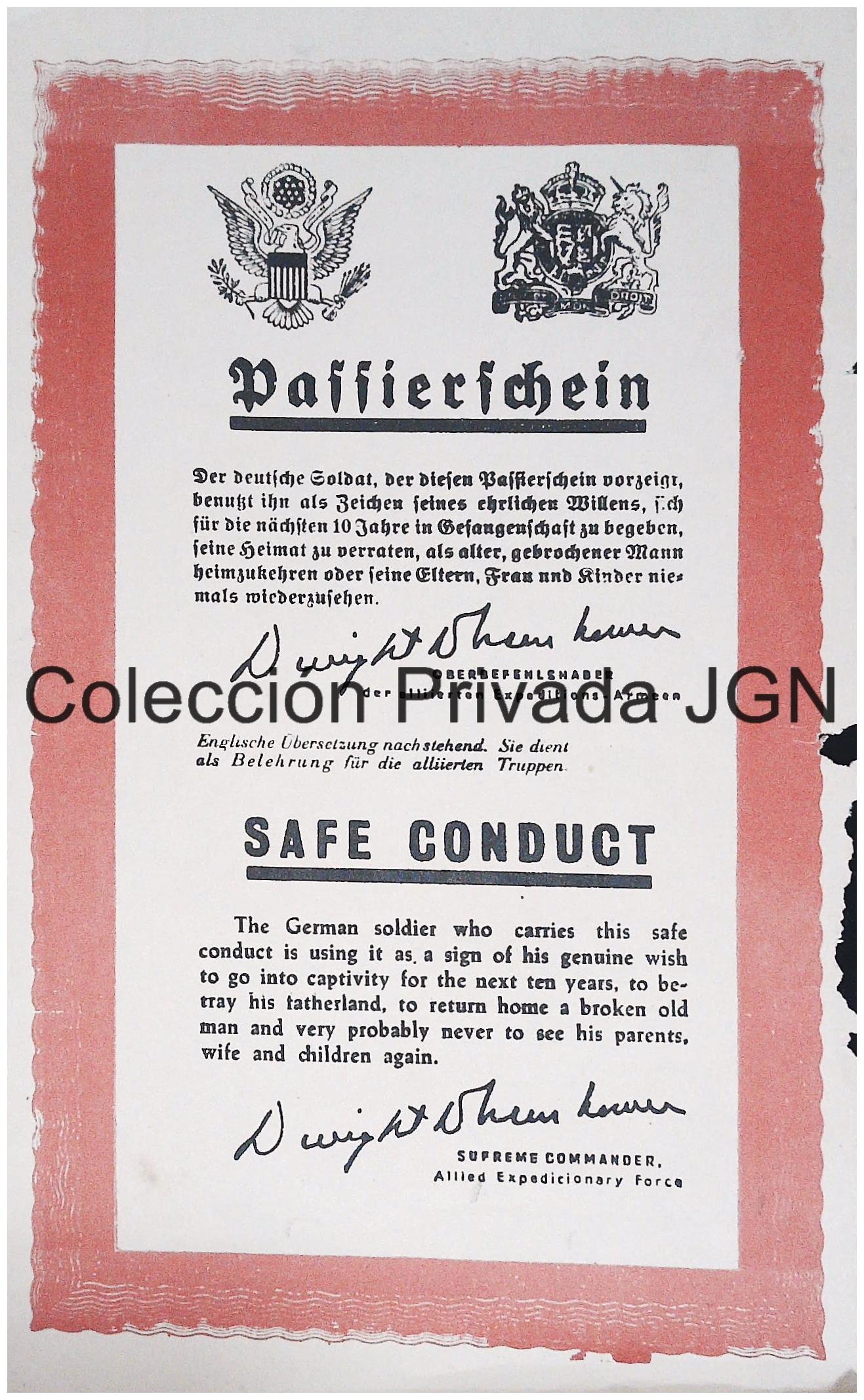
Original WWII Safe Conduct Pass & German Skorpion Counter-Propaganda Leaflet 1944
129,00 €
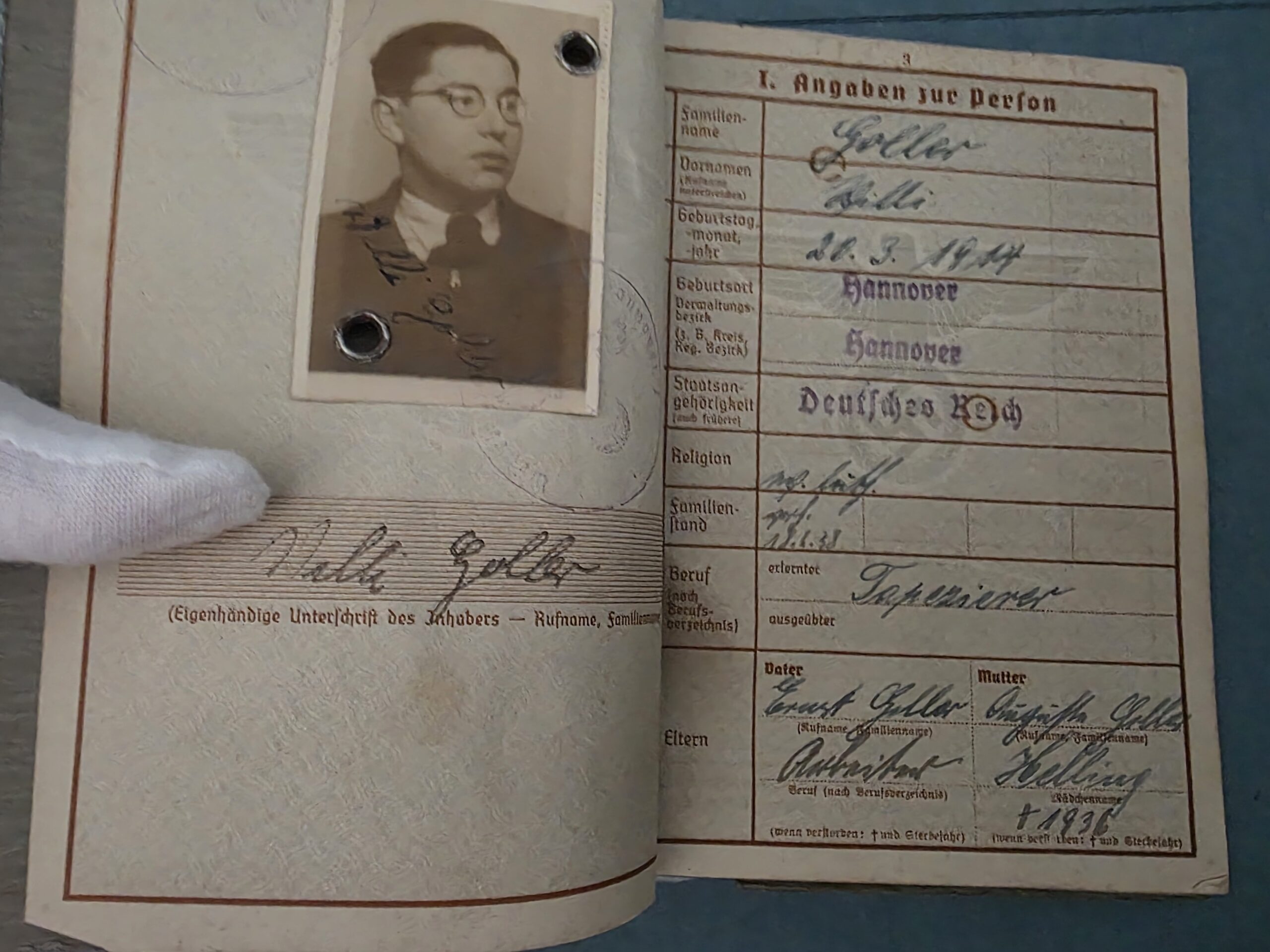
WWII German Wehrpass – Willi Geller, Hannover 1938–44
99,00 €
Original German Arbeitsbuch – Wilhelm Hils, Karlsruhe, 1st Pattern
49,00 €
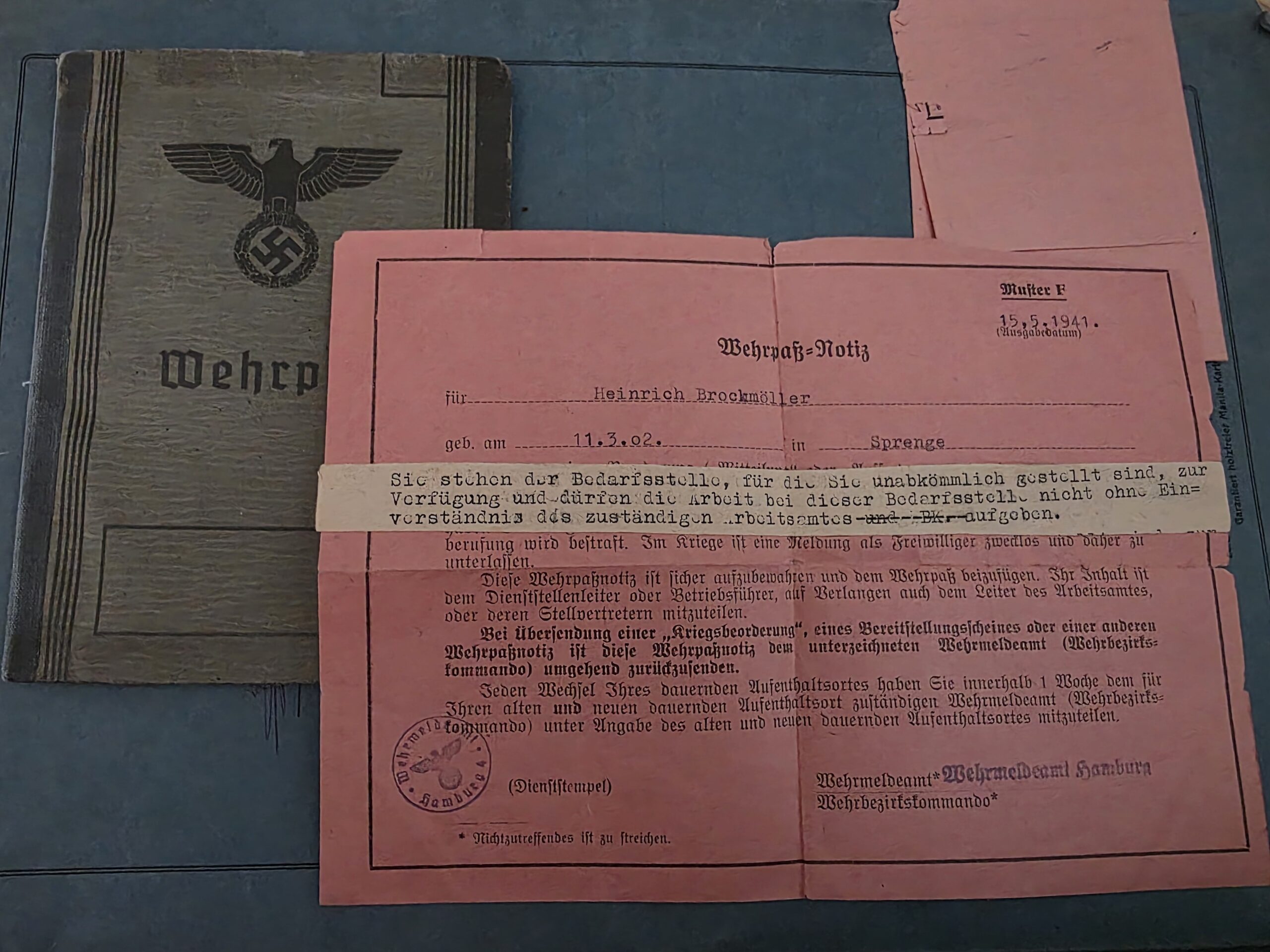
WWII German Wehrpass – Heinrich Brockmöller UK Exemption Papers 1940–43
99,00 €
About the Author: Juan García Nicolás

Authentication & certification
Have a signature or document you want examined? Independent analysis by a qualified graphologist and forensic handwriting examiner.
Research tools
What is my autograph worth?
Signed or facsimile?
Which German document do I have?
All Journal articles
From the collection
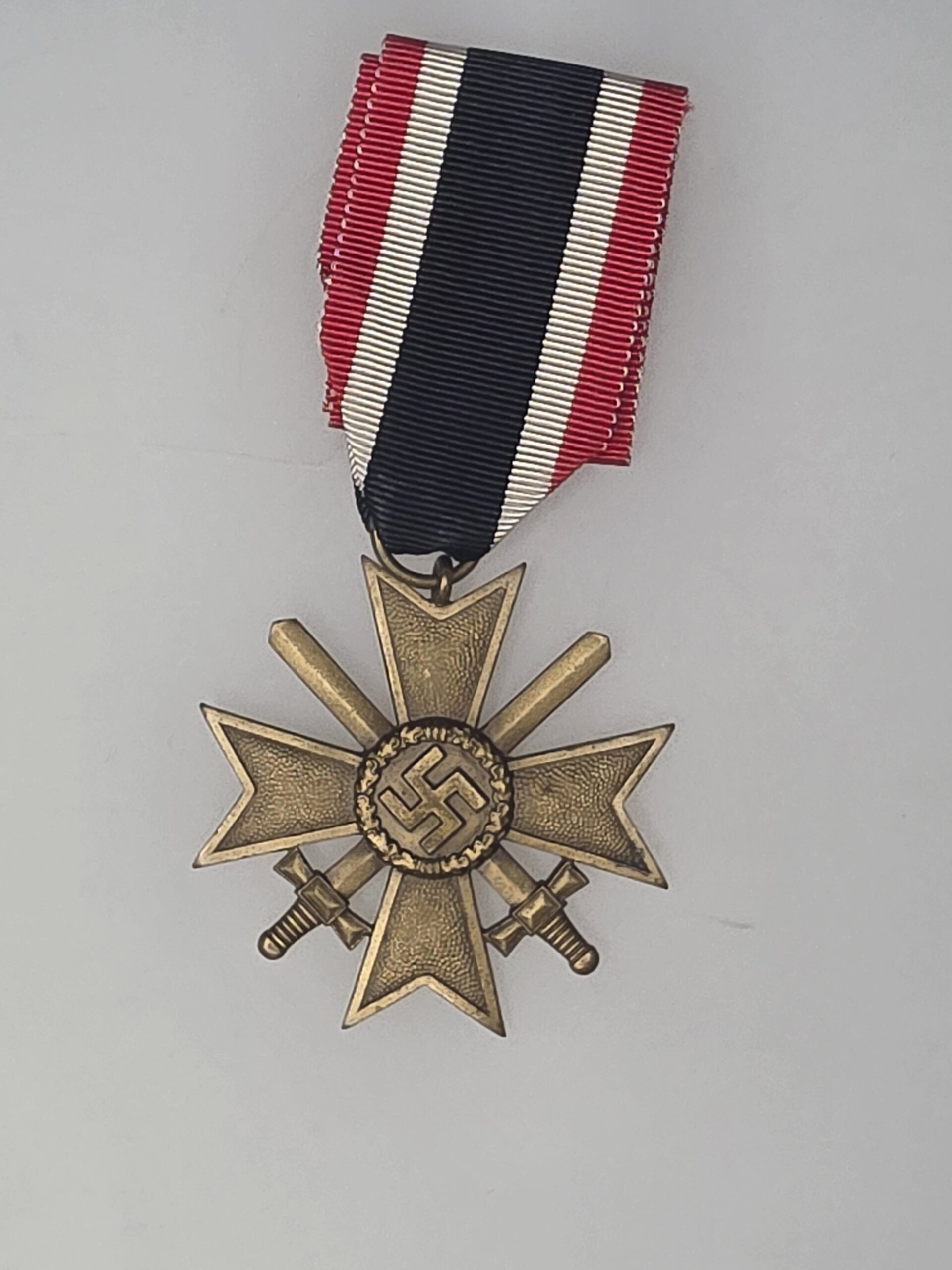
Kriegsverdienstkreuz mit Schwertern – Original German War Merit Cross 2nd Class 1939
59,00 €
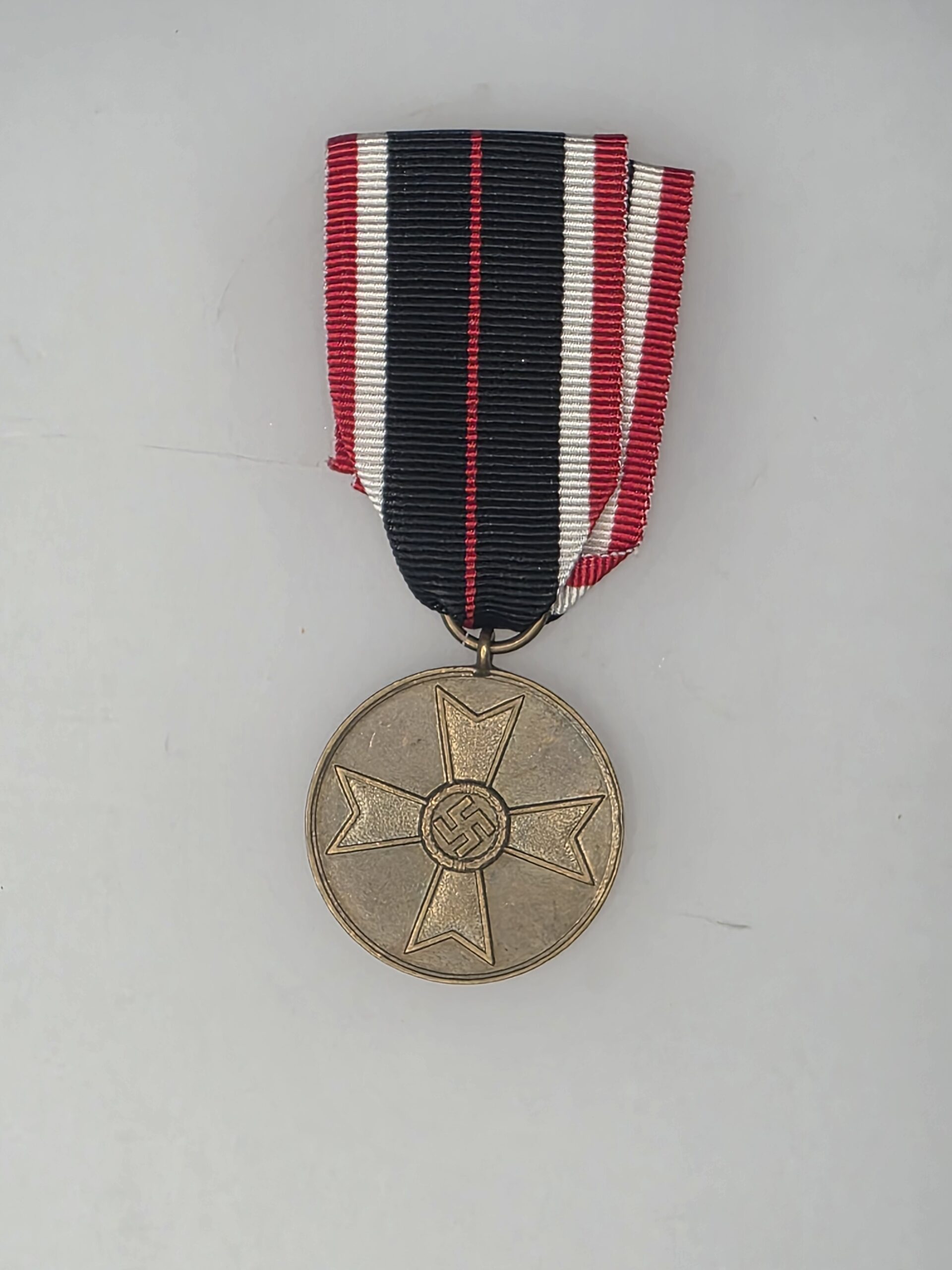
Kriegsverdienstmedaille 1939 – Original German War Merit Medal with Ribbon
45,00 €
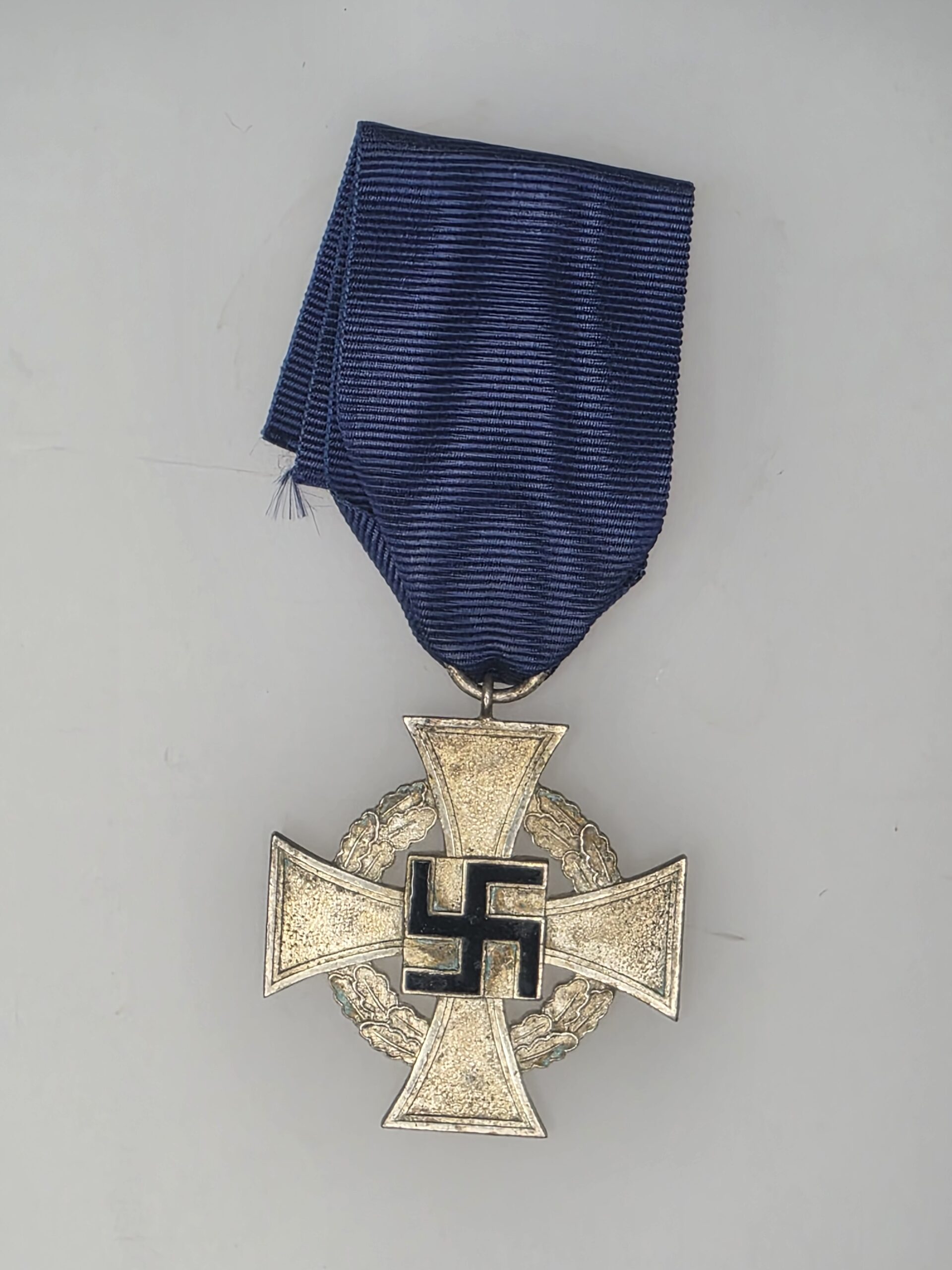
Treudienst-Ehrenzeichen 25 Jahre – Original Silver Faithful Service Cross
55,00 €