The Collector’s Encyclopaedia · Documents · Authentication
Original Signature or Facsimile: History, Contents and Collector’s Guide
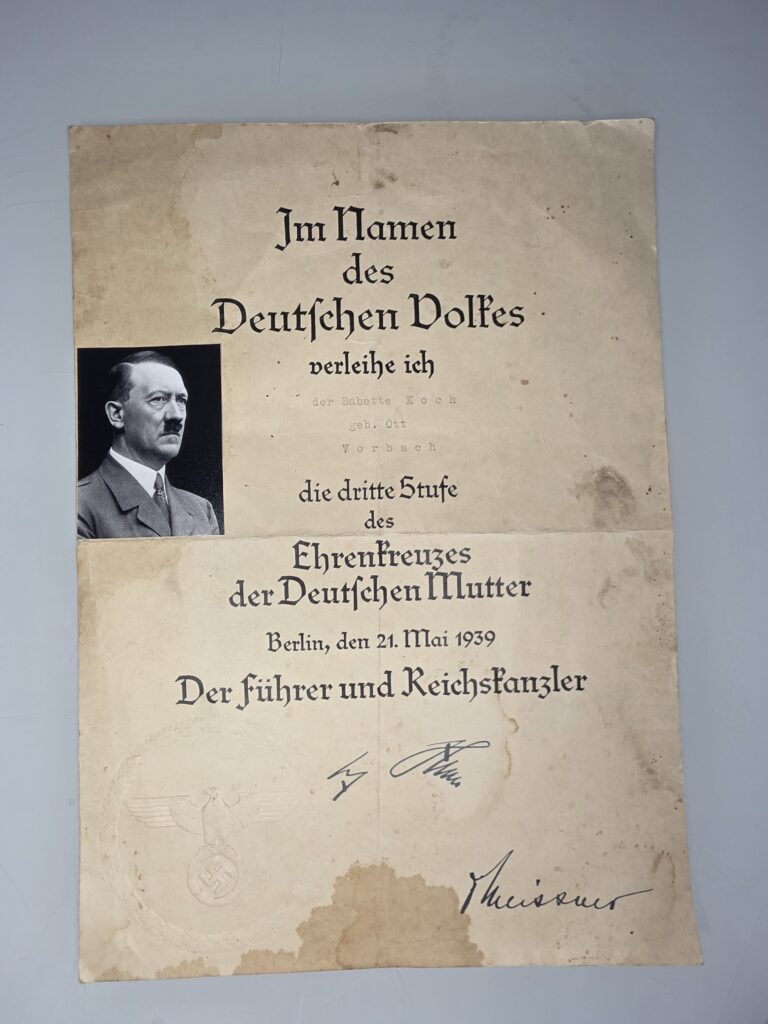
| Ink signature | Written by hand with pen and ink; shows pressure, ink flow and pen lifts |
|---|---|
| Printed facsimile | Reproduced with the printed form; flat, uniform, part of the printing |
| Stamped facsimile | Applied with a rubber or metal stamp; uniform ink, stamp edges |
| Secretarial signature | Written by an authorised assistant, in a different hand |
| In the collection | 6 pieces currently available (see below) |
Many documents of the period carry a famous name, but far fewer carry that person’s own handwriting. Telling an ink signature from a facsimile is the first and most important question for any collector of signed documents.
Why Do So Many Documents Carry Facsimiles?
State bureaucracies produced documents on an industrial scale. Award certificates, appointments and greetings were often issued with a printed or stamped facsimile of the signature of Hitler, a minister or a commander. Others were signed by authorised officials “on behalf of” the named person, or by secretaries. All of these are genuine period documents, but they are not autographs.
| Type | What you see | Is it an autograph? |
|---|---|---|
| Ink signature | Pressure, variable line width, ink flow, pen lifts, indentation | Yes, if in the named person’s hand |
| Printed facsimile | Flat, even line, same printing as the form | No |
| Stamped facsimile | Uniform ink, stamp squash at edges, identical across examples | No |
| Signed “on behalf” | Another person’s signature, often with “i.A.” or “i.V.” | No, but genuine |
Who Issued It, and Who Signed It?
The person named on a document is not necessarily the person who signed it. Check the signature block: abbreviations such as “i.A.” (on instruction) and “i.V.” (as deputy) mean someone else signed. Countersignatures by ministers and officials are often ink signatures even when the head of state’s signature is a facsimile.
What Should Collectors Watch For?
- Magnification: look for pressure, ink pooling and pen lifts.
- Comparison: identical signatures on several documents point to a facsimile.
- Office and date: the title in the signature block must fit the date.
- Expert opinion: for valuable items, ask for an independent examination.
Collector’s Note
As a certified handwriting examiner, I never base an opinion on one feature alone. Authentication rests on a coherent set of characteristics: line quality, pressure, rhythm, letter forms, materials and context.
Related Entries and Pieces
Pieces in the Collection
Browse the full Collector’s Encyclopaedia →
Frequently Asked Questions
How can I tell an ink signature from a facsimile?
Under magnification, ink signatures show pressure, variable line width and pen lifts; facsimiles are flat and uniform.
Is a document with a facsimile signature worthless?
No. It is a genuine period document, but not an autograph.
What do i.A. and i.V. mean?
They mean the document was signed on instruction of, or as deputy for, the named person.
Historical Responsibility Notice: this entry documents historical figures and artefacts for collecting, preservation, education and research. It does not endorse or glorify any ideology.
References & Further Reading
- Autographs & Militaria, Collector’s Journal: Adolf Hitler Facsimile Signature: Bureaucracy, Authority and Terror on Paper.