Products on sale
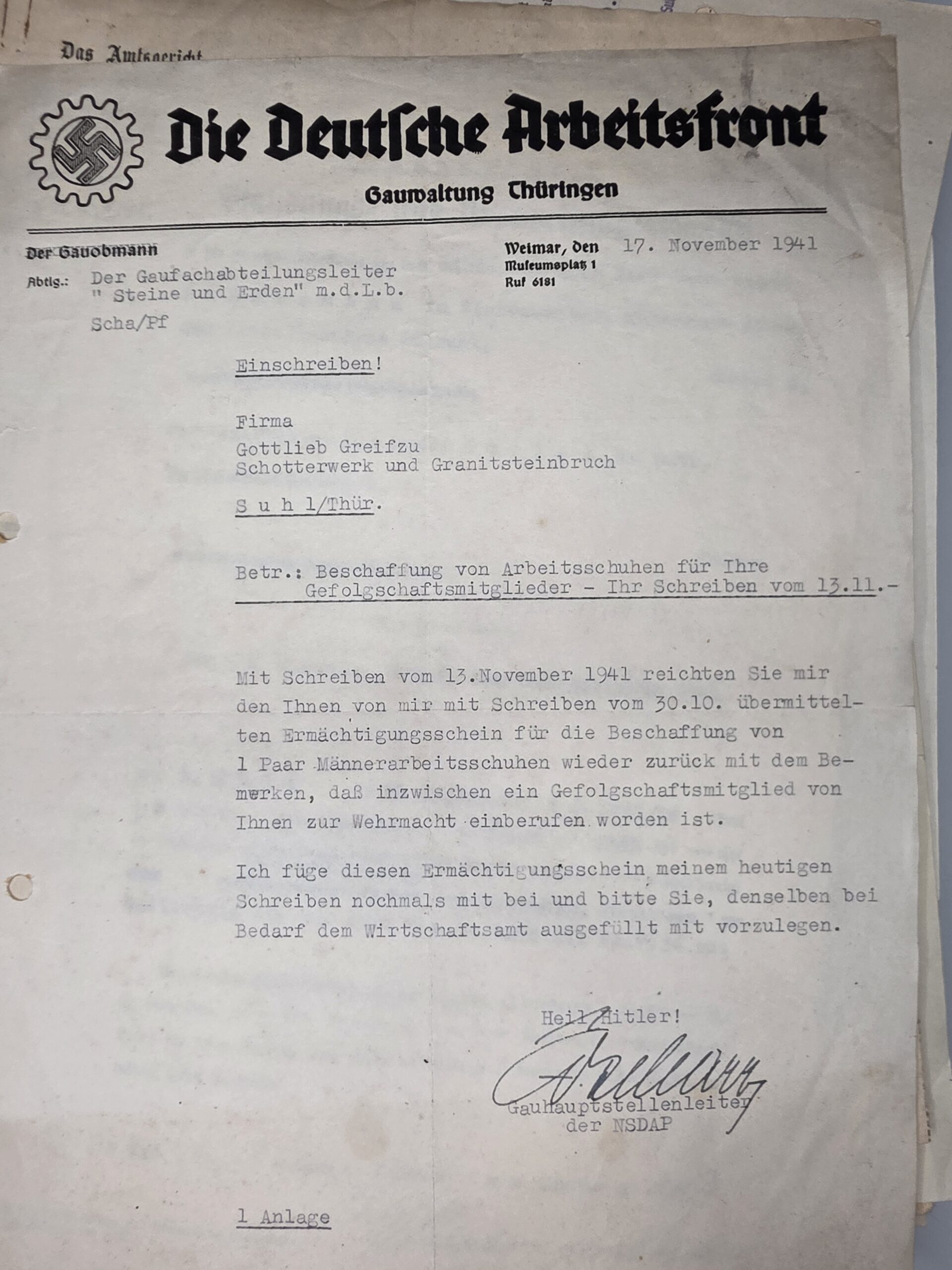
German Document Archive 1911–1967 – DAF, University and Business Papers
Original price was: 249,00 €.199,00 €Current price is: 199,00 €.
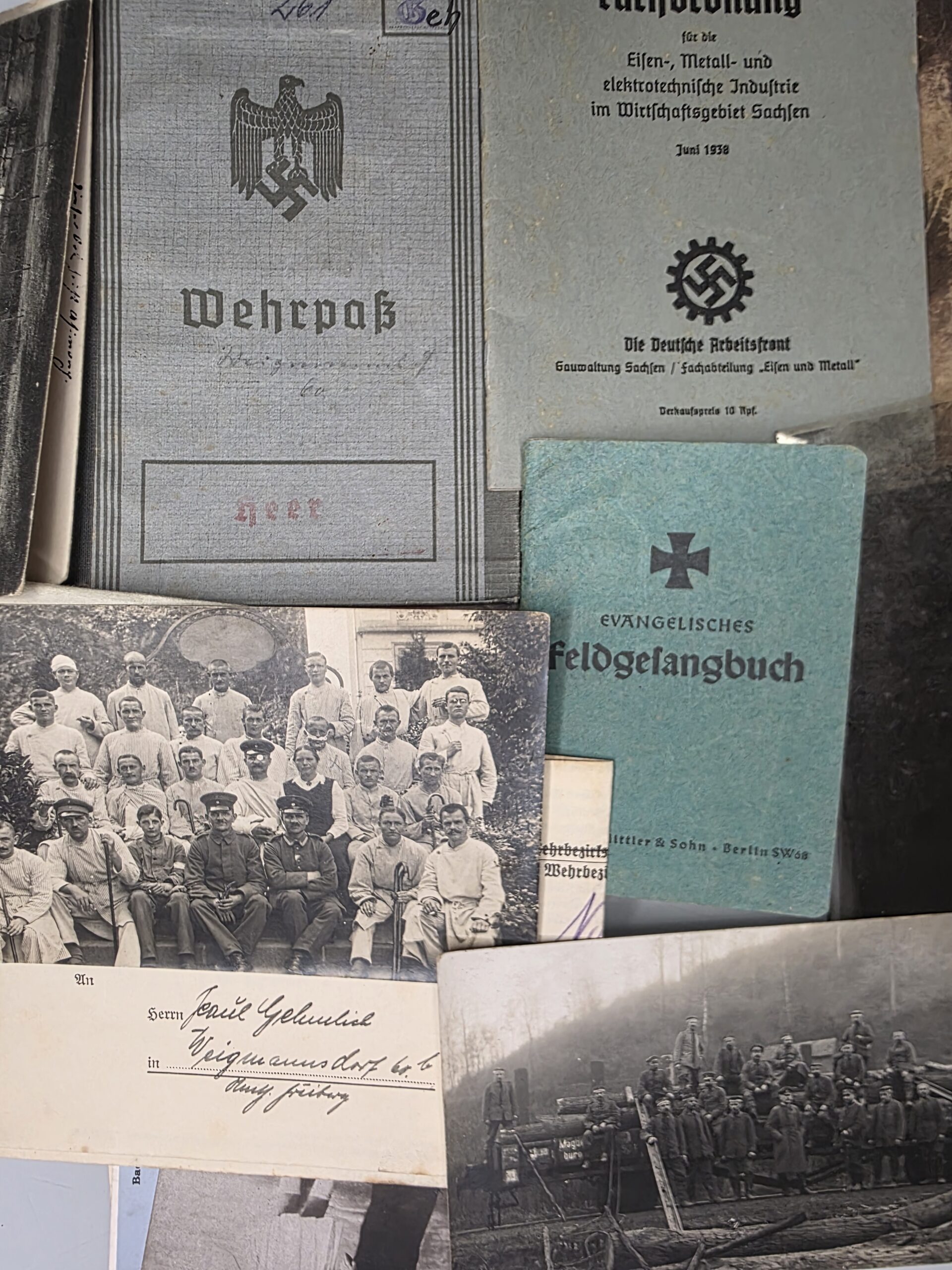
WWII German Wehrpass Group – 256th Infantry Division, Ostmedaille & Death Letter
590,00 €

WWII German Document Collection – U-Boat Training, DAF & Arbeitsbuch Archive
Original price was: 490,00 €.440,00 €Current price is: 440,00 €.
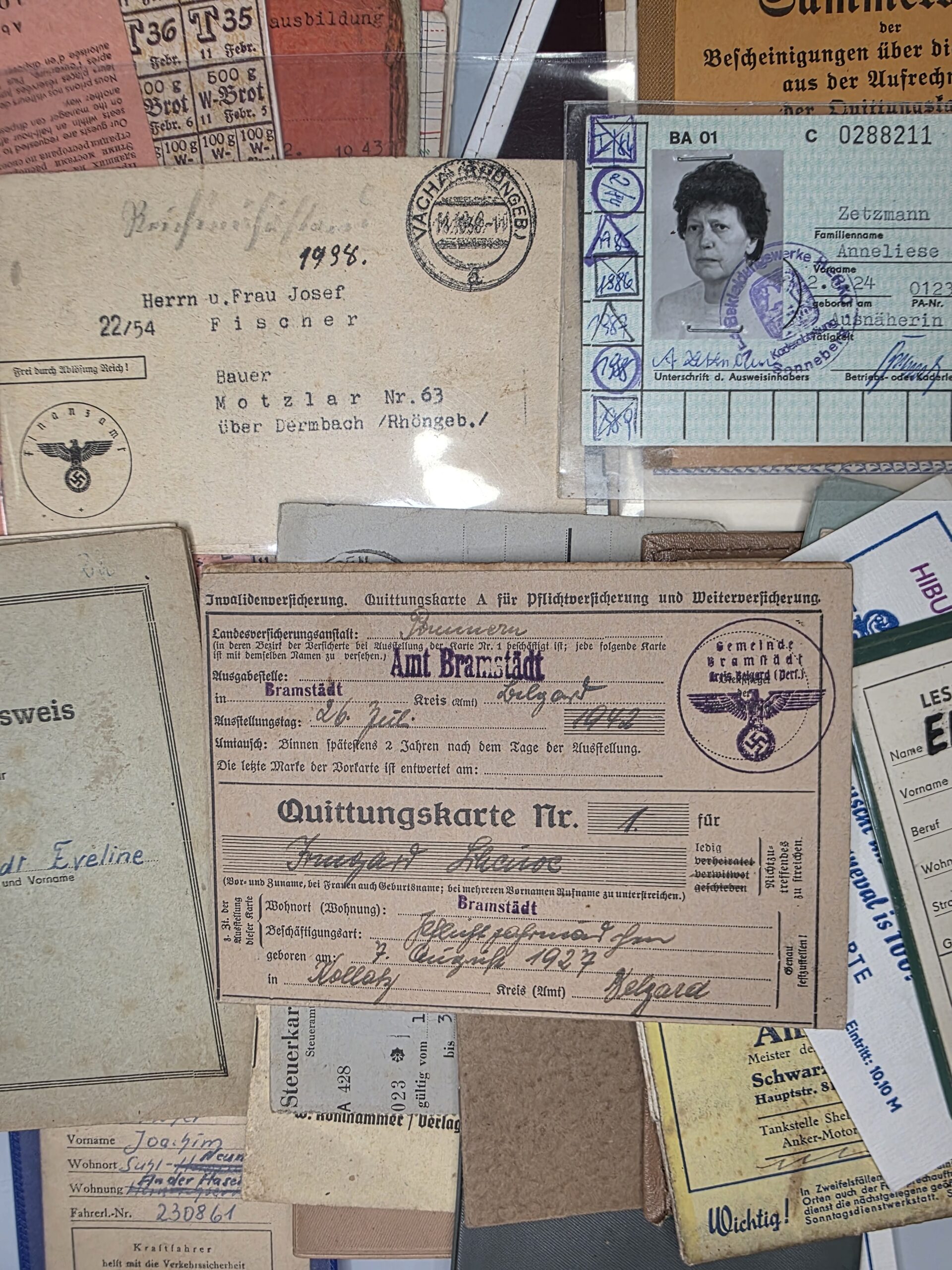
WWII German Document Archive 1938–1945 – Wehrmacht, IDs & Ration Papers
Original price was: 275,00 €.240,00 €Current price is: 240,00 €.
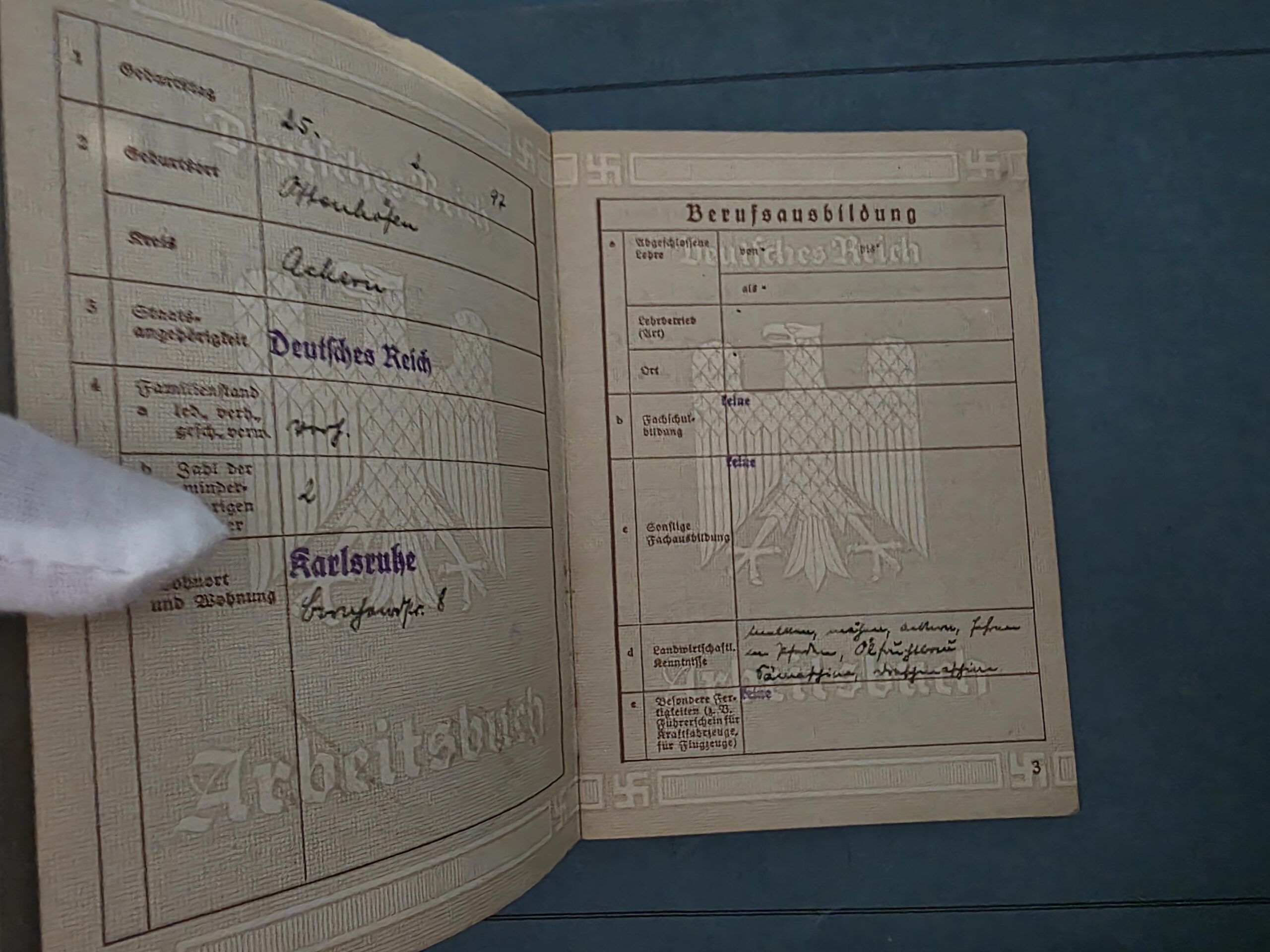
Original German Arbeitsbuch – Wilhelm Hils, Karlsruhe, 1st Pattern
49,00 €
Interested in this item? Please contact us directly by email, WhatsApp or through the enquiry form below for availability or other information. Kindly include the item SKU/reference number in your message so we can identify the piece.
Description
Original German Arbeitsbuch of Wilhelm Hils – Karlsruhe Employment Record
This original German Arbeitsbuch belonged to Wilhelm Hils and represents an interesting example of civilian employment documentation from National Socialist Germany that continued to be used beyond the end of the Second World War.
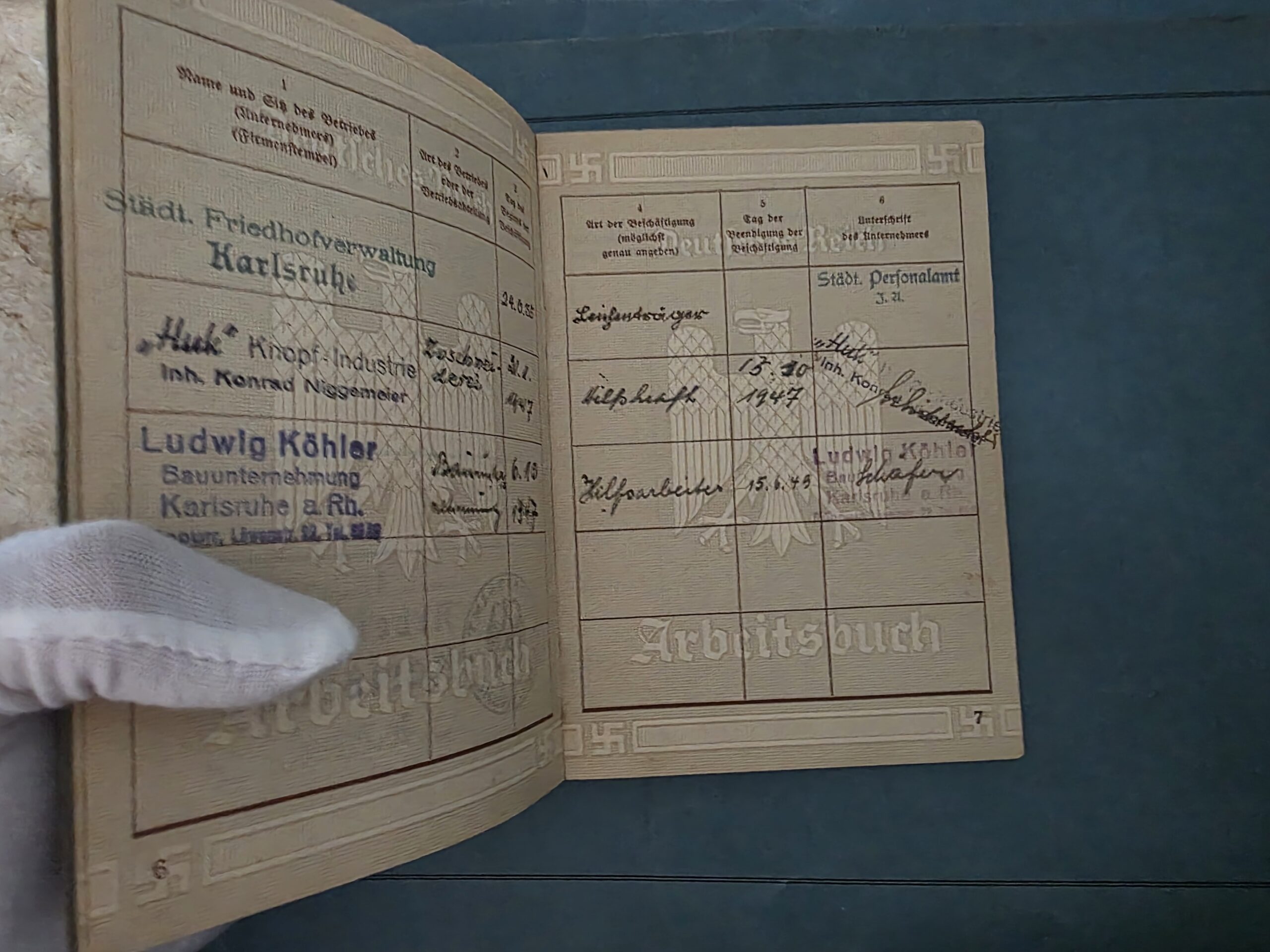
The booklet is particularly attractive from a documentary perspective because it is not an unused or minimally completed example. It contains handwritten personal information, official employment entries, employer stamps and records connected with several workplaces in Karlsruhe, including the city’s municipal cemetery administration.
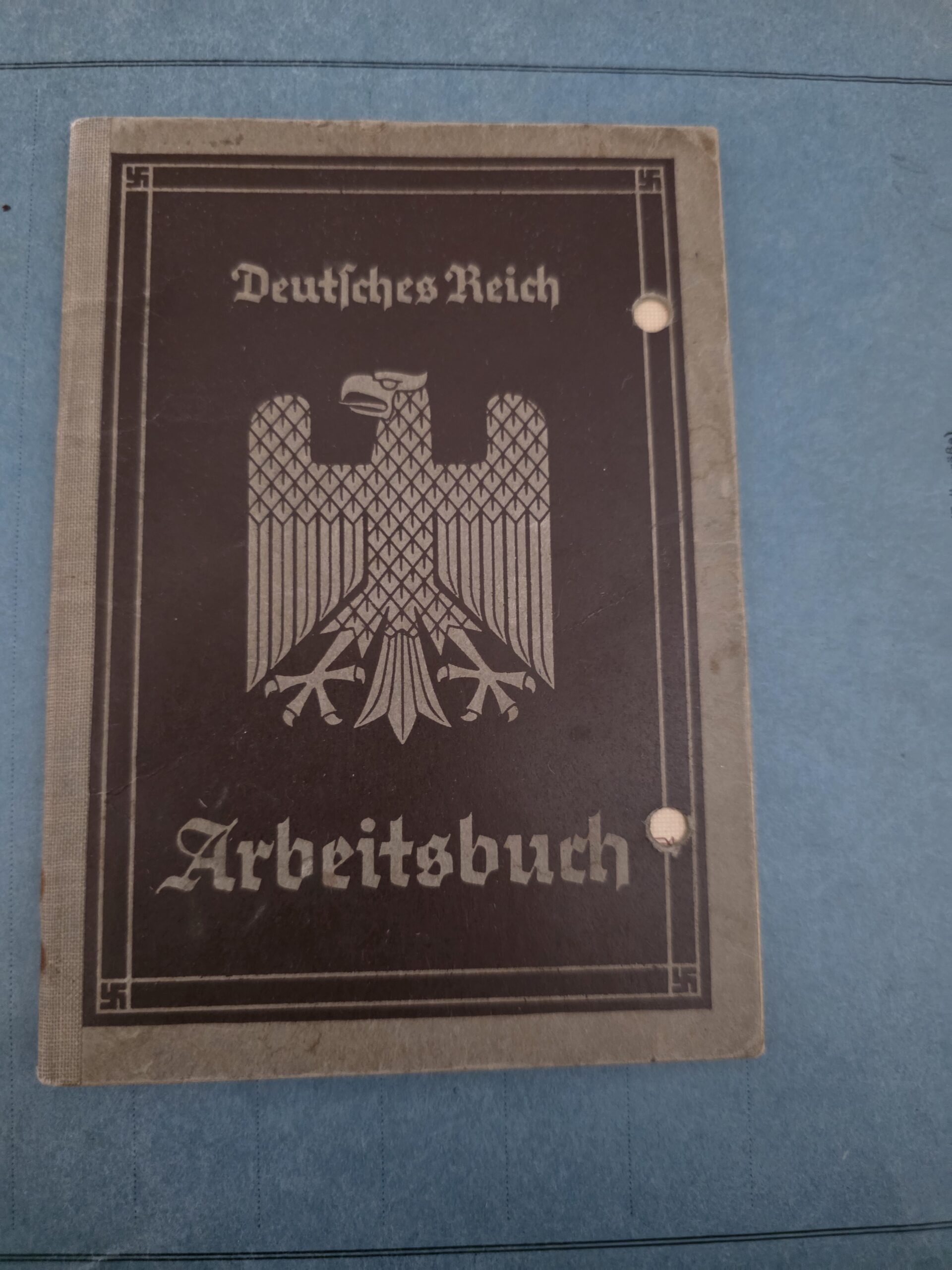
Its cover is also noteworthy. The design corresponds to what collectors generally classify as the first pattern Arbeitsbuch, characterised by the earlier German eagle design and small swastikas positioned in the four corners of the dark front panel. Specialist references distinguish this early pattern from the later versions in which the cover design was progressively altered.
The German Arbeitsbuch System
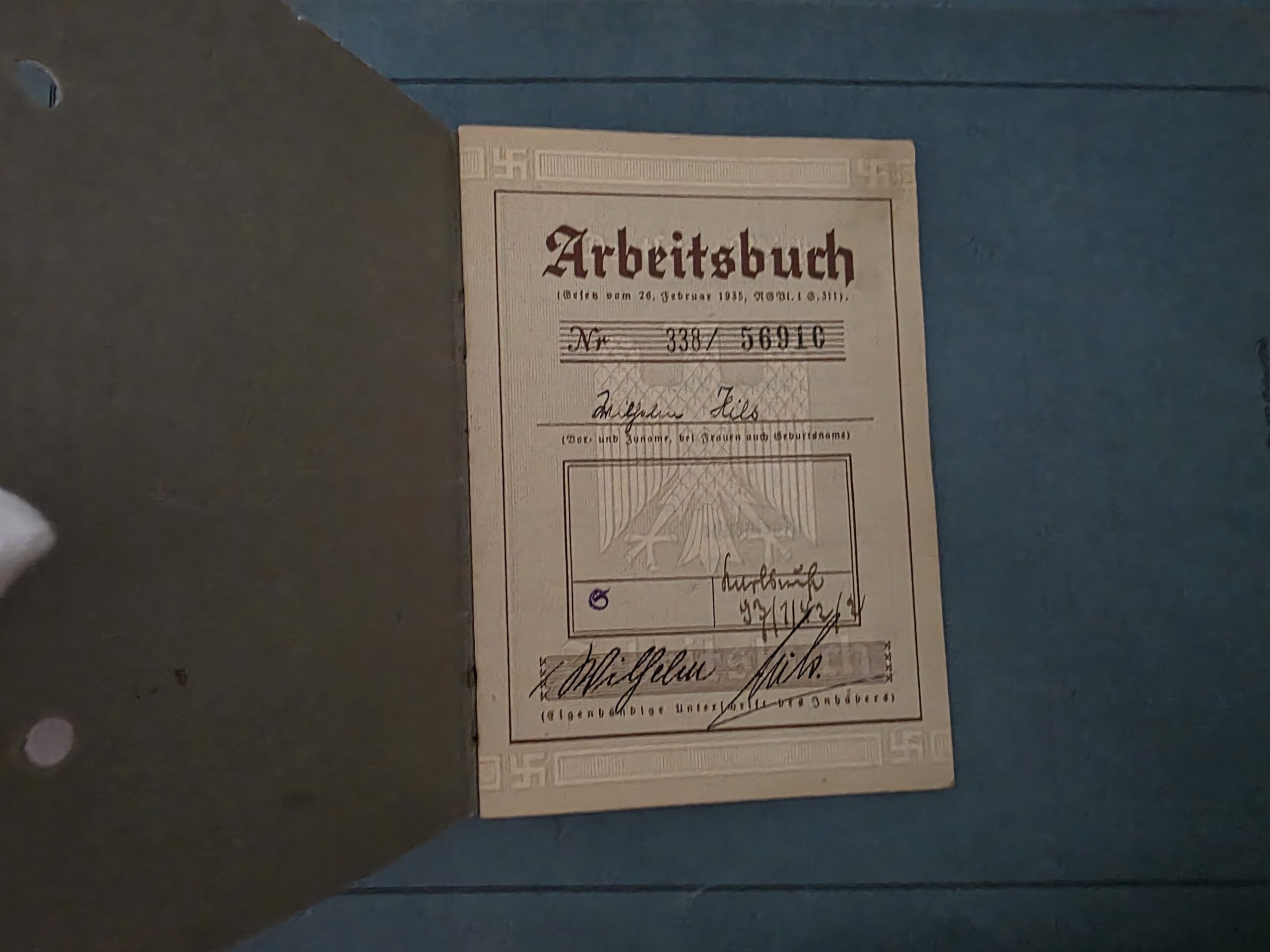
The Arbeitsbuch, literally “work book”, was introduced under the German law of 26 February 1935. The legal reference to this legislation is printed directly inside examples of this type.
The system was designed to record workers and their employment history and formed part of the wider state regulation of the labour market.
Arolsen Archives explains that Arbeitsbücher became widespread throughout the German Reich from the mid-1930s onward. German workers were required to provide the book at their workplace, and employers and labour offices used the system to record information relating to the worker, professional qualifications and individual jobs.
Historical educational documentation concerning Nazi labour administration similarly notes that local employment offices progressively issued Arbeitsbücher and corresponding record cards to workers throughout the Reich.
This makes an original Arbeitsbuch an important type of civilian historical document. Unlike a Wehrpass or Soldbuch, it was not intended to record military service. Instead, it provides insight into employment, professional mobility and the administrative control of civilian working life.
Wilhelm Hils – Named Personal Document
The opening page identifies the holder in handwritten script as:
Wilhelm Hils
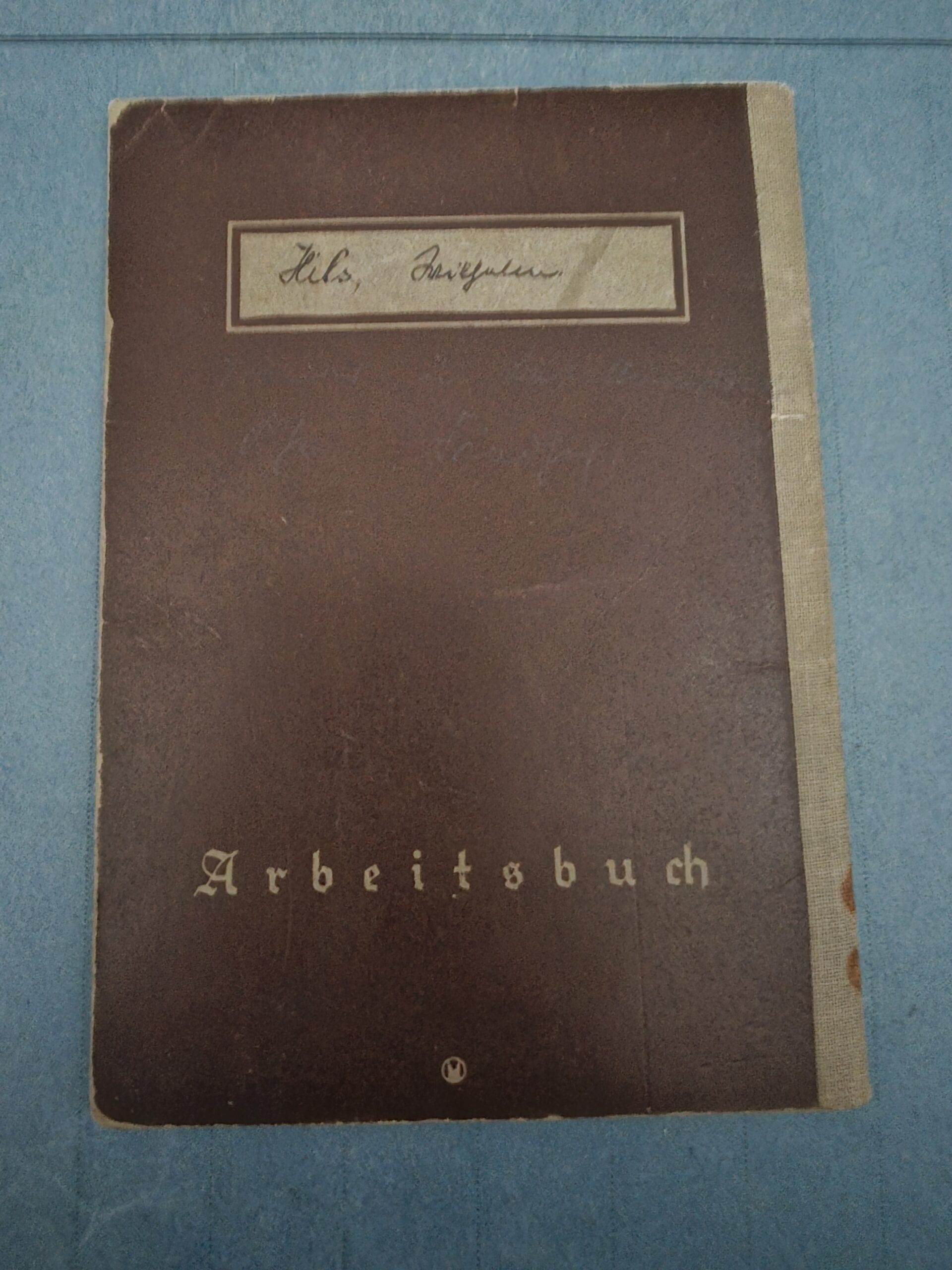
The same identity appears again on the rear cover label in the traditional surname-first format:
Hils, Wilhelm
The personal-information pages contain additional handwritten details concerning nationality, marital status, family and residence.
His nationality is stamped Deutsches Reich. The booklet records him as married and appears to note two minor children. A Karlsruhe residence is also visible.
Some of the older cursive handwriting relating to birthplace and exact personal dates is difficult to interpret with complete certainty from the photographs. These details are therefore intentionally not expanded or reconstructed in the description.
This is important when cataloguing original documents: where an entry cannot be read confidently, it is preferable to preserve the original evidence rather than invent a modern transcription.
Employment at Karlsruhe Municipal Cemetery
One of the most interesting entries is the large official stamp:
Städt. Friedhofverwaltung Karlsruhe
This identifies employment connected with the municipal cemetery administration of Karlsruhe.
The occupation recorded alongside this entry appears clearly as:
Leichenträger
The term literally refers to a coffin bearer or pallbearer and indicates work associated with funeral and cemetery services.
This gives the Arbeitsbuch a much more specific social-history context than a generic employment document.
Rather than simply recording an anonymous factory worker, this book preserves evidence of one individual’s work within Karlsruhe’s municipal services.
Other Employers and Post-War Entries
Additional employment entries remain visible on the following pages.
Among them is a private industrial employer whose stamp is partially difficult to read, followed by the clearly visible:
Ludwig Köhler
Bauunternehmung
Karlsruhe a. Rh.
The occupation associated with this later employment is written as Hilfsarbeiter, meaning general or auxiliary labourer.
Of particular historical interest, the entries continue beyond the National Socialist period. Dates visible among the later records extend into 1947 and 1949.
This creates a useful documentary continuity.
The Arbeitsbuch was created within the administrative framework of the Third Reich, but Wilhelm Hils appears to have continued using the same personal employment record after Germany’s defeat in 1945.
Similar surviving Arbeitsbücher are known to contain post-war employment entries; specialist dealers have documented examples that continued in use years after the collapse of the Nazi state.
For a collector, this gives the document an additional layer of interest because it crosses two fundamentally different historical periods within a single personal record.
First-Pattern Arbeitsbuch
The front cover differs noticeably from later Arbeitsbuch designs.
It displays:
- Deutsches Reich in Fraktur lettering;
- an earlier-style German eagle;
- the title Arbeitsbuch;
- small swastikas positioned in the four corners;
- a dark rectangular central panel surrounded by a lighter card border.
Collectors generally refer to this configuration as the first pattern.
A specialist example described by Militaria Plaza identifies the first pattern as the version introduced in 1935, followed by later cover revisions. Another specialist source similarly distinguishes the first style by its earlier eagle and four corner swastikas.
The distinction is useful for SEO and specialist cataloguing, although it should not be interpreted as making every first-pattern example inherently rare.
Arbeitsbücher were administrative documents produced on a very large scale. Their individual desirability depends more heavily on condition, completeness, employers, occupations, locations and historical associations.
In this case, the Karlsruhe employment history is more important than the cover variant alone.
A Civilian Document of Everyday Life
Military documents often dominate collections of material relating to Germany between 1933 and 1945, but civilian documents can provide an equally valuable historical perspective.
This Arbeitsbuch illustrates an ordinary individual’s relationship with employment authorities and employers.
Its pages document:
- personal identification;
- family information;
- professional skills;
- municipal employment;
- private-sector employment;
- changes of occupation;
- continued working life after 1945.
The combination provides a small but tangible record of one person’s working history across a period of enormous political change.
For collectors interested in social history, civilian life, German bureaucracy, labour administration or local Karlsruhe history, this is consequently a more interesting example than a blank or lightly completed Arbeitsbuch.
Condition
The Arbeitsbuch remains in genuine used condition appropriate to its age.
The first-pattern front cover retains its principal printed design clearly, although there is overall surface wear, rubbing, edge and corner wear, minor staining and age toning.
Two circular holes are present through the right-hand area of the front cover, presumably resulting from former filing or storage. These are clearly visible in the photographs and form part of the item’s history and condition.
Internally, the paper shows natural age toning and handling. The handwritten information and employer stamps remain generally clear.
The employment pages display period ink, handwritten occupations and multiple employer stamps. The rear cover retains the handwritten identification “Hils, Wilhelm” and also shows general wear and some staining.
The photographs supplied form an integral part of the condition description.
Authenticity
Original period German Arbeitsbuch belonging to Wilhelm Hils.
The printing, early-pattern cover, internal paper design, handwritten entries, employer stamps and physical ageing are consistent with an original used Arbeitsbuch.
No military service or political membership is implied by this document. It is a civilian employment record.
Historical Responsibility Notice
This original document is offered exclusively for historical, documentary, educational, research and collecting purposes.
Autographs & Militaria has no political or ideological affiliation with, sympathy for or endorsement of National Socialism, the Nazi regime or the symbols represented on this historical object.
HISTORICAL CONTEXT:
Arbeitsbücher became compulsory instruments of German labour administration from 1935 onward. Employment offices used them, together with corresponding work-book cards, to record workers, professional skills and changes of employment.
COLLECTOR’S INTEREST:
The strongest elements are the first-pattern cover, named Karlsruhe owner, municipal cemetery employment, multiple employer stamps and continued post-war use.
CONDITION AND AUTHENTICITY NOTE:
Original used period document showing age toning, rubbing and handling. Two filing holes are present on the front cover. Interior entries and employer stamps remain visible. Photographs form part of the condition description.
HISTORICAL RESPONSIBILITY NOTICE:
Offered exclusively as historical and documentary material. No ideological endorsement is intended or implied.
Is this an original German Arbeitsbuch?
Yes. It is an original first-pattern Arbeitsbuch with handwritten personal information and multiple period employer records.
Who owned this Arbeitsbuch?
The book is identified to Wilhelm Hils, whose name appears both on the opening page and on the rear-cover identification panel.
What is unusual about this example?
Its main interest is the combination of an early first-pattern cover, employment with Städt. Friedhofverwaltung Karlsruhe, and later employment entries extending into the post-war period.
What did Wilhelm Hils do at the Karlsruhe cemetery?
The occupation visible alongside the municipal cemetery entry is Leichenträger, meaning a pallbearer or coffin bearer.
Is an Arbeitsbuch a military document?
No. It is a civilian employment record. Arbeitsbücher were used to document workers and their employment and formed part of Germany’s state labour-administration system.
Why does this Arbeitsbuch contain post-war entries?
Existing Arbeitsbücher could continue to serve as personal employment records after 1945. Surviving examples with later entries are known on the collectors’ market.
What is a first-pattern Arbeitsbuch?
Collectors use this term for the early design featuring the older-style eagle and small swastikas in the four corners. Later patterns altered the cover design.
Additional information
| Availability | Available |
|---|
Only logged in customers who have purchased this product may leave a review.
Related products
German Document Archive 1911–1967 – DAF, University and Business Papers
Original price was: 249,00 €.199,00 €Current price is: 199,00 €.
20% Off
WWII German Wehrpass Group – 256th Infantry Division, Ostmedaille & Death Letter
590,00 €
WWII German Document Collection – U-Boat Training, DAF & Arbeitsbuch Archive
Original price was: 490,00 €.440,00 €Current price is: 440,00 €.
10% Off
WWII German Document Archive 1938–1945 – Wehrmacht, IDs & Ration Papers
Original price was: 275,00 €.240,00 €Current price is: 240,00 €.
13% Off
Reviews
There are no reviews yet.