The Collector’s Encyclopaedia · Documents · Civil papers
Arbeitsbuch: History, Contents and Collector’s Guide
| Introduced | By law on 26 February 1935 |
|---|---|
| Issued by | Labour offices (Arbeitsämter) |
| Records | Training, apprenticeships, special skills, employers, dates and type of work |
| Format | Small booklet, about 35 pages |
| In the collection | 6 pieces currently available (see below) |
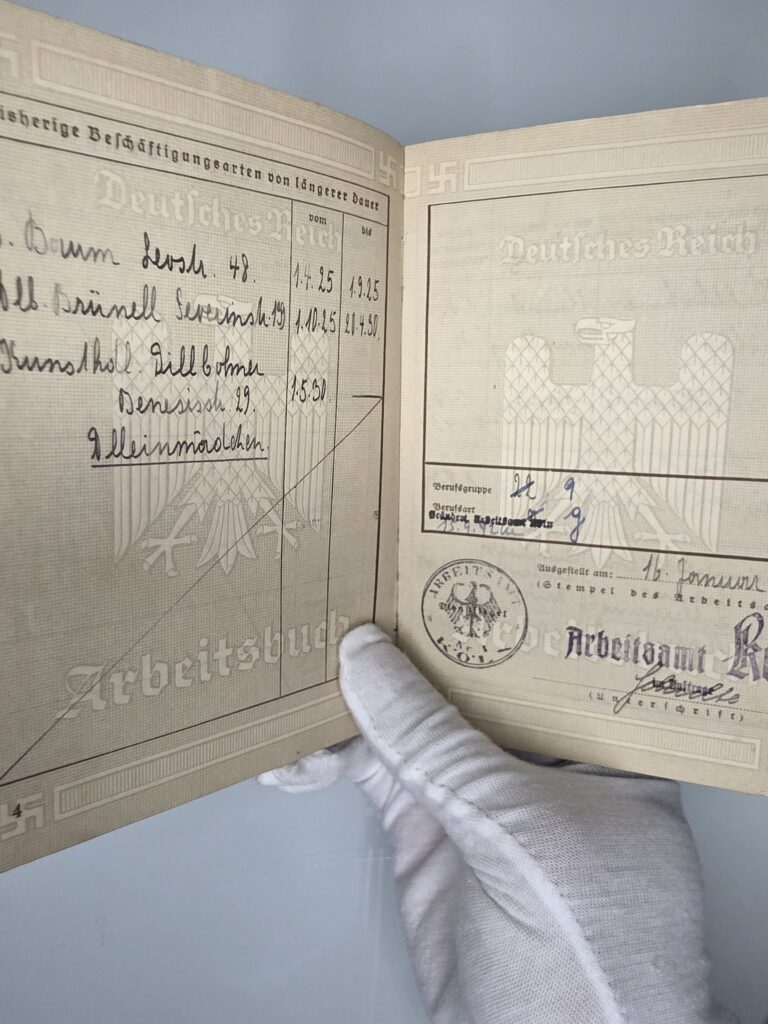
The Arbeitsbuch (labour book) recorded a worker’s training and employment history and allowed the state to steer labour. It is a common document, but each one traces a working life through the years of rearmament and war.
What Is a Arbeitsbuch?
The Arbeitsbuch was introduced by law on 26 February 1935. According to the Deutsches Historisches Museum, it recorded apprenticeships and training, specialist schooling, agricultural knowledge and special skills such as driving licences, and, “as precisely as possible”, each employer, the dates of employment and the type of work.
Who Issued It, and Who Signed It?
The books were issued by the labour offices, whose stamps appear on the cover and inside; employers entered and signed the periods of employment. Special versions were issued in occupied territories; see Arbeitskarte.
What Should Collectors Watch For?
- Employer entries are the most interesting part; firms can often be researched.
- Foreign workers’ documents may relate to forced labour and should be described with that context.
- Completeness: missing pages should be stated.
Collector’s Note
An Arbeitsbuch is quiet evidence of how the regime organised work. When the employer was an armaments firm, the document leads into a much larger history.
Related Entries and Pieces
Pieces in the Collection
Browse the full Collector’s Encyclopaedia →
Frequently Asked Questions
When was the Arbeitsbuch introduced?
By law on 26 February 1935.
Who issued it?
The labour offices.
What does it record?
Training, skills and each period of employment.
Historical Responsibility Notice: this entry documents historical figures and artefacts of the National Socialist period for collecting, preservation, education and research. It does not endorse or glorify any ideology, and it is written in memory of the victims of the regime.
References & Further Reading
- Deutsches Historisches Museum, Arbeitsbücher, 1935–1939, exhibition “Lebensstationen in Deutschland 1900 bis 1993”.