Products on sale
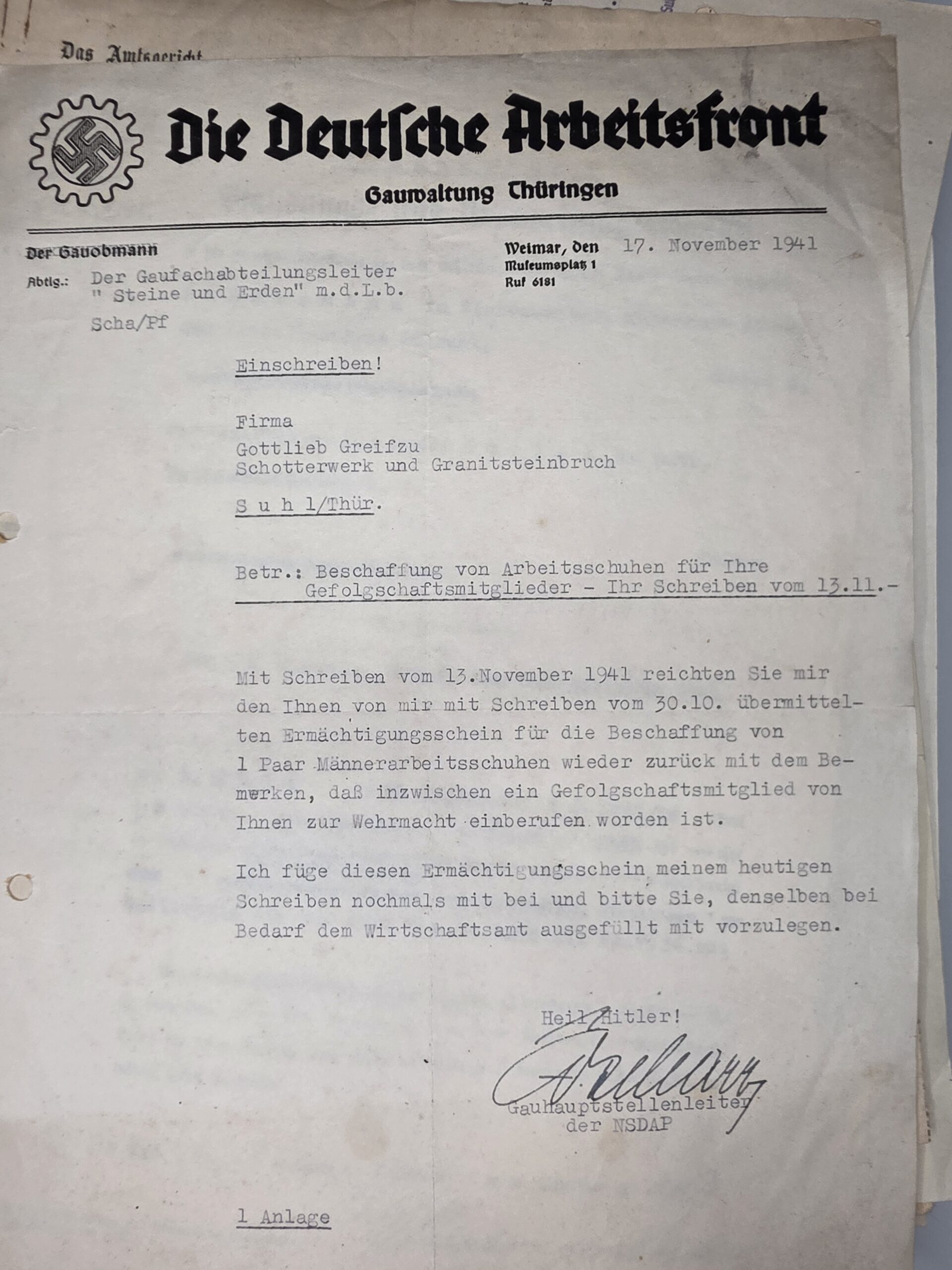
German Document Archive 1911–1967 – DAF, University and Business Papers
Original price was: 249,00 €.199,00 €Current price is: 199,00 €.
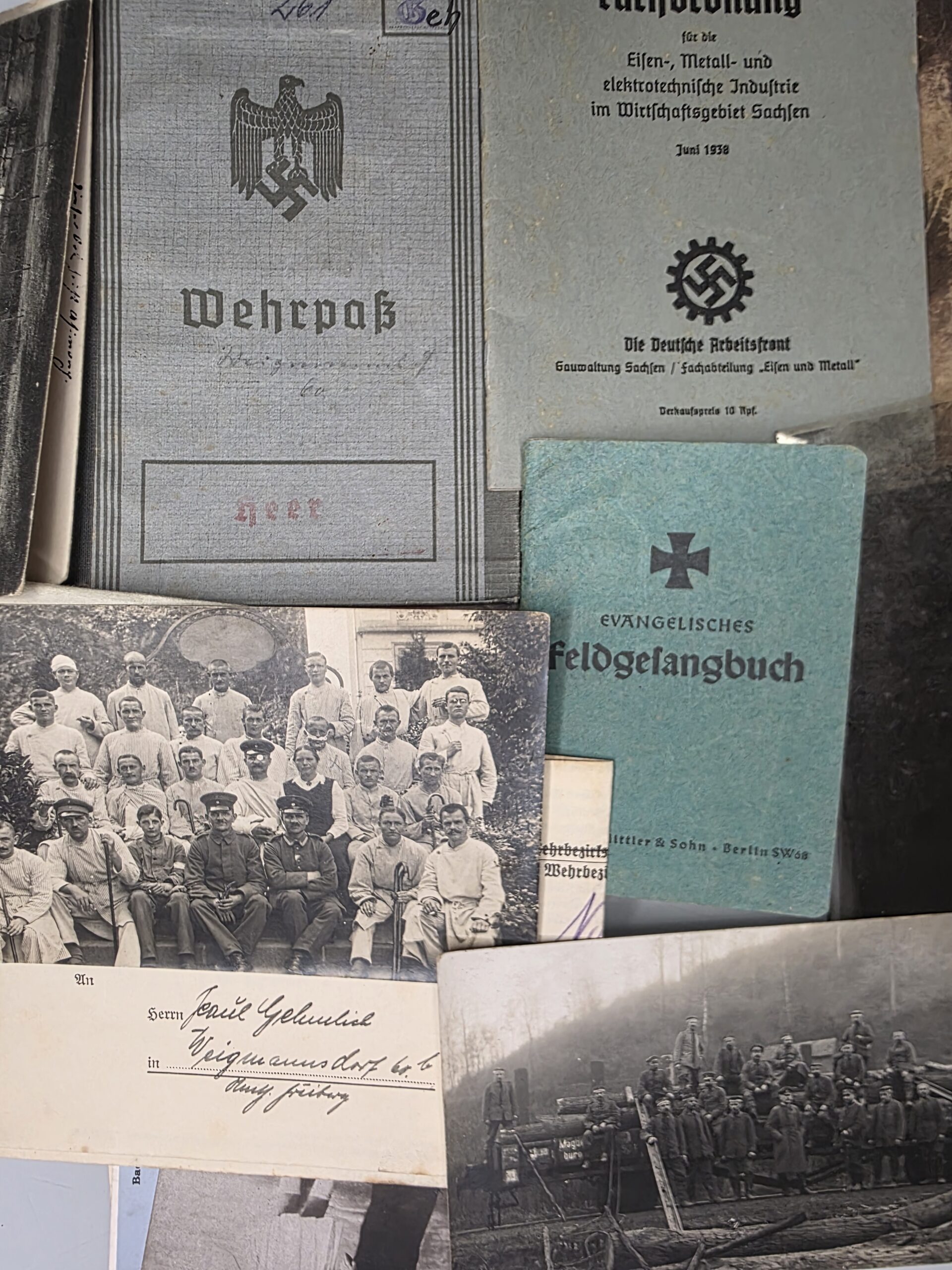
WWII German Wehrpass Group – 256th Infantry Division, Ostmedaille & Death Letter
590,00 €

WWII German Document Collection – U-Boat Training, DAF & Arbeitsbuch Archive
Original price was: 490,00 €.440,00 €Current price is: 440,00 €.
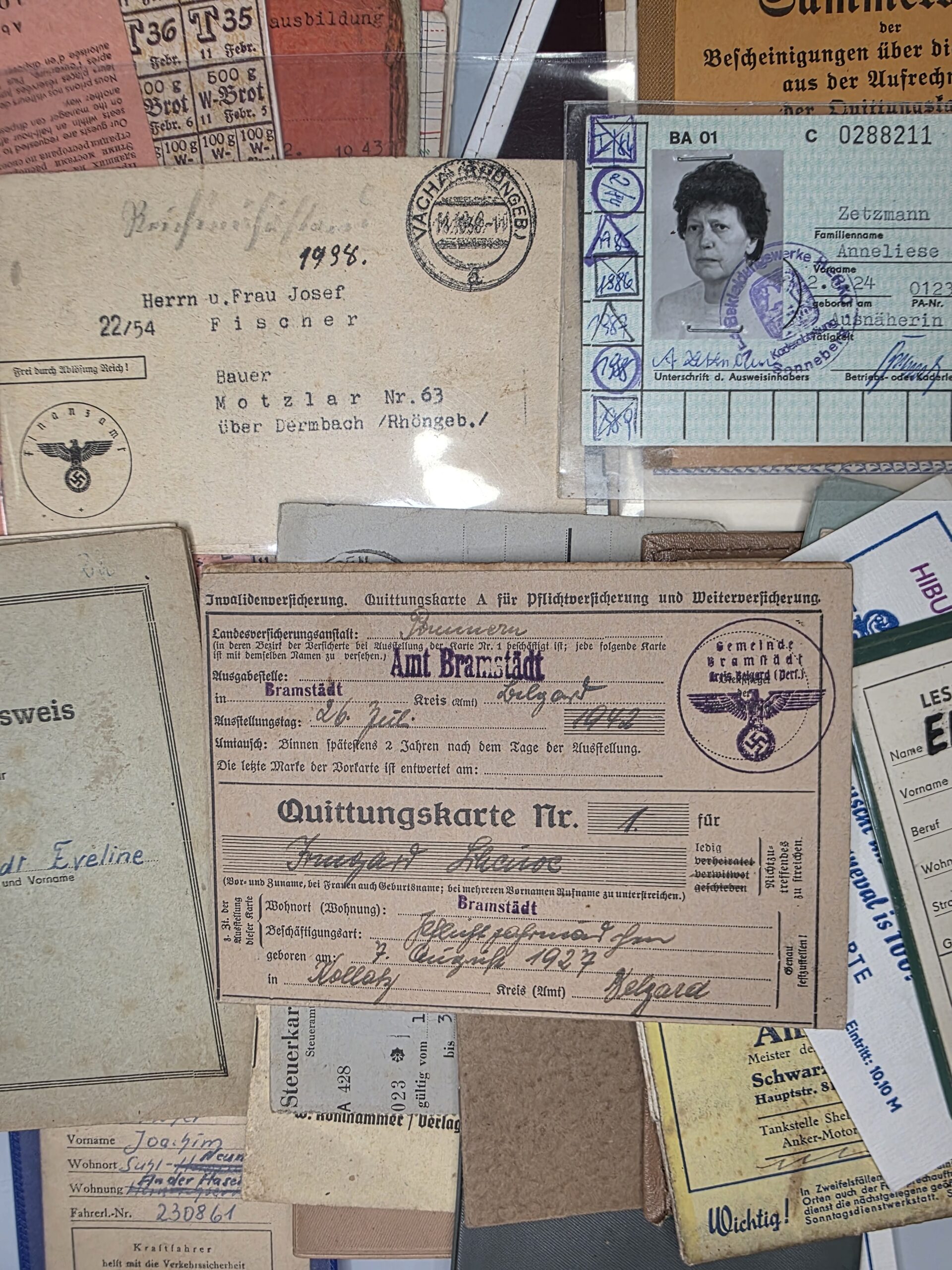
WWII German Document Archive 1938–1945 – Wehrmacht, IDs & Ration Papers
Original price was: 275,00 €.240,00 €Current price is: 240,00 €.
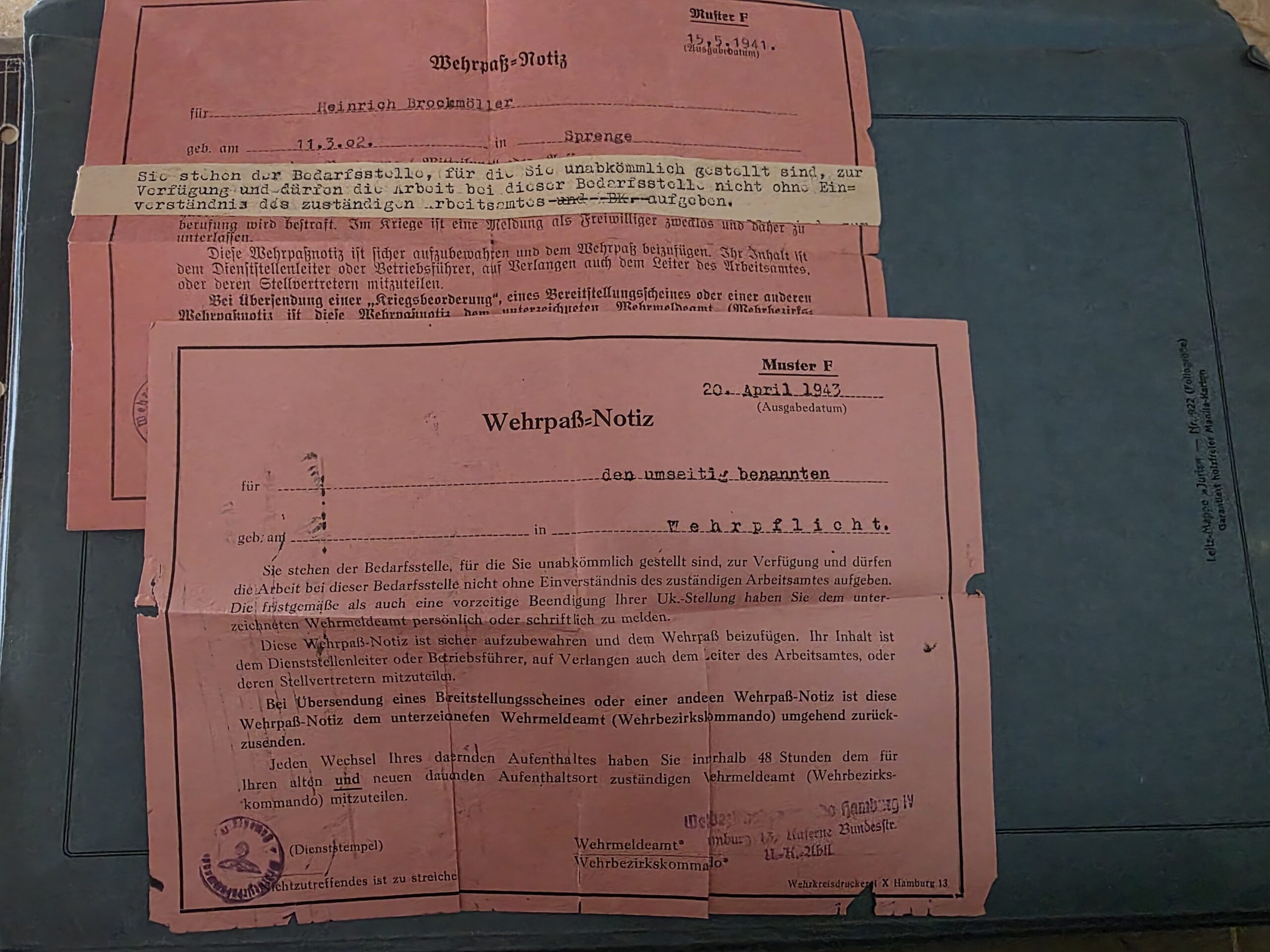
WWII German Wehrpass – Heinrich Brockmöller UK Exemption Papers 1940–43
99,00 €
Interested in this item? Please contact us directly by email, WhatsApp or through the enquiry form below for availability or other information. Kindly include the item SKU/reference number in your message so we can identify the piece.
Description
WWII German Wehrpass with Original UK Exemption Documentation
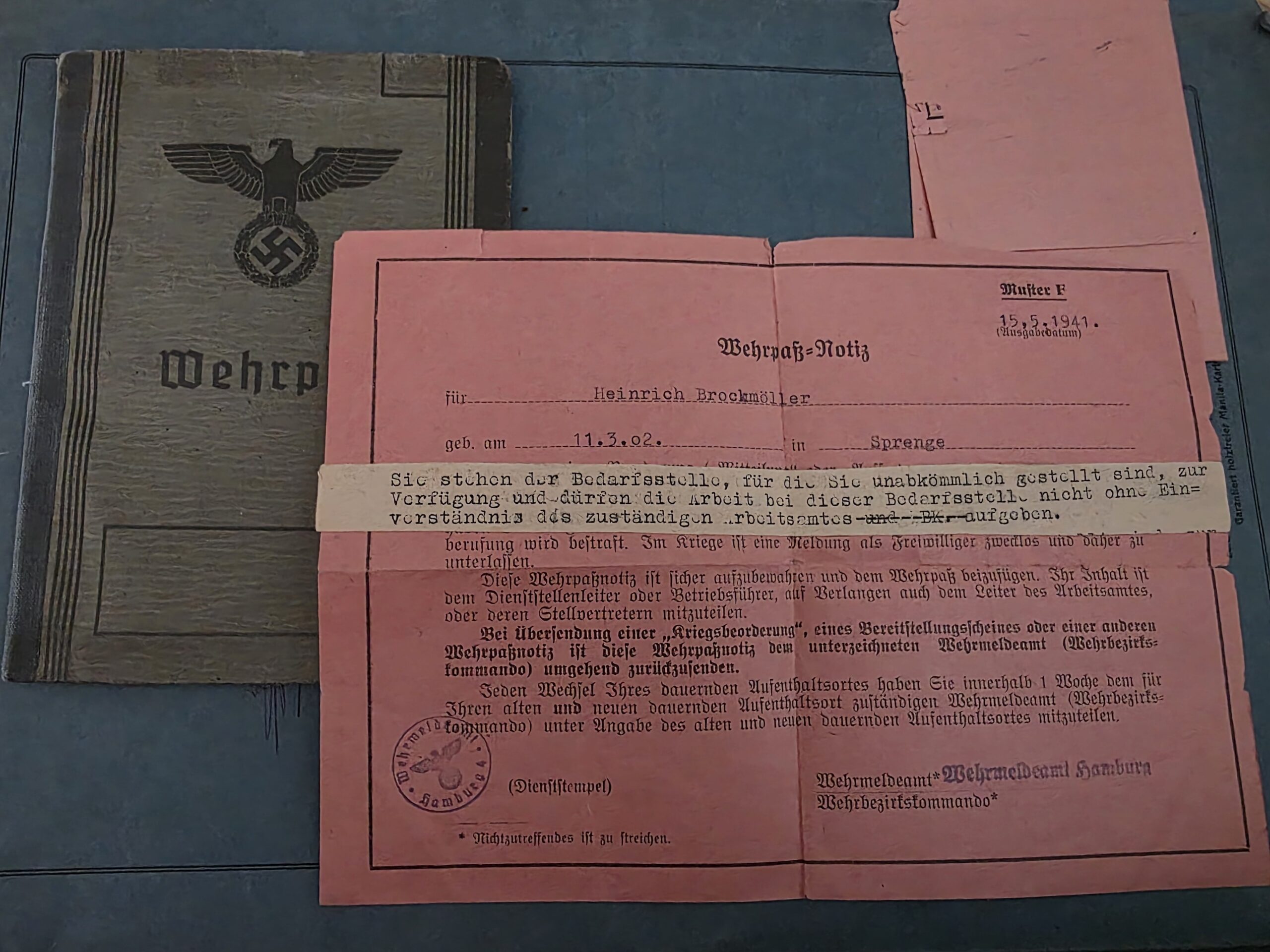
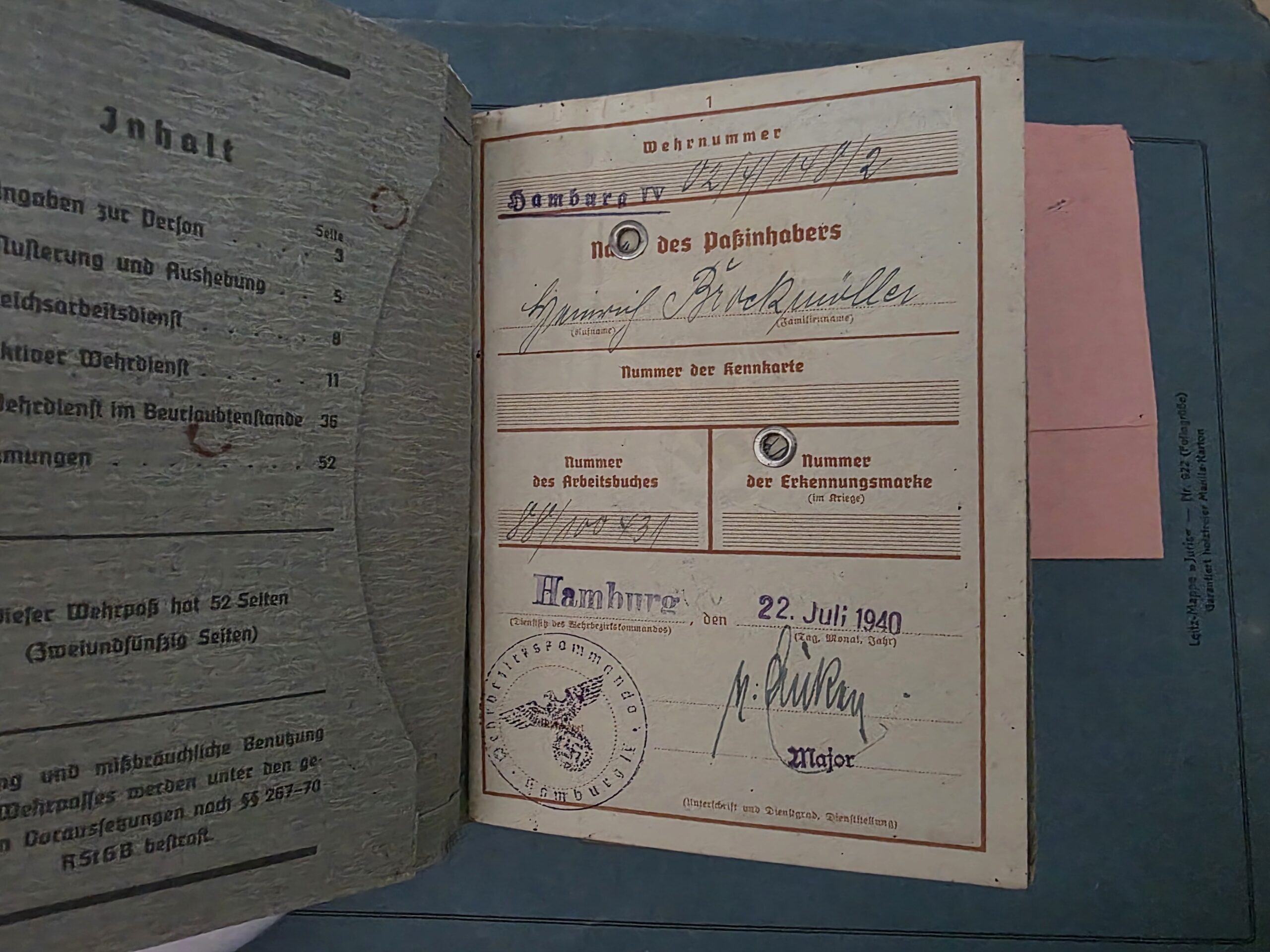
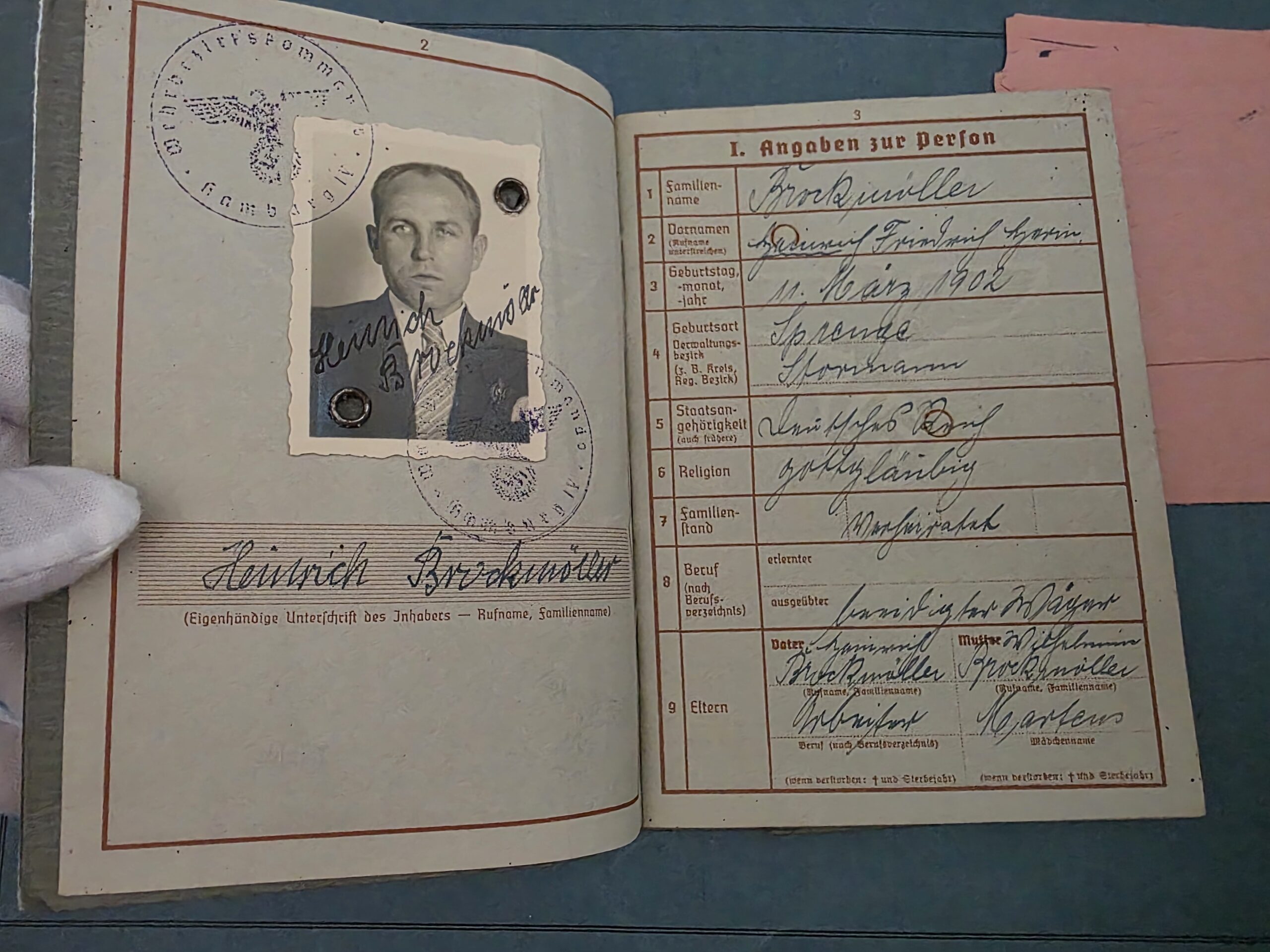
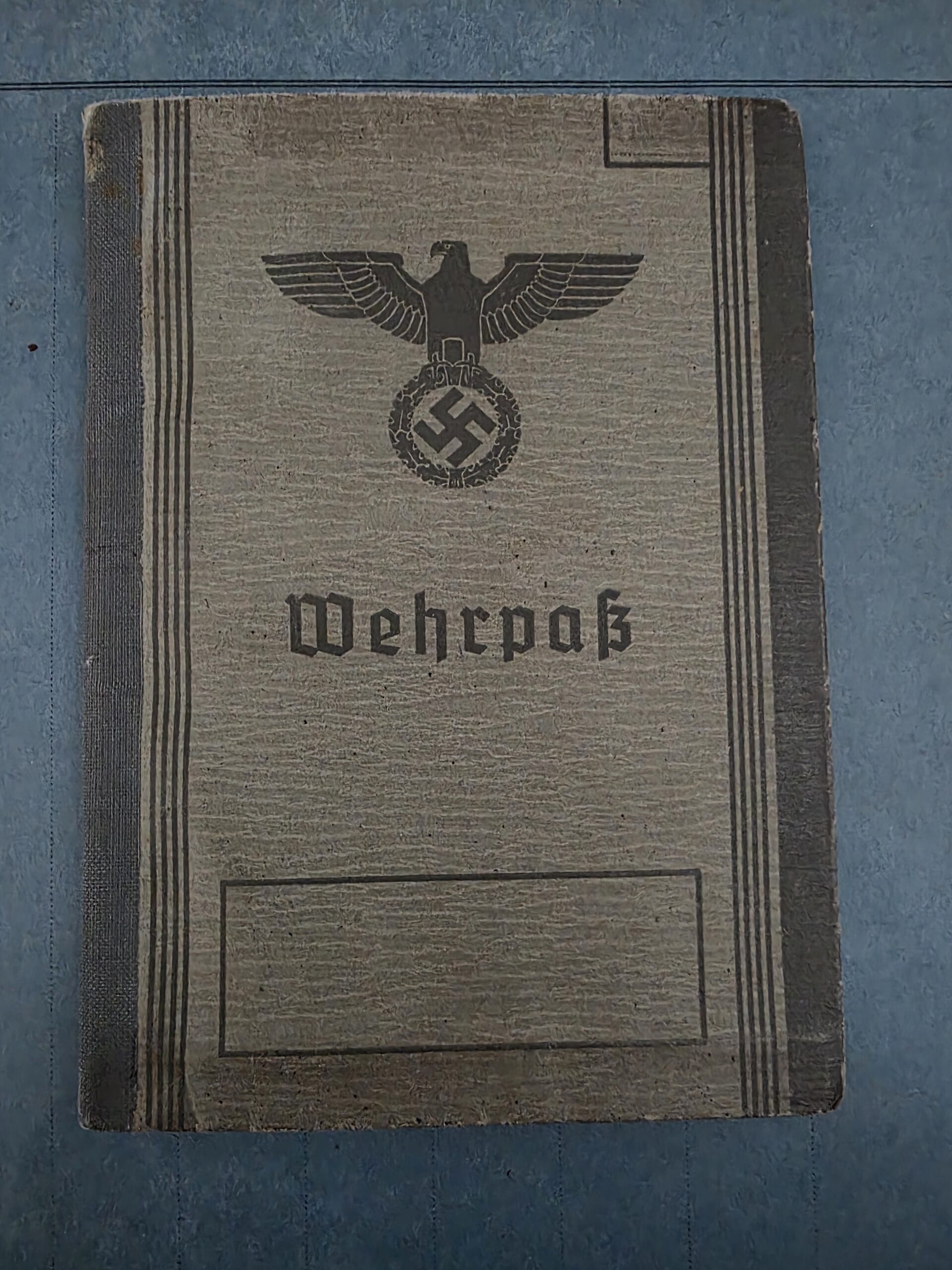
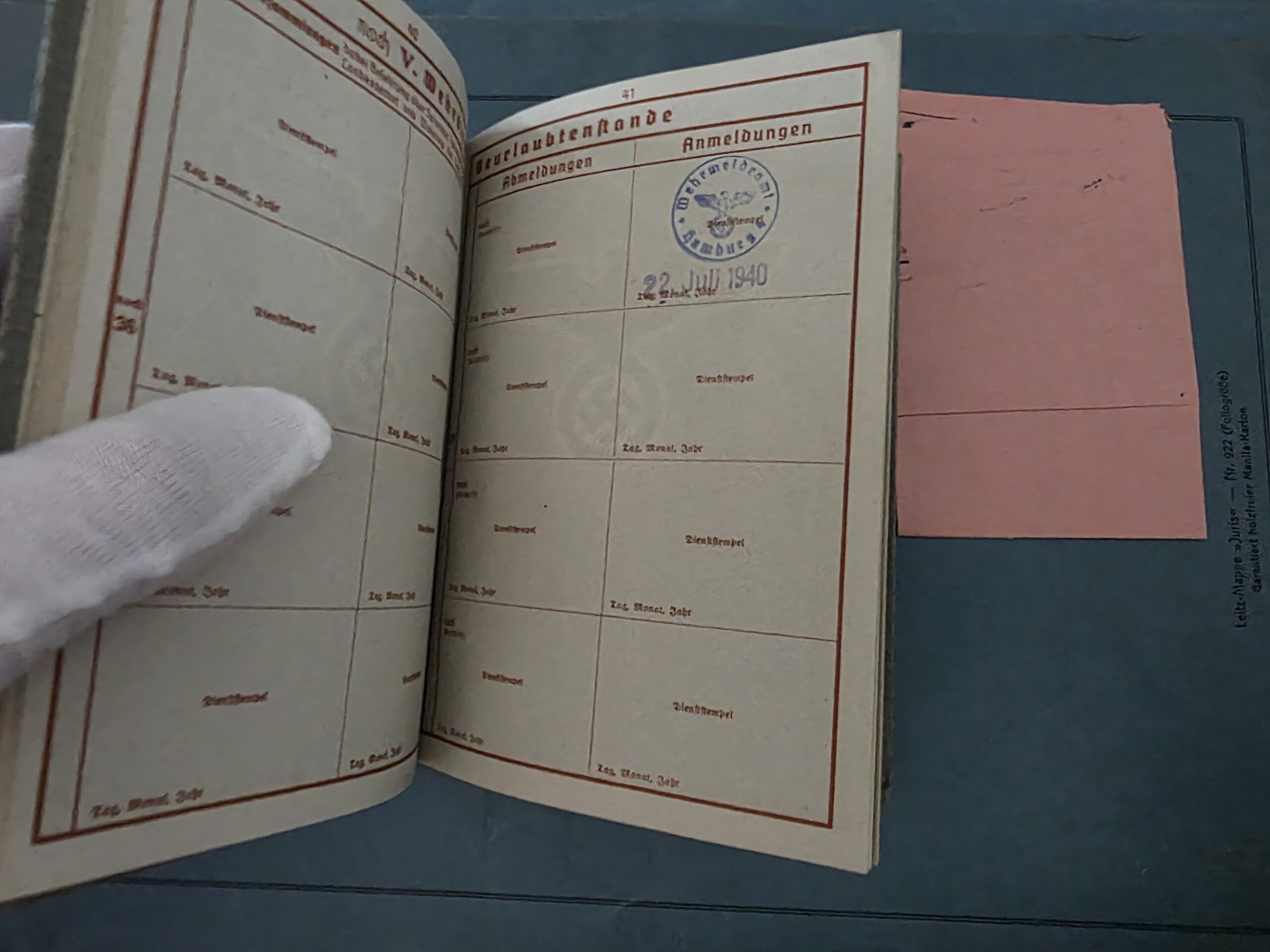
This WWII German Wehrpass is an original wartime military record belonging to Heinrich Brockmöller, born on 11 March 1902 in Sprenge, Kreis Stormarn. The booklet was issued in Hamburg on 22 July 1940 and retains Brockmöller’s original identification photograph, handwritten personal information, signature, official military stamps and Landwehr classification.
What gives this particular example considerably more documentary interest than an ordinary Wehrpass is the group of original pink Wehrpass-Notiz papers preserved with it. These accompanying documents relate directly to Brockmöller’s military liability and his status as unabkömmlich, normally abbreviated by German authorities as UK: a person considered indispensable in his civilian employment and therefore required to remain available to that workplace rather than being released for normal military mobilisation.
The grouping consequently documents not only an individual German citizen’s military registration, but also the interaction between military manpower requirements and essential civilian employment during the Second World War.
Heinrich Brockmöller – Personal Details
The personal pages identify the holder as Heinrich Brockmöller. His full handwritten given names appear to include additional names, while the contemporary typed Wehrpass-Notiz uses the simpler form Heinrich Brockmöller.
His date of birth is recorded as:
11 March 1902
and his birthplace as:
Sprenge, within Kreis Stormarn.
The facing page retains his original black-and-white identification portrait, showing Brockmöller in civilian clothing. The photograph is secured to the document and crossed by period official stamps, while his handwritten signature appears below.
His nationality is recorded as Deutsches Reich. The occupation entry appears to relate to agriculture, probably a form of landwirtschaftlicher Pächter or agricultural tenant/farmer. This is potentially relevant to the later UK documentation, although the surviving papers shown do not identify the precise Bedarfsstelle or essential workplace responsible for his exemption.
For that reason, no specific employer or agricultural establishment is attributed without further evidence.
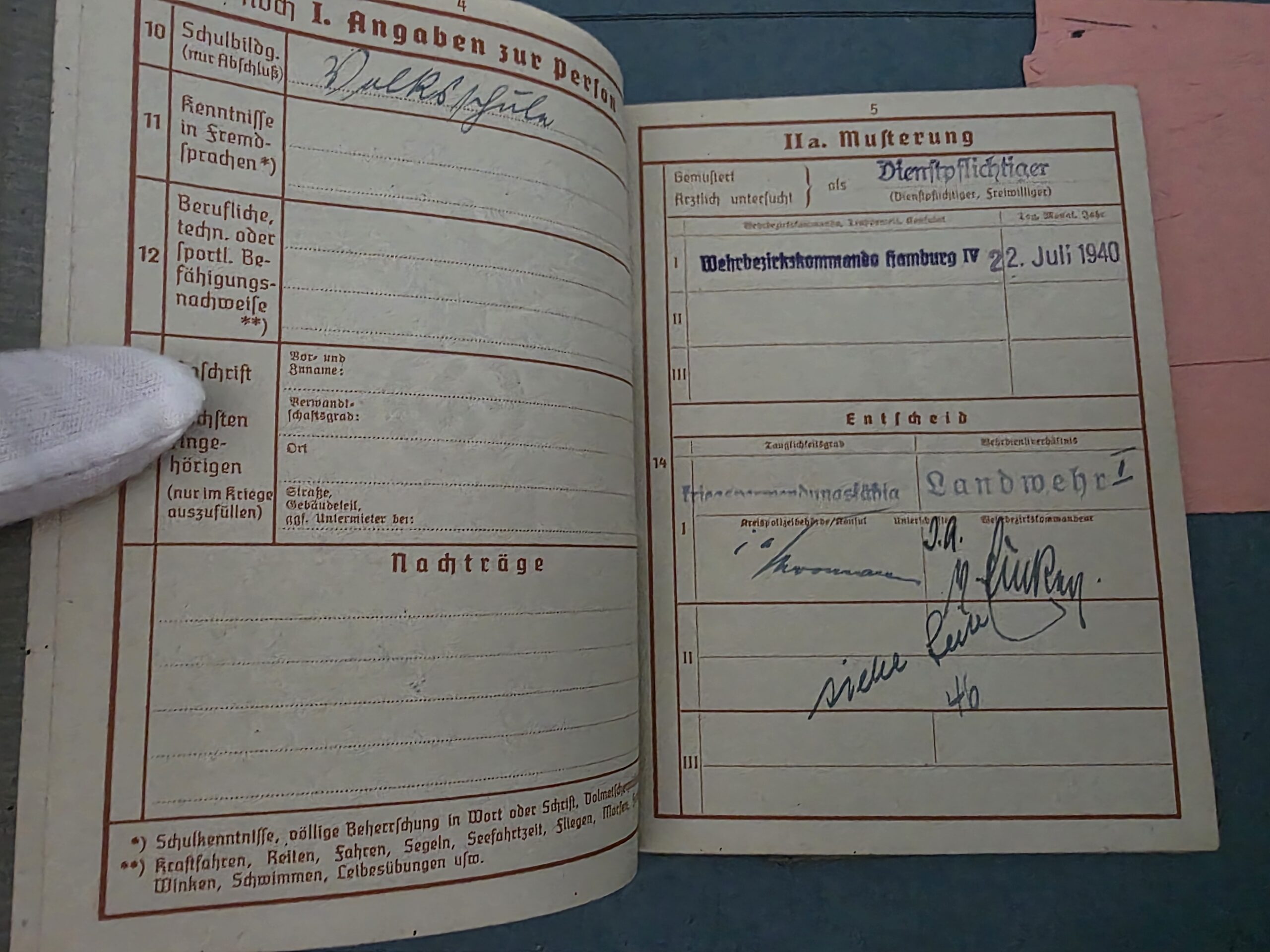
Issued by Wehrbezirkskommando Hamburg IV in 1940
The Wehrpass itself was issued in Hamburg on 22 July 1940.
The opening pages carry the relevant military-administrative stamps and the designation Wehrbezirkskommando Hamburg IV. The same authority appears on the Musterung or military examination page.
Brockmöller is recorded there as a Dienstpflichtiger, and the decision section includes Landwehr I together with a wartime fitness assessment.
A Wehrpass was the principal military record used to document a German man’s military liability and, where applicable, his later military career. Depending on the individual, it could contain examination results, training, units, promotions, campaigns, awards and other service information. Basic examples can therefore vary considerably in historical interest according to how extensively they were completed. Current specialist references distinguish the Wehrpass from the Soldbuch carried during active service.
In Brockmöller’s case, the pages supplied do not show a conventional sequence of front-line units. Instead, the accompanying documents explain why: his civilian work appears to have resulted in his being maintained outside normal mobilisation through UK status.
The 1941 Wehrpass-Notiz and “Unabkömmlich” Status
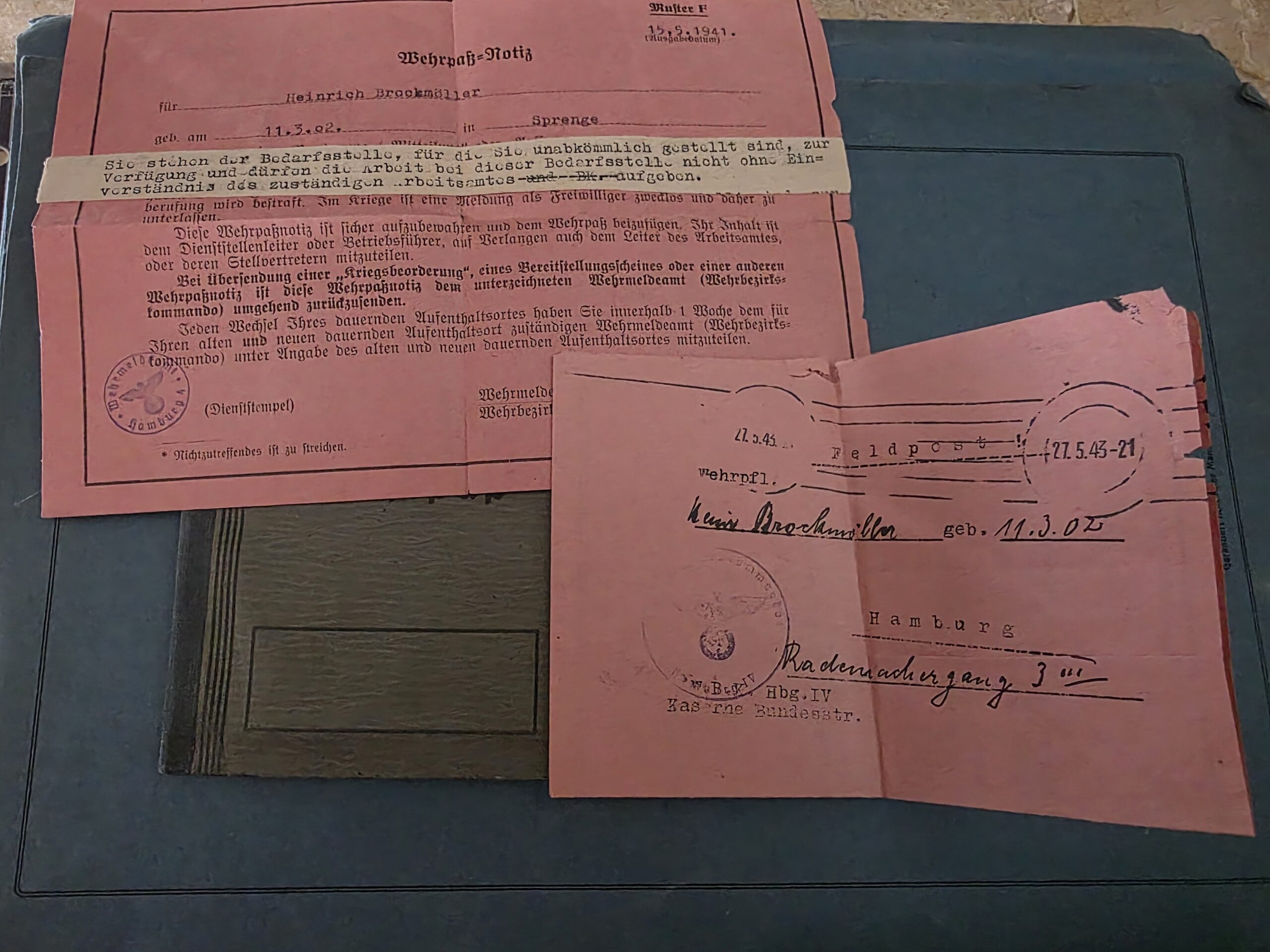
The most interesting accompanying document is a large pink Wehrpass-Notiz, Muster F, dated:
15.5.1941
It is typed directly to:
Heinrich Brockmöller
born 11.3.02
in Sprenge
The document states that Brockmöller was attached to a Bedarfsstelle for which he had been declared unabkömmlich.
In practical terms, unabkömmlich meant that a worker was considered sufficiently important to a necessary civilian occupation or enterprise that withdrawing him for military service would interfere with an essential function. The Bundesarchiv preserves extensive documentation relating to UK-Stellung, including preparations to exempt employees in establishments considered important to wartime production and essential services.
The wording of Brockmöller’s document is particularly revealing. It states that he remained at the disposal of the essential workplace and could not leave that employment without the consent of the responsible Arbeitsamt.
The form also instructed the holder to keep the Wehrpass-Notiz safely with his Wehrpass and to present its contents to his employer or relevant authorities when requested.
This is therefore not simply a loose administrative paper: it directly explains Brockmöller’s wartime military status.
Civilian Labour Versus Military Manpower
The UK system formed part of the wider conflict between two wartime requirements: the Wehrmacht needed men, while German agriculture, industry, transportation, public administration and other essential sectors also required workers.
Pre-war mobilisation planning already included arrangements for identifying personnel who would need to remain in enterprises classed as important to military or civilian wartime production. Bundesarchiv material specifically describes preparations for UK-Stellung of employees in such essential establishments.
A historical study available through the Deutsche Digitale Bibliothek similarly explains the contemporary abbreviation “uk” as unabkömmlich, meaning exempted from military service because the individual was required elsewhere.
This context makes the Brockmöller group much more informative than a Wehrpass whose owner simply never entered military service without explanation.
Additional 1943 Documents
The grouping continues beyond 1941.
Another pink Wehrpass-Notiz is dated 20 April 1943. Its visible front uses the same administrative system and refers to the military-liable person identified on the reverse.
A further pink postal or military-registration notice is dated 27 May 1943 and is addressed to Heinrich Brockmöller in Hamburg.
Taken together, these papers show that his military status continued to be monitored and documented during the war rather than ending with the original 1941 UK declaration.
This continuity is one of the stronger aspects of the grouping. The documents cover the period from the Wehrpass’s issue in 1940, through the named UK notice of 1941, and into additional administrative correspondence during 1943.
Collector’s Interest
From a collector’s perspective, what makes this WWII German Wehrpass interesting is not a combat record or famous military unit but the unusually clear documentation of wartime manpower administration.
The group includes:
- original Wehrpass;
- named holder;
- original identification photograph;
- handwritten signature;
- Hamburg issue dated 22 July 1940;
- Wehrbezirkskommando Hamburg IV markings;
- Landwehr I classification;
- named 1941 Wehrpass-Notiz;
- documented unabkömmlich / UK status;
- additional 1943 administrative papers;
- wartime postal or registration notice.
A loose Wehrpass-Notiz has comparatively modest monetary value by itself; specialist dealers have offered small groups incorporating such notices for around €20. Their real appeal becomes greater when the document remains together with the original Wehrpass of the same named individual, as in this grouping.
This combination makes the group particularly relevant to collectors interested in German military administration, mobilisation, reserve status, civilian labour during WWII and named document groupings.
Condition
The Wehrpass shows honest period wear.
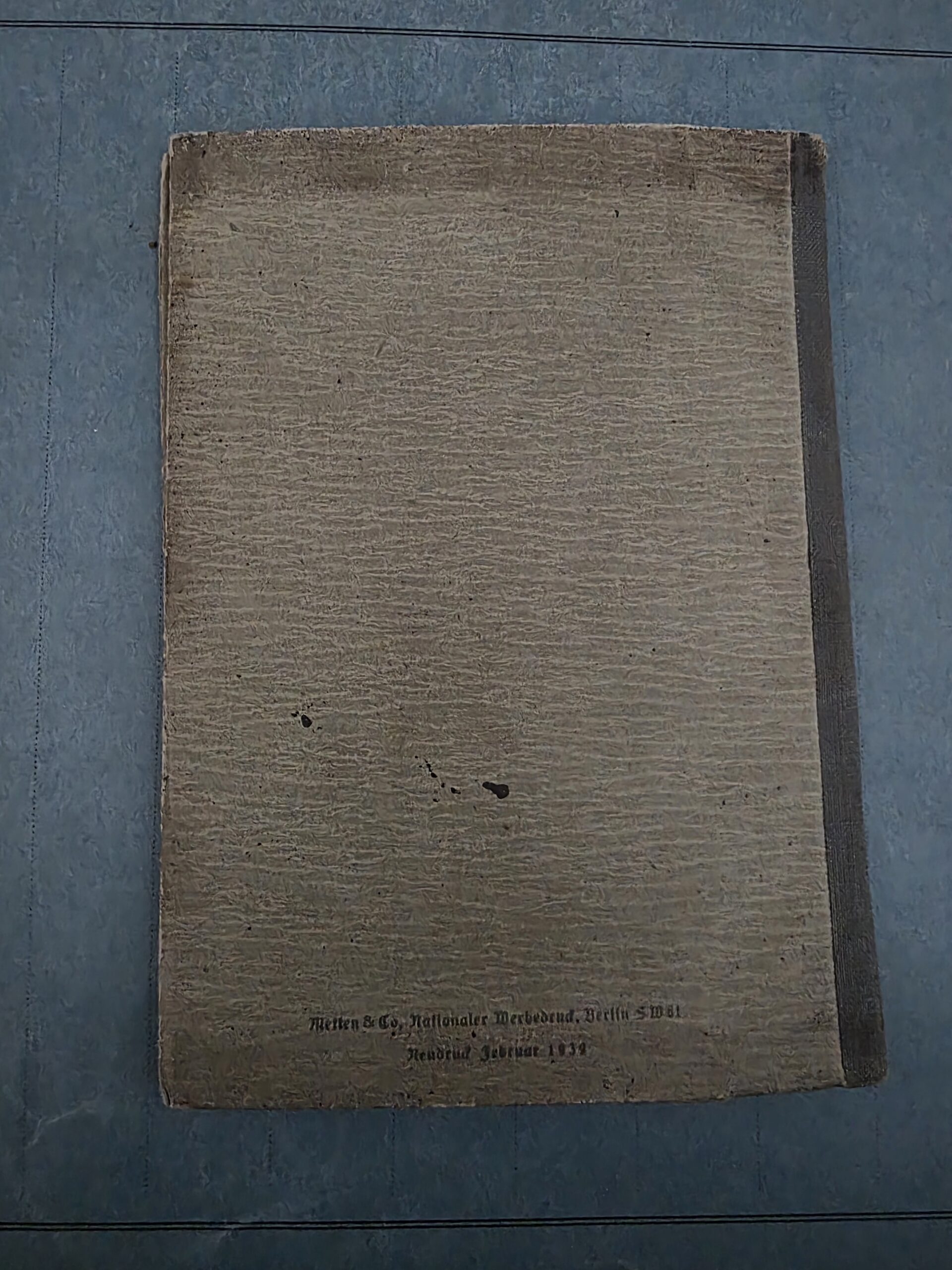
The grey cover has rubbing, surface marks, age toning, spotting and wear to the edges, corners and spine. Internally, the pages show expected toning and signs of handling. The original photograph, handwritten information and official stamps remain clearly visible.
The accompanying pink notices have stronger handling wear, including fold lines, edge losses, tears, creasing and other age-related damage. This is particularly visible on the 1943 material.
These signs of use are consistent with paperwork that was handled and retained during wartime rather than preserved unused.
The photographs form an integral part of the condition description.
Authenticity
Original WWII-period German Wehrpass and accompanying wartime administrative documents.
The booklet, photograph, handwriting, stamps, period printing and surviving Wehrpass-Notiz papers are consistent with original wartime documentation.
The material confirms Brockmöller’s Landwehr registration and UK/indispensable-worker status. No front-line service, combat participation or specific Wehrmacht field unit is claimed from the photographs supplied.
Historical Responsibility Notice
This grouping is offered strictly as original historical material for documentary, educational, research and collecting purposes.
Autographs & Militaria has no political or ideological affiliation with, sympathy for or endorsement of National Socialism, the Nazi regime or the organisations and symbols represented by these documents.
HISTORICAL CONTEXT:
The Unabkömmlichstellung system allowed personnel considered necessary to essential civilian work to remain at their workplace instead of being mobilised normally. Archival records show that UK status was integrated into German wartime economic and mobilisation planning.
COLLECTOR’S INTEREST:
The strongest feature is the survival of the Wehrpass together with its related UK-status paperwork. This allows the collector to understand why the holder remained within Landwehr/military registration while being retained for civilian employment.
CONDITION AND AUTHENTICITY NOTE:
Original used wartime grouping with age toning, cover wear and handling. The pink accompanying papers show folds, tears and edge losses. Photograph, stamps and principal entries remain present. Photographs form part of the condition description.
HISTORICAL RESPONSIBILITY NOTICE:
Offered exclusively as historical, documentary and collecting material. No ideological endorsement is intended or implied.
1. Is this an original WWII German Wehrpass?
Yes. The group contains an original period Wehrpass issued in Hamburg in 1940 to Heinrich Brockmöller, together with his original photograph, stamps and related wartime documentation.
2. What makes this Wehrpass different from an ordinary example?
The accompanying Wehrpass-Notiz papers explain the holder’s military status. Brockmöller was declared unabkömmlich, meaning he was considered indispensable in civilian employment and was retained there rather than being normally mobilised.
3. What does “UK-Stellung” mean?
UK derives from unabkömmlich. It was an administrative status used for workers required in important civilian occupations or enterprises whose removal for military service was considered detrimental to essential production or services.
4. Was Heinrich Brockmöller a front-line soldier?
The supplied documentation does not show front-line service. His Wehrpass records Landwehr I status, while the accompanying papers document his retention in indispensable civilian employment.
5. When was the grouping used?
The Wehrpass was issued on 22 July 1940. The named UK Wehrpass-Notiz dates from 15 May 1941, while additional documentation continues into 1943.
Additional information
| Availability | Available |
|---|
Only logged in customers who have purchased this product may leave a review.
Related products
German Document Archive 1911–1967 – DAF, University and Business Papers
Original price was: 249,00 €.199,00 €Current price is: 199,00 €.
20% Off
WWII German Wehrpass Group – 256th Infantry Division, Ostmedaille & Death Letter
590,00 €
WWII German Document Collection – U-Boat Training, DAF & Arbeitsbuch Archive
Original price was: 490,00 €.440,00 €Current price is: 440,00 €.
10% Off
WWII German Document Archive 1938–1945 – Wehrmacht, IDs & Ration Papers
Original price was: 275,00 €.240,00 €Current price is: 240,00 €.
13% Off
Reviews
There are no reviews yet.