The Collector’s Encyclopaedia · Documents · Military papers
Wehrpass: History, Contents and Collector’s Guide
| Introduced | With compulsory military service under the Defence Law of 21 May 1935 |
|---|---|
| Issued by | The military recruiting authorities (Wehrersatzdienststellen) |
| Records | Personal data, registration and medical classification, units, ranks, training, campaigns, awards, wounds, discharge |
| Companion document | The Soldbuch, carried by the soldier in the field |
| In the collection | 6 pieces currently available (see below) |
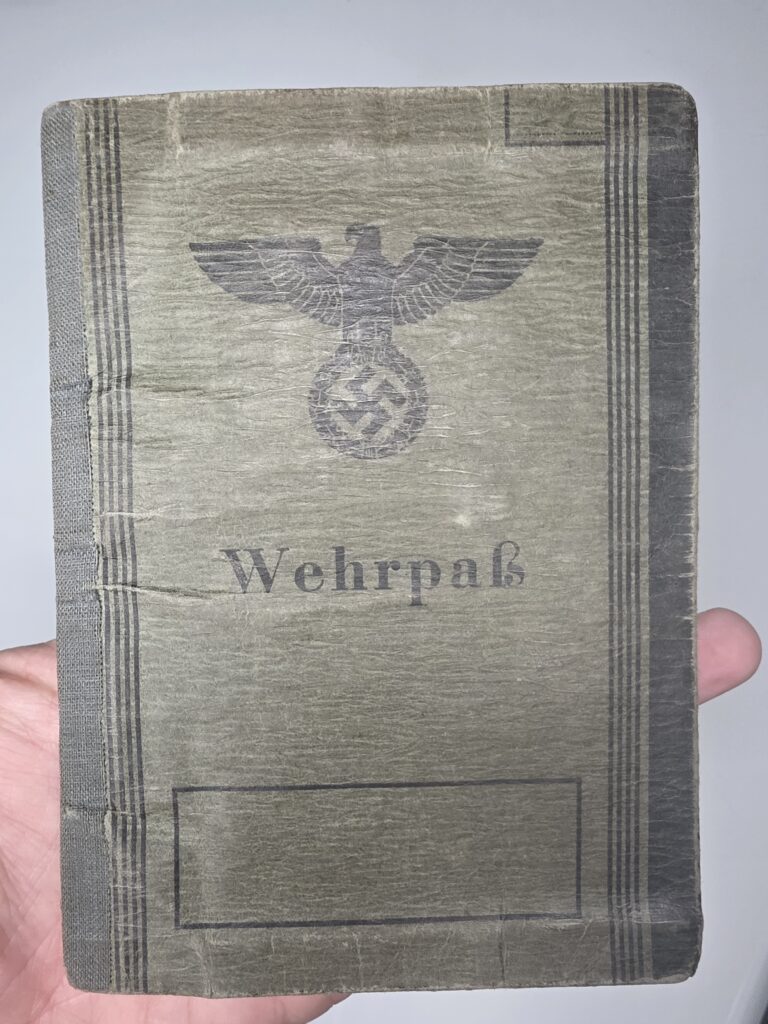
The Wehrpass is the backbone of most German Second World War document collecting. It recorded a man’s military life from his registration to his discharge, and a well-filled example can be read as a biography in official entries.
What Is a Wehrpass?
The Wehrpass belonged to the system of military personnel records created after the reintroduction of conscription by the Defence Law (Wehrgesetz) of 21 May 1935. Rudolf Absolon’s standard study, published by the Bundesarchiv, treats the Wehrpass together with muster rolls, troop identity papers and Soldbücher as the core personnel documents of the Wehrmacht.
Typical entries include personal data and photograph, the registration (Musterung) and medical classification, service with the Reich Labour Service, units and ranks, training, campaigns and battles, awards, wounds and discharge.
Who Issued It, and Who Signed It?
The Wehrpass was opened and kept by the recruiting authorities; entries were made and stamped by those offices and by the soldier’s units, and signed by the responsible officers or officials. While a man served, his Wehrpass was normally held by the unit administration, and he carried his Soldbuch instead.
What Should Collectors Watch For?
- Consistency: units, dates, stamps and signatures should form a coherent sequence.
- Added entries: awards or battles inserted later to raise value are a known problem; ink, hand and stamp must match the period entries.
- Photographs should be original to the document, with stamps crossing onto the page.
- Research: personnel records held by the Bundesarchiv can sometimes confirm details.
Collector’s Note
A Wehrpass is where I most often use my training as a document examiner: hands, inks and stamps tell you whether the record grew naturally over the years or was improved later.
Related Entries and Pieces
Pieces in the Collection
From the Collector’s Journal
- German Wehrpass Guide: How to Read and Research a WWII Military Service Record
- Wehrpass vs Soldbuch: 9 Key Differences Every Collector Should Know
- WW2 German Documents: Complete Collector’s Guide to Wehrpass, Soldbuch, Kennkarte & Award Papers
Browse the full Collector’s Encyclopaedia →
Frequently Asked Questions
What is a Wehrpass?
The German military service record book introduced with conscription in 1935.
What is the difference between a Wehrpass and a Soldbuch?
The Wehrpass was the full service record, normally kept by the authorities; the Soldbuch was the identity and pay book carried by the soldier.
Can a Wehrpass be researched?
Often yes; personnel records held by the Bundesarchiv can confirm units and dates.
Historical Responsibility Notice: this entry documents historical figures and artefacts of the National Socialist period for collecting, preservation, education and research. It does not endorse or glorify any ideology, and it is written in memory of the victims of the regime.
References & Further Reading
- Absolon, R. (1960) Wehrgesetz und Wehrdienst 1935–1945. Das Personalwesen in der Wehrmacht, Schriften des Bundesarchivs 5. Boppard am Rhein: Harald Boldt.
- Bundesarchiv, Die zentrale Personenkartei der Wehrmachtauskunftstelle.