The Collector’s Encyclopaedia · Decorations · Wehrmacht awards
Iron Cross 1939: History, Grades and Collector’s Guide
| Instituted | 1 September 1939 (renewal of the Prussian award of 1813) |
|---|---|
| Grades | Second Class; First Class; Knight’s Cross and its higher grades |
| Awarded to | Members of the Wehrmacht and Waffen-SS, for bravery and leadership in combat |
| Typical paperwork | Preliminary and formal award documents; entries in the Wehrpass and Soldbuch |
| In the collection | 4 pieces currently available (see below) |
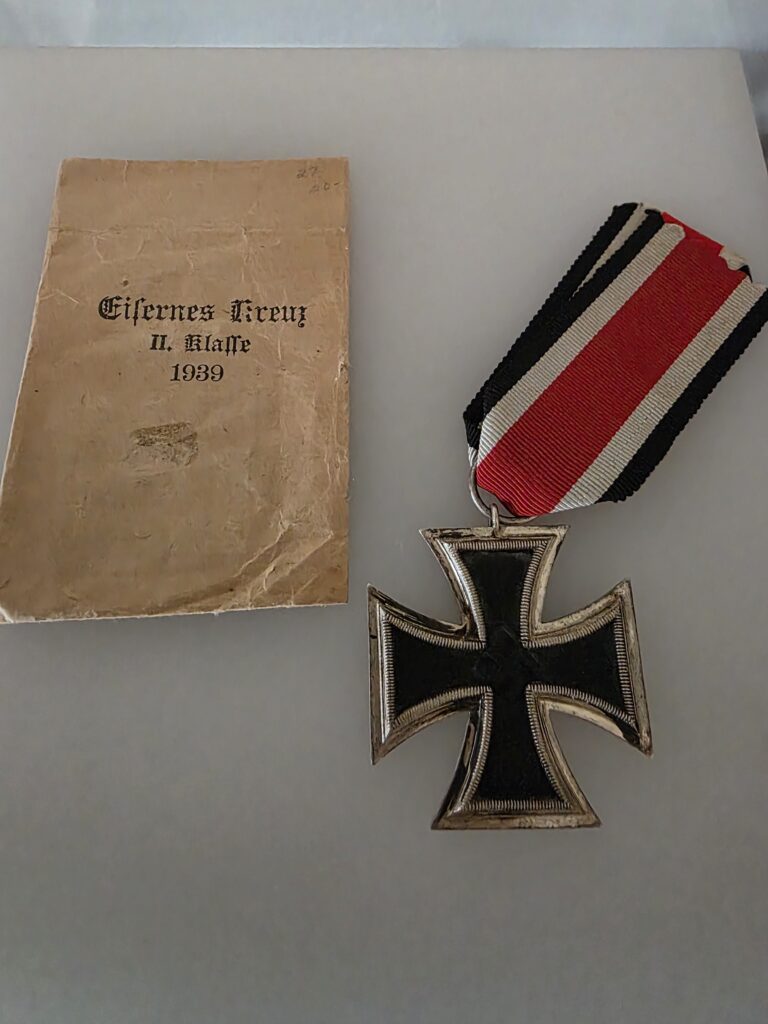
The Iron Cross is the best-known German decoration and the cornerstone of most collections of Second World War awards. Its 1939 version continued a Prussian tradition dating back to 1813, but now carried the swastika and the date 1939. It is also one of the most reproduced decorations on the market.
What Was the Iron Cross 1939?
Hitler renewed the Iron Cross on 1 September 1939, the day Germany invaded Poland. As before, it was awarded in Second and First Class; above them stood the Knight’s Cross, introduced with the renewal as the highest grade of the order. The Second Class was worn from a ribbon or, more often, shown as a ribbon in the buttonhole; the First Class was a pin-back cross worn on the left breast.
The 1939 cross shows the swastika in the centre and the year 1939 on the lower arm; the reverse of the Second Class carries the year 1813 of the original foundation.
Who Awarded It, and Which Documents Go With It?
Awards were authorised through the military chain of command, and the recipient received a award documents, usually a printed form signed by a divisional or regimental commander. The award should also appear in the soldier’s Wehrpass and Soldbuch. A cross that comes with its document and the man’s service books is far more valuable, historically and commercially, than the cross alone.
What Should Collectors Watch For?
- Reproductions are extremely common, some of good quality. Check the frame, the core, the paint and the weight, and compare with authenticated examples.
- Grouping: documents and crosses are sometimes “married” later. Names, units and dates must agree.
- Maker markings vary; a mark alone proves nothing, nor does its absence.
- 1957 pattern crosses (oak leaves instead of the swastika) are post-war items and should be described as such.
Legal note. In Germany the 1957 Orders and Decorations Act allows Second World War awards to be worn only without National Socialist emblems, which is why “1957 pattern” versions without the swastika exist. The public display of Nazi symbols is restricted in Germany, Austria and several other countries. Owning, buying and selling original decorations as historical objects is treated differently from country to country, so check the law where you live and where you ship.
Collector’s Note
For me, the Iron Cross is rarely the most interesting part of a group. The document, the Wehrpass and the photographs are what turn an anonymous cross into a man’s history.
Related Entries and Pieces
Pieces in the Collection
From the Collector’s Journal
Browse the full Collector’s Encyclopaedia →
Frequently Asked Questions
When was the Iron Cross 1939 instituted?
On 1 September 1939.
What is the difference between the Second and First Class?
The Second Class was worn from a ribbon; the First Class was a pin-back cross worn on the left breast.
Is an Iron Cross without documents worth less?
Usually yes. A documented award to a named soldier carries much more historical value.
Historical Responsibility Notice: this entry documents historical figures and artefacts of the National Socialist period for collecting, preservation, education and research. It does not endorse or glorify any ideology, and it is written in memory of the victims of the regime.
References & Further Reading
- Deutsches Historisches Museum, LeMO – Lebendiges Museum Online, Ritterkreuz des Eisernen Kreuzes (A. Scriba; last updated 19 May 2015).
- Federal Republic of Germany (1957, as amended) Gesetz über Titel, Orden und Ehrenzeichen (OrdenG), §§ 6 and 15, Bundesministerium der Justiz / gesetze-im-internet.de.