Iron Cross 1939: Complete Collector’s Guide to EK1, EK2, Makers, Authenticity & Value
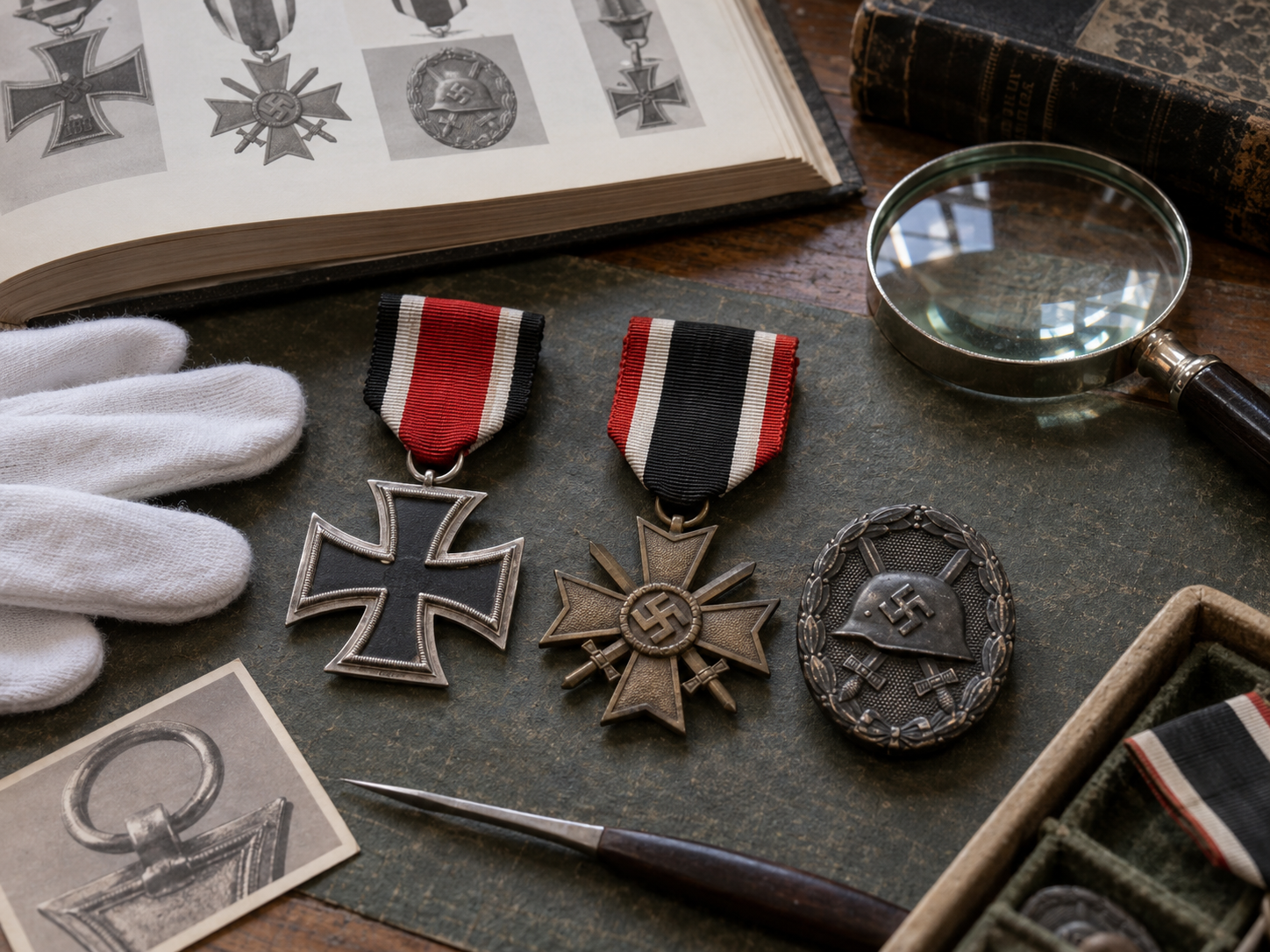
The Iron Cross 1939 is one of the most recognisable military decorations associated with the Second World War and remains one of the most widely studied German awards among militaria collectors.
Its apparently simple design can be deceptive. Two crosses that appear almost identical at first glance may differ considerably in construction, manufacturer, condition, originality and collector interest.
For that reason, identifying an Iron Cross should never be based on a single feature such as magnetism, a maker mark or the appearance of the ageing.
It is intended as a practical reference for collectors rather than a political or ideological discussion of the period.
What Is the Iron Cross 1939?
The Iron Cross was not created during the Second World War.
Its origins go back to 1813, when King Friedrich Wilhelm III of Prussia instituted the decoration during the Napoleonic Wars. The characteristic cross form is closely associated with the work of Karl Friedrich Schinkel and became one of the most enduring designs in German military award history. The decoration was subsequently renewed in 1870, 1914 and again in 1939.
The 1939 version was reinstituted at the beginning of the Second World War and retained the traditional cross pattée form while introducing the symbols and colours associated with Nazi Germany.
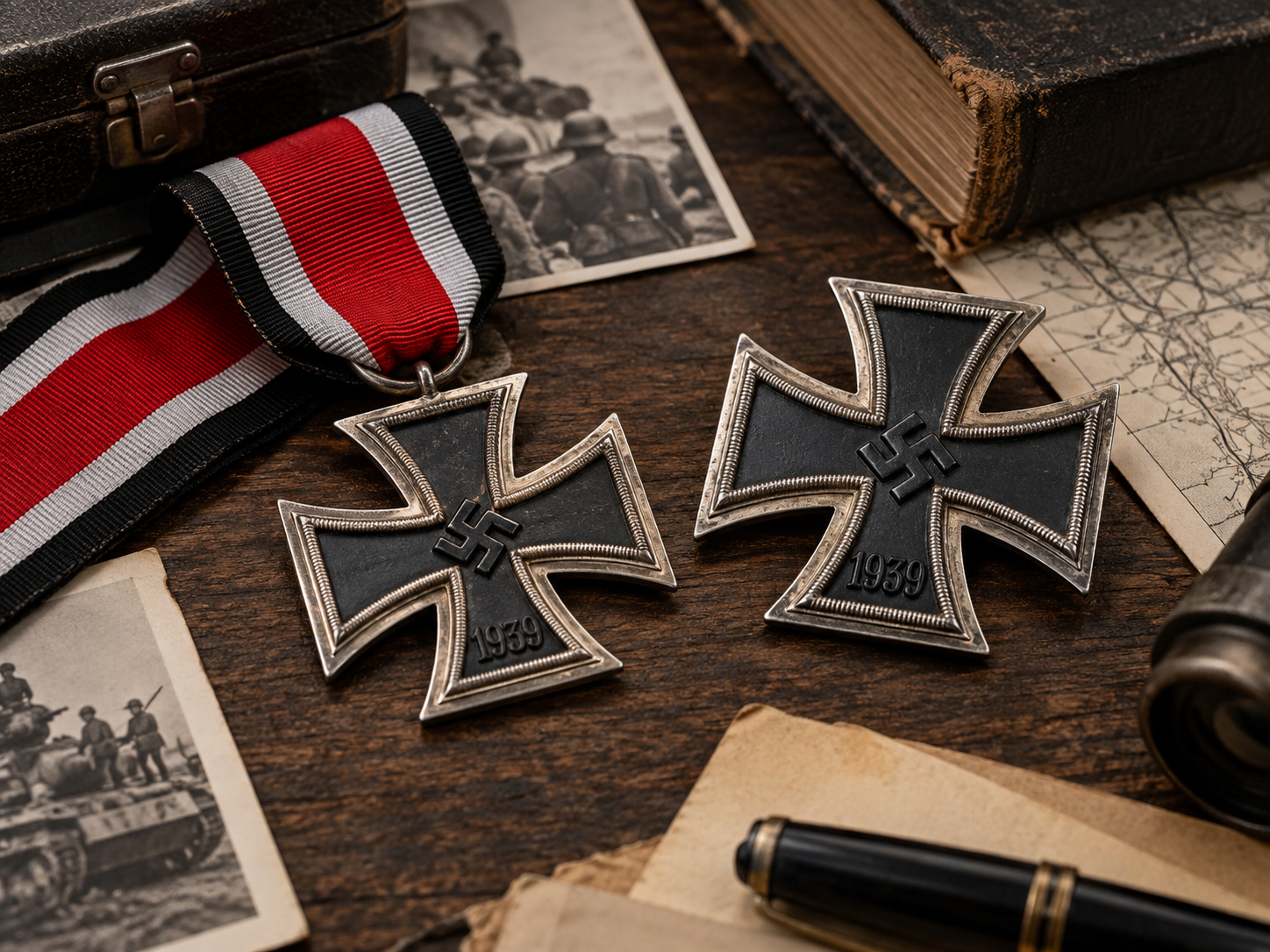
On the Second Class version, the obverse normally displays a central swastika with 1939 on the lower arm. The reverse preserves the historical date 1813, a direct reference to the origin of the decoration.
For collectors, this combination of historical continuity and wartime manufacture is one of the reasons the Iron Cross has become such a specialised collecting field.
Iron Cross 1939 EK2 vs EK1
Although the EK1 and EK2 share the same basic visual design, they were different awards and were worn differently.
| Feature | Iron Cross 2nd Class — EK2 | Iron Cross 1st Class — EK1 |
|---|---|---|
| German name | Eisernes Kreuz 2. Klasse | Eisernes Kreuz 1. Klasse |
| Ribbon | Yes | No |
| Suspension ring | Yes | No |
| Method of wear | Ribbon / buttonhole | Breast-mounted |
| Reverse | 1813 on lower arm | Generally plain metal reverse |
| Attachment | Suspension ring | Pin, catch or screw-back system |
| Typical size | Approx. 44 mm cross | Approx. 44 mm cross |
| Collector abbreviation | EK2 / EKII | EK1 / EKI |
Museum examples document the EK2 with its black, white and red ribbon and the EK1 as a breast decoration using a reverse mounting system rather than a ribbon.
This difference is fundamental when identifying incomplete examples.
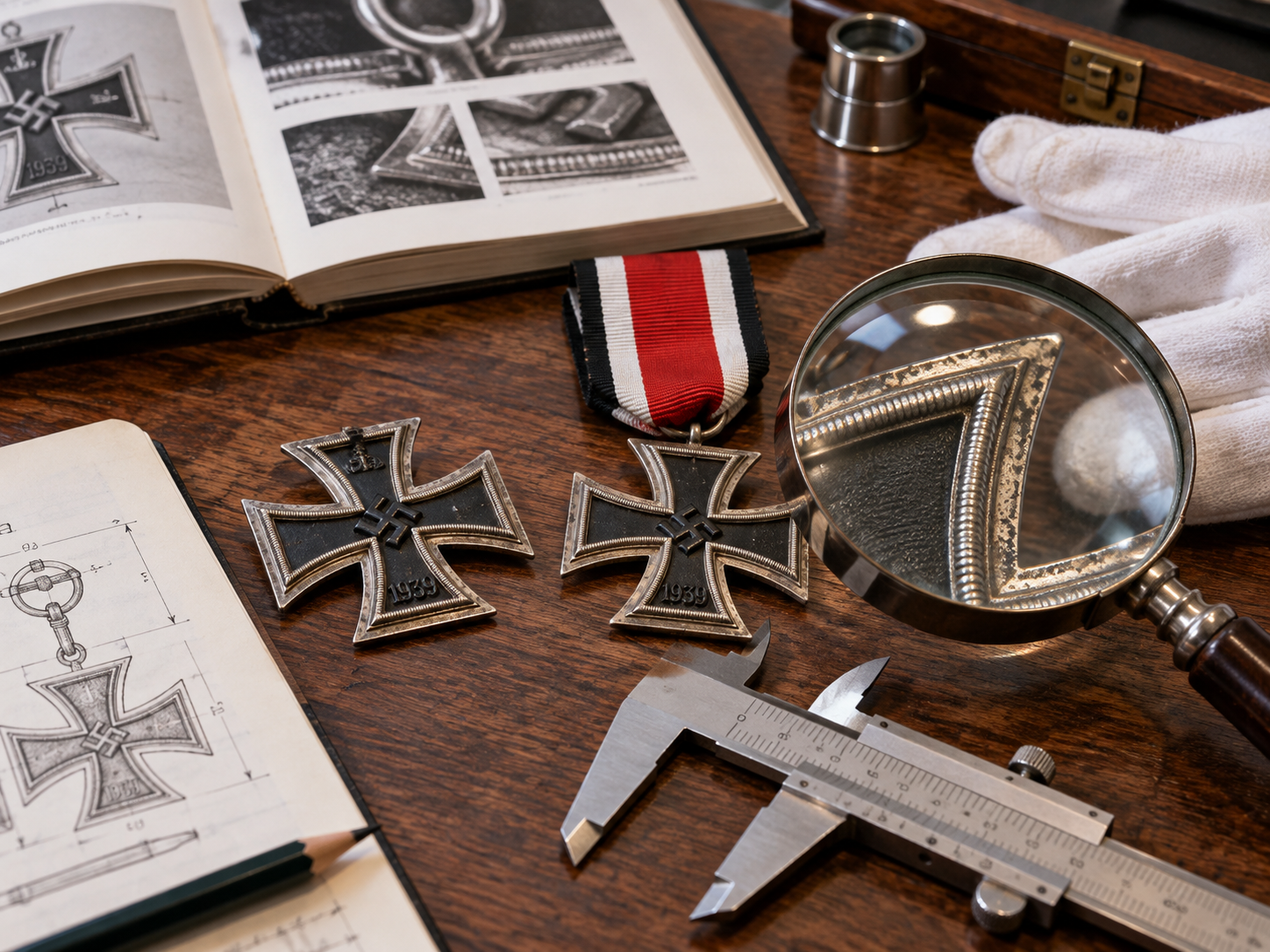
Iron Cross 2nd Class 1939 — EK2
The Iron Cross 2nd Class 1939 is the version most frequently encountered by collectors.
A standard example consists of the cross itself, a suspension loop and ring, and originally a black, white and red ribbon.
The obverse displays the political emblem used by the German state during the period together with the date 1939 on the lower arm. The reverse carries 1813.
An original example held by the Australian War Memorial is described as having a blackened iron centre surrounded by a silver-coloured two-piece beaded edge, with the 1939 design on the front and 1813 on the reverse.
After the award ceremony, recipients did not necessarily wear the complete decoration continuously. The ribbon could be worn through the uniform buttonhole instead.
Collector’s Note
When examining an EK2, do not concentrate exclusively on the face of the medal.
The suspension loop, ring, frame seam, ribbon, wear pattern and possible maker markings can sometimes be more informative than the front design itself.
This is one reason good photographs should always include the edge, suspension ring and reverse, rather than only an attractive frontal photograph.
Iron Cross 1st Class 1939 — EK1
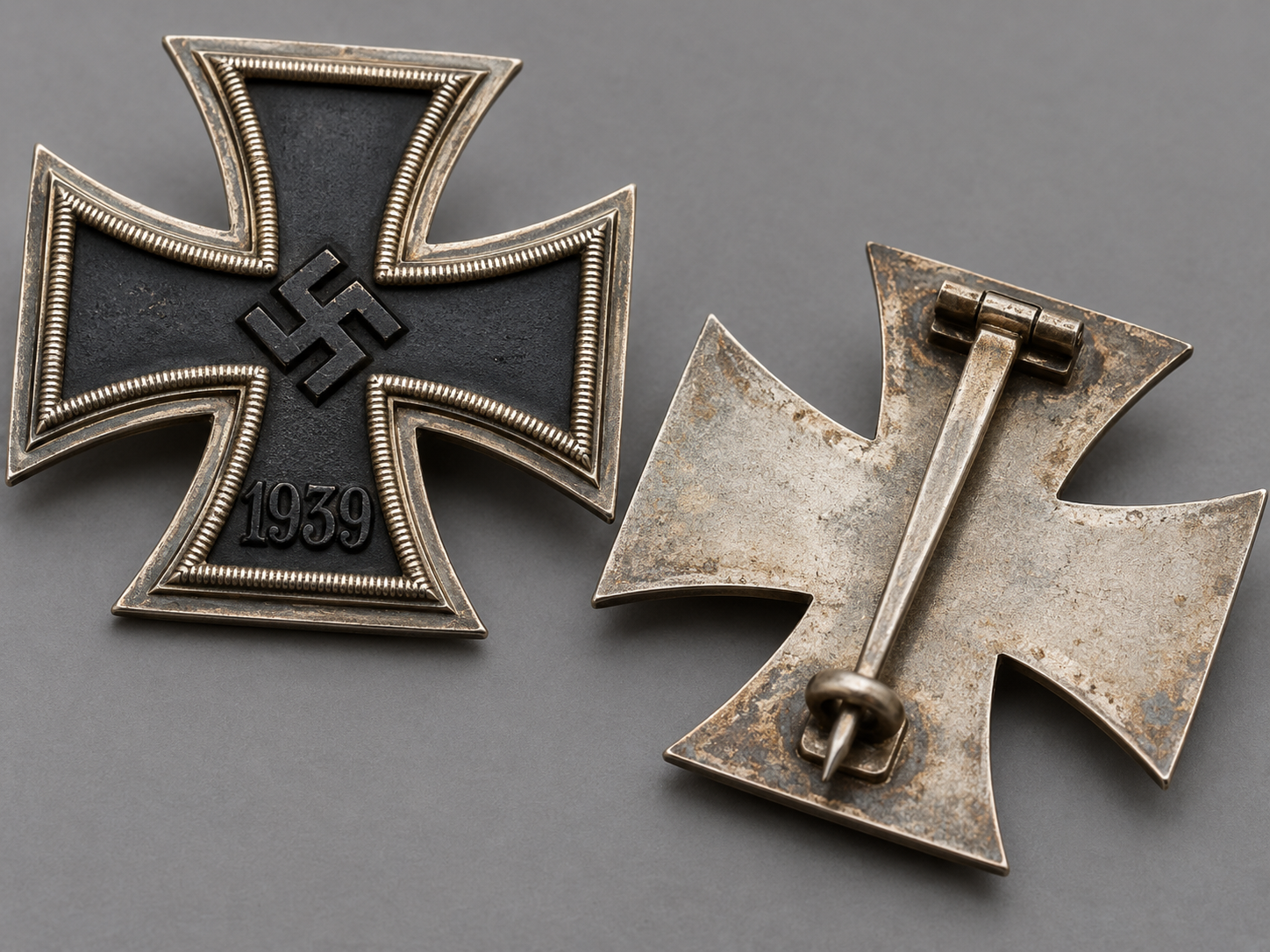
The Iron Cross 1st Class was a breast decoration rather than a ribbon-suspended medal.
Its front retained the familiar black centre, silver-coloured frame, central period emblem and the date 1939, but the reverse was designed for attachment directly to the uniform.
Museum collections preserve examples using pin systems as well as screw-type attachments. The Australian War Memorial describes its EK1 example as approximately 44 mm wide, with a black iron centre, silver edge and reverse fastening system.
For collectors, the reverse of an EK1 is therefore particularly important.
The hinge, pin, catch, screw fitting and manufacturer characteristics can all contribute to identification.
A convincing front does not make an EK1 authentic if the reverse construction is inconsistent with known period manufacture.
How Was an Iron Cross 1939 Constructed?
Many original Iron Crosses were produced using a multi-part construction.
A typical example consists of a dark central core held inside a silver-coloured outer frame. Museum records describe surviving crosses in combinations of iron, silver, steel, German silver and silver-coloured alloys depending on the example.
This is important because collectors sometimes assume that every authentic Iron Cross must conform to one exact recipe.
That is too simplistic.
Production occurred through different manufacturers, materials varied, and wartime manufacturing circumstances changed.
What matters is whether the complete construction makes sense.
The frame
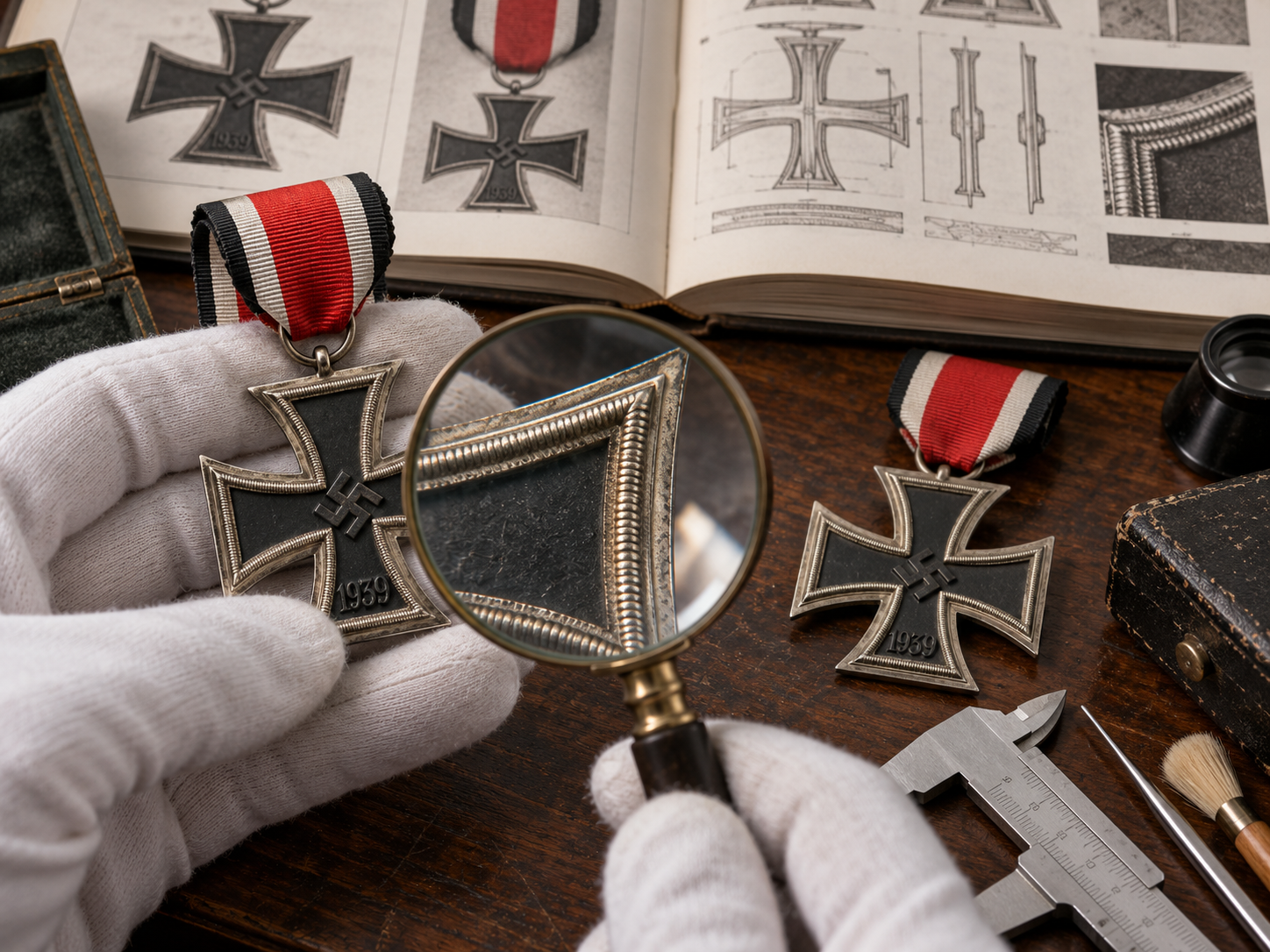
The silver-coloured outer frame is one of the first areas worth studying.
Collectors examine the shape of the beading, the geometry of the inner corners, the edge seam and the relationship between the frame and the core.
Different recognised manufacturers can display subtle variations.
The core
The centre is typically dark or blackened.
On well-preserved examples the original finish may remain strong. Other genuine examples show loss of finish, oxidation, exposed metal or handling wear.
Perfect condition is not automatically a sign of authenticity, just as heavy wear is not proof of age.
Artificial ageing is common on reproductions.

Is an Original Iron Cross Always Magnetic?
This is one of the most common collector questions.
A magnet test can be useful because many Iron Crosses were manufactured with an iron or steel core.
However, magnetism should never be used as a stand-alone authentication test.
A reproduction can contain ferrous metal and therefore attract a magnet. Conversely, construction variants mean that collectors should evaluate the complete medal before drawing a conclusion.
A magnet tells you something about the material.
It does not tell you when the object was manufactured.
That distinction is essential.
Iron Cross 1939 Dimensions
Many standard EK1 and EK2 crosses are approximately 44 mm across, although minor differences exist between manufacturers and examples.
Museum specimens illustrate this variation. The Australian War Memorial records an EK1 at approximately 44 mm, while Smithsonian examples also fall within the general mid-40 mm range.
Measurements are therefore useful for detecting obviously incorrect reproductions, but a difference of a fraction of a millimetre should not automatically decide authenticity.
More useful is the combination of:
dimensions, weight, frame profile, beading, core design, suspension or fastening system and recognised manufacturer characteristics.
Iron Cross 1939 Maker Marks
Manufacturer research is one of the most specialised areas of Iron Cross collecting.
Original examples may be marked with manufacturer numbers, initials or LDO codes, depending on the type and production context.
Marks can appear on the suspension ring of an EK2 or on components of an EK1 reverse.
One documented museum example of an EK1 carries the code L/11, identified by the Los Angeles Museum of the Holocaust as a manufacturer marking associated with Wilhelm Deumer of Lüdenscheid.
However, three points are essential.
An unmarked Iron Cross is not automatically fake.
A correct-looking manufacturer number is not automatically genuine.
And maker identification should ideally be confirmed by comparing construction characteristics with recognised examples from the same manufacturer.
Specialist reference works such as Gordon Williamson’s The Iron Cross of 1939 devote extensive attention to manufacturers, markings and die characteristics precisely because authentication goes far beyond reading the number stamped on a ring.
Does a Maker Mark Prove Authenticity?
No.
Maker marks are reproduced.
Modern copies can carry convincing numbers and even artificial wear.
A maker mark becomes meaningful only when the rest of the medal is compatible with the manufacturer it supposedly represents.
For example, a collector may compare the stamp style with the frame profile, inner corners, suspension system, core design and other manufacturing details.
If those characteristics contradict one another, the presence of a familiar number may actually become a warning sign.
This principle extends far beyond the Iron Cross:
authentication should be based on a group of consistent features, not one supposedly decisive clue.
How to Identify an Original Iron Cross 1939
When an Iron Cross enters my collection or I am considering an example, I prefer to examine it as a complete object rather than search for a single “proof” of authenticity.
A practical examination should consider the following:
| Area | What to examine |
|---|---|
| Overall form | Proportions and shape of the cross |
| Dimensions | Comparison with recognised period examples |
| Core | Material, finish and detail |
| Frame | Beading, inner corners and edge construction |
| Obverse | Period design and date 1939 |
| Reverse | 1813 on EK2 or mounting construction on EK1 |
| Suspension | Ring, loop and possible marks on EK2 |
| EK1 hardware | Hinge, pin, catch or screw fitting |
| Maker mark | Style and compatibility with manufacturer |
| Age | Natural wear rather than deliberately created ageing |
| Ribbon | Weave, colours, wear and construction |
| Provenance | Relationship with documents, grouping or known collection history |
The strongest conclusion normally comes when several independent characteristics point in the same direction.
One unusual feature deserves investigation.
Several contradictory features deserve caution.
Common Warning Signs on Reproduction Iron Crosses
Modern reproductions range from obviously decorative copies to extremely sophisticated collector fakes.
Poor examples may have crude dates, incorrect proportions, soft details, incorrect ribbon colours or obviously modern plating.
Better reproductions can be considerably harder.
They may be magnetic.
They may carry manufacturer numbers.
They may be artificially oxidised.
They may even be placed in reproduction cases and combined with supposedly period documents.
This is why “it looks old” should never be considered an authentication method.
Natural ageing tends to affect different materials differently. Paint, iron, plated frames, soldered components, ribbon fibres and hardware do not necessarily age in exactly the same way.
An object where every surface has been made uniformly dirty deserves careful examination.
The Importance of the Ribbon
The ribbon is sometimes treated as a secondary accessory, but for an EK2 it can significantly affect completeness and collector appeal.
The 1939 ribbon uses black, white and red, with a prominent red central field. Museum examples retain this characteristic arrangement.
Collectors should remember that ribbons are easily replaced.
A period cross can carry a replacement ribbon.
A reproduction cross can carry an original ribbon.
For this reason, medal and ribbon should be assessed separately before being considered together.
From the Collection: Iron Cross 1939 Examples
One advantage of studying an award through an actual collection is that theoretical descriptions can be compared with real objects.
Autographs & Militaria currently documents original Iron Cross 2nd Class examples, including German Iron Cross — INS50, described with its black iron core, silvered frame, suspension system and traditional 1939/1813 design.
Internal link here: link German Iron Cross — INS50 to the item page.
The collection also includes an Iron Cross 2nd Class 1939 with packet, which is particularly useful for studying the medal in relation to its associated presentation or packaging material. The item is currently visible within the Historical Collection.
Internal link here: link the phrase Iron Cross 2nd Class 1939 with packet to that product.
Use your own high-resolution photographs in this section.
This is where the article becomes much stronger than a generic SEO guide.
Provenance: Why a Named Group Can Matter More Than the Medal Alone
A loose Iron Cross can be an interesting historical object.
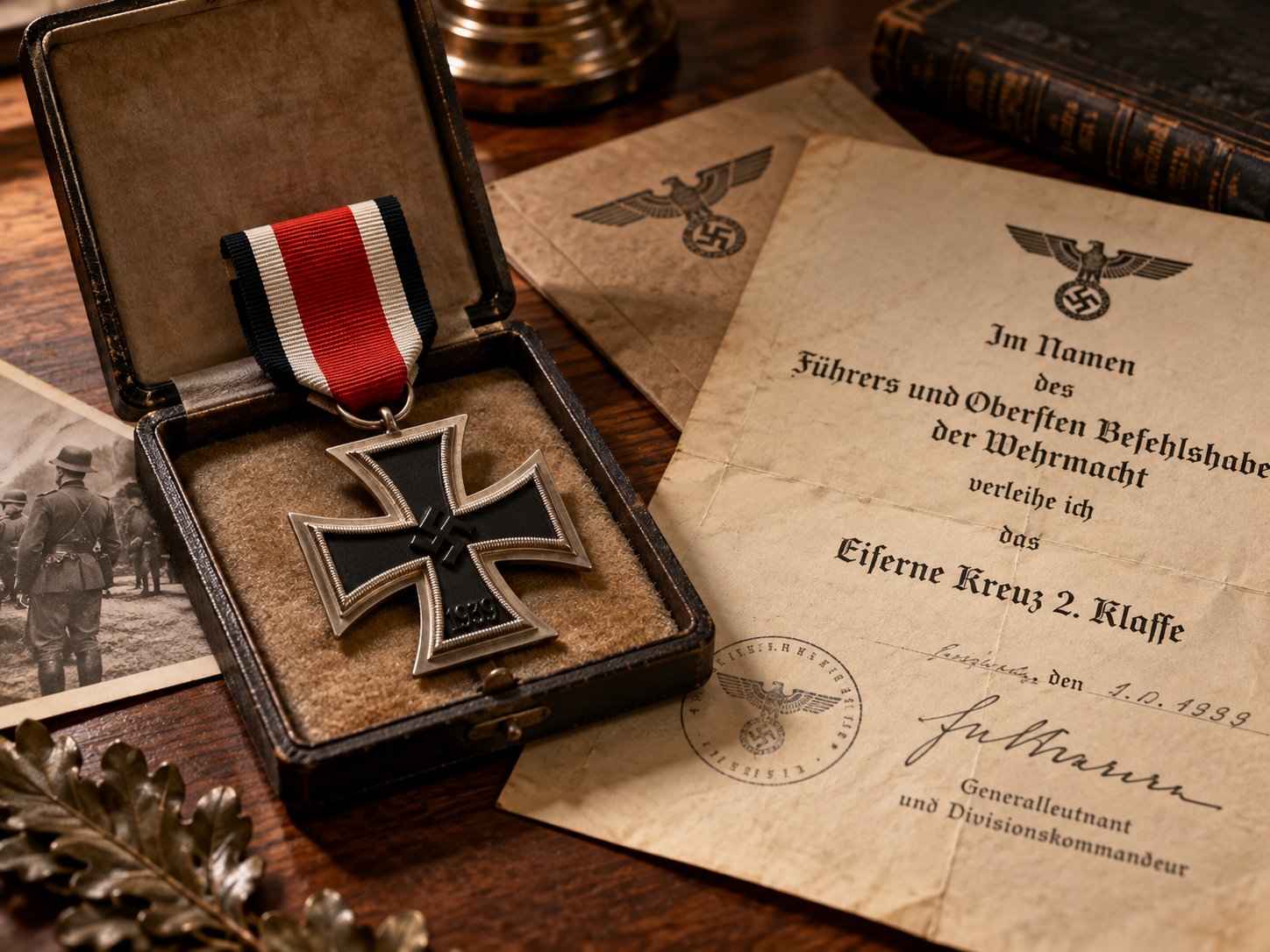
An Iron Cross connected with a named recipient, award document, Soldbuch, photographs or a preserved personal archive can provide considerably more historical context.
This does not automatically make every grouped medal more valuable, but provenance can transform the object from an anonymous decoration into evidence connected with an identifiable person and period.
That is why I generally consider the historical relationship between objects to be as important as their individual condition.
A complete archive should not be separated simply because individual pieces could be sold more easily on their own.
Internal link: use your Richard Anton Christ archive as an example of why complete medal-and-document groups have research value, while making clear that its medals are a different award grouping.
How Much Is an Iron Cross 1939 Worth?
There is no single value for an Iron Cross 1939.
The phrase “Iron Cross value” is useful for searches, but collectors should be cautious with fixed online price guides.
Value depends heavily on the exact cross.
A relatively common EK2 in average condition and without provenance will generally sit at a different level from an EK1, a cased example, a desirable manufacturer, an unusual variant or a documented grouping.
The main value factors are class, manufacturer, condition, completeness, ribbon, case or packet, provenance, documentation and current collector demand.
For this reason, I would never value an Iron Cross from a single photograph of the front alone.
Condition: Is Mint Better Than Used?
Not always in the simplistic sense.
A near-mint example may be extremely desirable.
But an honest, visibly worn medal with strong provenance may be considerably more interesting historically than a pristine but anonymous piece.
Collectors should distinguish between condition and authenticity.
Wear does not prove originality.
Pristine condition does not prove reproduction.
The ideal approach is to describe what is physically present without inventing a story for the wear.
Scratches are scratches.
Oxidation is oxidation.
A damaged ribbon is a damaged ribbon.
Unless provenance establishes where and how an object was used, physical wear should not be transformed into unsupported battlefield history.
Should an Iron Cross Be Cleaned?
Generally, aggressive cleaning should be avoided.
Polishing can remove original surface finish, alter patina and reduce the historical integrity of a piece.
Rust removal can also become destructive if performed without conservation knowledge.
Collectors should favour stable storage, controlled humidity, careful handling and minimal intervention.
When deterioration is active rather than cosmetic, professional conservation advice is preferable to experimenting with chemicals or polishing products.
Collector’s Note: The Most Important Authentication Principle
The Iron Cross is a good example of why militaria authentication is rarely binary at first inspection.
An experienced collector does not ask only:
“Is it magnetic?”
or:
“Does it have a maker mark?”
The better question is:
Do the materials, construction, proportions, hardware, markings, ageing and provenance make sense together?
Authentication becomes stronger when independent observations agree.
That methodology is applicable not only to the Iron Cross, but to medals, badges, documents and historical collectibles generally.
Iron Cross 1939 FAQ
What does 1939 mean on an Iron Cross?
The date identifies the Second World War version of the decoration. On an EK2, the obverse normally carries 1939 while the reverse preserves 1813, referring to the original institution of the Iron Cross.
What is the difference between an EK1 and EK2?
The EK2 is a ribbon-suspended decoration, while the EK1 was worn directly on the uniform using a pin or other reverse attachment system.
Is every original Iron Cross magnetic?
Many period examples have an iron or steel core, so magnetism can be useful evidence. It should not, however, be treated as proof of originality by itself.
Where are maker marks found on an Iron Cross?
Depending on manufacturer and version, marks can occur on the suspension ring of an EK2 or on reverse components of an EK1. Some genuine examples are also unmarked.
Does an unmarked Iron Cross have less value?
Not necessarily. Manufacturer attribution can influence collector interest, but originality, condition, construction, provenance and completeness can be equally or more important.
How can I tell if an Iron Cross 1939 is original?
Examine the entire object: dimensions, core, frame, edge construction, hardware, maker characteristics, ribbon, ageing and provenance. No single test is sufficient.
Are Iron Crosses still commonly reproduced?
Yes. The popularity of the decoration has resulted in reproductions ranging from inexpensive copies to sophisticated pieces intended to imitate period manufacture.
Final Thoughts
The Iron Cross 1939 is an ideal object for learning how serious militaria collecting works.
At first glance the design appears straightforward.
In practice, the field includes different classes, manufacturers, construction details, mounting systems, maker marks, cases, packets, ribbons and recognised variants.
That complexity is what makes the decoration interesting.
For a collector, the safest approach is not to search for one magical authenticity test but to build a conclusion from several consistent pieces of evidence.
Whenever possible, study documented originals, compare multiple examples and retain provenance.
The medal itself matters.
The historical context surrounding it matters even more.
Further original examples of period decorations, badges and military awards can be explored in the Medals & Militaria collection, while our WWII German Medals collector’s guide provides a broader introduction to identification, construction, maker marks and authenticity.
Historical Responsibility Notice
Items and symbols associated with Nazi Germany are documented by Autographs & Militaria exclusively as historical artefacts for collecting, preservation, education and research.
Their inclusion does not represent endorsement, promotion or glorification of the ideology or regime with which they are associated.
References & Further Reading
For the published article I would include these at the bottom:
Australian War Memorial — Iron Cross Second Class, 1939
Australian War Memorial — Iron Cross First Class
Bayerisches Nationalmuseum — Eisernes Kreuz von 1939
Staatliche Museen zu Berlin — Eisernes Kreuz II. Klasse / history of the 1813 design
Smithsonian National Air and Space Museum — Iron Cross Second Class
Gordon Williamson, The Iron Cross of 1939, R. James Bender Publishing, 2002.
Services & Expertise
Positive Reviews
Authenticity Focused

Document Authentication & Certification
Certificates issued for collector and archival purposes

Graphology & Signature Analysis
Independent professional service
About the Author: Juan García Nicolás

Popular products
-
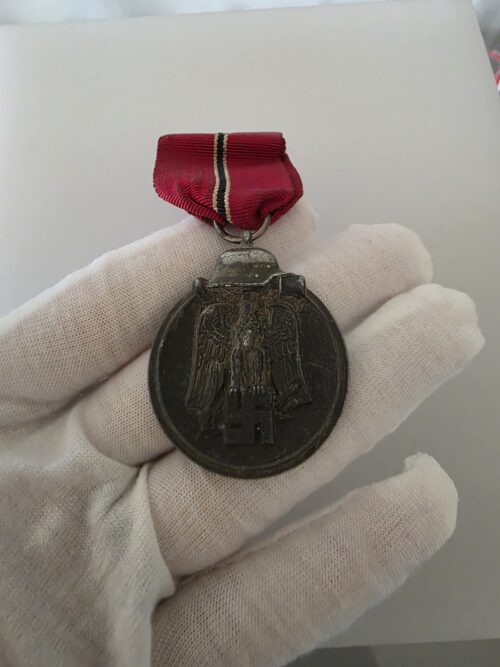 Original WWII German Eastern Front Medal 1941/42 – Ostmedaille
79,00 €
Original WWII German Eastern Front Medal 1941/42 – Ostmedaille
79,00 €
-
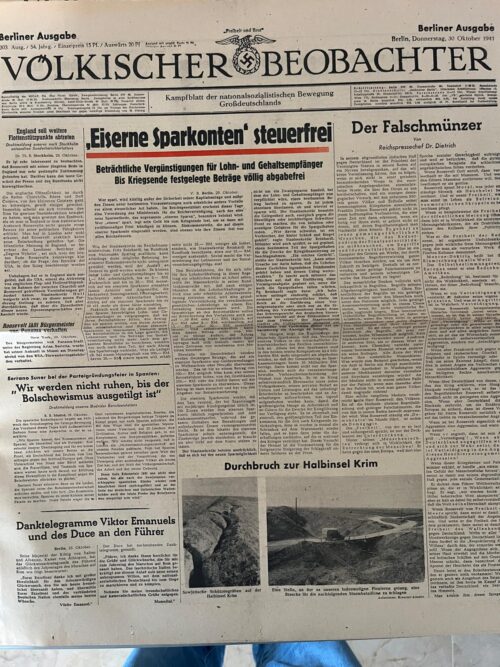 Original Völkischer Beobachter Berlin Newspaper – 30 October 1941
Original price was: 79,00 €.69,00 €Current price is: 69,00 €.
Original Völkischer Beobachter Berlin Newspaper – 30 October 1941
Original price was: 79,00 €.69,00 €Current price is: 69,00 €.
-
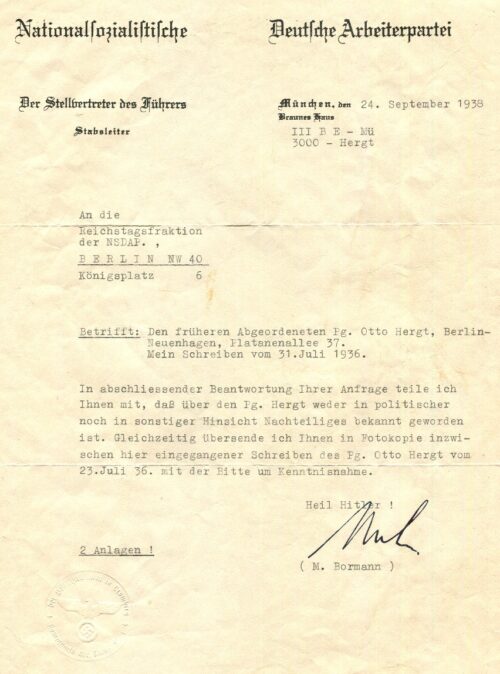 Original Martin Bormann Signed Document 1938 – Deputy Führer’s Office
Original price was: 1.690,00 €.1.490,00 €Current price is: 1.490,00 €.
Original Martin Bormann Signed Document 1938 – Deputy Führer’s Office
Original price was: 1.690,00 €.1.490,00 €Current price is: 1.490,00 €.
-
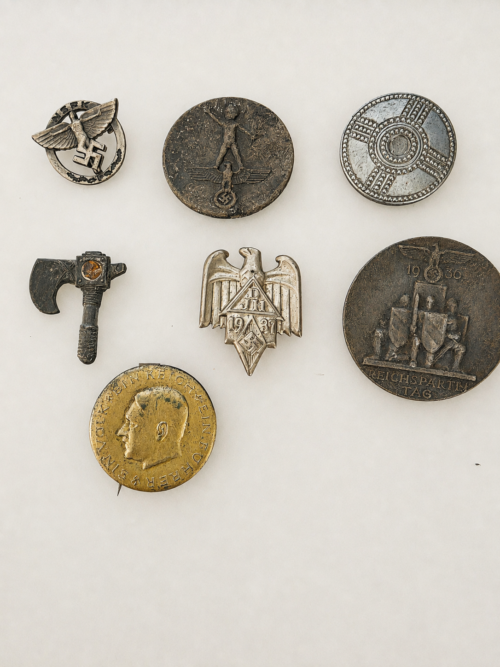 Original WWII German Third Reich Badge Lot – 7 Period Militaria Pieces
99,00 €
Original WWII German Third Reich Badge Lot – 7 Period Militaria Pieces
99,00 €
-
 Original WWII German Mother’s Cross in Bronze 1938 with Ribbon
Original price was: 69,00 €.59,00 €Current price is: 59,00 €.
Original WWII German Mother’s Cross in Bronze 1938 with Ribbon
Original price was: 69,00 €.59,00 €Current price is: 59,00 €.
-
 Original Baldur von Schirach 1935 Cut Signature – Historical Autograph Display
Original price was: 360,00 €.280,00 €Current price is: 280,00 €.
Original Baldur von Schirach 1935 Cut Signature – Historical Autograph Display
Original price was: 360,00 €.280,00 €Current price is: 280,00 €.
-
 1935 German Group Photograph with Joseph Goebbels Attributed Signature & Inscription
Original price was: 1.000,00 €.850,00 €Current price is: 850,00 €.
1935 German Group Photograph with Joseph Goebbels Attributed Signature & Inscription
Original price was: 1.000,00 €.850,00 €Current price is: 850,00 €.
-
 Leopoldo Calvo-Sotelo Signed Osborne Label – Spanish Political Autograph
Original price was: 190,00 €.175,00 €Current price is: 175,00 €.
Leopoldo Calvo-Sotelo Signed Osborne Label – Spanish Political Autograph
Original price was: 190,00 €.175,00 €Current price is: 175,00 €.
-
 Heinrich Jung German Arbeitsbuch, Kaiserslautern–Landstuhl, 1936
Original price was: 59,00 €.49,00 €Current price is: 49,00 €.
Heinrich Jung German Arbeitsbuch, Kaiserslautern–Landstuhl, 1936
Original price was: 59,00 €.49,00 €Current price is: 49,00 €.
-
 Dolores Ibarruri Signed Soviet Envelope – La Pasionaria Autograph
Original price was: 315,00 €.280,00 €Current price is: 280,00 €.
Dolores Ibarruri Signed Soviet Envelope – La Pasionaria Autograph
Original price was: 315,00 €.280,00 €Current price is: 280,00 €.