5 Most Valuable Third Reich Medals: Ultimate Collector Guide
Most Valuable Third Reich Medals are among the most complex, historically significant and difficult objects to evaluate in the field of German militaria collecting. Some were produced in relatively substantial numbers, while others were awarded to only a few dozen individuals. At the extreme end of the spectrum, certain decorations were presented only once.
Their value today is determined by far more than precious metals or diamonds.
Historical importance, rarity, recipient provenance, manufacturer, award documents, presentation cases, originality and an uninterrupted chain of ownership can transform an already rare decoration into a museum-level object.
This guide examines five of the most valuable Third Reich medals and decorations, concentrating on pieces whose scarcity can be supported by historical records and whose collector importance extends far beyond their visual appearance.
The term “medals” is used here because it is widely employed by collectors and researchers. Technically, however, some objects discussed below are orders, badges or higher grades of military decorations.
This article is presented exclusively for historical research, documentation and militaria collecting. The study or collection of historical objects connected with National Socialist Germany should not be understood as endorsement of the ideology or political system that produced them.
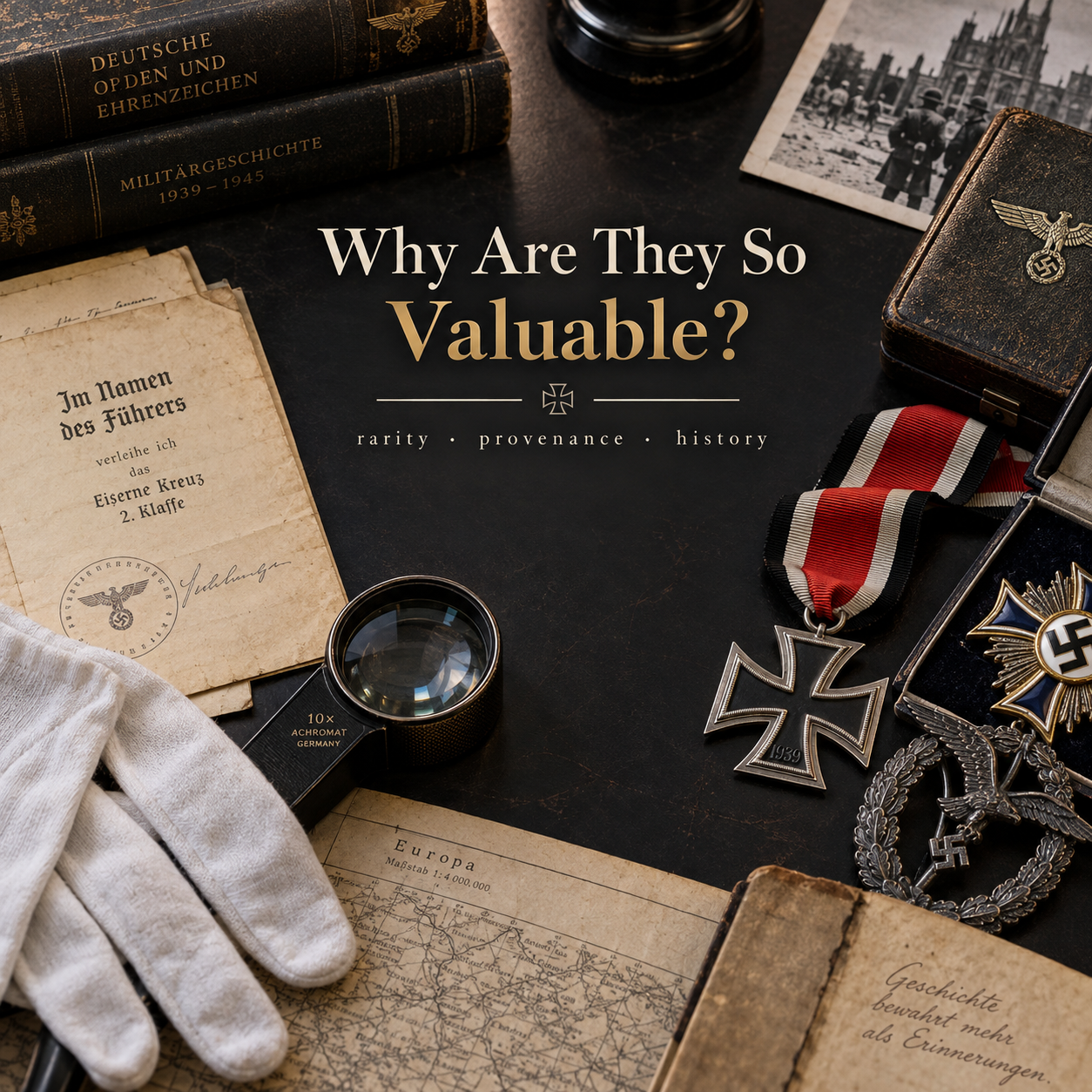
Why Are the Most Valuable Third Reich Medals So Expensive?
The market for high-level German military decorations is very different from the market for ordinary medals.
An Iron Cross 2nd Class, War Merit Cross or standard campaign medal may survive in relatively large quantities. At the opposite end of the collecting spectrum are decorations whose original recipient population can be counted in dozens—or even on one hand.
For the most valuable Third Reich medals, rarity is therefore only the beginning.
Collectors examine several interconnected factors.
Award numbers
The fewer legitimate recipients an award had, the greater its potential historical significance.
A decoration awarded 20,000 times exists in a fundamentally different collecting category from one awarded 28 times.
Provenance
An unnamed decoration is interesting.
The same decoration accompanied by its original case, award certificate, photographs and documented ownership history can be considerably more important.
If the recipient was historically significant, provenance can become the dominant factor in determining value.
Period originality
Rare German decorations have been reproduced since the end of the Second World War.
Some manufacturers that produced wartime decorations continued making replacement or collector pieces after 1945.
This means that an apparently spectacular object may still be a post-war production.
Manufacturer
Construction methods, hallmarks, dimensions and hardware can often be associated with particular manufacturers.
For elite decorations, understanding the work of firms such as C. E. Juncker, Godet or Otto Klein can be essential.
Condition
Condition matters, but not always in the way beginners expect.
A genuinely issued and worn decoration associated with a documented recipient may be considerably more desirable than an immaculate but anonymous example.
Historical context frequently outweighs cosmetic perfection.
How This List of the Most Valuable Third Reich Medals Was Created
Creating a list of the most valuable Third Reich medals requires an important distinction between market value and historical rarity.
Some extraordinary decorations have appeared at auction and provide real market evidence.
Others are essentially unique historical objects and are unlikely to enter the open market.
For that reason, this ranking considers:
- known award numbers;
- number of surviving original examples;
- historical hierarchy;
- named provenance;
- documented auction results;
- quality of manufacture;
- precious materials;
- collector demand;
- probability of an original example becoming available.
It should therefore be understood as a collector and historical ranking rather than a fixed price list.
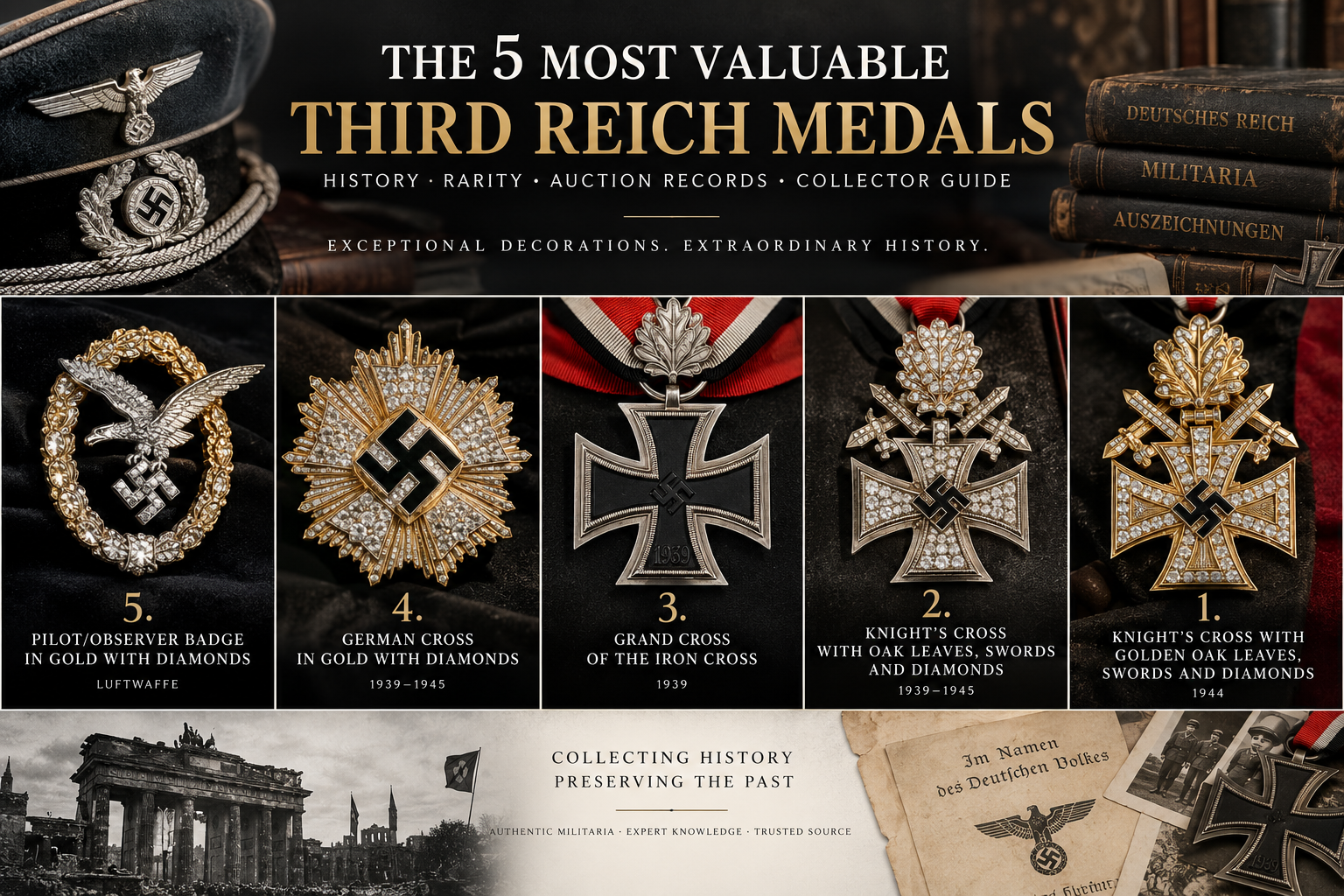
5. Combined Pilot and Observer Badge in Gold with Diamonds
One of the Rarest Luftwaffe Decorations
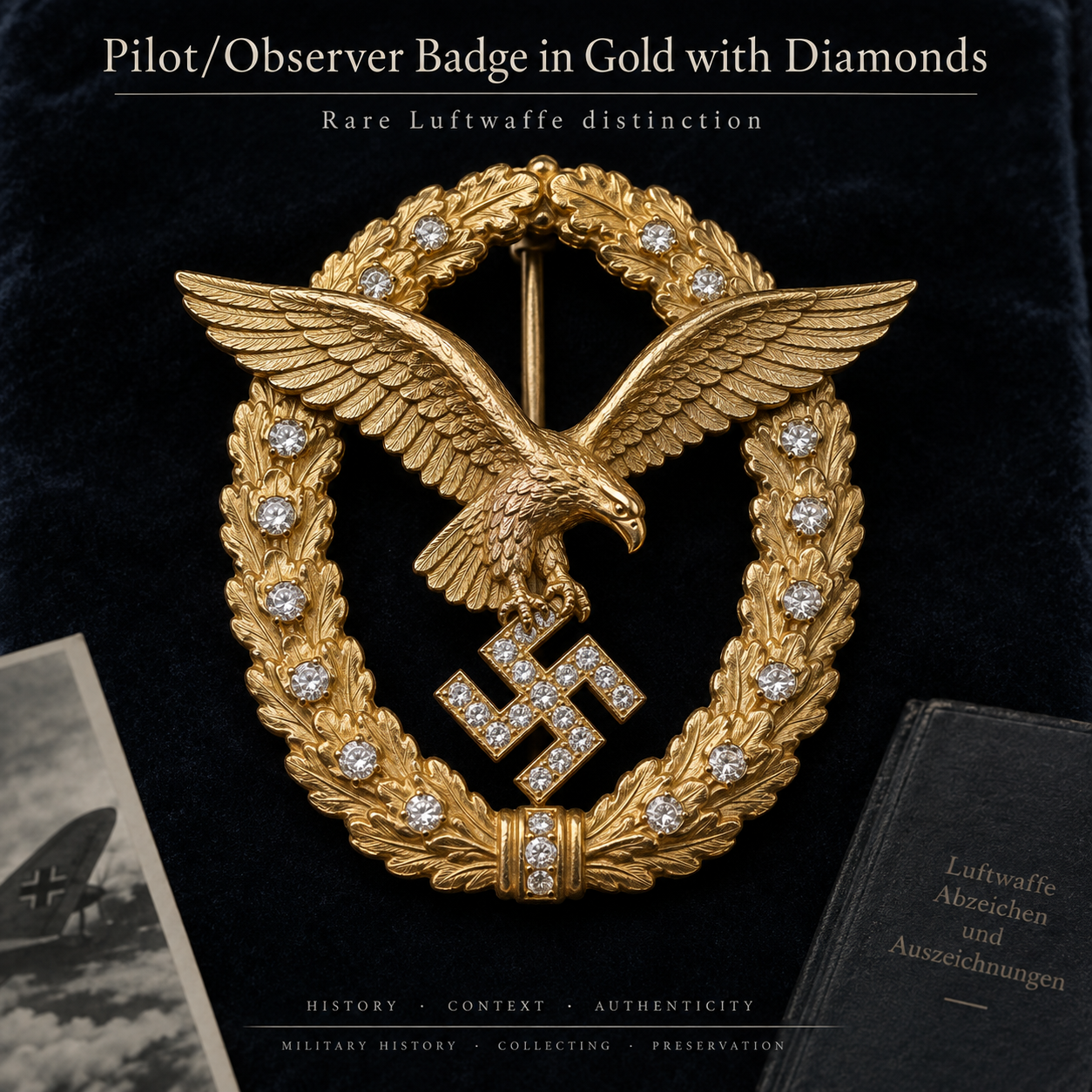
The Combined Pilot and Observer Badge in Gold with Diamonds, or Gemeinsames Flugzeugführer- und Beobachterabzeichen in Gold mit Brillanten, occupies an unusual place among the most valuable Third Reich medals and badges.
The standard Combined Pilot and Observer Badge was a Luftwaffe qualification badge.
The diamond version was something very different.
It became an exceptional personal distinction associated with Hermann Göring and was bestowed on a small number of senior Luftwaffe figures, outstanding aviators and, occasionally, individuals receiving an honorary presentation.
The first known recipients included Walther Wever and Erhard Milch on 11 November 1935.
Unlike an ordinary mass-produced qualification badge, diamond examples were elaborate jeweller-made objects.
Known pieces were manufactured using valuable materials such as gold, white gold or platinum and genuine diamonds.
A documented example associated with Generaloberst Bruno Loerzer was made with a 14-karat gold wreath and a white-gold eagle set with diamonds.
How Rare Is It?
The exact number remains debated because the award did not follow the same straightforward administrative system as many other decorations.
Modern specialist sources estimate roughly 30 to 60 presentations, although precise figures remain uncertain.
That uncertainty itself makes recipient provenance particularly important.
Collector Value
Real market evidence demonstrates why the badge belongs among the most valuable Third Reich medals.
A rare Pilot/Observer Badge in Gold with Diamonds sold in December 2013 for $42,500, against an estimate of $50,000–$70,000.
Other important attributed examples have appeared with values around or above €65,000, particularly when accompanied by original cases or significant provenance.
At this level, collectors are not simply purchasing a Luftwaffe badge.
They are purchasing an individually manufactured historical object whose identity may be inseparable from its original recipient.
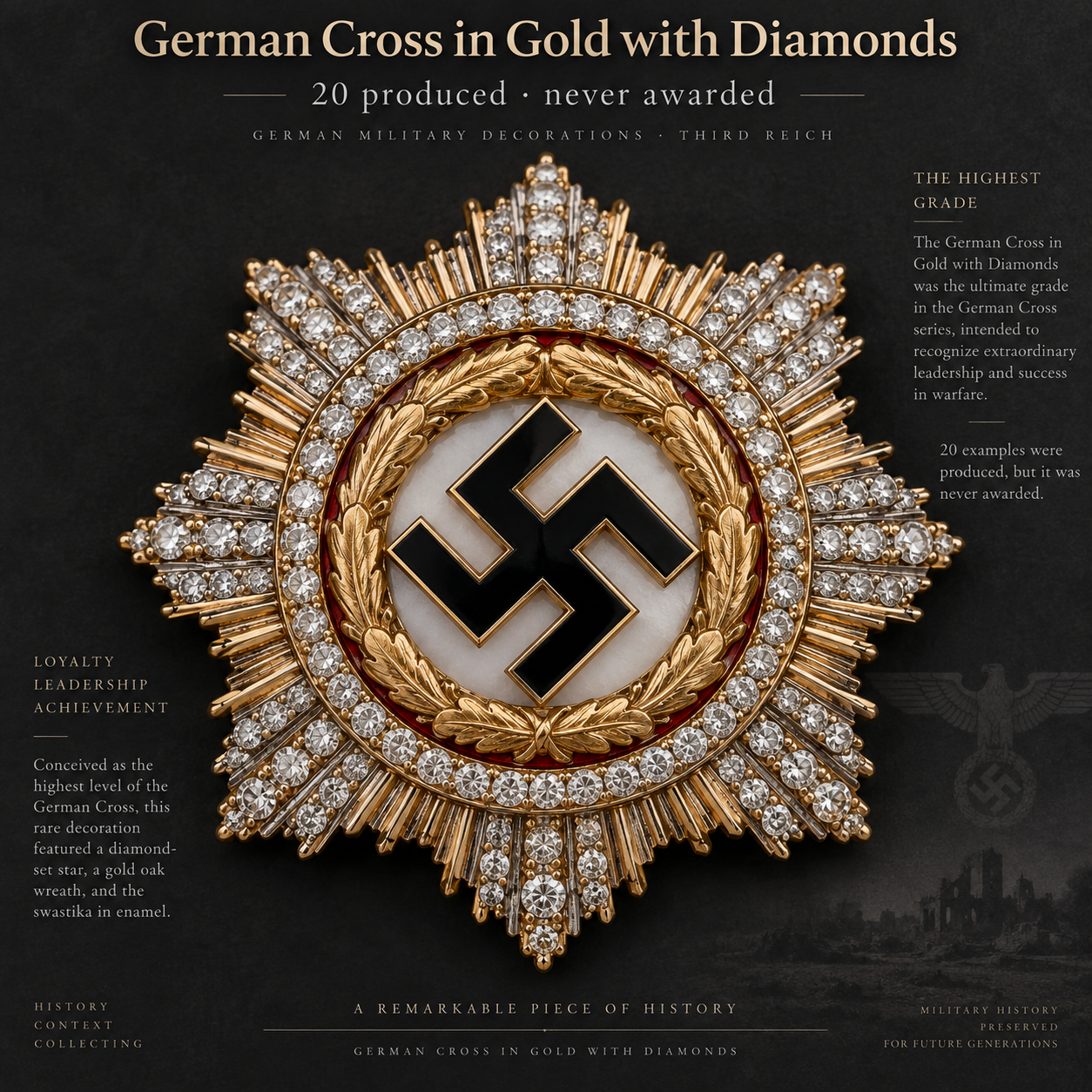
4. German Cross in Gold with Diamonds
A Decoration That Was Manufactured but Never Awarded
Few objects demonstrate the complexity of Third Reich phaleristics better than the German Cross in Gold with Diamonds.
The normal German Cross was instituted on 28 September 1941.
The Gold grade recognised repeated acts of bravery or exceptional military leadership, while the Silver grade related to distinguished non-combat war service.
A far more elaborate German Cross in Gold with Diamonds was subsequently developed.
What makes it extraordinary is that examples were actually manufactured—but the grade was never formally bestowed.
Twenty specimen pieces were produced in 1942.
This immediately places the decoration among the most valuable Third Reich medals, even though calling it an “awarded medal” would technically be incorrect.
Construction
Known originals are exceptionally elaborate.
One documented example is manufactured from silver with a gold laurel wreath set with approximately 105 diamonds and a black-enamelled central emblem.
The reverse carries the jeweller identification Rath München.
The twenty examples were reportedly delivered to the Presidential Chancellery in December 1942.
They remained unawarded.
At the end of the war, examples were among material associated with Schloss Klessheim near Salzburg. Several subsequently entered institutional and private collections.
Collector Value
An original German Cross in Gold with Diamonds reportedly sold at auction in Germany in 2006 for approximately €60,000.
The comparison with a normal German Cross in Gold is dramatic.
A genuine standard example may sell for several thousand euros depending on maker and condition; for example, Ratisbon’s recorded a light Otto Klein German Cross in Gold at €4,480 in June 2026.
The diamond version belongs to an entirely different category.
Its value derives from the combination of:
- only twenty manufactured examples;
- genuine precious materials;
- extremely low survival rate;
- unusual “never awarded” status;
- direct association with the highest level of the wartime decoration system.
3. Grand Cross of the Iron Cross 1939
A Grade Awarded Only Once
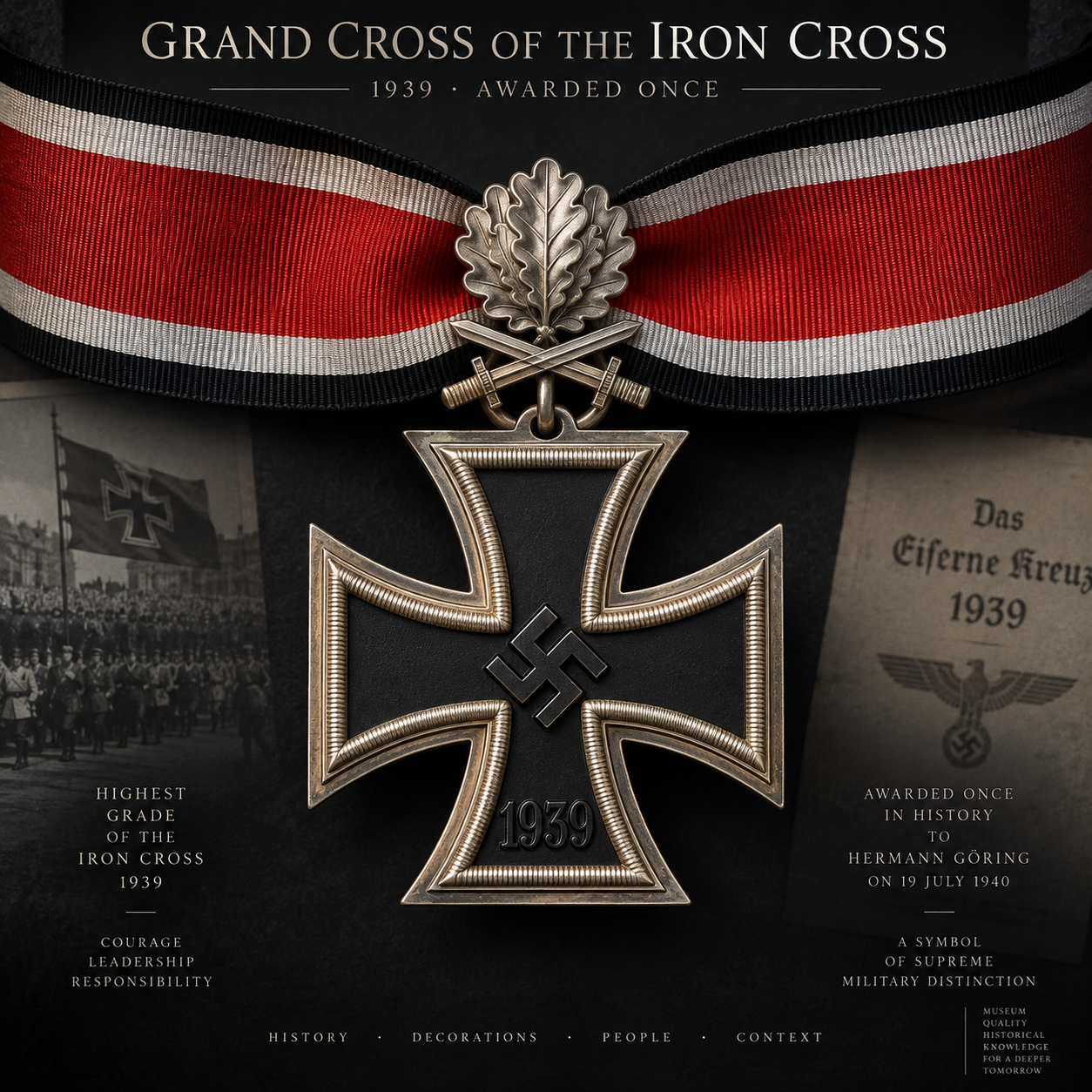
Few decorations can compete with the Grand Cross of the Iron Cross 1939 in terms of formal hierarchy.
The Grand Cross was established as the highest grade within the renewed 1939 Iron Cross system.
During the entire Second World War, it was awarded only once.
The recipient was Hermann Göring, who received the Grand Cross on 19 July 1940, at the same time that he was promoted to Reichsmarschall following the campaign in Western Europe.
That single award makes the Grand Cross one of the historically rarest of all most valuable Third Reich medals.
Appearance and Construction
The Grand Cross retained the visual language of the Iron Cross but was substantially larger and was worn around the neck on a wider ribbon.
Period examples were produced by C. E. Juncker of Berlin, with known pieces carrying silver hallmarks such as “800” and maker identification.
Although only one individual received the decoration, several period examples and presentation or reference pieces were produced.
This distinction is extremely important.
“One recipient” does not mean that only one physical Grand Cross was ever manufactured.
Göring’s Special Examples
Göring also possessed extraordinary privately manufactured variants.
Two Grand Crosses made with black onyx centres and platinum frames were presented in a silver casket associated with his fiftieth birthday in 1943.
A comparable earlier example had achieved a hammer price of €44,000, according to auction documentation.
Specialist market references place particularly rare Grand Cross variants at very substantial valuations, sometimes well into five figures or beyond.
For collectors, however, the key issue is determining exactly what type of Grand Cross is being examined:
- official period production;
- recipient-associated piece;
- manufacturer sample;
- presentation piece;
- later replacement;
- post-war reproduction.
This is an area where expert authentication is essential.
2. Knight’s Cross with Oak Leaves, Swords and Diamonds
Only 27 Recipients
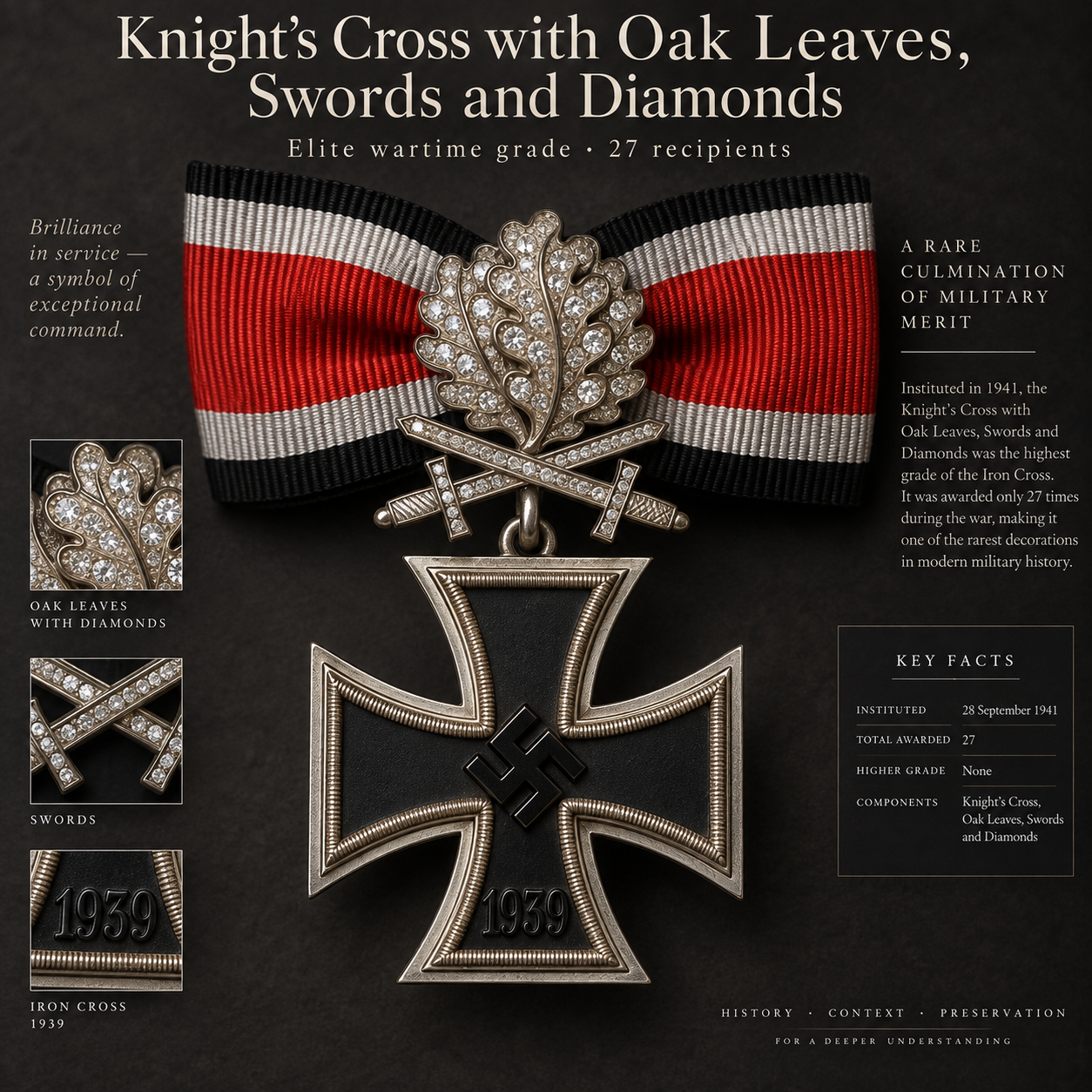
Among the most valuable Third Reich medals, very few combine rarity, famous recipients and documented auction values as dramatically as the Knight’s Cross of the Iron Cross with Oak Leaves, Swords and Diamonds.
The Diamonds grade was introduced in 1941 as the hierarchy of the Knight’s Cross expanded.
To reach this level, a serviceman had already progressed through preceding grades of the Knight’s Cross system.
Only 27 individuals received the Diamonds grade during the Second World War.
Recipients included figures from the Luftwaffe, Army, Kriegsmarine and Waffen-SS.
The group included fighter pilots, commanders, U-boat officers and field marshals.
From a collecting perspective, this produces something extremely important:
almost every genuine wartime Diamonds set has potentially identifiable provenance.
There simply were not enough recipients for anonymous examples to be treated casually.
Hermann Balck’s Diamonds: A €300,000 Auction Result
One of the clearest demonstrations of the value of elite German military decorations occurred at a Künker auction in November 2013.
An Oak Leaves with Swords and Diamonds set associated with General Hermann Balck carried an estimate of €150,000.
The hammer price reached:
€300,000.
That result is extremely important when discussing the most valuable Third Reich medals because it demonstrates the effect of documented recipient provenance.
The decoration itself was already exceptionally rare.
Association with a known Diamonds recipient transformed it into a major historical object.
Why Provenance Matters So Much
At this level of collecting, the phrase “looks original” is nowhere near sufficient.
The researcher wants to know:
- Who manufactured it?
- Was it an official presentation piece?
- Was it a wearer’s copy?
- Can it be connected to a documented recipient?
- When did it first appear after the war?
- Does the construction match accepted examples?
- Are the diamonds genuine or simulated?
- Is the case original to the set?
- Is documentary provenance available?
A mistake involving a €500 medal is unpleasant.
A mistake involving a supposed six-figure Diamonds set can be catastrophic.
1. Knight’s Cross with Golden Oak Leaves, Swords and Diamonds
The Rarest Awarded Grade
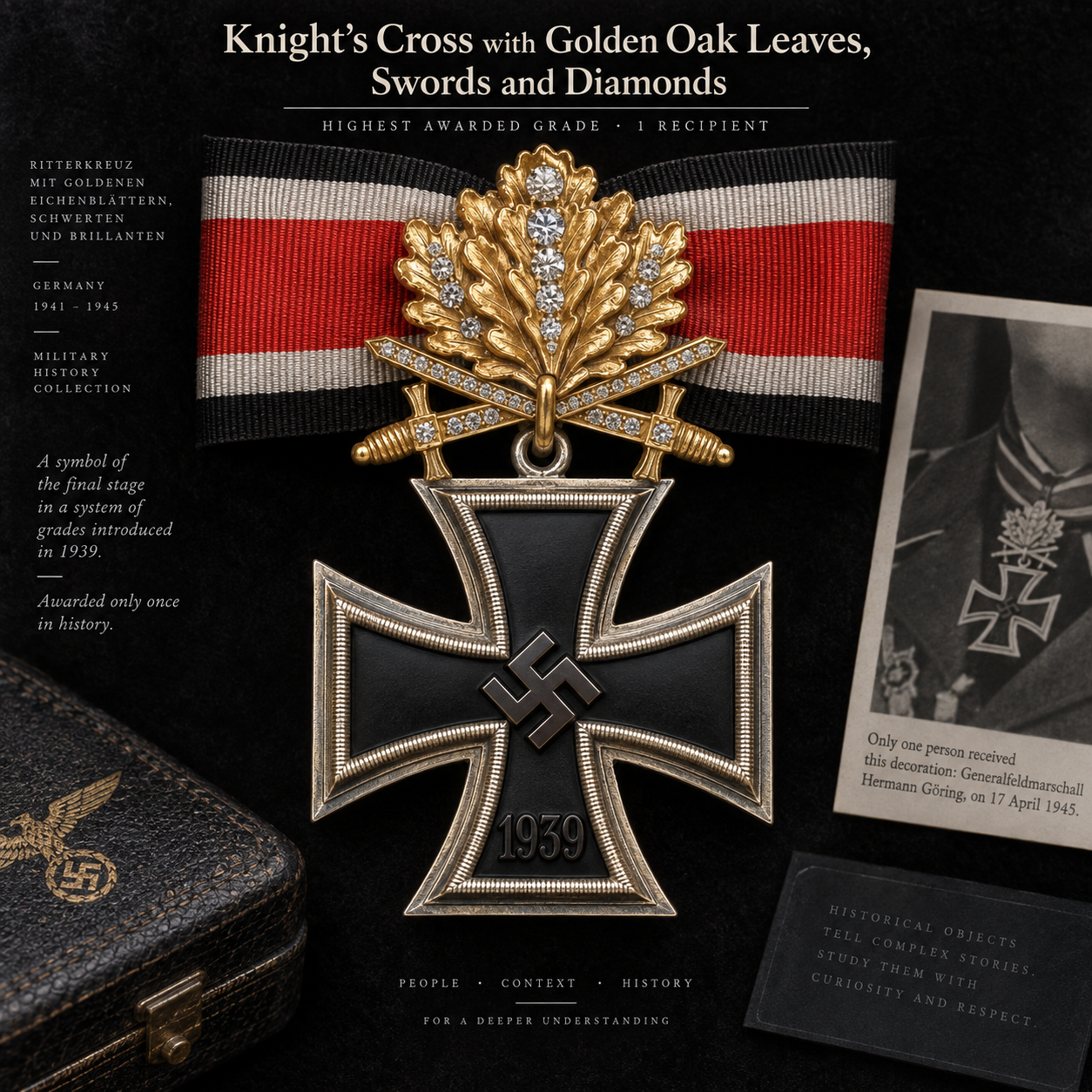
At the top of our list of the most valuable Third Reich medals is an award whose rarity is effectively unique:
The Knight’s Cross of the Iron Cross with Golden Oak Leaves, Swords and Diamonds.
The grade was formally created on 29 December 1944.
It was reportedly intended to be limited to twelve recipients.
Only one individual actually received it:
Hans-Ulrich Rudel.
Rudel received the award on 29 December 1944.
Whatever one’s interpretation of individual wartime careers, from a purely phaleristic perspective the result is extraordinary:
there was only one wartime recipient of the highest awarded grade in the Knight’s Cross hierarchy.
Why It Cannot Be Given a Normal Market Price
This presents a problem when writing about the most valuable Third Reich medals.
What is the value of an award that essentially has no normal market?
There is no meaningful price guide comparable to an Iron Cross or German Cross.
Post-war jeweller productions and replacement examples exist and have appeared at auction, but these must never be confused with Rudel’s wartime award.
For example, a post-war Klein-produced Golden Oak Leaves, Swords and Diamonds set sold through Ratisbon’s in April 2026 for several thousand euros. The auction house explicitly identified it as a 1950s production, not Rudel’s original wartime award.
That distinction is fundamental.
The unique awarded wartime decoration would possess a completely different historical status.
If unquestionably authenticated and legally offered with complete provenance, its theoretical value could not realistically be calculated from ordinary militaria price guides.
Its importance would be closer to that of a major museum object.
That is why it occupies first position.
Not because we can assign it a precise price, but because rarity has reached the point where conventional pricing stops being meaningful.
Honourable Mention: Spanish Cross in Gold with Swords and Diamonds
The Spanish Cross in Gold with Swords and Diamonds deserves special mention, particularly for collectors interested in the Spanish Civil War and the Condor Legion.
Instituted on 14 April 1939, the Spanish Cross recognised German participation in the conflict.
Its highest grade, Gold with Swords and Diamonds, was awarded only 28 times.
Recipients included prominent Luftwaffe figures who later became important during the Second World War.
Its connection with both German militaria and the Spanish Civil War gives it particular historical interest.
Documented examples have appeared with auction estimates or starting prices in the €15,000–€30,000 range, depending heavily on construction and provenance.
For a Spain-based militaria collection, this is arguably one of the most historically relevant elite decorations of the period.
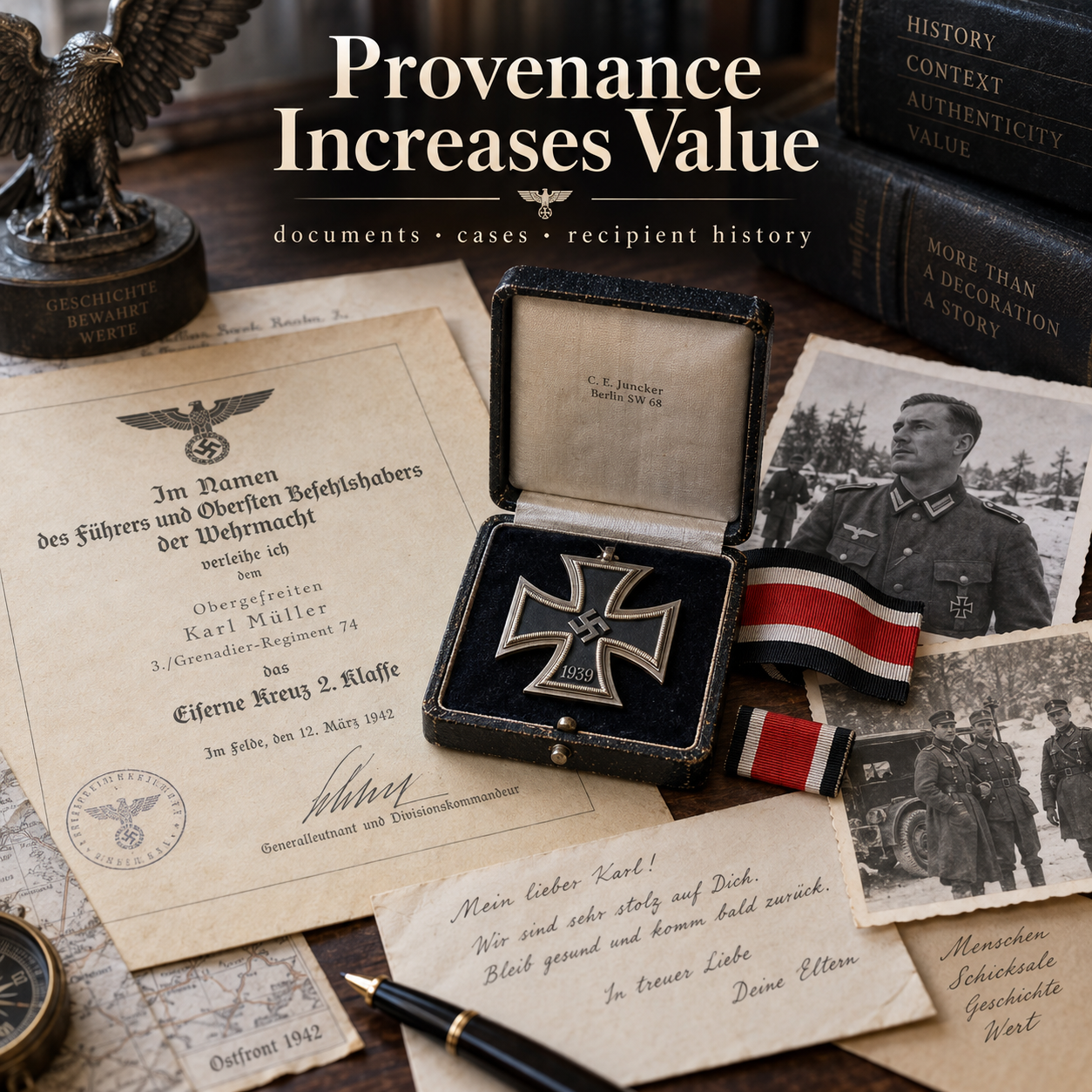
What Determines the Price of the Most Valuable Third Reich Medals?
1. Recipient Provenance
At the highest level, provenance can matter more than condition.
A documented award belonging to a known historical recipient is fundamentally different from an anonymous example.
2. Award Documents
Original award documents can greatly strengthen attribution.
Large formal Knight’s Cross documents can themselves be major collector pieces.
3. Original Presentation Case
For elite decorations, an original case is important.
However, collectors must verify that the case genuinely belongs to the decoration.
A correct-looking case added decades later does not create provenance.
4. Manufacturer and Construction
Research should include:
- dimensions;
- weight;
- hallmarks;
- rivets;
- suspension loops;
- pin systems;
- precious-metal marks;
- stone setting;
- tooling characteristics.
5. Wartime vs Post-War Production
This is particularly important with Knight’s Cross accessories.
Manufacturers continued producing replacements after 1945.
Some are extremely high-quality objects in their own right, but they are not wartime awards.
6. Historical Documentation
Photographs showing the recipient wearing the decoration, wartime correspondence, estate provenance and early post-war records can be extraordinarily valuable.
Most Valuable Third Reich Medals: Quick Comparison
| Decoration | Wartime Awards / Production | Collector Status | Documented Market Evidence |
|---|---|---|---|
| Golden Oak Leaves, Swords & Diamonds | 1 recipient | Effectively unique awarded grade | No meaningful normal market |
| Knight’s Cross with Oak Leaves, Swords & Diamonds | 27 recipients | Extreme rarity | Balck example: €300,000 hammer |
| Grand Cross of the Iron Cross 1939 | 1 recipient | Museum-level rarity | Period/special examples can reach major five-figure sums |
| German Cross in Gold with Diamonds | 20 manufactured, none awarded | Prototype-level rarity | Original reported at €60,000 |
| Pilot/Observer Badge in Gold with Diamonds | Exact total uncertain; very few | Extremely rare Luftwaffe award | $42,500 documented 2013 sale |
Frequently Asked Questions About the Most Valuable Third Reich Medals
What is the rarest Third Reich military decoration?
Among officially awarded wartime grades, the Knight’s Cross with Golden Oak Leaves, Swords and Diamonds is extraordinary because only one recipient received it.
What is the most expensive Third Reich medal ever sold?
There is no definitive universal record because major private transactions are not always public.
However, the documented €300,000 hammer price achieved by Hermann Balck’s Oak Leaves, Swords and Diamonds at Künker in 2013 demonstrates the extraordinary prices that recipient-attributed elite decorations can reach.
Was the Grand Cross of the Iron Cross awarded more than once?
No.
The 1939 Grand Cross was awarded only to Hermann Göring, on 19 July 1940.
Several physical examples existed, however, so “one recipient” should not be confused with “only one cross manufactured.”
Was the German Cross in Gold with Diamonds actually awarded?
No.
Twenty examples were manufactured, but the diamond grade was never formally bestowed.
Are all diamond decorations made with real diamonds?
No.
Different presentation and wear examples could use different materials, and post-war copies also exist.
Never assume authenticity simply because a decoration contains genuine precious stones.
Are the most valuable Third Reich medals commonly found for sale?
No.
The highest-level original decorations may remain in museums, institutional collections or long-established private collections for decades.
When exceptional examples do appear, provenance and specialist authentication become essential.
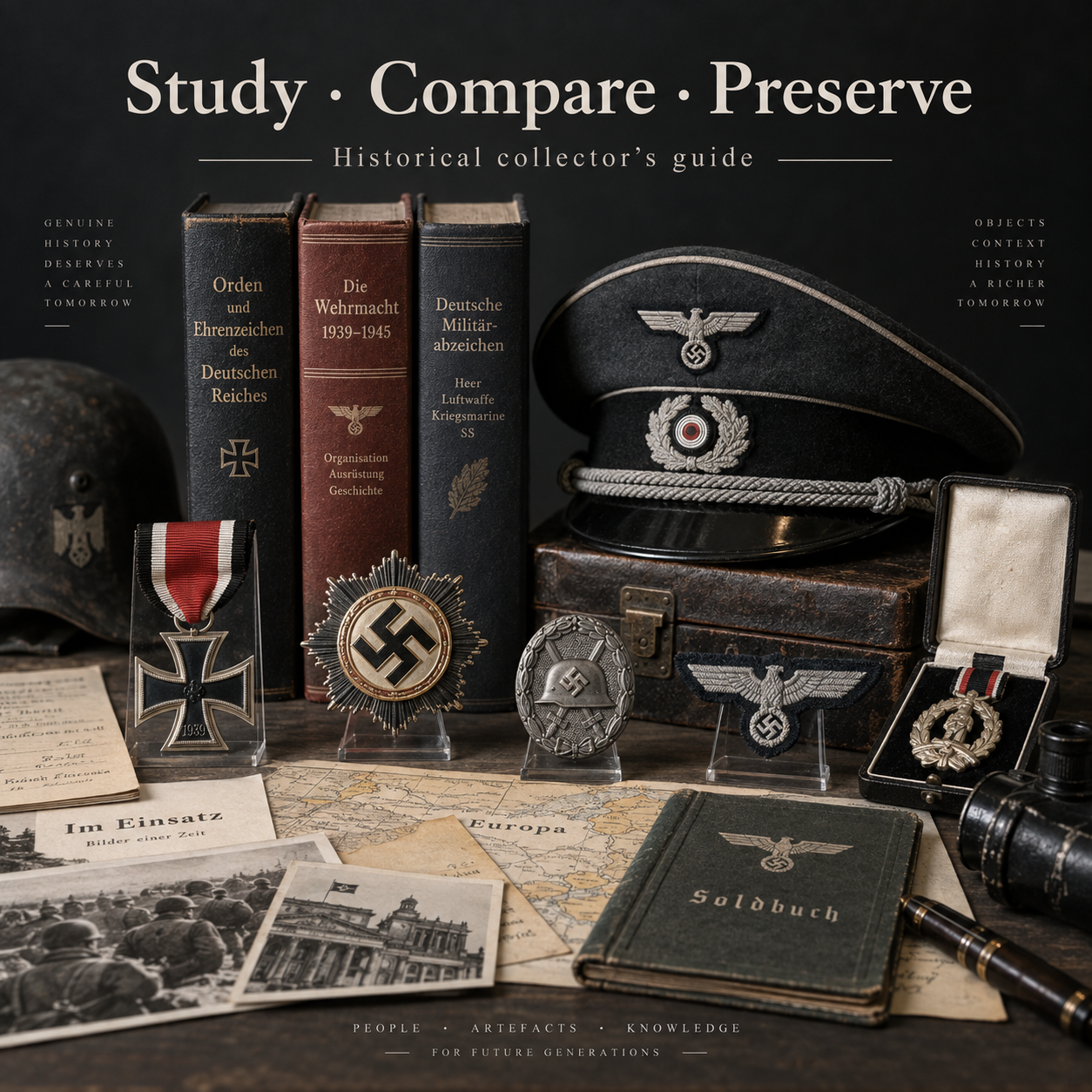
Conclusion
The most valuable Third Reich medals reveal just how complicated advanced militaria collecting can become.
At the lower end of the market, price can often be estimated by examining manufacturer, condition and comparable sales.
At the highest level, those rules begin to change.
A decoration with twenty-eight recipients is already exceptionally rare.
A decoration with twenty-seven recipients belongs to an even more restricted historical group.
A decoration produced in only twenty specimens enters prototype territory.
And an award presented to one single individual ceases to behave like a normal collectible altogether.
This is why the most valuable German decorations of the 1933–1945 period cannot be understood through price alone.
Their true collector significance lies in the intersection of:
rarity, provenance, recipient history, construction, documentation and historical context.
For serious collectors, the lesson is simple:
Never buy the story first and examine the object second.
Study the construction. Research the manufacturer. Verify the provenance. Compare documented originals. Examine every piece of supporting evidence.
At the highest level of militaria collecting, documentation is not an accessory to the object.
It is part of the object.
Services & Expertise
Positive Reviews
Authenticity Focused

Document Authentication & Certification
Certificates issued for collector and archival purposes

Graphology & Signature Analysis
Independent professional service
Related posts
Popular products
-
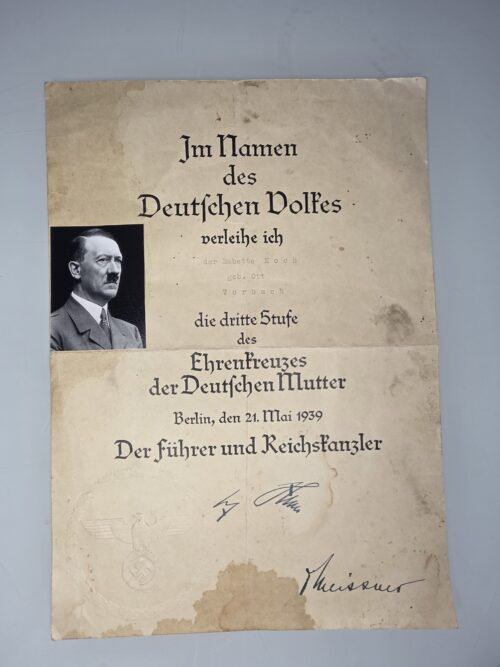 1939 German Mother’s Cross Award Document – Adolf Hitler Facsimile Signature
640,00 €
1939 German Mother’s Cross Award Document – Adolf Hitler Facsimile Signature
640,00 €
-
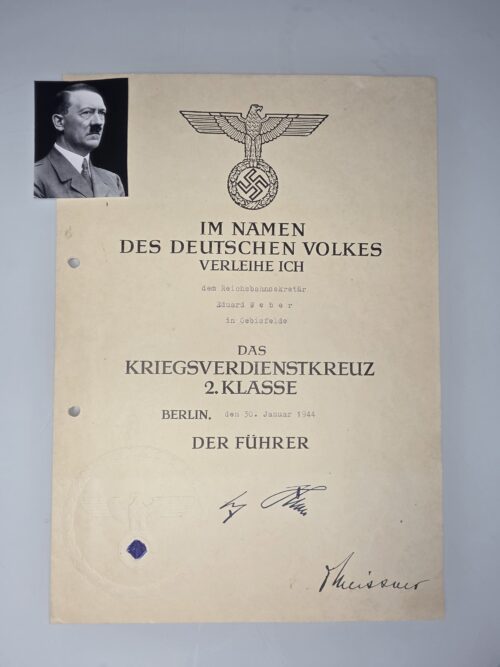 Original WWII German War Merit Cross Document 1944 – Adolf Hitler Facsimile Signature
640,00 €
Original WWII German War Merit Cross Document 1944 – Adolf Hitler Facsimile Signature
640,00 €
-
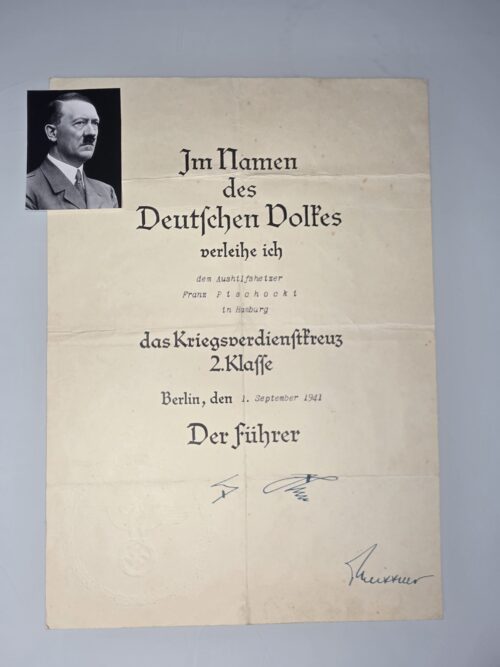 Original WWII German War Merit Cross Award Document 1941 – Adolf Hitler Facsimile Signature
590,00 €
Original WWII German War Merit Cross Award Document 1941 – Adolf Hitler Facsimile Signature
590,00 €
-
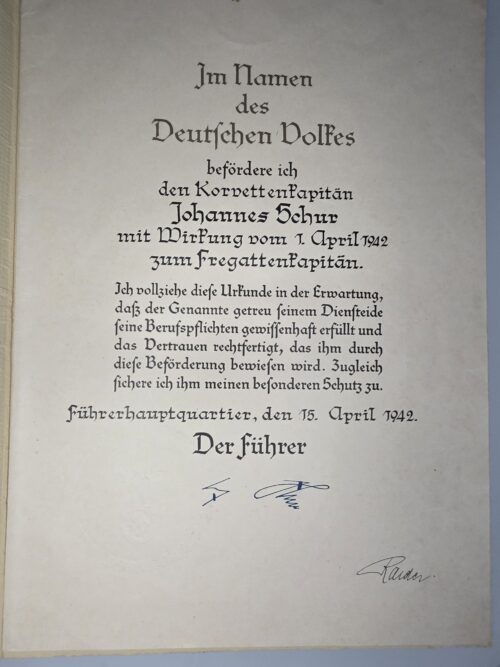 Original WWII Kriegsmarine Johannes Schur Promotion Document Erich Raeder Signed 1942
749,00 €
Original WWII Kriegsmarine Johannes Schur Promotion Document Erich Raeder Signed 1942
749,00 €