Post-War Letters of Third Reich Figures: Why 1945–1975 Autographs Matter to Collectors
The Second World War ended in Europe in May 1945, but the documents did not stop. Former politicians kept writing letters, commanders corresponded with their families, convicted war criminals published memoirs, and men who had served the Nazi regime wrote to journalists, historians and old associates.
For collectors this created an important and often overlooked category: post-war autograph letters written by people whose lives had been shaped by Nazi Germany and the war. They sit in an unusual position. They belong to the years after the dictatorship, yet their authors often discuss the people, institutions and events of the period before. A letter from 1957 can show political attitudes in the Cold War; one from 1969 can reveal how a former minister presented his past; a signed typescript from 1972 can show someone revising his own account of events.
The historical interest lies not simply in the signature but in the circumstances of the document and in the tension between personal testimony and established historical evidence. As a collector and forensic handwriting examiner, I also find that these letters raise their own questions of authentication and provenance. This article explores them through four documents connected with our collection: letters and papers of Franz von Papen, Albert Speer, Otto Skorzeny and Albert Kesselring.
Why collect post-war autograph letters?
A post-war letter can preserve statements by someone who took part in major events; contain biographical detail absent from official records; connect with identifiable recipients, addresses and dates that can be researched; and document how a historical figure chose to present his own past.
That last point matters most. A post-war letter is not an impartial account. The writer may be defending earlier decisions, answering critics, seeking rehabilitation or building a more favourable image, and those biases are themselves worth studying. The aim is not to accept the contents uncritically, but to understand what the person wrote, when, to whom and why.
Why is 1945 such an important turning point?
The collapse of Nazi Germany changed the circumstances in which its surviving political and military figures communicated. Many lost their positions; some were imprisoned; others faced investigation, denazification or war crimes trials. The International Military Tribunal at Nuremberg created the central legal framework for judging leading figures of the regime (USHMM: International Military Tribunal at Nuremberg), but their post-war paths diverged sharply. Papen was acquitted at Nuremberg; Speer was convicted; Kesselring was tried separately by a British military court; Skorzeny eventually settled in Spain.
Those different paths are reflected in the documents that survive. A prison letter records very different circumstances from a business letter, and an author’s corrections to his memoirs belong to a different category from a signed greeting card.
Are post-war signatures easier to authenticate?
Not necessarily. It is tempting to think post-war letters are safer because their paper, pens and addresses are more familiar. They are not: a post-war signature can still be forged, signed by a secretary, reproduced as a facsimile or added to an authentic document later.
Some post-war examples do offer research advantages: an address that shows where the writer lived, an envelope with postal evidence, a traceable correspondent, informative letterhead, or a series of dated letters that allows comparison across a short period. None of this proves authorship, but it can supply supporting evidence that an isolated wartime signature lacks. The examination principles stay the same: reliable comparison material, good images or the original, and an understanding of natural variation. For the warning signs to watch for, see How Historical Signatures Are Forged.
What makes a post-war letter historically valuable?
Distinguish the autograph from the information the document carries. Imagine two genuine letters signed by the same man: one thanks a correspondent for birthday wishes; the other discusses a major political event or his own earlier actions. Same name, very different research potential. A letter with identifiable references can be checked against newspapers, memoirs, government records and other correspondence. It shows what the writer believed or wanted others to remember, which is not the same as proving his statements true. Historical significance and historical reliability are not interchangeable.
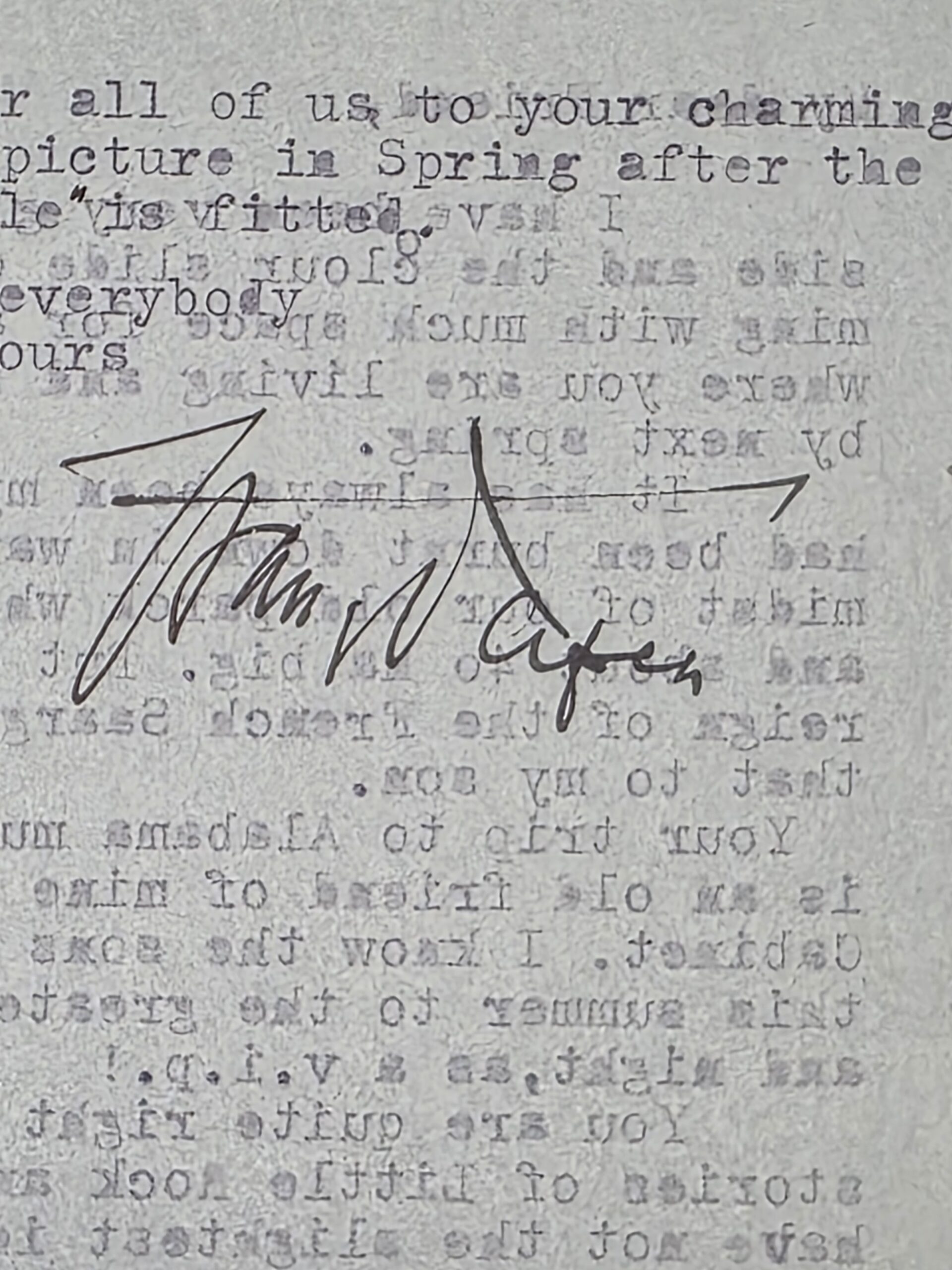
DOC196: the ink signature “Franz v. Papen” at the foot of his typed letter of 6 October 1957.
What does Franz von Papen’s 1957 letter reveal?
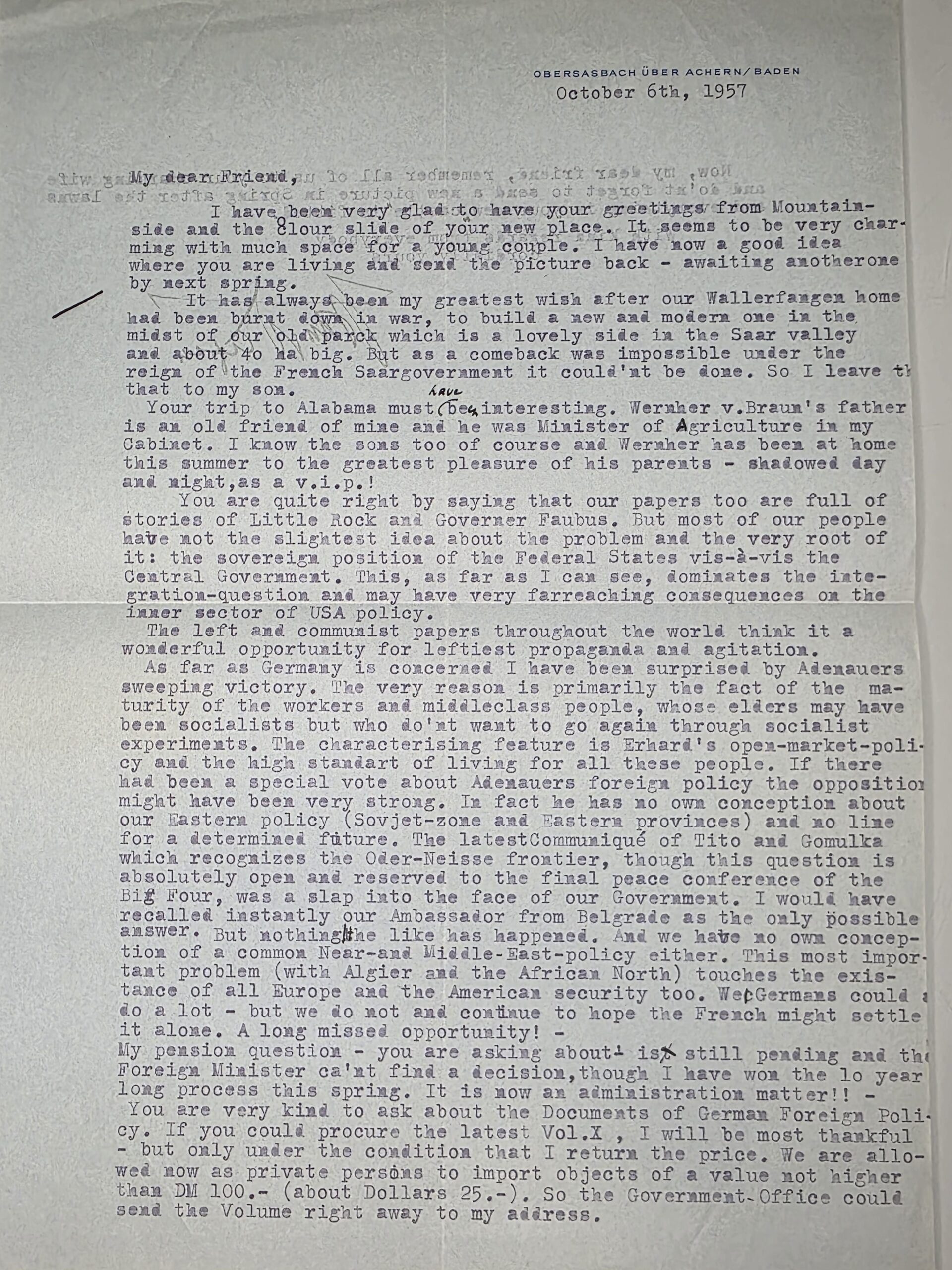
From the collection: DOC196, typed letter signed, Obersasbach, 6 October 1957
DOC196 is a typed letter in English, written over both sides of a single sheet and signed in ink “Franz v. Papen”. Headed Obersasbach über Achern, Baden, it was written to a friend abroad a few weeks after the West German federal election of September 1957. In it, the former chancellor comments on Adenauer’s victory, Erhard’s economic policy, the communiqué in which Tito and Gomułka recognised the Oder–Neisse frontier, the Little Rock crisis in the United States, and the father of Wernher von Braun, Magnus von Braun, who had been Minister of Agriculture in Papen’s own cabinet of 1932.
That range of references makes it far more than an isolated autograph. Papen calls the Tito–Gomułka communiqué a slap in the face for the Federal Government and says he would have recalled the German ambassador from Belgrade at once. Thirteen days later, on 19 October 1957, Bonn did break off relations with Yugoslavia. The letter belongs not to the politics of 1933 but to the world of 1957, and it lets us watch a man of the Weimar and Nazi years reading the Cold War.
Who was Franz von Papen?
Papen was Reich Chancellor in 1932 and Vice-Chancellor in Hitler’s first government, later envoy to Austria and ambassador to Turkey. He was acquitted of all charges at Nuremberg; in 1949 a German denazification court sentenced him to a labour camp, but he was released following appeals (USHMM: Franz von Papen). He spent his last years at Obersasbach, where this letter was written. See also our encyclopaedia entry on Franz von Papen.
Collector’s Note – verifiable references make richer evidence: Letters containing several checkable historical references are especially useful to me: the date, place and events can be tested against the historical record independently of the signature. That does not authenticate the handwriting, but it creates a far richer body of evidence than an isolated autograph on a blank card.

DOC15: Speer’s typed letter on his post-war Heidelberg letterhead, signed in blue ink, 9 October 1969.
Why is Albert Speer’s 1969 letter so interesting?
From the collection: DOC15, typed letter signed, Heidelberg, 9 October 1969
DOC15 is a typed letter in German on Speer’s post-war letterhead as an architect in Heidelberg, signed by hand in blue ink. In it, Speer gives his opinion on a handwriting sample connected with Adolf Hitler and mentions sending a copy of his memoirs, Erinnerungen, at 25 Deutsche Mark. It therefore combines an original autograph with comments on another historical signature and with the launch of his own published account of the Nazi years.
Who was Albert Speer?
Hitler’s architect, Speer became Minister of Armaments and Munitions in 1942 and used millions of forced labourers to raise production. At Nuremberg he was convicted of war crimes and crimes against humanity, sentenced to twenty years and released in 1966 (USHMM: Albert Speer). His memoirs appeared in 1969, the year of this letter. A statement Speer made in 1969 cannot be read as neutral testimony: his public account of his own responsibility has been critically reassessed by historians, and his correspondence shows what he wished to say at the time, not what he actually did. See also Albert Speer in our encyclopaedia, and his signature studied in Firma de Albert Speer (in Spanish).
A letter about Hitler’s handwriting
For an autograph collector there is an extra dimension: a former member of Hitler’s inner circle commenting on a Hitler handwriting sample. One distinction must be kept, though. Speer’s opinion is not a forensic authentication. Recognising a signature informally, even one you saw often, is a different activity from a technical handwriting examination. DOC15 is valuable because it records Speer’s response, not because that response settles anything.
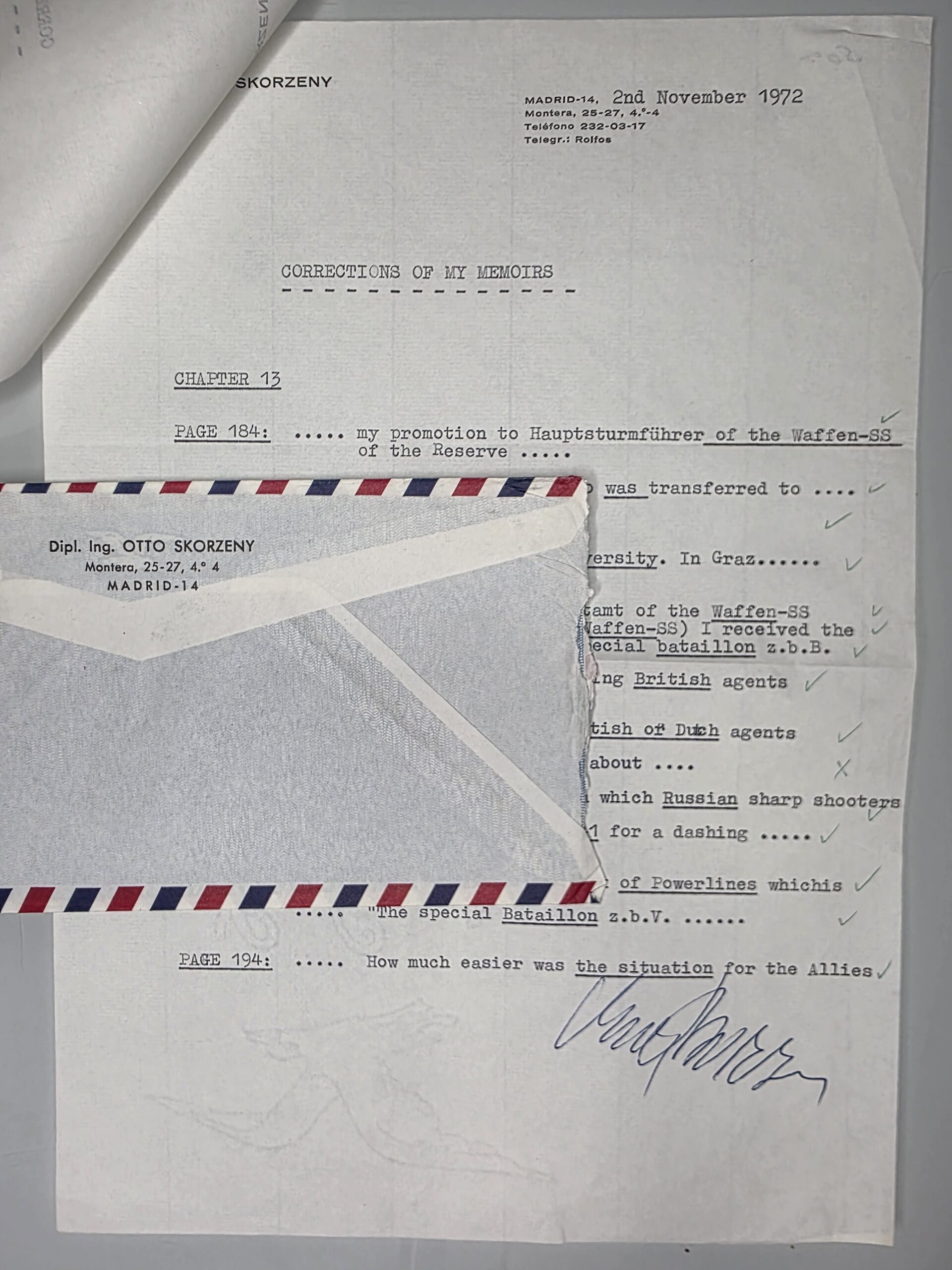
DOC166: a page of “Corrections of my Memoirs”, Madrid, 2 November 1972, signed in blue ink.
What do Otto Skorzeny’s 1972 memoir corrections show?
From the collection: DOC166, signed typescript, Madrid, 2 November 1972
DOC166 is not an ordinary letter. It is a three-page typescript headed “CORRECTIONS OF MY MEMOIRS”, dated 2 November 1972 on Skorzeny’s personal Madrid letterhead, with dozens of amendments keyed to chapters and pages of his wartime memoirs. They touch on the Waffen-SS, the Abwehr, the RSHA, Walter Schellenberg and episodes of his own career. The last page is signed in blue ink, and the original mailing envelope survives.
Who was Otto Skorzeny?
An Austrian-born Waffen-SS officer associated with German special operations, Skorzeny became widely known for his part in the September 1943 Gran Sasso operation that freed Mussolini. After the war he settled in Spain. Madrid had by then become a meeting point and base for exiled fascists and far-right activists from across Europe, as Pablo del Hierro shows in “The Neofascist Network and Madrid, 1945–1953” (Contemporary European History). See also Otto Skorzeny in our encyclopaedia.
Why are memoir corrections interesting?
A memoir is not an archival record but a narrative its author constructs: he chooses what to include, what to stress and how to describe people and organisations. Corrections show that process at work. They should not be assumed to improve accuracy; revisions can equally reflect an effort to control how the past is remembered, so the document must be read critically against independent evidence.
Is DOC166 a letter?
Strictly, no: it is a signed typescript of memoir corrections. Precise terminology matters, and every signed paper should not be filed as a “letter”. Our guide to cataloguing a historical collection explains why document types should be distinguished.

DOC146 (archive): Kesselring’s handwritten letter of 3 July 1952, written months before his release.
What makes Albert Kesselring’s 1952 prison letter different?
From the archive: DOC146, autograph letter signed, 3 July 1952
The fourth example, now sold and kept in our archive, is a handwritten letter from Albert Kesselring to his wife Liny, dated 3 July 1952 and written during his imprisonment. Unlike the Papen and Speer letters, it is an autograph letter signed: both the text and the signature are in his own hand, written in blue ink on both sides of a single leaf. Interestingly, and as I noted in our guide to the Sütterlin alphabet, it is written predominantly in a rapid Latin-based cursive rather than the Kurrent one might expect from a man born in 1885.
What was Kesselring’s situation in 1952?
Kesselring, the field marshal who commanded German forces in Italy, was tried for war crimes in 1947 and later pardoned and released from prison in 1952 (NS-Täter in Italien: Albert Kesselring); the release came in October that year. The letter was written only months before. See also Albert Kesselring in our encyclopaedia.
Why does a prison letter deserve special reading?
Prison correspondence is shaped by restrictions, institutional conditions and the writer’s situation, and a letter to a spouse has an intimacy far removed from official papers. For handwriting research, continuous writing also offers much more than an isolated signature: letter construction, spacing and rhythm can all be compared. Yet a personal letter is still an act of communication, not a transparent window into the writer’s mind. He chooses what to reveal.
How do the four documents compare?
| Reference | Writer | Date | Document type | Main research interest |
|---|---|---|---|---|
| DOC196 | Franz von Papen | 6 October 1957 | Typed letter signed (English) | Cold War politics, Oder–Neisse, Adenauer |
| DOC15 | Albert Speer | 9 October 1969 | Typed letter signed (German) | Comment on a Hitler handwriting sample; memoirs |
| DOC166 | Otto Skorzeny | 2 November 1972 | Signed typescript of memoir corrections | Revision of his own wartime narrative |
| DOC146 (archive) | Albert Kesselring | 3 July 1952 | Autograph letter signed (German) | Personal letter from prison before release |
Post-war material is not a single collecting category. The autograph matters in every case, but it is never the only reason to preserve the document.
Can post-war letters help identify genuine signatures?
Sometimes. Several securely documented signatures from a short period can show how a person signed at that time. But a signature from 1972 is not an ideal comparison for one from 1938: age, health, habits, instruments and conditions all change. That is why choosing comparison material is fundamental to handwriting examination, and why date, format and writing conditions must always be weighed. For how much a genuine signature can vary, see natural variation in signatures (in Spanish).
Why are letterhead, envelopes and related papers worth preserving?
Letterhead gives information independent of the signature: an address, an occupation, a period in the writer’s life. Speer’s Heidelberg letterhead and Skorzeny’s Madrid letterhead help place their documents. They support consistency but prove nothing on their own, since letterhead can be kept, reused or reproduced.
Envelopes add further evidence: postmarks date the letter’s entry into the post, addresses identify recipients, and filing marks or later notes help reconstruct how a letter was kept. A group of related letters is often far more informative than isolated signed pages. The relationship between documents is part of their history. For practical advice, see How to Preserve Autographs: 9 Keys to Protecting Them.
Does historical importance automatically increase value?
No. A famous name is not a price. Value depends on the specific object: date, subject, recipient, condition, provenance and format. A wartime document tied to an important event may matter more than a routine post-war reply; a post-war letter discussing a major question may say more than a wartime form with little personal content. An autograph letter signed contains more of the writer’s hand than a typed letter signed, but a typed letter with exceptional content can still be the more desirable research object. Read the letter before deciding what makes it interesting. Our Autograph Value Guide explains the factors.
Can post-war correspondence mislead as historical evidence?
Absolutely, and this is the main reason to read it critically. Former officials and officers had strong personal interests in how their wartime actions were remembered: some faced prosecution, others wanted to defend past decisions or rebuild reputations. Memoirs and private letters may contain selective memory, omissions and self-justification. A misleading statement is still evidence of what the writer wanted others to believe, but it can never replace independent research against archives, contemporary sources and scholarship. Speer is the clearest case: his account of his own responsibility must be read against the documented record of his ministry’s use of forced labour.
How should a post-war autograph letter be catalogued?
For significant post-war correspondence, I record:
- the writer’s full name, and the date and place;
- the recipient, where known;
- whether the document is handwritten or typed, and the nature of the signature;
- a factual summary of the contents;
- any envelope or associated material;
- provenance, condition and reliable historical references.
I keep the original wording wherever possible and keep research notes separate. If a letter contradicts the historical record, the contradiction is noted, not silently corrected. That preserves the document as a primary source.
Frequently Asked Questions
What are post-war autograph letters?
Letters written after the war and signed by their author. Here the term refers to correspondence of 1945–1975 by figures active during the Nazi period.
Are post-war signatures more reliable than wartime ones?
Not automatically. Some are easier to research because they preserve addresses, envelopes or other context, but every signature must be examined on its own merits.
What does ALS mean?
Autograph Letter Signed: a letter written entirely by hand and signed by its author.
What does TLS mean?
Typed Letter Signed: the text is typed and the signature is handwritten by the signatory.
Why is Albert Speer’s 1969 letter historically interesting?
It combines his handwritten signature with his opinion on a handwriting sample connected with Hitler and a reference to his memoirs, published that same year.
Is Otto Skorzeny’s 1972 document a letter?
No. It is best described as a signed typescript of corrections to his memoirs, a document with a different purpose from ordinary correspondence.
Can a prison letter be valuable to researchers?
Yes. It can preserve personal handwriting, dates, relationships and the writer’s circumstances, although its claims must still be read critically.
Does collecting letters by former Nazi officials imply support for them?
No. Historical documents can be preserved and studied as evidence without endorsing their authors, provided they are presented with accurate context and acknowledgement of what those individuals did.
Final Thoughts
The historical life of an autograph does not end when the events that made its writer famous are over. The decades afterwards can be just as revealing. A post-war letter can preserve a man’s attempts to explain, defend or reinterpret his past; it can show how politics changed around him, and record new relationships, publications and careers.
For the collector, such a document offers two separate kinds of evidence: the signature, which bears on authorship, and the text, which shows what the writer chose to communicate at a particular moment. Neither should be confused with the other. That is why I believe this category deserves more attention in serious autograph collecting. The best examples reward careful reading, patient research and accurate attribution. If you want to test any signature before buying, begin with the seven warning signs of forged autographs.
Original objects, real stories.
Historical Responsibility Notice
Autographs & Militaria preserves original historical material exclusively for documentation, collecting, preservation, education and research. Several individuals discussed here served or were associated with Nazi Germany, a dictatorship responsible for wars of aggression, persecution and genocide. Their signatures and correspondence are examined strictly as historical evidence; preservation or research does not imply admiration, sympathy or endorsement of National Socialism or of their actions. See also Collecting WWII and Third Reich Material Responsibly.
References & Further Reading
- United States Holocaust Memorial Museum, Holocaust Encyclopedia: “International Military Tribunal at Nuremberg”; “Franz von Papen”; “Albert Speer”.
- Carlo Gentile, NS-Täter in Italien: “Albert Kesselring”.
- Pablo del Hierro: “The Neofascist Network and Madrid, 1945–1953: From City of Refuge to Transnational Hub and Centre of Operations”, Contemporary European History 31, 2 (2022), 171–194.
- Autographs & Militaria: How Historical Signatures Are Forged; German Document Signatures.
- Juan García Nicolás: “How to Preserve Autographs”.
About the Author: Juan García Nicolás
Juan García Nicolás is a historical collectibles researcher, qualified graphologist and forensic handwriting examiner, and the editor of Autographs & Militaria. His work focuses on historical autographs, original documents, provenance, handwriting comparison and the responsible interpretation of twentieth-century historical material. He issues certificates of authenticity and forensic handwriting reports through VS Certificate of Authenticity, and writes on graphology and historical signatures at Aprende Grafología and Análisis Grafológico Online (both in Spanish).
Joachim von Ribbentrop Signed New Year Card 1936
Original price was: 1.200,00 €.1.090,00 €Current price is: 1.090,00 €.
Collector’s OfferHitler Facsimile Signature Golden Wedding Certificate – Original 1938 Document
Original price was: 600,00 €.499,00 €Current price is: 499,00 €.
Collector’s OfferGoebbels Facsimile Signature Winter Relief Fund Certificate 1936-37
Original price was: 150,00 €.120,00 €Current price is: 120,00 €.
Collector’s OfferHermann Göring Signed Photograph – Original WWII Historical Autograph
Original price was: 600,00 €.500,00 €Current price is: 500,00 €.
Collector’s Offer


About the Author: Juan García Nicolás

Authentication & certification
Have a signature or document you want examined? Independent analysis by a qualified graphologist and forensic handwriting examiner.
Research tools
What is my autograph worth?
Signed or facsimile?
Which German document do I have?
All Journal articles
From the collection
Original German Historical Document Lot 1935–1958 – DAF, Reichsbahn, Karlsruhe Banking & DDR
Original price was: 300,00 €.250,00 €Current price is: 250,00 €.
Collector’s OfferOriginal WWII German Wehrpass Archive – Walter Schirmer, Friedrichshafen Teacher, 1927–1944
Original price was: 300,00 €.240,00 €Current price is: 240,00 €.
Collector’s OfferGerman Youth Propaganda Magazines 1935–1941 – HJ, Der Pimpf, Junge Welt & Hilf mit! Collection
Original price was: 250,00 €.175,00 €Current price is: 175,00 €.
Collector’s Offer