How Historical Signatures Are Forged: 7 Warning Signs Every Autograph Collector Should Know
An old signature can look remarkably convincing. The paper shows natural toning, the ink seems right for the period, and the name belongs to a famous politician, commander or writer. Yet none of that proves the person actually signed the document.
Forged autographs are difficult precisely because a successful imitation rarely looks crude. Some reproduce the general appearance of a genuine signature well enough to convince an experienced collector at first sight. Others are not handwritten imitations at all: a printed facsimile sold as an autograph, a genuine document with a signature added later, or a secretary’s signature passed off as the principal’s.
As a collector and forensic handwriting examiner, I start from a simple principle: a signature is physical evidence, not just an attractive historical name. A signature may look right and still be wrong, and a genuine one may look odd because of age, illness, haste or natural variation. The real challenge is telling evidence of forgery apart from the ordinary differences of human handwriting.
This guide explains the main types of historical autograph forgery and seven warning signs that should make a collector look more closely. It does not replace a forensic examination; it helps you recognise when one is needed.
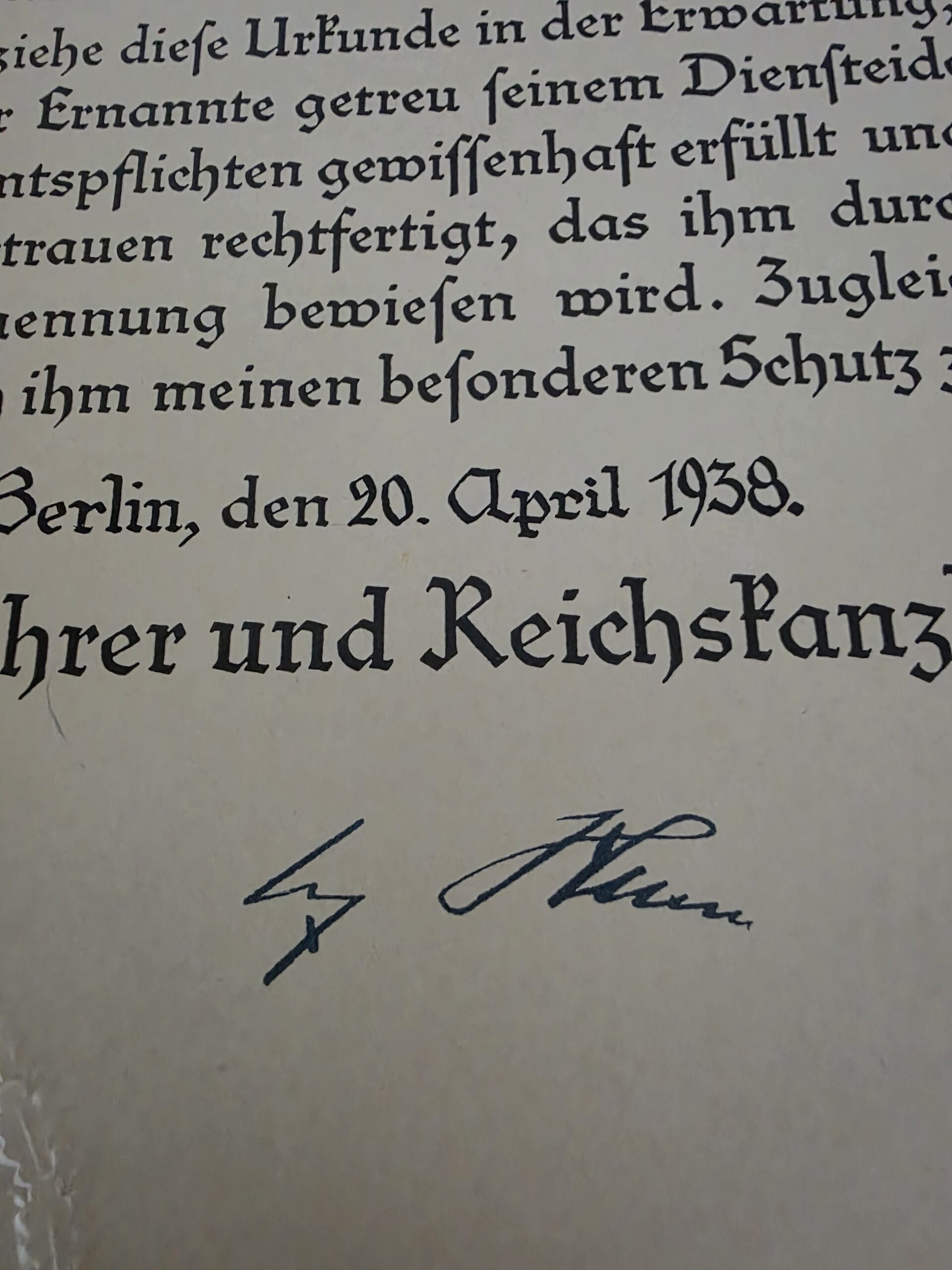
DOC111, 1938: a legitimate printed Hitler facsimile. Genuine as part of the document; sold as a “Hitler autograph”, it becomes a misdescription.
What is a forged autograph?
A forged autograph is a signature falsely presented as written by a particular person. In historical collecting the term covers an unauthorised imitation, but also any other mark deceptively presented as that person’s own handwriting.
The definition matters because not every reproduced or delegated signature is fraudulent. A document legitimately issued with a printed facsimile can be entirely authentic; a letter signed by a secretary may have left the named person’s real office. The problem arises when an object is described as something it is not: a facsimile sold as a handwritten signature, or a secretarial signature attributed to the principal.
Forensic handwriting examination addresses authorship by comparing writing evidence. It is a different discipline from graphology, which interprets personality, a distinction the European Network of Forensic Science Institutes (ENFSI) makes explicit in its Best Practice Manual for the Forensic Examination of Handwriting.
How are historical signatures forged?
There is no single method. For collectors, five categories of forged autographs matter most.
Traced signatures
A tracing is copied stroke by stroke from an existing model. It can match the design of a genuine specimen closely while lacking the movement of spontaneous writing, so a very close resemblance is never, on its own, proof of authenticity.
Freehand simulations
Here the imitator copies the look of a signature without following every stroke mechanically. The result may be pictorially convincing while differing in movement, proportions, connections and execution.
Invented signatures
Sometimes the forger has no reliable model at all and simply produces something that looks historically plausible. It can fool someone who has never studied genuine examples, but comparison with reliable material usually exposes it.
Mechanical reproductions sold as originals
A printed facsimile, a signature stamp or an autopen reproduces the appearance of an autograph without the person writing that mark. The reproduction may be perfectly legitimate; selling it as a handwritten autograph is the problem. I discuss this in detail in Facsimile Signature: Meaning, Value and How to Identify One.
Genuine documents with added signatures
An authentic period document can receive a signature decades later. The paper is genuine; the autograph is not. The date of the paper and the date of the signature are always separate questions.
Warning sign 1: is the signature suspiciously identical to another example?
Collectors often find a close match reassuring. Sometimes it is, but an unusually exact correspondence deserves investigation. Human handwriting varies: even when a person signs repeatedly under similar conditions, placement, spacing, proportions, connections and endings change. A signature that reproduces another specimen almost exactly may share a common source, whether a tracing, a print or a stamp.
Exact appearance alone cannot identify the production method, though. Photographs may have been resized, compressed or retouched, and a printed reproduction may simply have been photographed at a different angle. What I look for is correspondence in unusual features across several specimens, together with physical evidence of how the mark was produced. I would never call a signature forged merely because it resembles a genuine one closely. For how naturally written signatures vary, see my article on natural variation in signatures (in Spanish).
Warning sign 2: does the writing show hesitation or unnatural movement?
A genuine signature is usually a practised, habitual movement; the writer does not consciously construct each letter. An imitator, by contrast, concentrates on reproducing a visual pattern, and the result may show:
- unexpected interruptions in movement;
- irregular connections between strokes;
- retouching or corrections;
- abrupt changes of direction;
- uneven line quality.
But hesitation does not prove forgery. A genuine signer may write slowly because of illness, age, injury, an awkward surface or an unfamiliar pen, and a skilled imitator may produce a fluent line. The NIST expert working group report Forensic Handwriting Examination and Human Factors stresses systematic method, awareness of limitations and control of human factors when forming conclusions.
Collector’s Note – no single feature decides: A small interruption in a signature can have many explanations. What matters is how that feature relates to the rest of the writing, to reliable comparison specimens and to the physical document. A conclusion should come from the combined evidence, never from an isolated sign.

Fluent, habitual movement: the hand-signed closing of Albert Speer’s 1969 letter (DOC15). A traced or simulated copy rarely keeps this rhythm.
Warning sign 3: does the signature fall outside the writer’s known handwriting?
Comparison is the heart of autograph examination, but comparison material must be chosen with care. A signature from 1936 should not be judged against a single specimen from thirty years later: age, health, instrument and circumstances all change handwriting, and a short formal signature can differ from a name written inside a letter. I prefer comparison material that is independently established, reasonably contemporary and similar in format, and I look at letter construction, proportions, spacing, connections, stroke direction, beginnings and endings, and the overall organisation of the signature.
An isolated difference does not necessarily mean another writer. Every writer has a range of natural variation, and the question is whether the questioned signature can reasonably be explained within it. Handwriting examination is a judgement-based discipline whose reliability has been measured: a large FBI-led study published in 2022 tested the accuracy of trained examiners under controlled conditions (Accuracy and reliability of forensic handwriting comparisons), and such studies also show why conclusions depend on adequate material. The practical lesson for collectors is simple: a single image found online is rarely a sound basis for a confident attribution.
Warning sign 4: was it really signed by a secretary, or produced mechanically?
Some of the most misleading listings involve no amateur forger at all, just a failure to identify how the document was actually signed. A genuine official document connected with a famous leader may carry a printed name, a facsimile, a signature stamp, a subordinate’s signature or another official’s handwritten countersignature. Each means something different.
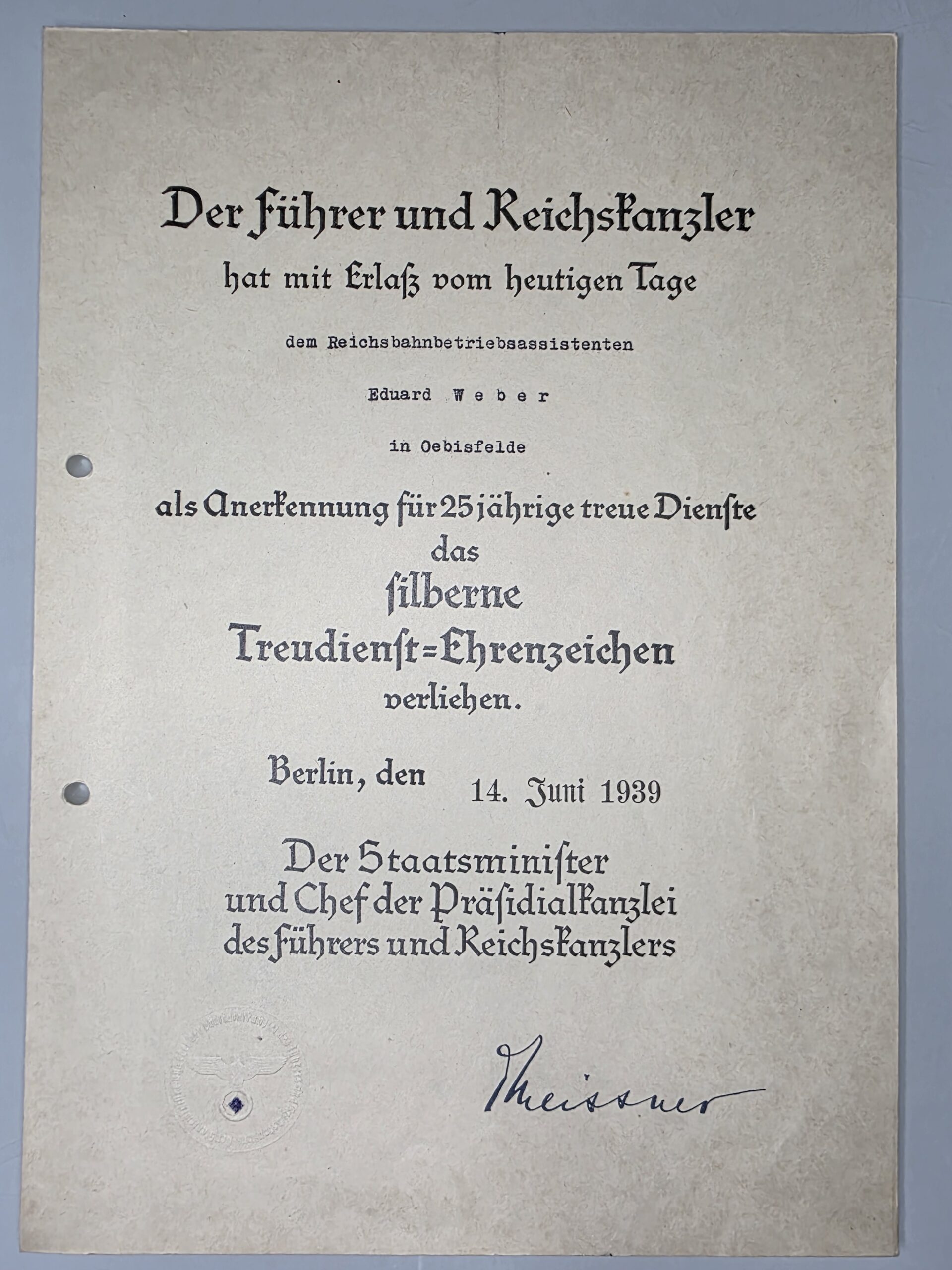
This is especially important for German political and military documents of 1933–1945. A document issued in Hitler’s name does not necessarily contain Hitler’s autograph, and a typed gez. Himmler is not Himmler’s handwriting. Our guide to German document signatures: i.A., i.V., gez. and F.d.R. explains these conventions, and Adolf Hitler Facsimile Signature shows how printed signatures worked in practice.
The same applies outside Germany. A reply from a famous person’s office may have been written and signed by staff: authentic correspondence, but not necessarily the principal’s autograph. A correct catalogue description identifies the actual signer wherever possible.
Warning sign 5: do the ink, paper and document fit the claimed date?
This is one of the strongest reasons never to examine handwriting in isolation. A convincing signature on an impossible document is an immediate problem. Examine the whole object: paper, printing, writing instrument, watermarks, folds, filing marks, mounting traces and later alterations. Genuine old paper does not date every mark on it, and an unusual material is not automatically modern either: offices used different supplies, and documents were handled, corrected and stored in very different conditions.
What can the Hitler Diaries teach collectors?
The classic modern case came in April 1983, when the magazine Stern presented supposed diaries of Adolf Hitler. On 6 May 1983, after examination by the Federal Institute for Materials Research (BAM), the Federal Criminal Police Office (BKA) and the Bundesarchiv, the Federal Archives announced that the diaries were forgeries (Bundesarchiv). The forger, Konrad Kujau, had imitated Hitler’s handwriting quite well, but the materials and the historical content betrayed him. Forty years later, the publisher handed the forged volumes to the Bundesarchiv, where they are now preserved as evidence of the forgery itself (Bundesarchiv press release).
The lesson is fundamental: a convincing handwriting appearance cannot outweigh contradictory physical or historical evidence. I tell the story in more detail in “Falsos diarios de Hitler: 9 claves del gran engaño” (in Spanish), and you can compare Hitler’s genuine signature in this study of Adolf Hitler’s signature (in Spanish).

Continuous handwriting, as in this 1952 Kesselring letter (DOC146, archive), offers far more comparison material than an isolated signature.
Warning sign 6: does the historical context make sense?
A signature cannot be separated from the document it sits on. I ask whether the letterhead, date, recipient, terminology and circumstances fit the attribution. Did the person hold that position on that date? Did the organisation exist yet? Is the title correct? Does the stated purpose make sense? Does the text refer to events that had not yet happened?
These questions do not replace handwriting examination; they are an independent line of evidence, and particularly valuable for letters connected with regimes, armies and major events. An attractive signature should never make a collector overlook an impossible title or an anachronism. At the same time, the unexpected can be genuine: records contain errors and informal practices. The task is to investigate a discrepancy, not to declare an item forged on the spot. If old German handwriting is part of the problem, start with our guide to the Sütterlin alphabet and Kurrent.
Warning sign 7: is the provenance unclear, contradictory or unsupported?
Provenance is the documented history of an object: earlier collections, original envelopes, family correspondence, invoices, auction records. A credible chain of ownership helps connect an object with its claimed history, but it cannot by itself prove a signature genuine. An authentic-looking invoice can accompany a false autograph, and a genuine signature can survive with no ownership history at all. Missing provenance deserves attention; it is not proof of forgery.
What concerns me most is a story that grows more elaborate as the evidence grows weaker. Claims such as “obtained personally from the general” or “from an important private archive” should be documented. A named collection is not an explanation unless the connection can be shown. Our guide to cataloguing a historical collection explains how to record provenance properly.
What do the seven warning signs tell us together?
| Warning sign | Possible concern | What it does not prove |
|---|---|---|
| Near-identical signature forms | Tracing or mechanical reproduction | That every close match is forged |
| Unnatural movement | Simulation or copying | That every hesitant line is false |
| Differences from known examples | Another writer or a poor attribution | That all variation indicates forgery |
| Secretarial or mechanical signing | An incorrect autograph description | That the underlying document is fake |
| Material inconsistencies | Alteration or wrong dating | That every unusual material is modern |
| Historical contradictions | Mistaken attribution or fabrication | That every administrative error is fraudulent |
| Weak provenance | Missing supporting evidence | That an unprovenanced signature is false |
This table is a screening tool for spotting possible forged autographs, not a forensic decision system. An authentication conclusion requires all the relevant evidence to be weighed together.
Can a forged historical document become a genuine collectable?
Yes, but in a different category. A documented historical forgery can itself be an object of study. The British Library holds a collection of Shakespeare “autographs” forged by William Henry Ireland, which he presented in 1834 as specimens of what he called his “Shaksperian fabrications” (British Library, Add MS 37831); the Shakespeare Birthplace Trust likewise preserves his forged signatures of Shakespeare and Elizabeth I (Shakespeare Birthplace Trust). Their interest lies not in any Shakespearean authorship but in their place in the history of literary forgery.
The distinction is clear: a knowingly catalogued historical forgery can be a legitimate research object. A newly made autograph marketed as genuine is something else entirely.
Why is the original document so important?
Photographs are indispensable for research and cataloguing, and many forged autographs are first exposed from good images, but they cannot always preserve everything a forensic examination needs: the physical interaction between pen and paper, pressure, indentation. Compression, lighting, colour correction and resolution all affect what the examiner sees. That is why I distinguish a preliminary assessment from images from a full examination of the original. Keep the original photographic files too, and never substitute heavy digital enhancement for the untouched record.
How do I approach a questioned historical signature?
I work through a sequence of independent questions:
- What is the object? A handwritten letter, typed letter, certificate, signed photograph or cut signature each presents different evidence.
- What exactly is being claimed? The identity of the signer must be stated clearly.
- How was the signature produced? Handwriting, or a reproduction?
- What comparison material exists? Known examples must be reliable and appropriate.
- Does the wider document support the attribution?
- What limitations prevent a stronger conclusion?
An inconclusive opinion is not a failure; it is often the most honest conclusion when the evidence is insufficient. My full method is set out in How to Authenticate a Signature on a Historical Document.
What should collectors do before buying an expensive autograph?
For an important purchase, ask for clear photographs of the whole item, both sides of the document and detailed images of the signature. The seller’s description should say whether the mark is handwritten, printed, stamped or attributed. Any certificate should name its issuer and state precisely what it concludes; a certificate does not replace understanding the evidence, and it can be wrong. See How to Buy an Autograph Without Being Deceived and how to recognise a reliable certificate of authenticity. If the handwriting is in doubt, an independent certificate or forensic report may be appropriate. For price, compare genuinely comparable objects rather than the famous name; our Autograph Value Guide explains the factors.
Collector’s Note – a beautiful signature can still be the wrong signature: Collectors sometimes fall in love with how an autograph looks before establishing what it is. I understand the attraction, but aesthetics are not authentication. My priority is always the physical nature of the signature, the person responsible for it and the evidence behind that conclusion. A modest document with a secure attribution is worth more than a spectacular claim built on uncertain evidence.
Frequently Asked Questions
How can I tell whether an autograph is forged?
Check whether the signature is handwritten, whether its features are consistent with reliable examples, and whether the document’s date, materials, context and provenance support the attribution. No single warning sign proves forgery.
What is a traced signature?
A signature copied stroke by stroke from an existing model. It can match the model’s appearance closely while lacking the movement of natural writing.
What is a freehand simulated signature?
A handwritten imitation of another person’s signature made without tracing. Its execution may reveal differences in movement, construction and proportions.
Are printed facsimiles forgeries?
Not necessarily. A period facsimile is a legitimate reproduction; the problem arises when it is sold as a personal handwritten autograph.
Can genuine signatures show hesitation?
Yes. Age, illness, writing conditions and unfamiliar instruments all affect handwriting. Hesitation alone cannot establish that someone else signed.
Can a certificate of authenticity be wrong?
Yes. A certificate is an opinion supported to a greater or lesser degree by evidence. Consider who issued it and what examination it actually reflects.
Can an autograph be authenticated from photographs?
Photographs support a preliminary assessment, but they may not show pressure, indentation or ink behaviour. Important conclusions should rest on the original.
Does a lack of provenance mean an autograph is fake?
No. Many genuine objects survive with incomplete histories. Missing provenance reduces supporting evidence but does not prove the writing false.
Final Thoughts
The most dangerous forged autograph is not the one that looks obviously suspicious. It is the one that makes the collector stop asking questions. A famous name makes an object attractive; a familiar signature shape makes it convincing; old paper makes it look credible. None of these is enough on its own.
Authenticating historical handwriting requires comparison, physical examination, documentary context and honesty about the limits of the evidence. That is why I describe historical objects conservatively: if a signature is attributed, it is described as attributed; if a document carries a facsimile, it says facsimile; and a handwritten autograph is always kept distinct from a document’s general historical association. For a different angle on the same question, see why post-war letters of Third Reich figures reward careful research. The goal is not only to catch forged autographs but to protect the historical integrity of the collection.
Original objects, real stories.
Historical Responsibility Notice
Autographs & Militaria studies and preserves original historical material exclusively for documentation, collecting, preservation, education and research. Documents associated with Nazi Germany, war, persecution or mass violence are discussed strictly within their historical context. Their preservation, examination or sale does not imply approval of the ideologies, individuals or organisations concerned. See also Collecting WWII and Third Reich Material Responsibly.
References & Further Reading
- European Network of Forensic Science Institutes (ENFSI): Best Practice Manual for the Forensic Examination of Handwriting.
- Expert Working Group for Human Factors in Handwriting Examination: Forensic Handwriting Examination and Human Factors: Improving the Practice Through a Systems Approach, NISTIR 8282r1, National Institute of Standards and Technology, 2021.
- Hicklin, R. A. et al.: “Accuracy and reliability of forensic handwriting comparisons”, Proceedings of the National Academy of Sciences, 2022.
- Bundesarchiv: “Pressekonferenz des Bundesarchivs zu ‘Hitler-Tagebüchern’”; “Bertelsmann hat gefälschte ‘Hitler-Tagebücher’ an das Bundesarchiv übergeben”.
- British Library: Add MS 37831, collection of Shakespeare forgeries by William Henry Ireland.
- Shakespeare Birthplace Trust: “The Shakespearian forgeries of William Henry Ireland”.
- Juan García Nicolás: “How to Authenticate a Signature on a Historical Document”.
About the Author: Juan García Nicolás
Juan García Nicolás is a historical collectibles researcher, qualified graphologist and forensic handwriting examiner, and the editor of Autographs & Militaria. His work focuses on historical autographs, original documents, provenance, handwriting comparison and the responsible interpretation of twentieth-century historical material. He issues certificates of authenticity and forensic handwriting reports through VS Certificate of Authenticity, and writes on graphology and historical signatures at Aprende Grafología and Análisis Grafológico Online (both in Spanish).
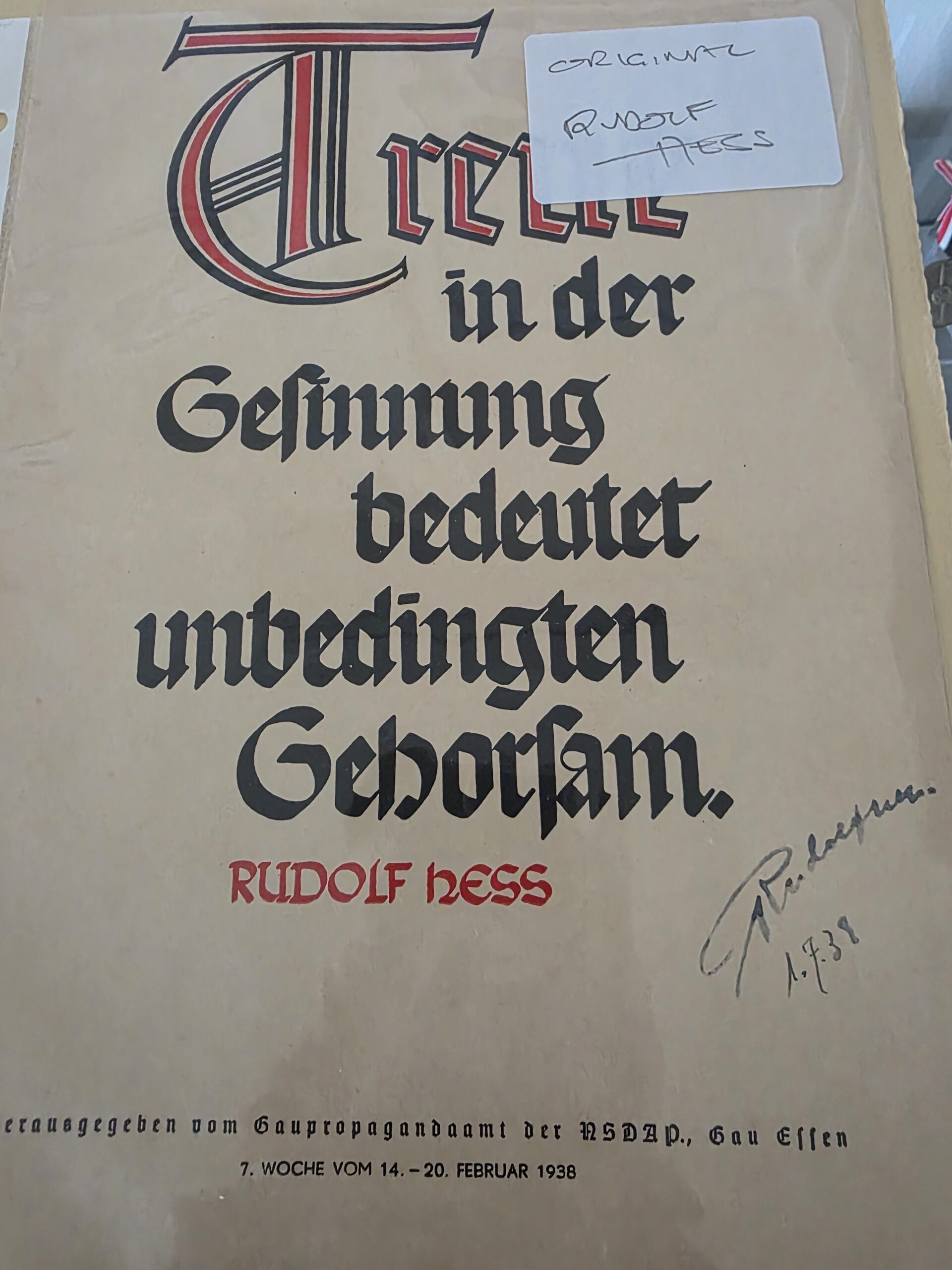
Rudolf Hess Autograph – Signed NSDAP Wochenspruch Poster, 1938
Original price was: 1.600,00 €.1.490,00 €Current price is: 1.490,00 €.
Collector’s OfferOriginal 1938 Joseph Goebbels Signed Appointment Document – Hitler Facsimile
Original price was: 2.290,00 €.2.190,00 €Current price is: 2.190,00 €.
Collector’s OfferFritz Darges Autograph – Original WWII Signed Cut + 1 Photo
Original price was: 300,00 €.229,00 €Current price is: 229,00 €.
Collector’s OfferWalter Bürger Signed Document – Rare 4-Piece Reichsbahn Archive 1934–1941
Original price was: 259,00 €.219,00 €Current price is: 219,00 €.
Collector’s Offer


About the Author: Juan García Nicolás

Authentication & certification
Have a signature or document you want examined? Independent analysis by a qualified graphologist and forensic handwriting examiner.
Research tools
What is my autograph worth?
Signed or facsimile?
Which German document do I have?
All Journal articles
From the collection
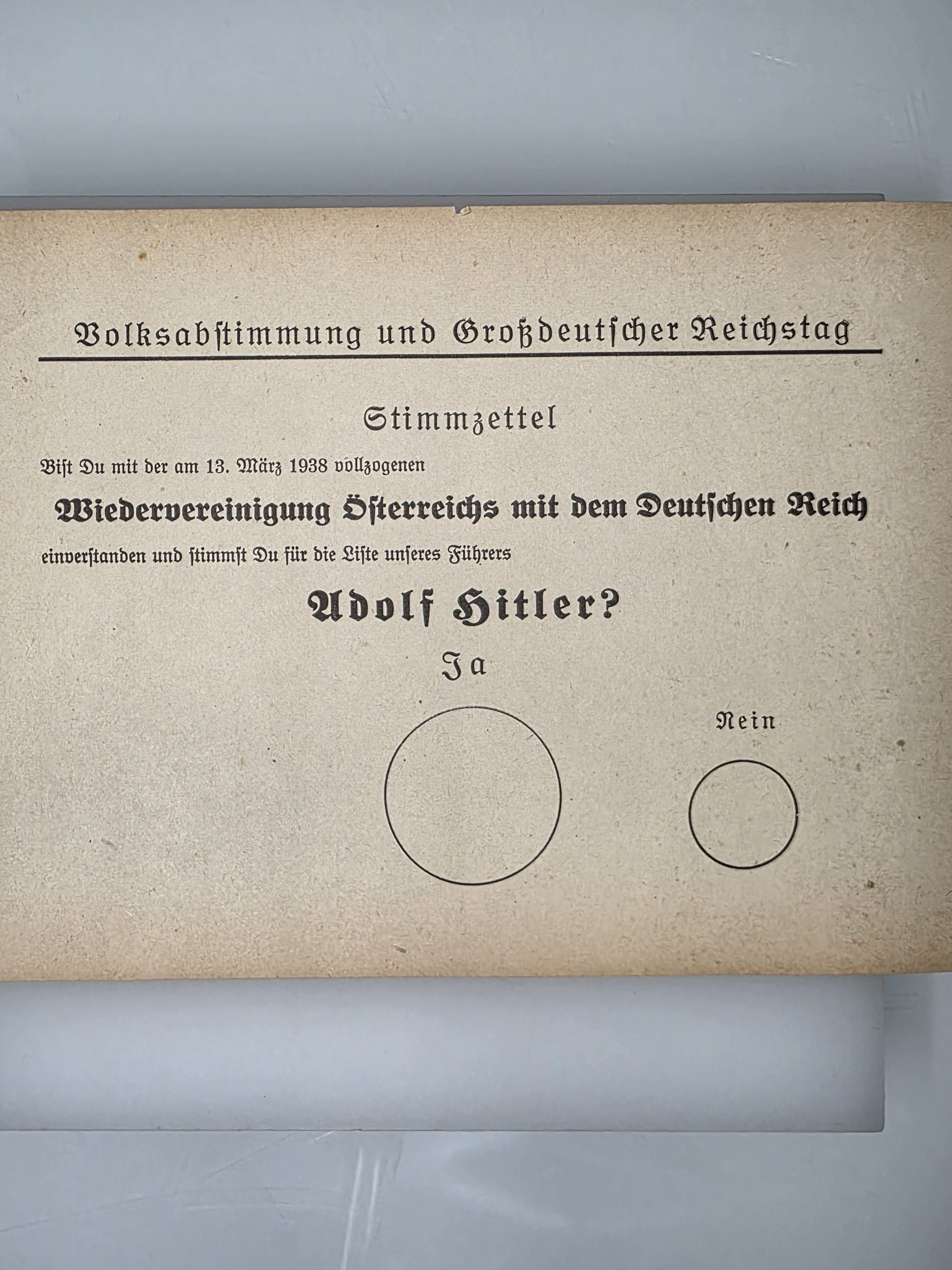
Volksabstimmung 1938 Ballot – Anschluss Plebiscite & Großdeutscher Reichstag, Unmarked Front
Original price was: 75,00 €.65,00 €Current price is: 65,00 €.
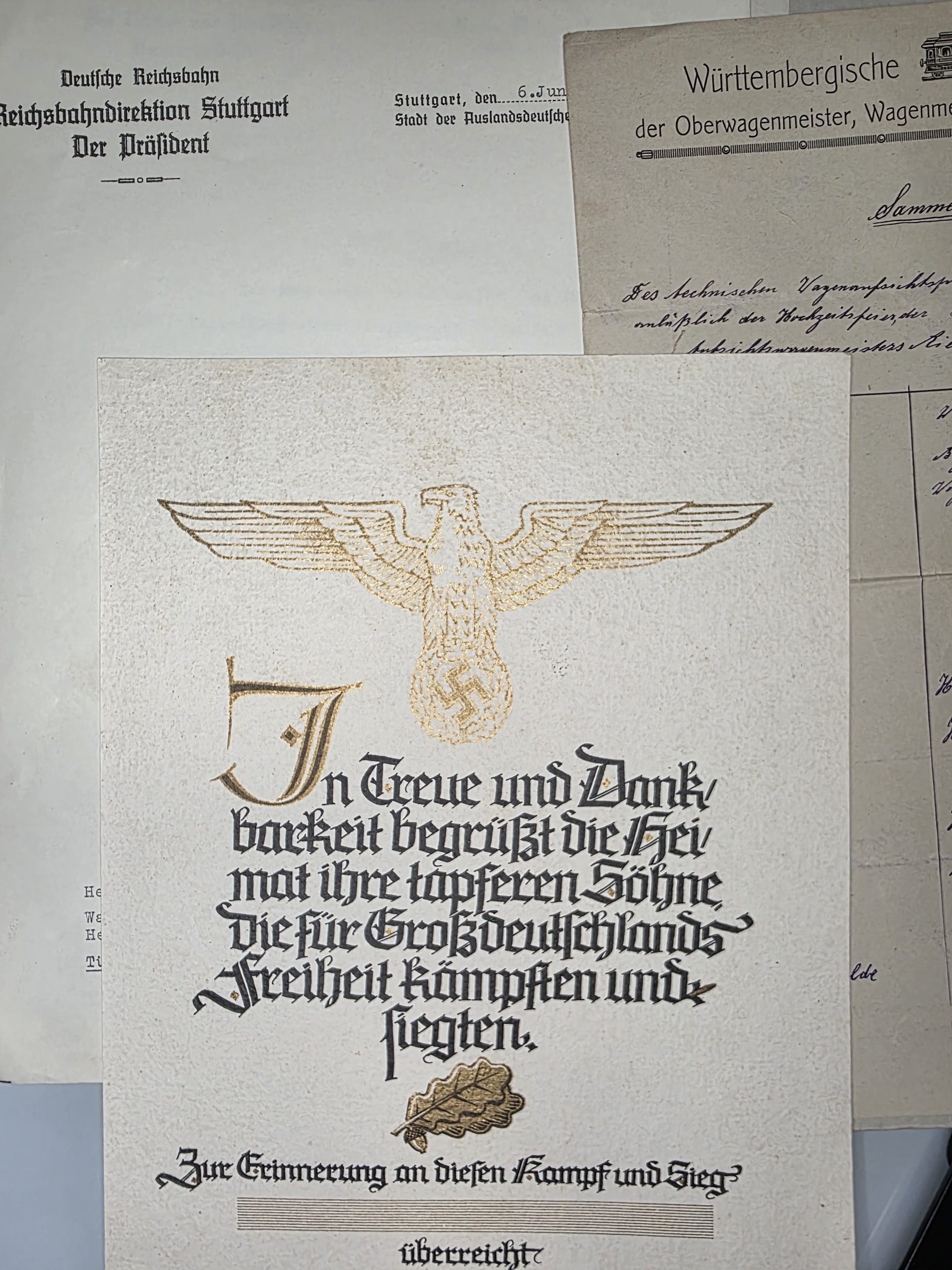
Collector’s OfferReichsbahn Document Lot 1936–1943 – Hermann Rieder Treudienst Group with Dorpmüller Letter & Certificates
Original price was: 180,00 €.150,00 €Current price is: 150,00 €.
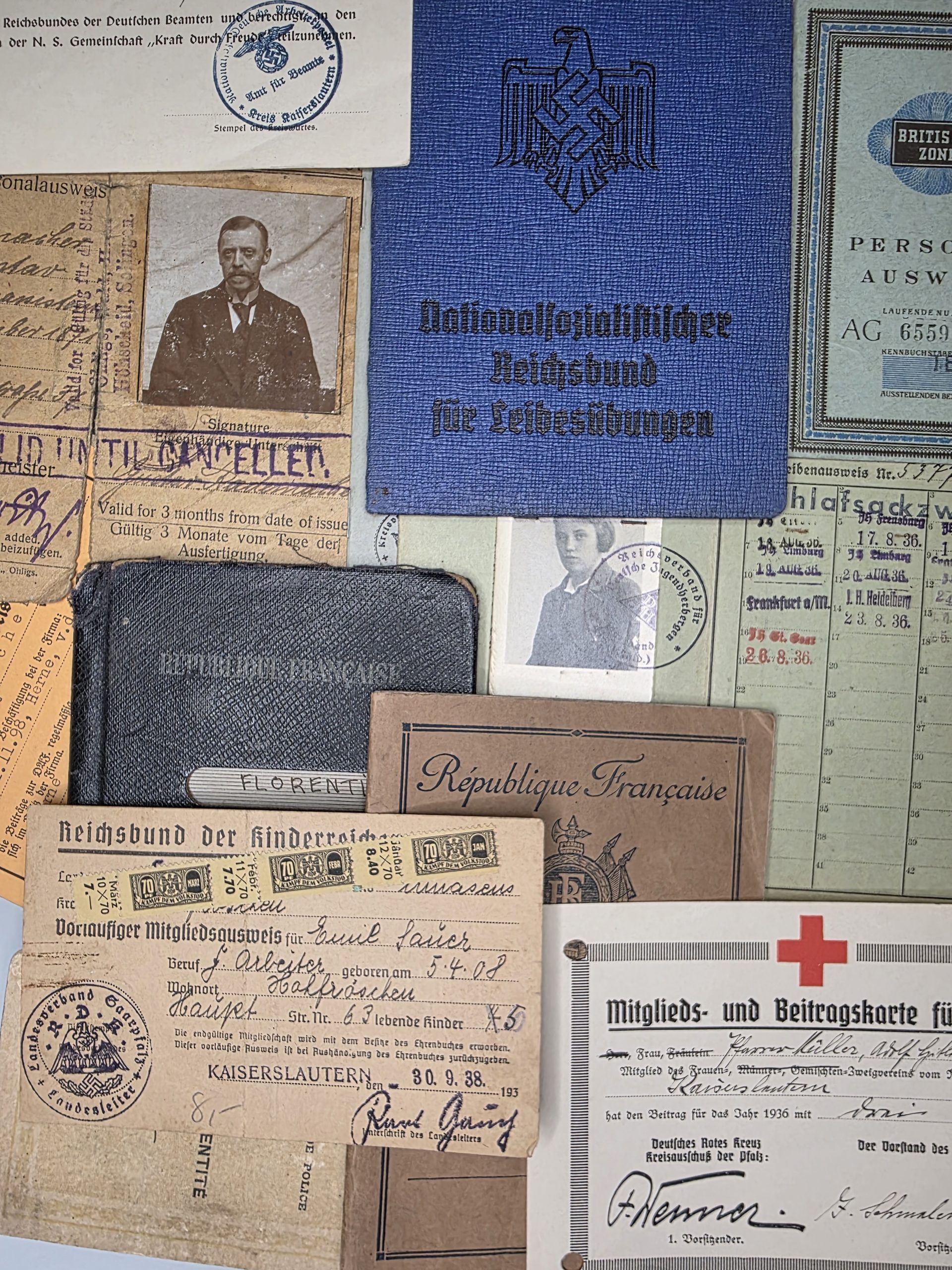
Collector’s OfferGerman Document Lot – Identity & Membership Cards, 1930s to Post-War, Kaiserslautern & Pfalz
Original price was: 270,00 €.245,00 €Current price is: 245,00 €.
Collector’s Offer