The Collector’s Encyclopaedia · Decorations · Wehrmacht awards
Wound Badge 1939: History, Grades and Collector’s Guide
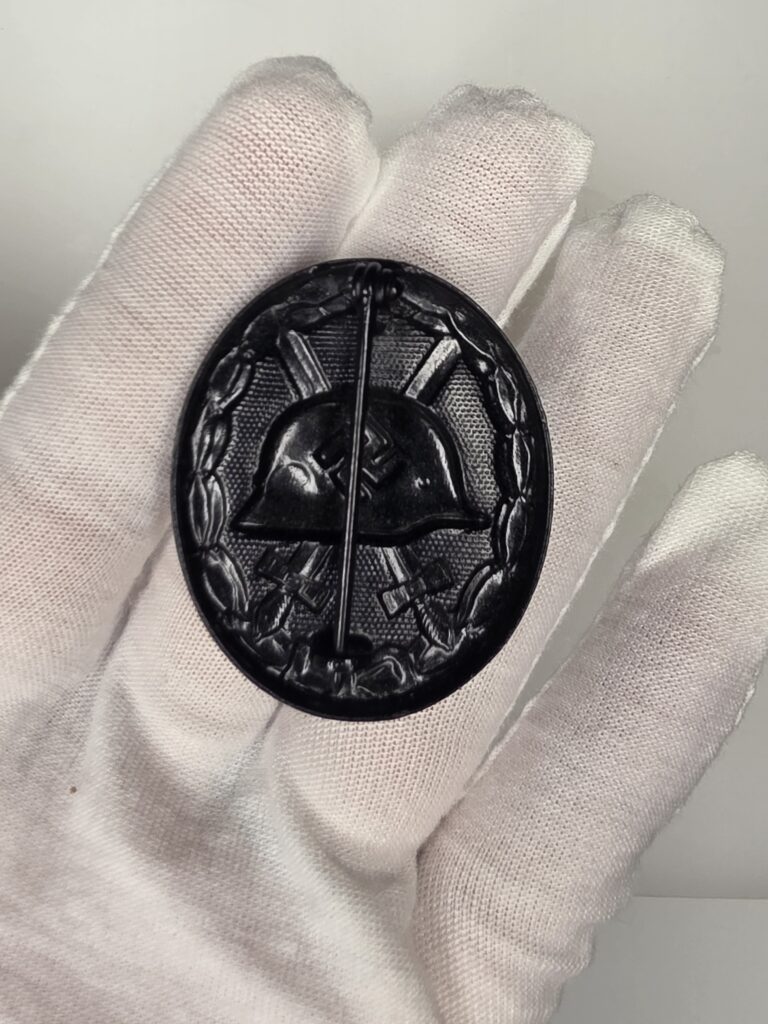
| Introduced | Renewed in 1939 (first introduced in 1918) |
|---|---|
| Grades | Black: one or two wounds; Silver: three or four; Gold: five or more |
| Also awarded for | Severe frostbite; a grade could be skipped for severe injuries |
| Typical paperwork | Award document; entry in Soldbuch and Wehrpass |
| In the collection | 3 pieces currently available (see below) |
The Wound Badge was one of the most widely awarded German decorations of the Second World War. Behind each one is an injury, and a documented badge often leads straight to a soldier’s medical history in his service books.
What Was the Wound Badge 1939?
The badge was first introduced in 1918 and renewed in 1939. It came in three grades. According to Museum Berlin-Karlshorst, black was awarded for one or two wounds, silver for three or four, and gold for more than four; for severe injuries a grade could be skipped, and it was also awarded for severe frostbite. A special version, dated 20 July 1944, was created for those killed or wounded in the bomb attack on Hitler at the Wolf’s Lair; The National WWII Museum puts the number of recipients at only 24.
Who Awarded It, and Which Documents Go With It?
Award documents were printed forms completed by the unit or hospital. The wound, the date and the badge should appear in the Soldbuch and Wehrpass. See award documents.
What Should Collectors Watch For?
- Black badges are common; silver and gold are scarcer and more often reproduced.
- 20 July 1944 badges are among the rarest German awards and are often reproduced, sometimes very closely. Only impeccable provenance will do.
- Documents and badge must agree in grade and date.
Legal note. In Germany the 1957 Orders and Decorations Act allows Second World War awards to be worn only without National Socialist emblems, which is why “1957 pattern” versions without the swastika exist. The public display of Nazi symbols is restricted in Germany, Austria and several other countries. Owning, buying and selling original decorations as historical objects is treated differently from country to country, so check the law where you live and where you ship.
Collector’s Note
A Wound Badge with its document is a quiet reminder of what war did to the body. I describe such groups with that in mind.
Related Entries and Pieces
Pieces in the Collection
Browse the full Collector’s Encyclopaedia →
Frequently Asked Questions
How many wounds were needed for each grade?
Black for one or two, silver for three or four, gold for five or more.
Was the Wound Badge given for frostbite?
Yes, for severe frostbite.
Are gold Wound Badges rare?
They are much scarcer than black ones and more often reproduced.
Historical Responsibility Notice: this entry documents historical figures and artefacts of the National Socialist period for collecting, preservation, education and research. It does not endorse or glorify any ideology, and it is written in memory of the victims of the regime.
References & Further Reading
- Museum Berlin-Karlshorst, Verwundetenabzeichen in Schwarz (inv. 207414), museum-digital: berlin.
- Decuers, L. (2017) Looting the Reich: German Wound Badge, The National WWII Museum, New Orleans.
- Federal Republic of Germany (1957, as amended) Gesetz über Titel, Orden und Ehrenzeichen (OrdenG), §§ 6 and 15, Bundesministerium der Justiz / gesetze-im-internet.de.