
German Document Signatures: Who Really Signed? i.A., i.V., gez. and F.d.R. Explained
A document bearing Heinrich Himmler’s name is not necessarily signed by Heinrich Himmler. Nor is an appointment bearing Adolf Hitler’s name necessarily a Hitler autograph.
After years of examining historical paperwork, I regard this as one of the most important distinctions in autograph collecting. A remarkable number of misunderstandings arise not from sophisticated forgeries but from a simple failure to understand how German administration recorded signatures and reproduced official documents.
The abbreviations i.A., i.V., gez. and F.d.R. look deceptively simple. They are short, easily overlooked and often sit right beside a famous name. Yet they can completely change what a collector is actually holding. A handwritten signature, a typed attribution, a facsimile and a clerk’s certification can all appear on documents issued by the same authority, and each records a different act.
So when reading German document signatures from 1933–1945, the essential question is not whose name appears at the bottom? It is who physically signed this particular sheet of paper, and in what capacity?
In this guide I explain the German administrative signature conventions, show how to read them in context and why identifying the true signatory matters for provenance, authentication and value. My approach combines historical collecting with forensic handwriting examination: I treat the document as evidence before I treat it as an autograph.

DOC75, 1938: Bormann’s handwritten signature above his typed name in brackets. The typed line identifies the signatory; the ink signature is the autograph.
What do German document signatures actually tell us?
A German administrative document can name several different people:
- the authority in whose name the document was issued;
- the official who approved its contents;
- the person who physically signed the surviving sheet;
- the person who prepared or certified a copy.
These may all be different people. A document can also reproduce the name of an official who signed a different version, without containing a single stroke of that official’s handwriting.
German administrative language developed precise formulas for delegated signing, representation, attribution and certification. Their meanings are recorded in the Duden, and modern administrative rules still distinguish them: the Joint Rules of Procedure of the German Federal Ministries (GGO) devote separate sections to signing authority (§ 17) and the form of signature (§ 18). Those modern rules help explain the concepts, but they are not legislation governing every German office in 1933–1945. A historical document must always be read in its own administrative context.
What does i.A. mean on a German document?
i.A. stands for im Auftrag: “on behalf of” or “by instruction” (Duden: i. A.). In a signature block it indicates that the person signing acts under an authorisation from the office or authority named above. A simplified example:
Der Minister
i.A.[handwritten signature of an official]
The handwritten signature belongs to the official who signs beneath the abbreviation, not to the minister named in the heading. For a collector that changes the description considerably. If the minister was historically important, the document has an interesting institutional connection, but it is not that minister’s autograph merely because it was issued by his department.
Does i.A. make a document less authentic?
No. An original document signed im Auftrag can be an entirely genuine historical document. The notation concerns the capacity in which an official signed, not the authenticity of the object. A historical document and a personal autograph are simply different collecting categories, and a document can be authentic without containing the signature of its most prominent named official.
What does i.V. mean, and how does it differ from i.A.?
i.V. usually means in Vertretung, “acting as representative”. The Duden also records in Vollmacht (“by power of attorney”) as a possible expansion (Duden: i. V.), so the meaning must be established from context.
Der Behördenleiter
i.V.[handwritten signature of a deputy]
Here the deputy is the physical signatory; the heading identifies the office being represented. This matters particularly in ministerial correspondence, military administration and appointment documents.
Was i.V. always a higher form of authority than i.A.?
It would be misleading to state that as a universal historical rule. In modern German practice the distinction often follows the hierarchy. Bavarian rules for public prosecutors’ offices, for example, state that officials entrusted with matters for independent handling sign “Im Auftrag”, while representatives of the head of the authority sign “In Vertretung” (OrgStA, No. 18). That is useful comparative evidence, but it does not prove that exactly the same distribution applied in every wartime office. When cataloguing, I record the wording exactly before interpreting it.
What does gez. mean after a famous German name?
This may be the single most important abbreviation in this guide. gez. is short for gezeichnet, “signed”. The danger lies in assuming that it proves a handwritten signature is present on the sheet in front of you. It does not.
The Duden is explicit: gezeichnet, abbreviated gez., is used before a name that is not handwritten, beneath a typed or duplicated document, to indicate that the original was signed by that person (Duden: zeichnen).
Consider the line gez. H. Himmler. If the whole line is typewritten, what is physically present? A typed attribution. Not an autograph.
Can a document contain gez. and a real handwritten signature?
Yes. A document may carry a typed attribution and, separately, a genuine handwritten signature by someone else, or it may reproduce an earlier signature in a copy. The abbreviation cannot tell you how every mark on the sheet was produced. Never treat the word gezeichnet as a substitute for physical examination.
What does a correctly catalogued hand-signed document look like?
Museums draw the same line. The Deutsches Historisches Museum, for instance, catalogues a Himmler order on the uniforms of concentration camp guards as a hand-signed order, classified as “signature on document; autograph”, with Himmler recorded as signatory (Deutsche Digitale Bibliothek record). The classification states what is physically present: Himmler’s own signature. A typed “gez. Himmler” on a copy of such an order would belong in an entirely different category.
On a smaller scale, a letter in our own collection shows both elements side by side. In DOC75, a 1938 letter from the office of the Deputy Führer, Martin Bormann’s large handwritten signature sits directly above his typed name in brackets. The typed line identifies the signatory; the ink signature is the autograph.
What does F.d.R. mean on an official German document?
F.d.R. stands for Für die Richtigkeit: “certified correct”. A longer and more explicit form is Für die Richtigkeit der Abschrift (F.d.R.d.A.), certifying that a copy is accurate. This is not the same as signing the original decision. The official who signs beside such a certification is vouching for the correctness of the text or copy, nothing more.
Who actually signs beneath F.d.R.?
The person whose handwriting appears beside or beneath the certification. That person may be a clerk, an adjutant, an officer or another authorised official, so it would be wrong to assume that every F.d.R. signature belongs to a junior clerk. Rank and role must be read from the document itself. A simplified example:
gez. [senior official] F.d.R.[handwritten signature of another official]
Two roles are recorded here. The first line attributes the underlying text to the senior official; the second records a certification by the person who physically signed. If the senior official’s name is only typed, the sheet does not acquire his autograph.
Collector’s Note – read the signature block before the biography: Before researching the famous person named in a document, I record the complete signature block: abbreviations, titles, typed attributions, handwritten marks, seals and any certification. Only then do I investigate the individuals. This prevents an attractive attribution from colouring the initial classification of the physical evidence. The document may become more interesting once the real signatory is identified, or it may turn out to contain no autograph at all. Either result is better than an incorrect description.
What do beglaubigt, Abschrift and Ausfertigung mean?
Beglaubigt: certified, but certified what?
Beglaubigt means certified in an administrative sense, and the object of the certification matters. A certified copy (beglaubigte Abschrift) confirms that the copy corresponds to the original presented; it does not mean that anyone has examined and authenticated the handwriting of the original signatory. A certified copy and a certified signature are not the same thing.
Abschrift: a copy
An Abschrift is a copy or transcript of another document (Duden: Abschrift). It may reproduce the names of the original signatories without containing their handwriting, and it may carry a separate handwritten certification by the person who checked it. The collector must distinguish the signatory named in the text from the person who signed the surviving copy.
Ausfertigung: the issued version
Ausfertigung has a more specialised meaning. Besides an executed document or copy in general, the Duden records its legal sense: a copy of an official document prepared in a legally prescribed form as a substitute for the original, which carries the force of the original (Duden: Ausfertigung). The key point for collectors is that Ausfertigung must not be translated as “personally signed original”. An issued version may carry original signatures, reproduced signatures or certification marks, depending on the document and procedure.
Can a certified copy still be an original historical artefact?
Certainly. A copy officially prepared and certified in 1942 is an original surviving artefact of wartime administration; the word copy describes its relationship to another document, not a modern reproduction. I would legitimately catalogue it as an original wartime certified copy, but never as an autograph of the person whose name appears only in the copied text.
Which 10 signature conventions should every collector recognise?
The table classifies the surviving physical item, not the legal validity of the underlying administrative act.
| Convention | What it means | Who signed the surviving sheet? | Collector status |
|---|---|---|---|
| i.A. | Im Auftrag: on behalf of, by instruction | The person who signs beneath the notation | Autograph of that official, if handwritten |
| i.V. | In Vertretung (or in Vollmacht): as representative | The representative whose signature appears | Autograph of the representative, if handwritten |
| gez. | Gezeichnet: signed (original signed by the named person) | No one: a typed attribution identifies no signer on this sheet | Document or copy, not an autograph |
| F.d.R. | Für die Richtigkeit: certified correct | The person who signs the certification | Possible autograph of the certifying official |
| F.d.R.d.A. | Für die Richtigkeit der Abschrift: copy certified correct | The person certifying the copy | Certified copy; possible signature of the certifier |
| beglaubigt | Certified administratively | Depends on the certification | Certified document or copy; examine any signature separately |
| Abschrift | Copy or transcript | Often no one, or a separate certifier | Historical copy, not an autograph |
| Ausfertigung | Formally issued version | Depends on the issuing procedure | Original issued document; handwriting or reproductions possible |
| Facsimile | Printed reproduction of a signature | The named person did not sign this sheet | Original period document possible; not an autograph |
| Signature stamp | Impression from a signature stamp | The operator is usually unidentifiable | Stamped signature, not an autograph |
If these abbreviations sit inside unit stamps and military headings, our guide to WWII German military abbreviations will help; if the handwriting itself is the obstacle, start with the Sütterlin alphabet and old German handwriting.
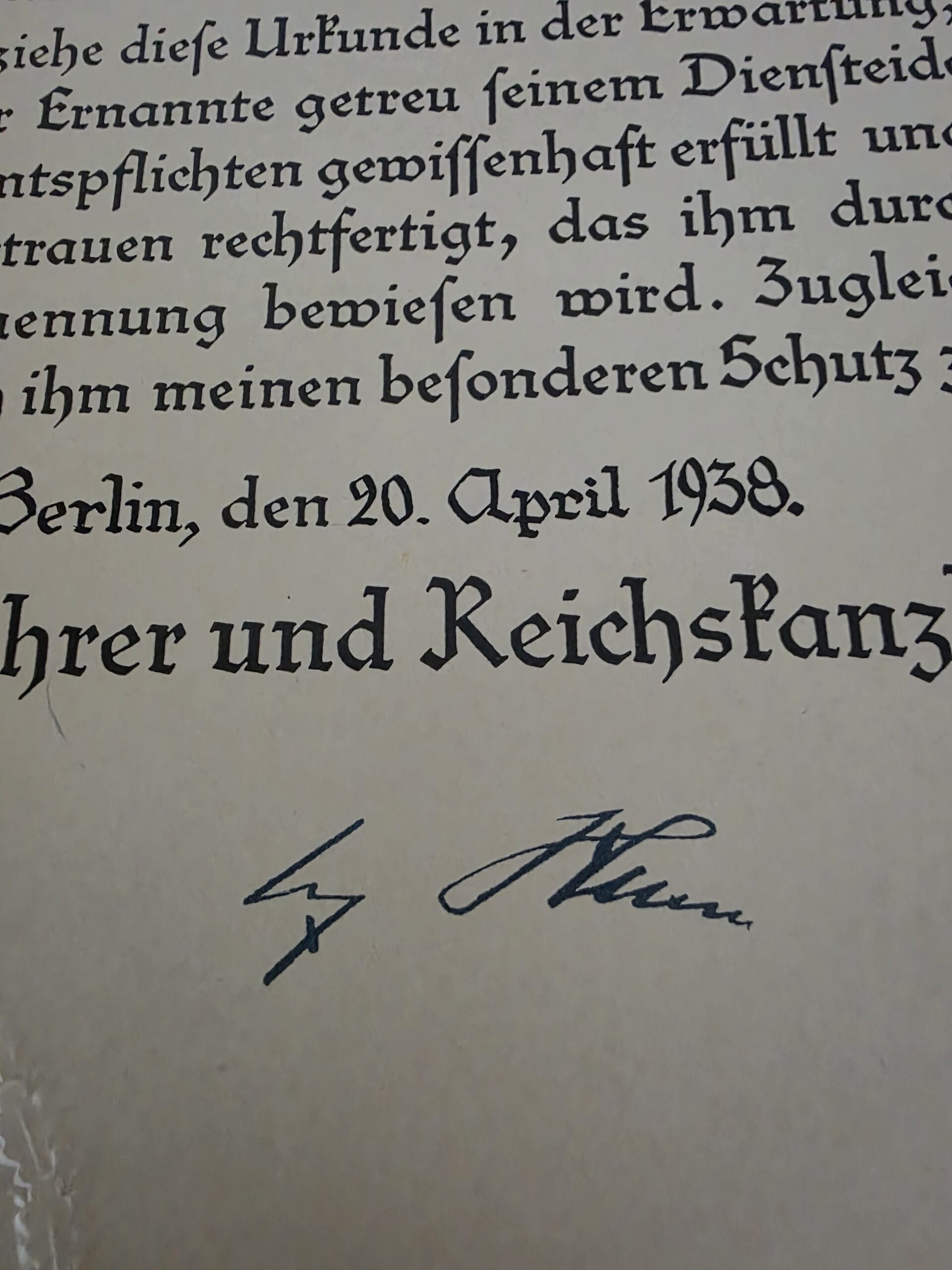
DOC111, 20 April 1938: the Hitler signature beneath Der Führer und Reichskanzler is a printed facsimile, part of the official document.
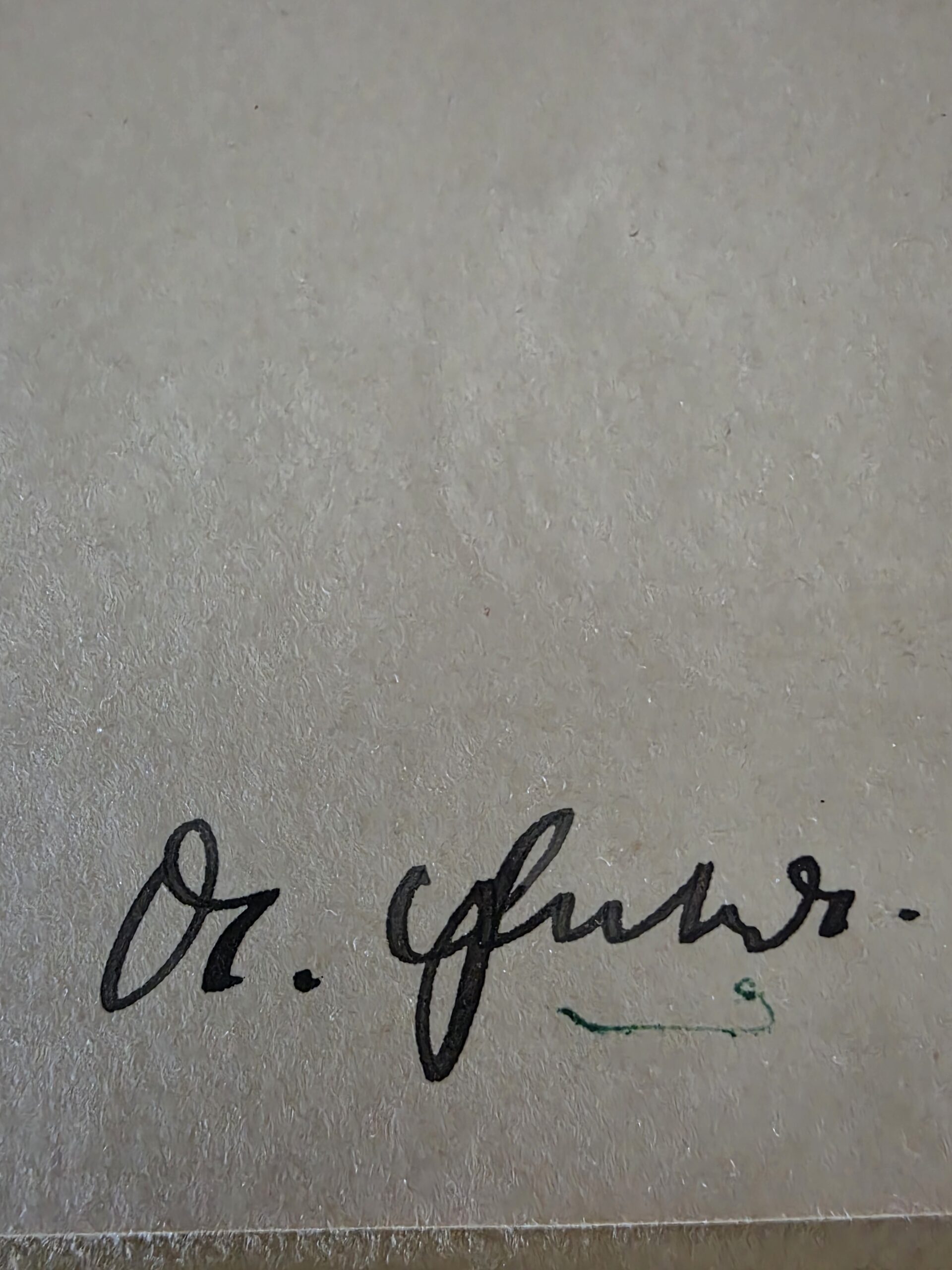
The same document, lower right: Joseph Goebbels’s handwritten ink signature. Two famous names, one autograph.
How can I tell whether a signature is handwritten, printed or stamped?
This is where administrative interpretation becomes physical examination. As a forensic handwriting examiner, I do not begin by asking whether a name resembles a familiar autograph. I first ask how the mark was produced. The Best Practice Manual for the Forensic Examination of Handwriting published by the European Network of Forensic Science Institutes (ENFSI) sets out the professional framework for this work.
Ink and printing characteristics
A pen deposits ink in a way that differs from printing or stamping, and magnification often reveals the difference. But no single visible feature proves authenticity: instruments, inks, printing processes and paper surfaces all vary.
Stroke quality
Natural handwriting is movement. The examiner looks at stroke formation, direction, fluency, connections, beginnings and endings, and the changes that come with writing speed. These must be interpreted with care: a smooth line is not automatically genuine, and a hesitant one is not automatically forged.
Pressure and indentation
When the original paper is available, pressure features and indentation can be informative. They are different kinds of evidence from the ink line itself, and the presence or absence of one feature is never a complete authentication test.
Position relative to typed text
Does the signature cross a typed line? Does it sit naturally in the signing space? Was it applied as a separate operation? Does the sheet combine a typed name, a reproduced signature and a separate handwritten countersignature? These questions show how the document was assembled, although an apparent overlap in a photograph does not prove which mark came first.
Repeated identical signatures
Where several documents show exactly the same signature form, a common mechanical source is likely. No one signs exactly the same way twice, a point I discuss in natural variation in signatures (in Spanish). Even so, image scaling and reproduction quality must be considered before drawing a conclusion. For printed signatures in depth, see Facsimile Signature: Meaning, Value and How to Identify One, Original Signature or Facsimile? and my comparison of facsimile and handwritten signatures (in Spanish).
Why is examining the original paper so important?
A good photograph shows the shape of a signature. It may not show pressure, indentation, the behaviour of ink on paper or the traces of a reproduction process, and working from copies, photographs and scans is a recognised limitation in handwriting examination.
In practice, a seller’s photographs can support a preliminary classification, but they do not always justify an unqualified authentication. When the physical evidence remains uncertain, I record a limitation rather than present a certainty the evidence does not support. For the method in full, see my guide on how to authenticate a signature on a historical document, and for when a collector needs a certificate and when a formal report, certificate of authenticity or forensic handwriting report?
What are the most common signature mistakes in the collectors’ market?
- Selling a typed attribution as an autograph. “Himmler signed document” is not established by the typed words gez. Himmler. If there is no handwritten Himmler signature on the item, the description must say so. (For what his real signature looks like, see this study of Heinrich Himmler’s signature, in Spanish.)
- Confusing the issuing authority with the signer. An appointment issued in the name of a senior official may have been signed by someone else.
- Mistaking a certification signature for the principal signature. A handwritten signature after F.d.R. is a genuine specimen of the certifier’s hand, not an autograph of the official named above.
- Describing every facsimile as a forgery. A reproduced signature on a genuinely issued period document can be entirely correct for that document type: not an autograph, but not a fake either. My study of Adolf Hitler facsimile signatures explains their role in the bureaucracy of Nazi Germany.
- Confusing a signature stamp with pen writing. A stamp can reproduce a real signature design without any fresh handwritten act.
- Assuming an official seal authenticates a famous autograph. A seal supports the administrative context; it does not prove who signed.
- Valuing the famous name before identifying the actual autograph. First classify the evidence, then establish the context, and only then assess value.

DOC162, Führerhauptquartier, 15 April 1942: a printed Hitler facsimile beneath Der Führer and, at the lower right, Grand Admiral Erich Raeder’s handwritten signature.
What can three documents from my collection teach us?
These examples illustrate different collecting questions. The descriptions identify the catalogued pieces; they do not replace examination of the originals.
DOC75: Martin Bormann signed document, 1938
DOC75 is a one-page letter issued in Munich on 24 September 1938 from the office of the Deputy Führer, with a large handwritten Bormann signature above his typed name. It illustrates the question that should precede any valuation: is the visible signature handwritten, and does the complete document, from letterhead and reference to recipient and seal, support the attribution?
DOC111: Goebbels appointment with Hitler facsimile, 1938
DOC111 appoints Karl Passarge to Oberregierungsrat on 20 April 1938. The Hitler signature beneath Der Führer und Reichskanzler is a period facsimile; the Goebbels signature at the lower right is handwritten in ink. Two historically important names on one document, but only one autograph, a distinction that must be stated clearly in the title, description and certificate. For the document type, see Appointment Certificates.
DOC162: Erich Raeder Kriegsmarine promotion, 1942
DOC162 promotes Korvettenkapitän Johannes Schur to Fregattenkapitän. It carries a Hitler facsimile and an original handwritten signature of Grand Admiral Erich Raeder, then Commander-in-Chief of the Kriegsmarine. The handwritten Raeder signature and the printed Hitler facsimile belong in separate catalogue categories. For comparable objects, see Award Documents and our WW2 German Documents guide.
How do signature conventions affect value and provenance?
Correctly identifying the signatory can materially change how a document is catalogued, researched and valued. A handwritten signature of a prominent figure is not equivalent to his name typed into an administrative copy, and a certified copy signed by an unidentified clerk is not the same proposition as an original signed appointment.
That does not make the copy unimportant. A wartime copy may preserve information absent from surviving originals, with distribution marks, annotations, stamps and evidence of how it circulated. The problem is never that one category is worthless and another valuable. The problem is misclassification: a price comparison only means something between equivalent categories. For more, see the Autograph Value Guide.
What should a provenance record contain?
When cataloguing an administrative document, I record separately:
- the issuing authority;
- the person named as approving or signing the underlying text;
- the person whose handwriting survives on the sheet;
- the status of the document: issued version, copy, certified copy or other;
- the acquisition history and supporting evidence.
This avoids writing “signed by” when the evidence only establishes “issued in the name of”. A provenance record should also preserve uncertainty: if an attribution is not fully established, the catalogue should say so.
How should a collector examine a German signature block?
My method is straightforward:
- Identify the document’s date, issuing office and purpose.
- Transcribe every abbreviation around the signature exactly as written.
- Decide which names are typed, printed, stamped or handwritten.
- Examine the original wherever possible, paying attention to how each mark was produced.
- Establish whether any handwritten signature belongs to the named official, a representative or a certifier.
- Check the interpretation against reliable references and the surrounding provenance.
If the document is a copy, say so. If the signature is a facsimile, say so. If the writing is original but the signer remains uncertain, record that uncertainty. The aim is not to make an object sound more impressive. It is to describe what survives.
Frequently Asked Questions
What does i.A. mean on a German document?
i.A. stands for im Auftrag, meaning on behalf of or by instruction. It identifies the capacity of the person who signs beneath it and does not mean that the superior named in the document signed it personally.
What does i.V. mean before a signature?
i.V. usually means in Vertretung, signing as a representative. The Duden also records in Vollmacht, so the meaning should be established from context.
Does gez. Himmler mean Himmler signed the document personally?
No. Gez. (gezeichnet) is used before a name that is not handwritten, on a typed or duplicated document, to show that the original was signed by that person. A typed gez. Himmler is not a Himmler autograph.
What does F.d.R. mean on a Third Reich document?
F.d.R. stands for Für die Richtigkeit, certified correct. The handwritten signature beside it usually belongs to the official certifying the text or copy, not to the person named in the underlying document.
Can an original wartime document be a copy?
Yes. A copy prepared and used during the period is itself an original historical artefact, but its status as a copy must be stated clearly.
Is a facsimile signature the same as a forged autograph?
No. A period facsimile can be an authorised reproduced signature forming part of a genuine document. It is not an autograph, but it is not a forgery either.
Can a photograph prove that a signature is genuine?
A photograph supports a preliminary examination but may not show pressure, indentation or ink behaviour. Important conclusions should rest on examination of the original.
Does a handwritten certification make a document more valuable?
It may add historical interest, depending on who the certifying official was and the type of document, but it must never be presented as the autograph of someone else.
Final Thoughts
When I examine a German administrative or military document, I try to resist beginning with the famous name. A document may say gez. Himmler; it may carry Hitler’s facsimile; it may come from a ministry or a military headquarters. None of these features establishes who physically signed the paper. That question needs the whole signature block and the document’s administrative purpose.
For collectors, the difference between im Auftrag, in Vertretung, gezeichnet and Für die Richtigkeit is therefore much more than terminology. It is the difference between understanding an object and misidentifying it. An original historical document deserves an accurate description, whether it holds a famous autograph, a subordinate’s signature, an official facsimile or simply a typed attribution. The history is important enough without embellishment.
Original objects, real stories.
Historical Responsibility Notice
Autographs & Militaria researches and preserves original historical documents exclusively as historical artefacts for collecting, preservation, education and research. Documents associated with Nazi Germany are studied within the historical context of the dictatorship, including its systems of administration, repression, persecution and war. Identifying officials, institutions or signatures does not imply admiration for, or endorsement of, National Socialism, its organisations or its ideology. See also Collecting WWII and Third Reich Material Responsibly.
References & Further Reading
- Duden: “i. A.”; “i. V.”; “zeichnen” (gezeichnet, gez.); “Abschrift”; “Ausfertigung”.
- Bundesministerium des Innern: Gemeinsame Geschäftsordnung der Bundesministerien (GGO), §§ 17–18 (Zeichnungsbefugnis, Zeichnungsform).
- Bavarian State Ministry of Justice: Anordnung über Organisation und Dienstbetrieb der Staatsanwaltschaften (OrgStA), No. 18 “Art der Zeichnung”.
- Deutsches Historisches Museum, via Deutsche Digitale Bibliothek: hand-signed order by Heinrich Himmler on the uniform regulations of concentration camp guards.
- European Network of Forensic Science Institutes (ENFSI): Best Practice Manual for the Forensic Examination of Handwriting.
- Peter-Johannes Schuler, Historisches Abkürzungslexikon (Historische Grundwissenschaften in Einzeldarstellungen 4), Stuttgart: Steiner, 2007.
- Juan García Nicolás: “How to Authenticate a Signature on a Historical Document: A Guide for Collectors”.
About the Author: Juan García Nicolás
Juan García Nicolás is a historical collectibles researcher, qualified graphologist and forensic handwriting examiner, and the editor of Autographs & Militaria. His work focuses on historical autographs, original documents, provenance, signature examination and twentieth-century military and political history. He issues certificates of authenticity and forensic handwriting reports through VS Certificate of Authenticity, and writes on graphology and historical signatures at Aprende Grafología and Análisis Grafológico Online (both in Spanish).
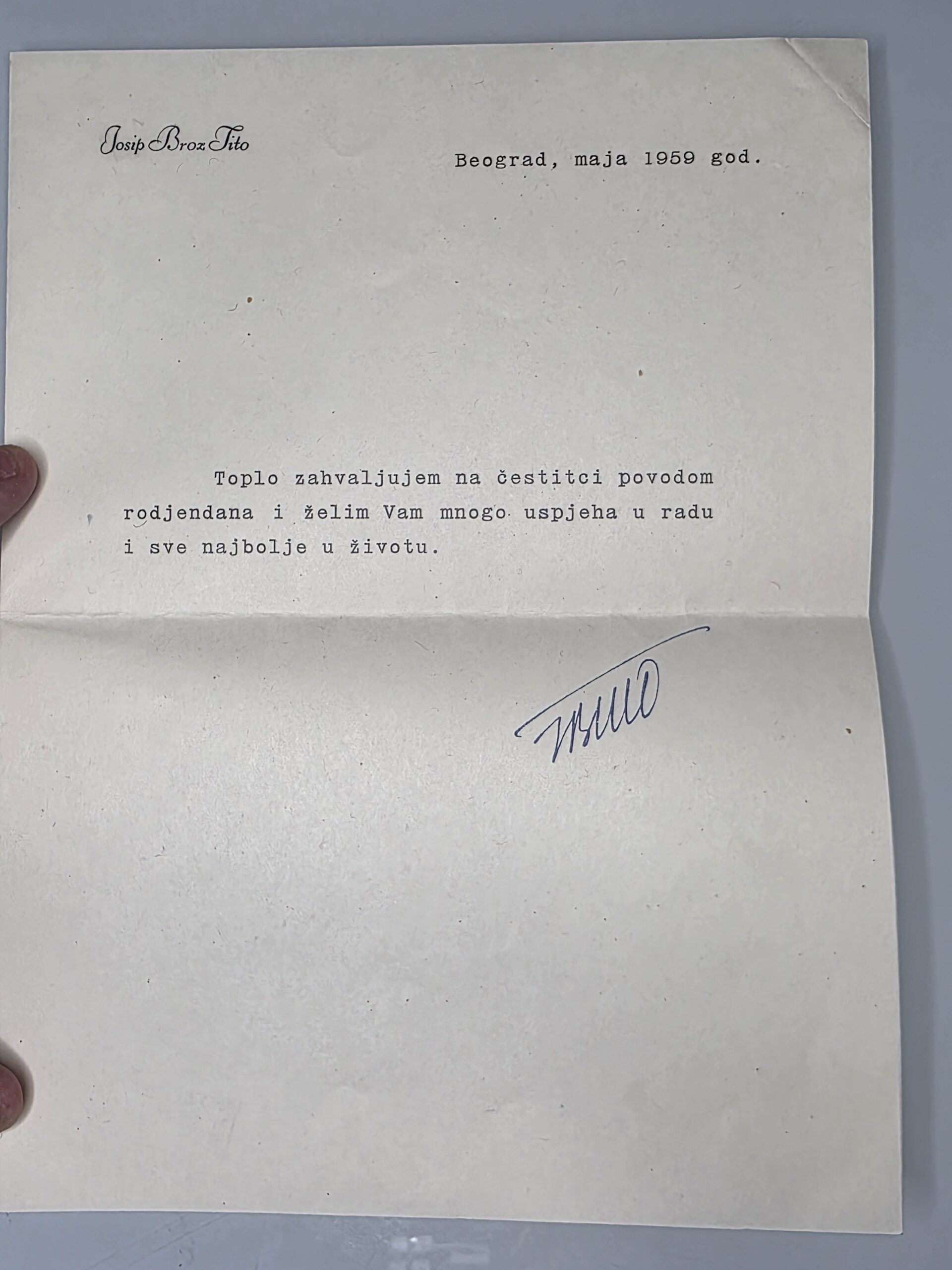
Josip Broz Tito Signed Letter 1959 – Birthday Reply with Registered Presidential Envelope, Belgrade
690,00 €
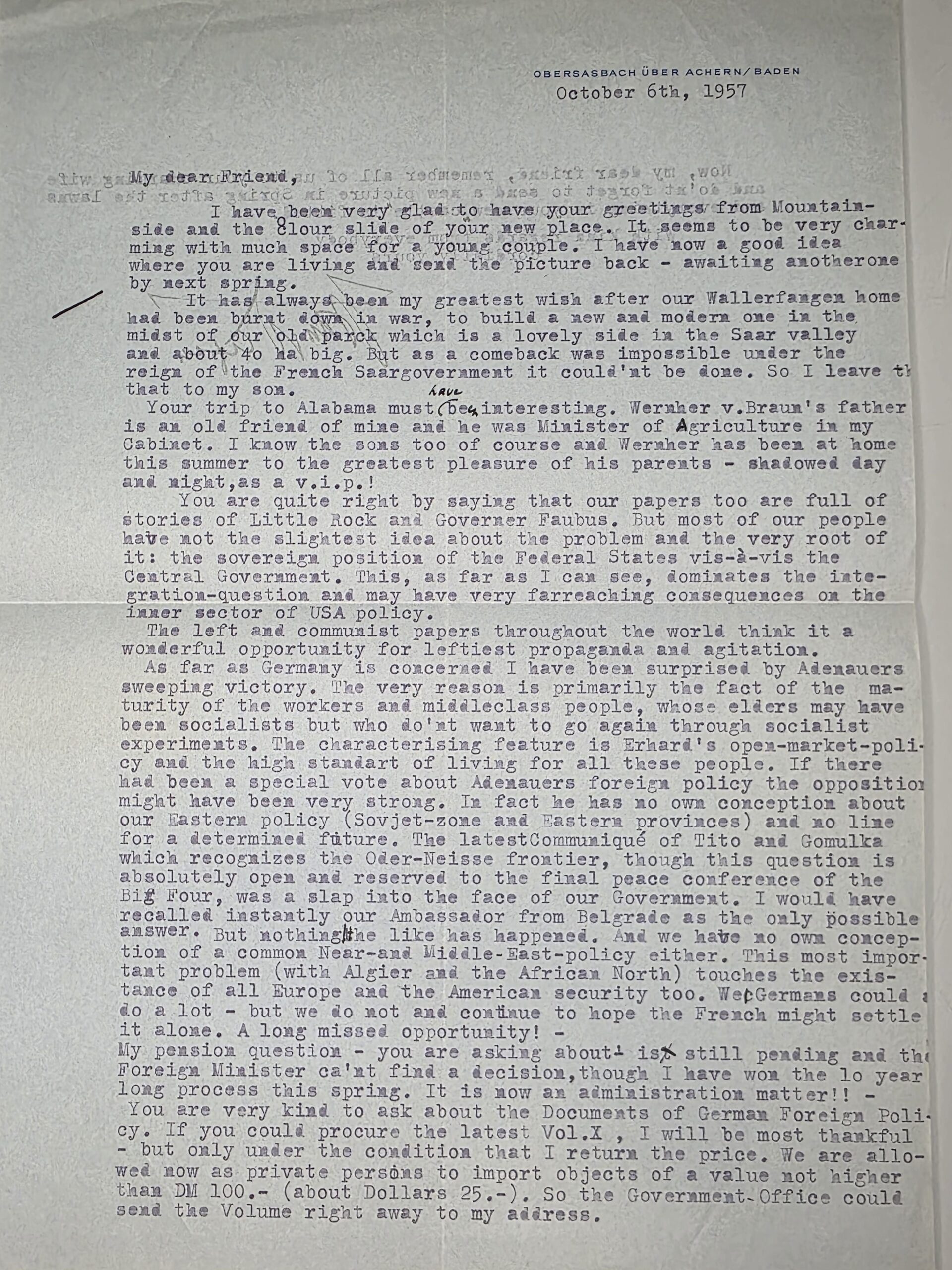
Franz von Papen Signed Letter 1957 – Adenauer, Tito & Gomułka, Wernher von Braun, Little Rock
450,00 €
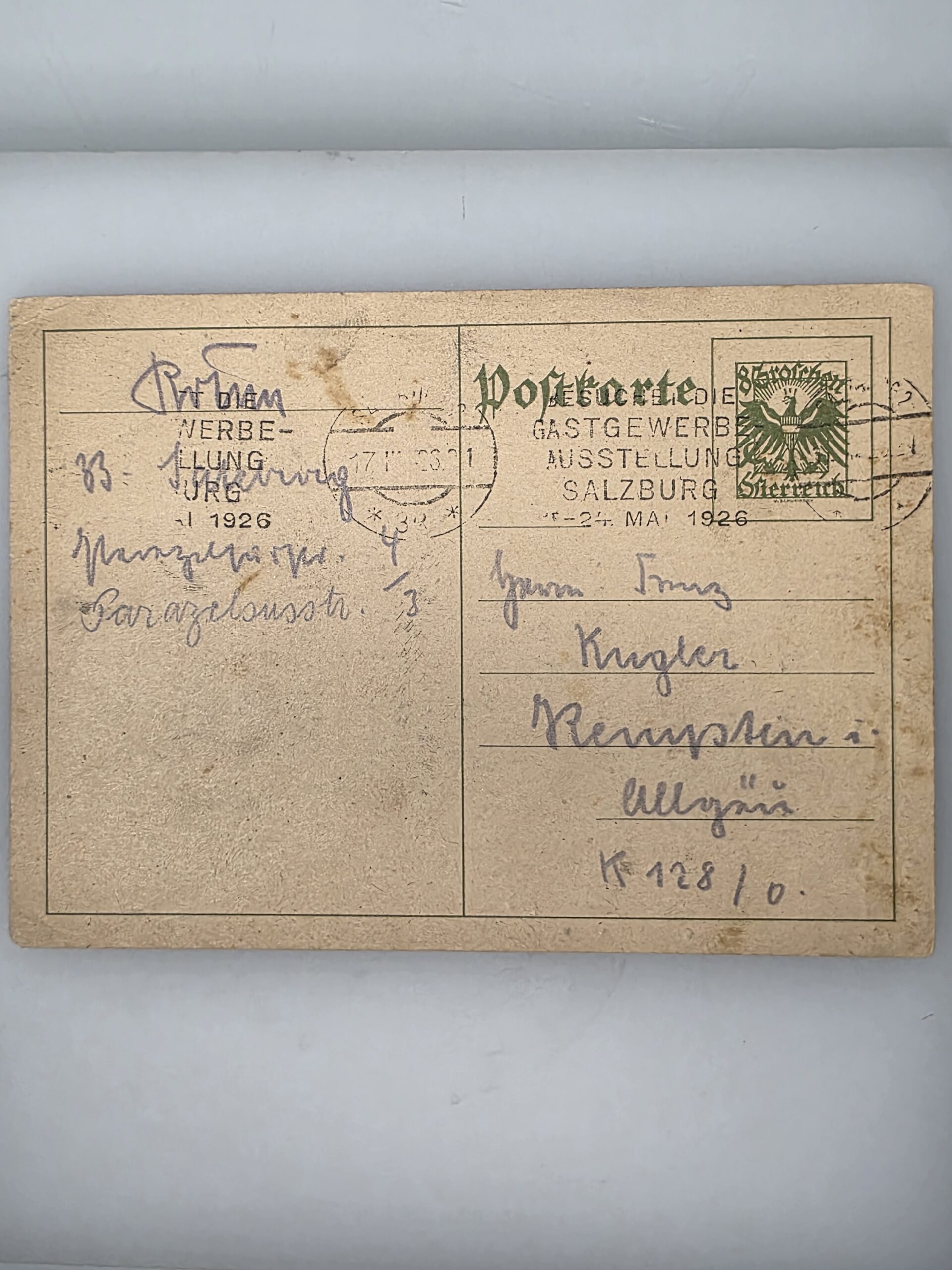
Ernst Röhm Autograph – Signed Postcard to Franz Kugler, 1926
Original price was: 2.600,00 €.2.490,00 €Current price is: 2.490,00 €.
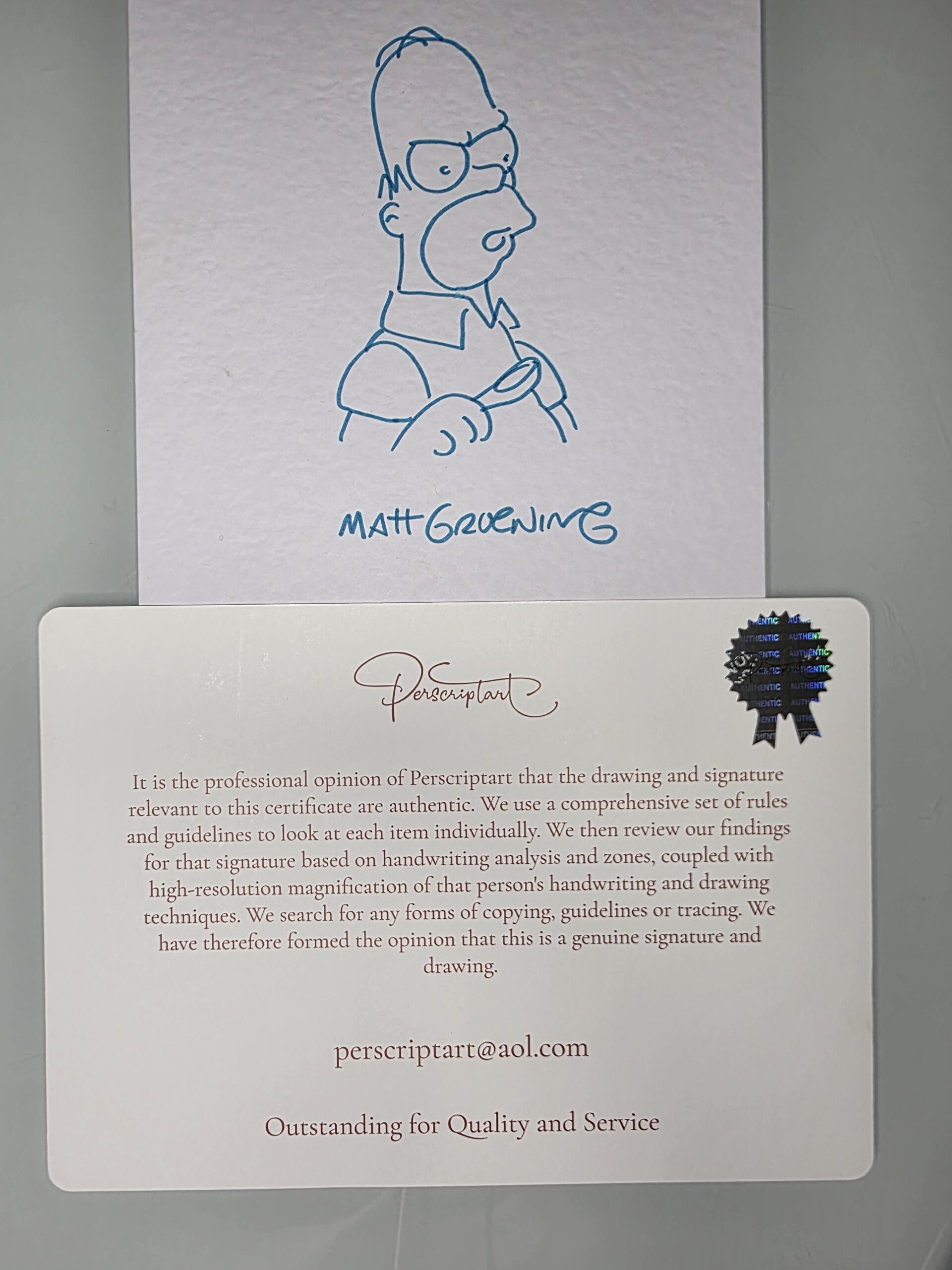
Collector’s OfferMatt Groening Homer Simpson Drawing – Original Signed Sketch with COA
Original price was: 500,00 €.440,00 €Current price is: 440,00 €.
Collector’s Offer
About the Author: Juan García Nicolás

Authentication & certification
Have a signature or document you want examined? Independent analysis by a qualified graphologist and forensic handwriting examiner.
Research tools
What is my autograph worth?
Signed or facsimile?
Which German document do I have?
All Journal articles
From the collection
Adolf Hitler Metal Profile Relief – Hollow Wall Portrait, Reverse Marked GES. GESCH.
Original price was: 290,00 €.260,00 €Current price is: 260,00 €.
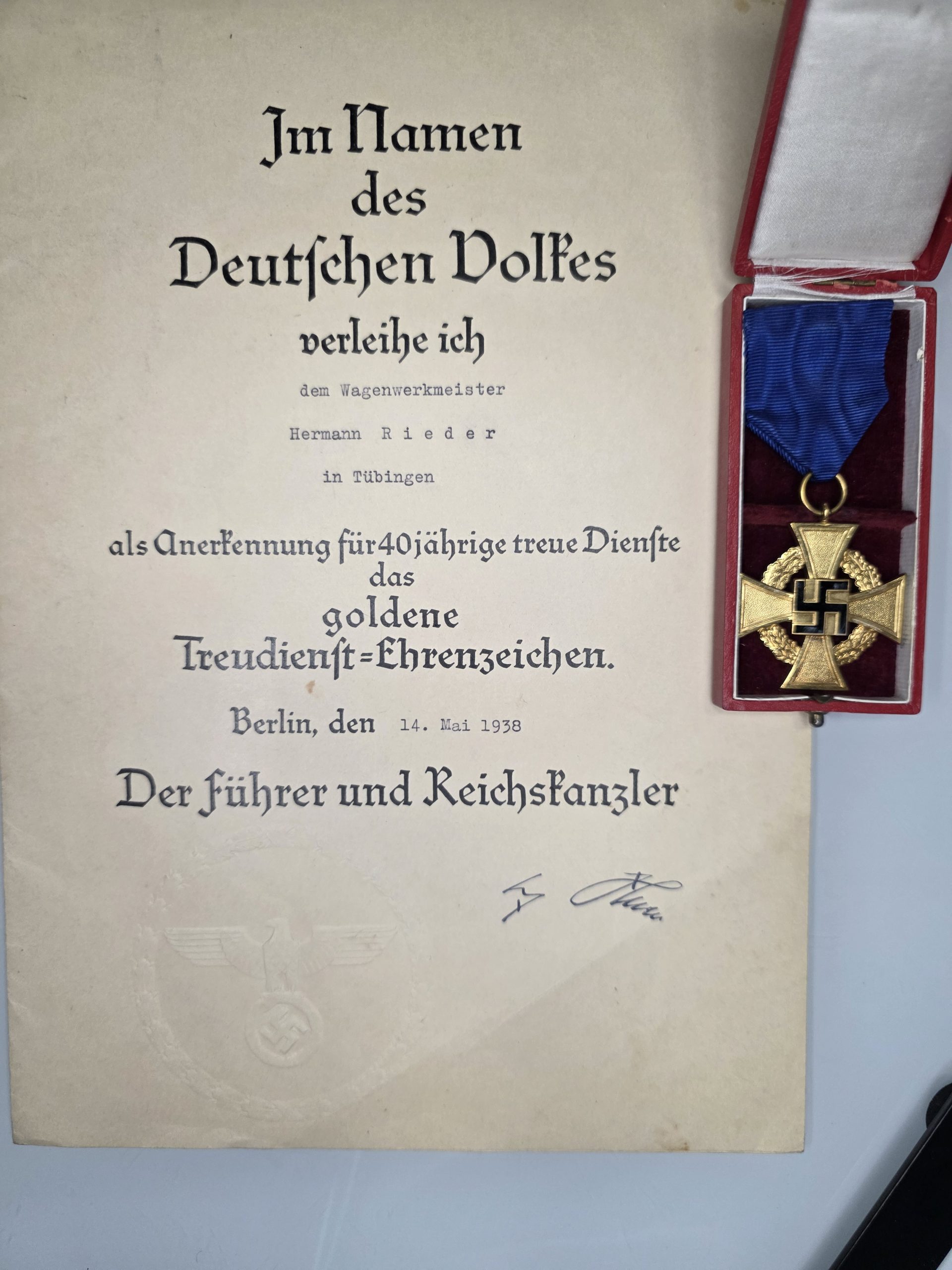
Collector’s OfferNamed Treudienst-Ehrenzeichen 40 Years with Award Document & Case – Hermann Rieder, Tübingen 1938
Original price was: 700,00 €.590,00 €Current price is: 590,00 €.
Collector’s OfferGerman Faithful Service Decoration 40 Years – Treudienst-Ehrenzeichen 1st Class in Gold with Case
Original price was: 175,00 €.149,00 €Current price is: 149,00 €.
Collector’s Offer