Products on sale
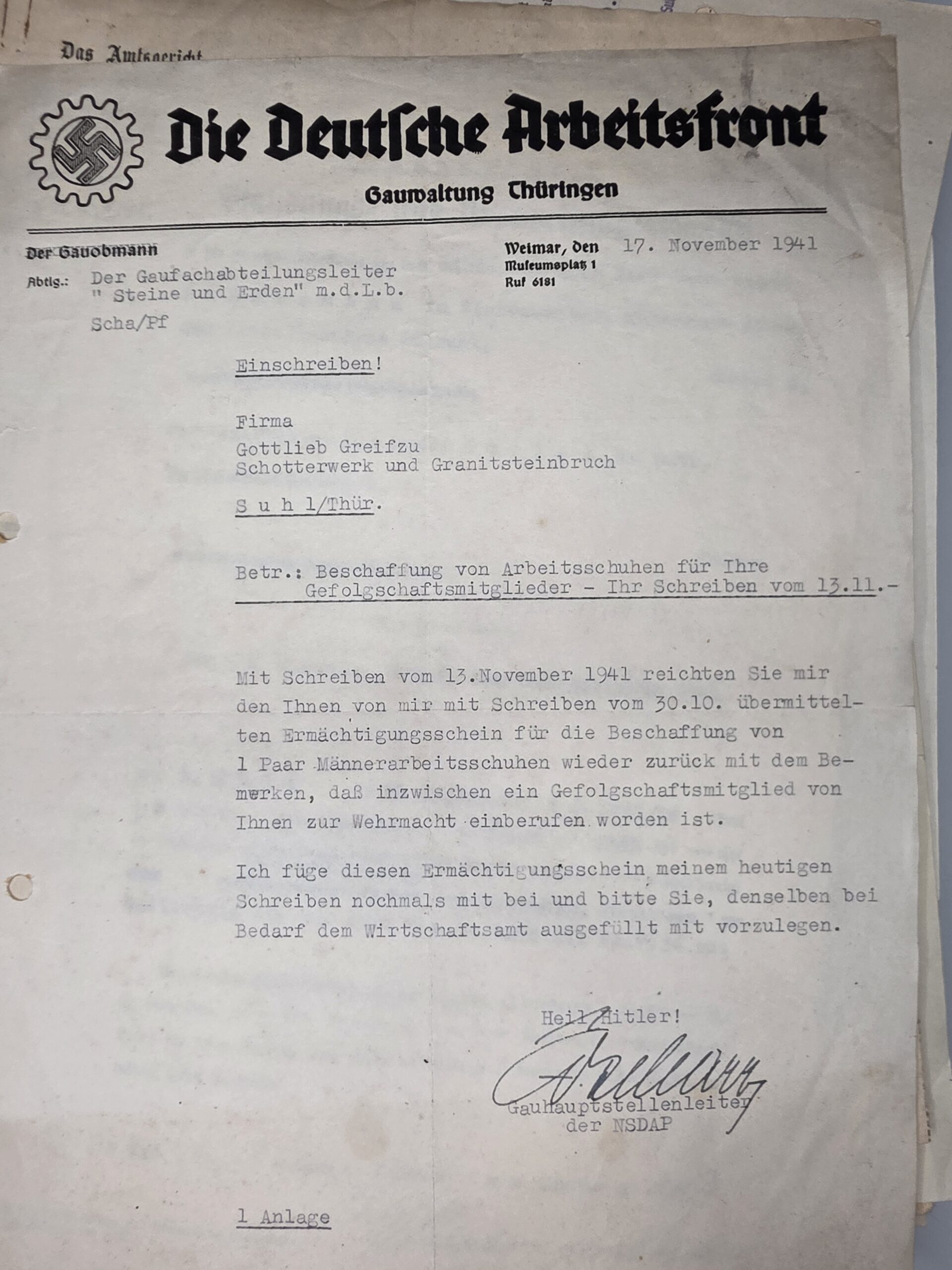
German Document Archive 1911–1967 – DAF, University and Business Papers
Original price was: 249,00 €.199,00 €Current price is: 199,00 €.
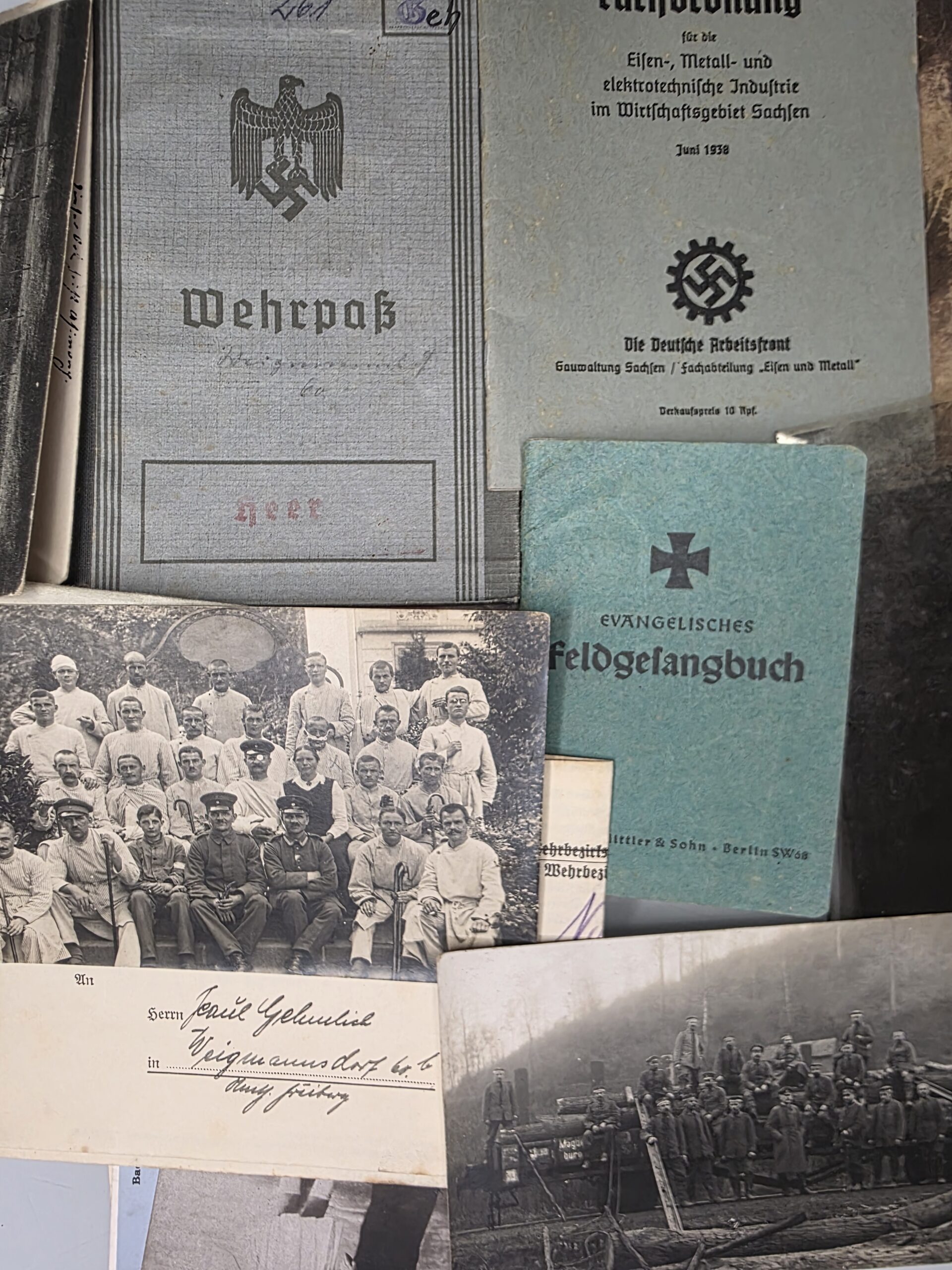
WWII German Wehrpass Group – 256th Infantry Division, Ostmedaille & Death Letter
590,00 €

WWII German Document Collection – U-Boat Training, DAF & Arbeitsbuch Archive
Original price was: 490,00 €.440,00 €Current price is: 440,00 €.
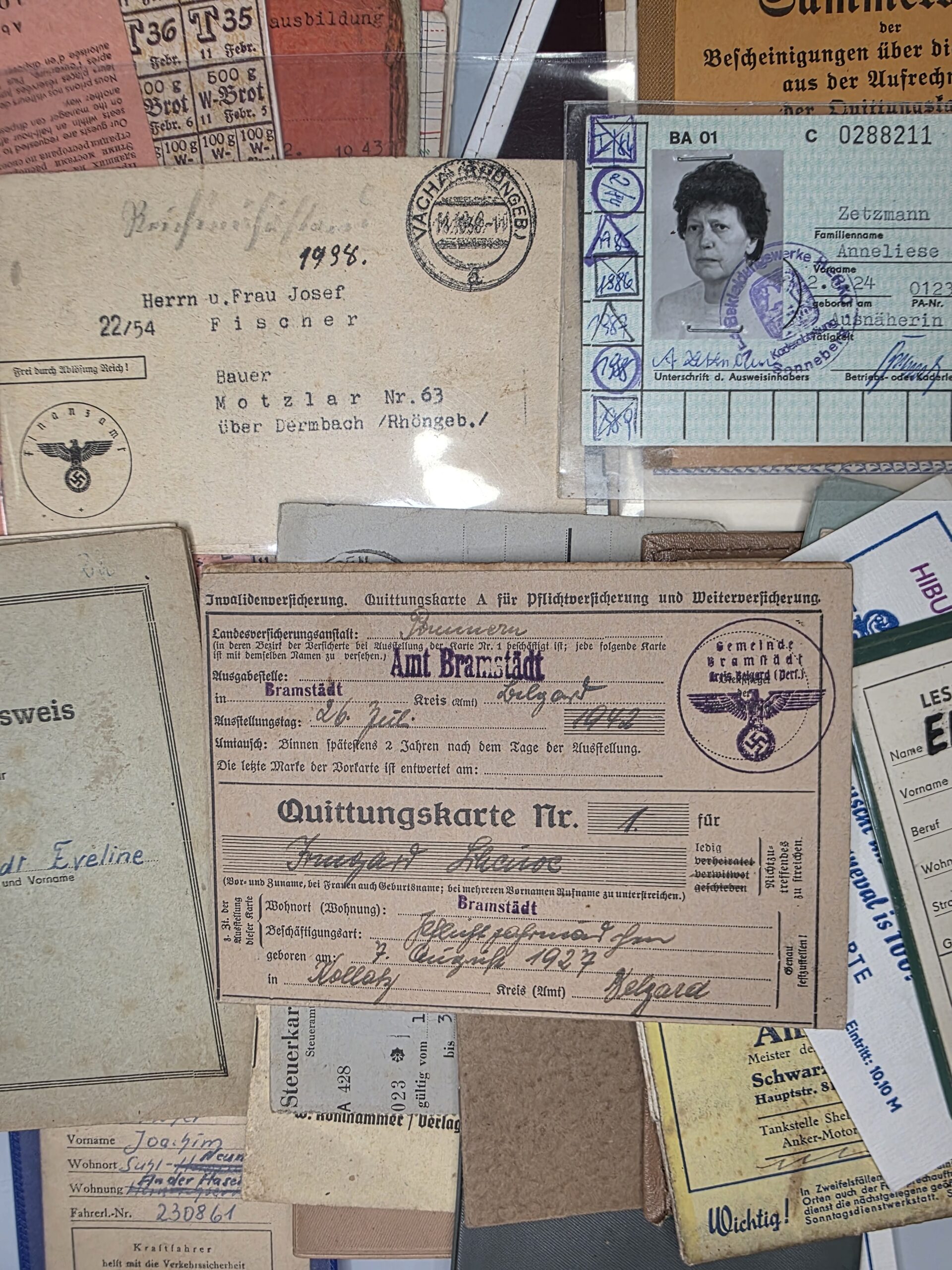
WWII German Document Archive 1938–1945 – Wehrmacht, IDs & Ration Papers
Original price was: 275,00 €.240,00 €Current price is: 240,00 €.
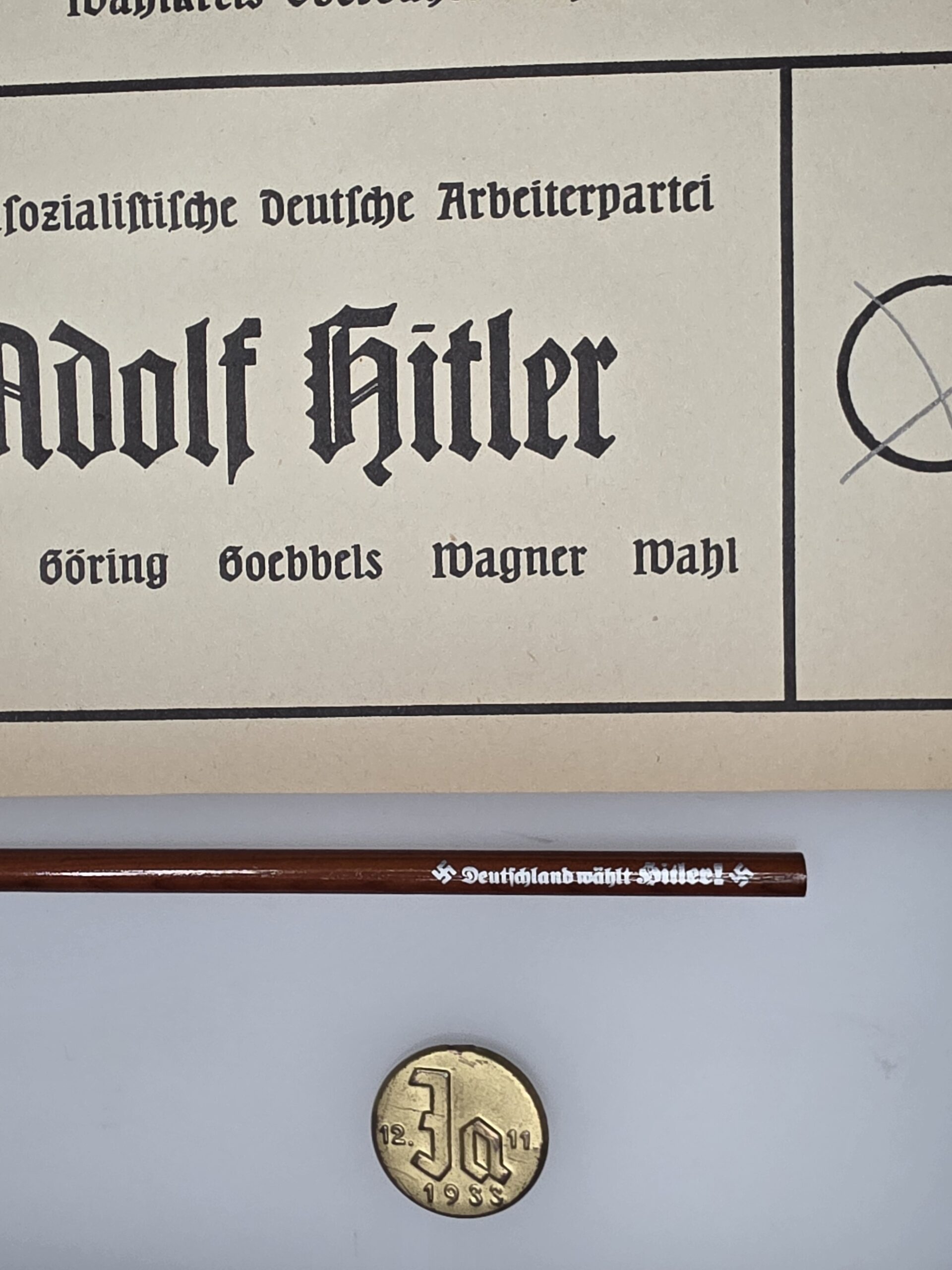
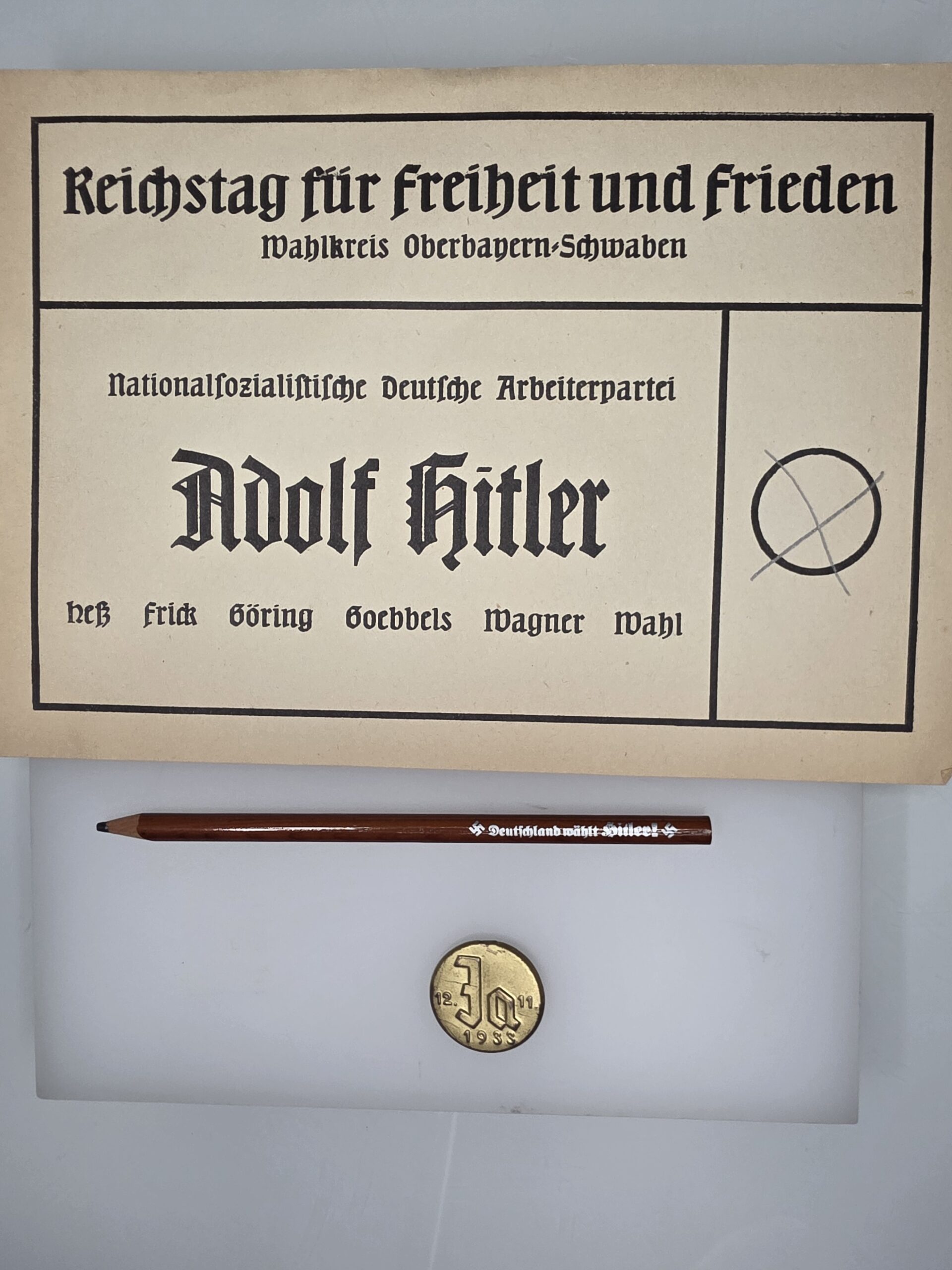
Original Hitler Election Propaganda Set 1933–1936 – Reichstag Ballot, Pencil and Badge
Original price was: 200,00 €.149,00 €Current price is: 149,00 €.
26% Off
Interested in this item? Please contact us directly by email, WhatsApp or through the enquiry form below for availability or other information. Kindly include the item SKU/reference number in your message so we can identify the piece.
Description
Original Hitler Election Propaganda Set from 1933–1936
This original Hitler election propaganda set brings together three period German political objects associated with the consolidation of National Socialist power between 1933 and 1936.
The group comprises:
- An original marked Reichstag ballot paper from 1936
- An original brown “Deutschland wählt Hitler!” propaganda pencil
- An original “Ja – 12.11.1933” election and referendum badge
Although these pieces predate the official beginning of the Second World War, they are directly connected with the development of the Third Reich, Adolf Hitler’s dictatorship and the political system that later led Germany into WWII.
Rather than being an assortment of unrelated souvenirs, this original Hitler election propaganda set combines three different forms of political communication: an official voting document, an everyday promotional object and a wearable badge intended to display public approval.
Original 1936 Adolf Hitler Reichstag Ballot
The principal item is an original printed ballot bearing the prominent heading:
“Reichstag für Freiheit und Frieden”
This can be translated as:
“Reichstag for Freedom and Peace.”
The electoral district is identified beneath the heading as:
“Wahlkreis Oberbayern-Schwaben”
The ballot prominently displays the complete name of the National Socialist German Workers’ Party:
“Nationalsozialistische Deutsche Arbeiterpartei”
The name Adolf Hitler appears in large black Gothic lettering at the centre. Beneath it are the surnames of several leading figures of the regime:
Heß, Frick, Göring, Goebbels, Wagner and Wahl.
A clearly visible pencil cross has been placed inside the printed voting circle on the right-hand side.
The ballot corresponds to the Reichstag election held on 29 March 1936. By this stage, Germany was a one-party dictatorship and voters were presented with a unified list controlled by the NSDAP rather than a genuine choice between competing political parties. The German Historical Museum describes these later Reichstag votes as events without democratic character, used to provide apparent popular legitimacy to decisions made by the National Socialist leadership.
The 1936 Vote and the Remilitarisation of the Rhineland
The 1936 election was called shortly after German troops entered the demilitarised Rhineland in violation of the post-First World War settlement.
Hitler used the election and associated referendum to seek public confirmation of this foreign-policy action. The Federal Agency for Civic Education explains that the campaign was less a genuine election than a public declaration of support for Hitler and his policies. The officially announced result claimed that 98.8 percent had supported the unified list.
The wording “Freiheit und Frieden” — “Freedom and Peace” was therefore highly propagandistic. It presented an aggressive and risky political action as a peaceful restoration of German sovereignty.
For collectors of WWII history, the ballot represents an important stage in the road towards war. The successful Rhineland operation strengthened Hitler’s domestic authority, encouraged further German rearmament and demonstrated the unwillingness of Britain and France to respond militarily at that moment.
Original “Deutschland wählt Hitler!” Election Pencil
The second item is an original brown wooden pencil printed in white with the slogan:
“Deutschland wählt Hitler!”
This translates as:
“Germany votes for Hitler!”
The slogan is positioned between political symbols at both ends of the inscription. The pencil has been sharpened and retains a strong brown surface with the wording clearly visible.
Election pencils of this type were inexpensive pieces of political propaganda. Unlike posters, which were displayed temporarily in streets and public spaces, pencils placed campaign messages on functional everyday objects.
The use of a pencil is particularly relevant within this group because the accompanying ballot retains a visible pencilled cross inside its voting circle. It is not possible to establish that this specific pencil was used to mark this individual ballot, so the pieces are presented as an associated historical set rather than as a documented matched voting group.
Original “Ja – 12.11.1933” Badge
The third object is a circular gold-coloured political badge displaying the large Gothic word:
“Ja”
The German word “Ja” means:
“Yes.”
The date is divided around the central lettering:
12.11.1933
The badge relates to the Reichstag election and national referendum held on 12 November 1933. The referendum concerned Germany’s withdrawal from the League of Nations and was held together with a Reichstag election in which only a National Socialist-dominated unified list was permitted. The German Historical Museum records the connection between the election and the referendum concerning withdrawal from the League of Nations.
Badges carrying the word “Ja” were intended to encourage an affirmative vote and allow the wearer to demonstrate visible political conformity. A museum-documented example describes this model as a small circular badge made from gold-coloured light metal, bearing the date and the word “Ja.”
Specialist collectors consider surviving examples desirable pieces of early National Socialist election propaganda.
From the 1933 One-Party State to the 1936 Controlled Election
The two dates represented in this original Hitler election propaganda set illustrate the rapid transformation of Germany from a damaged parliamentary democracy into a dictatorship.
By November 1933, political opponents had been suppressed and the population was presented with a unified list rather than a competitive election. The regime used mass propaganda to transform voting into a public demonstration of loyalty.
By March 1936, Hitler’s personal power was firmly established. The Reichstag no longer operated as an independent parliamentary institution and was primarily used to approve decisions already made by the leadership.
The ballot, pencil and badge show how similar messages were repeated across official documents, consumer objects and wearable political material. Words such as “freedom,” “peace,” “Germany,” “Hitler” and “yes” were used to create the appearance of national unity while political opposition had already been eliminated.
Connection with the Second World War
These objects were produced before September 1939, but their importance for WWII collections is clear.
They document the political environment that made the later war possible: the elimination of democratic opposition, the construction of the Hitler personality cult, the expansion of state propaganda and the use of controlled referendums to legitimise aggressive foreign policy.
The 1936 ballot is especially relevant because it followed the remilitarisation of the Rhineland, one of the major foreign-policy steps through which Hitler tested and weakened the post-1918 European order. The success of the operation strengthened the regime and contributed to the increasingly aggressive policies that followed.
Condition
The ballot displays natural age toning, small marks, scattered spotting, minor edge wear and light handling creases. The printed design remains dark, complete and clearly legible.
A pencil cross is clearly visible inside the voting circle. The lower-right corner shows a small crease or folded area.
The brown wooden pencil has been sharpened and displays minor wear associated with handling and storage. The white “Deutschland wählt Hitler!” inscription remains clearly visible.
The “Ja – 12.11.1933” badge retains its gold-coloured surface. It displays small scratches, marks, colour variation and age-related surface wear. Only the front of the badge is visible in the supplied photographs, so no statement is made concerning reverse markings or its complete fastening system.
All photographs form an essential part of the condition description.
Original Third Reich Historical Collectible
This original Hitler election propaganda set would be suitable for collections focused on:
- Third Reich political history
- Adolf Hitler election material
- German propaganda
- Pre-WWII Germany
- The origins of the Second World War
- Reichstag ballots and political documents
- NSDAP electoral material
- Political badges and tinnies
- German referendums
- Historical ephemera
- Original twentieth-century documents
The pieces are offered strictly as historical collectables for preservation, research, education and documentation. Their sale does not endorse National Socialist ideology, dictatorship, racial persecution or the political system represented by the objects.
Additional information
| Availability | Available |
|---|
Only logged in customers who have purchased this product may leave a review.
Related products
German Document Archive 1911–1967 – DAF, University and Business Papers
Original price was: 249,00 €.199,00 €Current price is: 199,00 €.
20% Off
WWII German Wehrpass Group – 256th Infantry Division, Ostmedaille & Death Letter
590,00 €
WWII German Document Collection – U-Boat Training, DAF & Arbeitsbuch Archive
Original price was: 490,00 €.440,00 €Current price is: 440,00 €.
10% Off
WWII German Document Archive 1938–1945 – Wehrmacht, IDs & Ration Papers
Original price was: 275,00 €.240,00 €Current price is: 240,00 €.
13% Off
Reviews
There are no reviews yet.