Products on sale
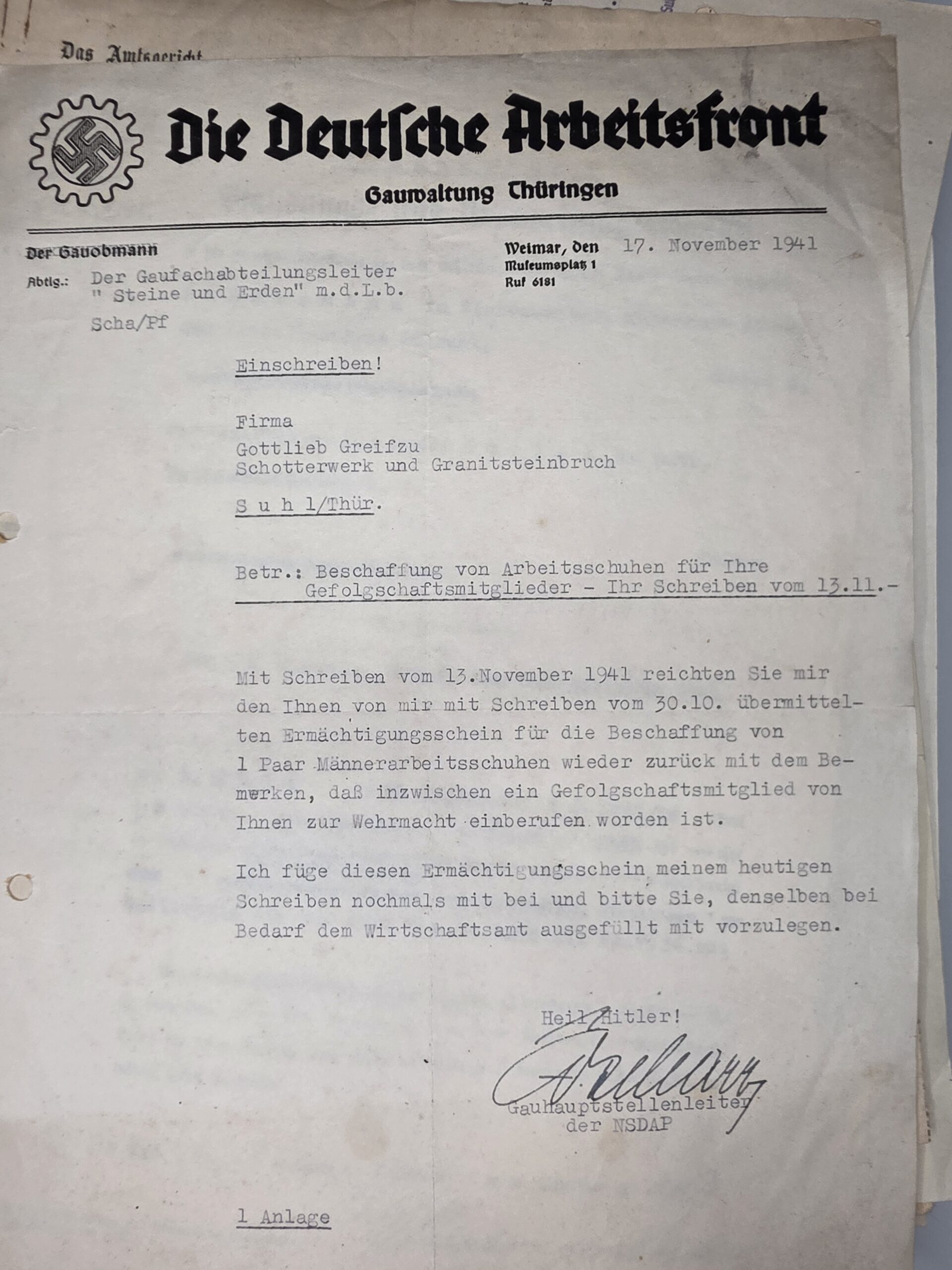
German Document Archive 1911–1967 – DAF, University and Business Papers
Original price was: 249,00 €.199,00 €Current price is: 199,00 €.
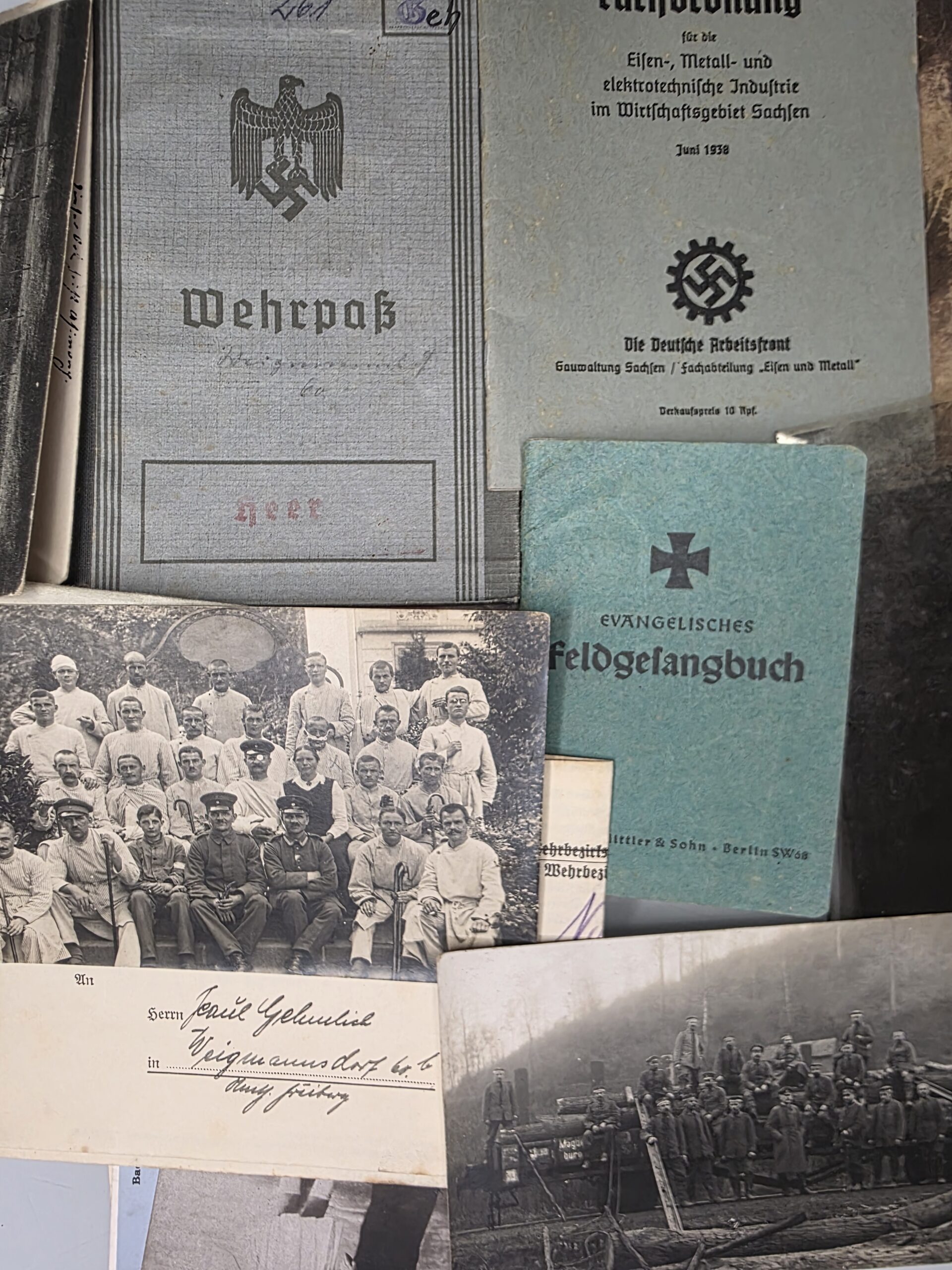
WWII German Wehrpass Group – 256th Infantry Division, Ostmedaille & Death Letter
590,00 €

WWII German Document Collection – U-Boat Training, DAF & Arbeitsbuch Archive
Original price was: 490,00 €.440,00 €Current price is: 440,00 €.
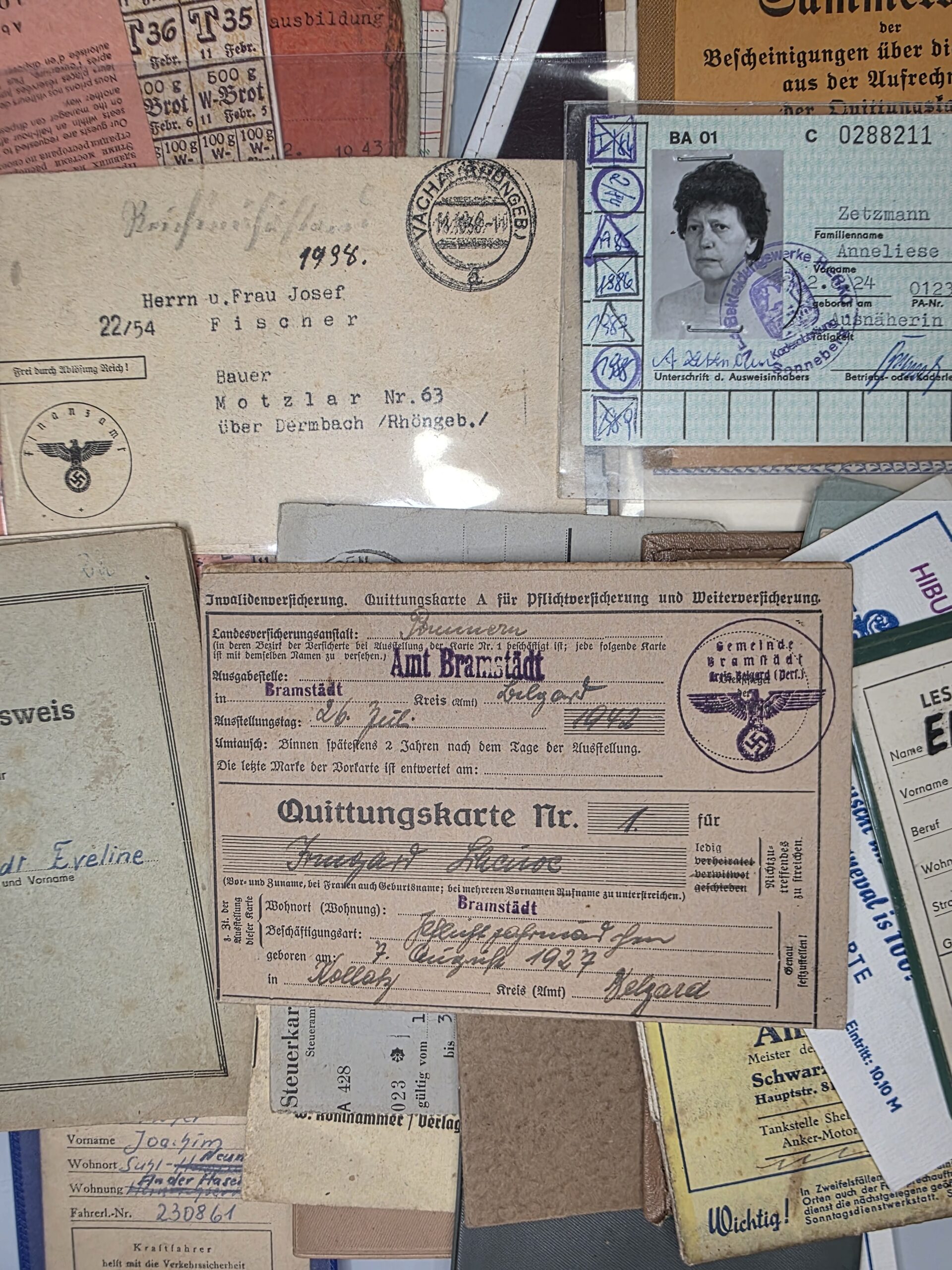
WWII German Document Archive 1938–1945 – Wehrmacht, IDs & Ration Papers
Original price was: 275,00 €.240,00 €Current price is: 240,00 €.

WWII German Wehrpass – Heer Landwehr I Johann Georg Zingler 1937–44
99,00 €
Interested in this item? Please contact us directly by email, WhatsApp or through the enquiry form below for availability or other information. Kindly include the item SKU/reference number in your message so we can identify the piece.
Description
WWII German Wehrpass – Johann Georg Zingler, Heer and Landwehr I
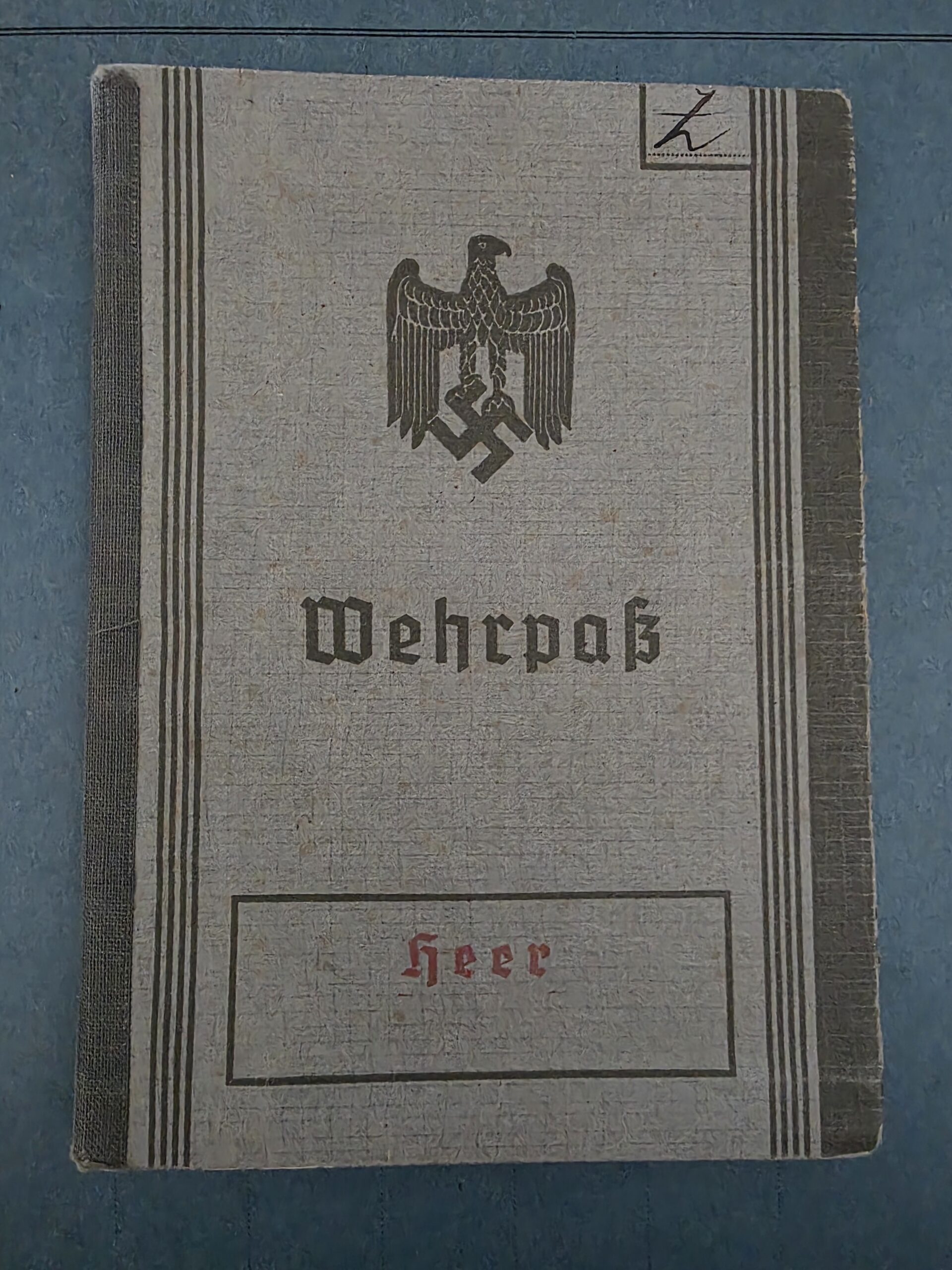
This WWII German Wehrpass is an original period military record belonging to Johann Georg Zingler, a German man born on 13 April 1895. The document carries a clear Heer designation on the front cover and contains handwritten personal information, official military-office stamps and administrative entries spanning the years 1937 to 1944.
Rather than documenting the career of a young front-line serviceman, this Wehrpass is particularly interesting as a record of an older reservist belonging to Landwehr I. It shows how men of Zingler’s generation remained within the German military-registration system and continued to be reviewed by military authorities as the Second World War progressed.
The supplied pages include his personal details, a transfer into Landwehr I dated 1937 and later examination and registration entries from Ehingen (Donau) in 1943 and 1944.
Johann Georg Zingler – Personal Record
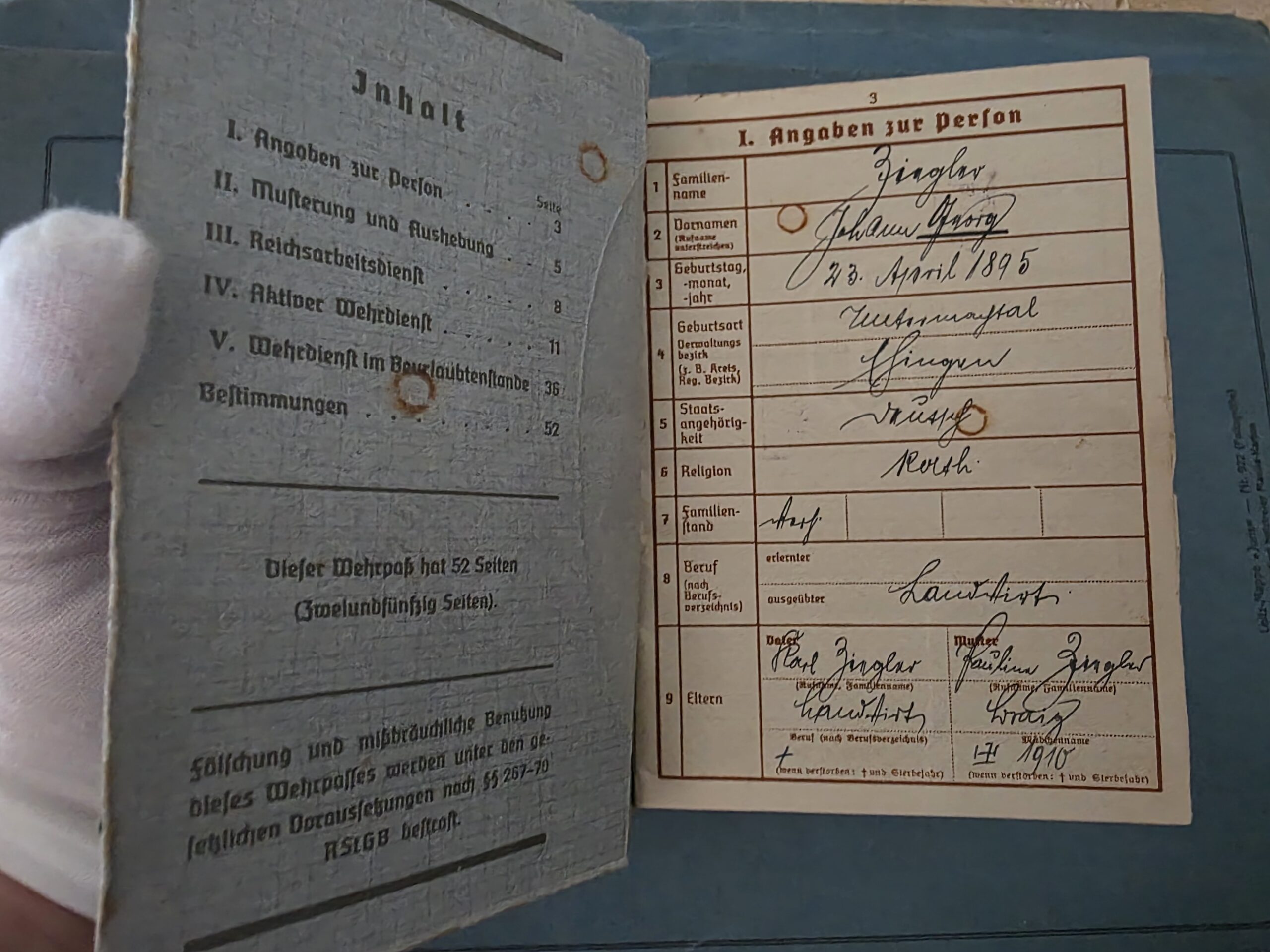
The personal-data page identifies the holder as:
Johann Georg Zingler
His date of birth is recorded as:
13 April 1895
The birthplace appears to read Untermarchtal, with the administrative district recorded as Ehingen.
His occupation is entered as Landwirt, meaning farmer or agricultural worker. His religion is recorded as Catholic, and his marital status appears as verh., the standard abbreviation for verheiratet, or married.
The document also records information concerning his parents. His father is shown as Paul Zingler, likewise associated with agriculture, while his mother is entered separately with her maiden name and a death date in 1910.
These individual details are one reason named Wehrpasses are attractive to collectors: they preserve more than a generic military form. They provide a documentary starting point for researching the life and military status of a real person.
The German Federal Archives continues to accept research enquiries concerning individuals who served or were registered within the former German armed forces, meaning that a named document such as this may potentially be researched further using surviving archival records.
What Was a Wehrpass?
The Wehrpass was a personal military record used within the German armed forces system. Surviving examples contain varying levels of information depending on the individual: personal details, examination results, military status, training, units, promotions, campaigns or awards may appear in different sections.
The Deutsches Historisches Museum preserves Wehrpass examples as historical military identity and administrative documents, describing them as printed, handwritten and stamped personal records.
This example belongs to the Heer, the German Army branch of the Wehrmacht, as indicated directly on the cover.
However, it is important not to confuse the branch designation with evidence of front-line service. The pages supplied here principally document Zingler’s military-liability and reserve status. No specific field regiment, combat campaign or decoration is visible in the photographs provided.
That distinction makes the description historically more accurate.
Landwehr I – Entry Dated 12 March 1937
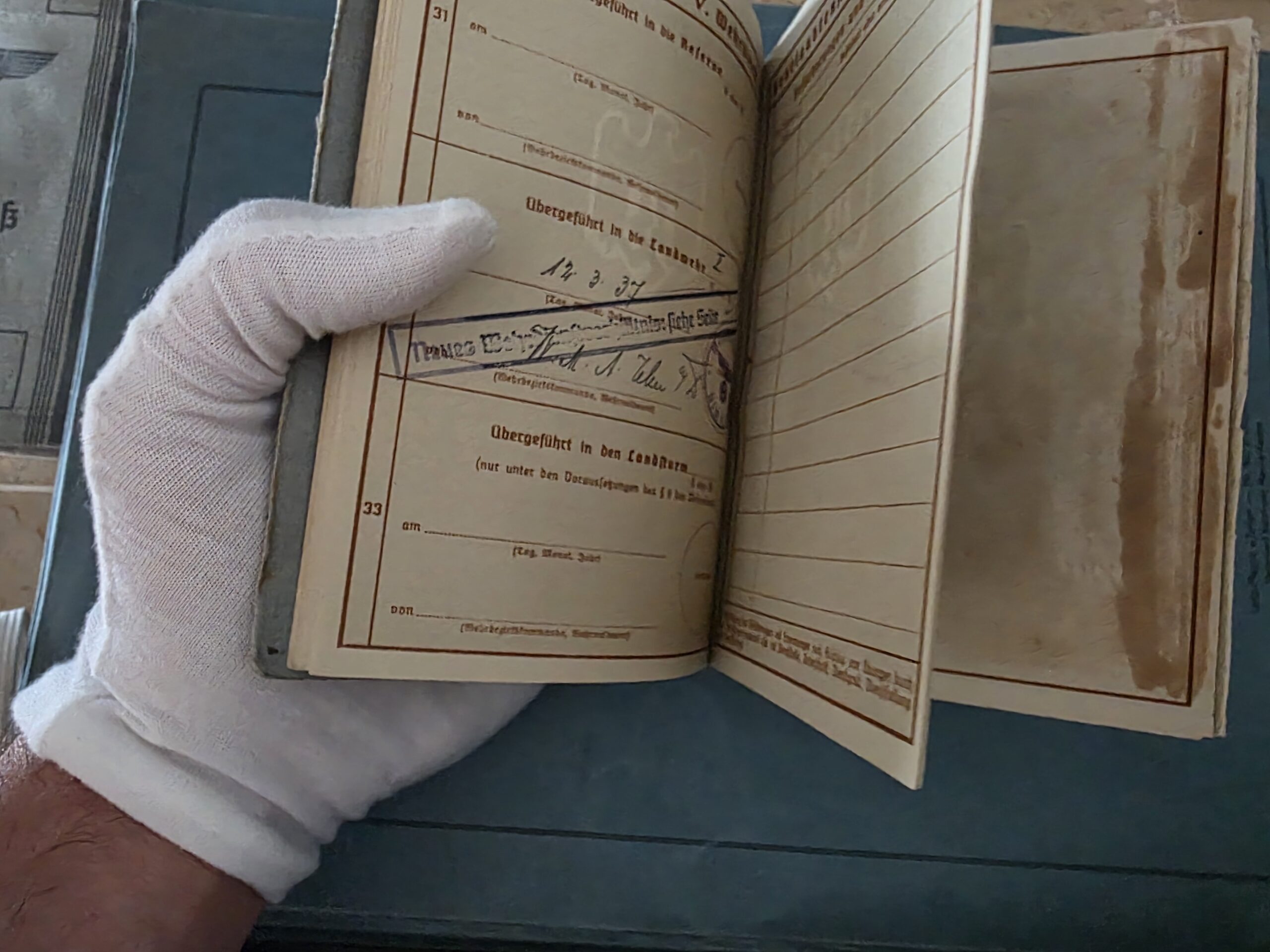
One of the strongest entries in this Wehrpass appears on the later military-status pages:
“Übergeführt in die Landwehr I”
followed by the date:
12.3.37
This means that Zingler was transferred into the Landwehr I category on 12 March 1937.
The German Wehrgesetz of 21 May 1935 reorganised military liability following the restoration of conscription. Its provisions placed men within different reserve categories according to age, previous training and military status. The law defined Landwehr obligations within the older military-age groups, while contemporary military classifications distinguished Landwehr I from Landwehr II according to training.
For a man born in 1895, the 1937 Landwehr entry is entirely plausible. Zingler was approaching 42 years old when the notation was made.
This is particularly useful historically because it places the document in the period before the outbreak of the Second World War, showing the expansion and organisation of German reserve manpower during the rearmament years.
Bundesarchiv material also documents Landwehr organisation and training activity during 1936–37, confirming the wider institutional context in which these older reserve classes were being organised.
Wartime Reviews in 1943 and 1944
The Musterung page becomes particularly interesting because the administrative trail continues well into the Second World War.
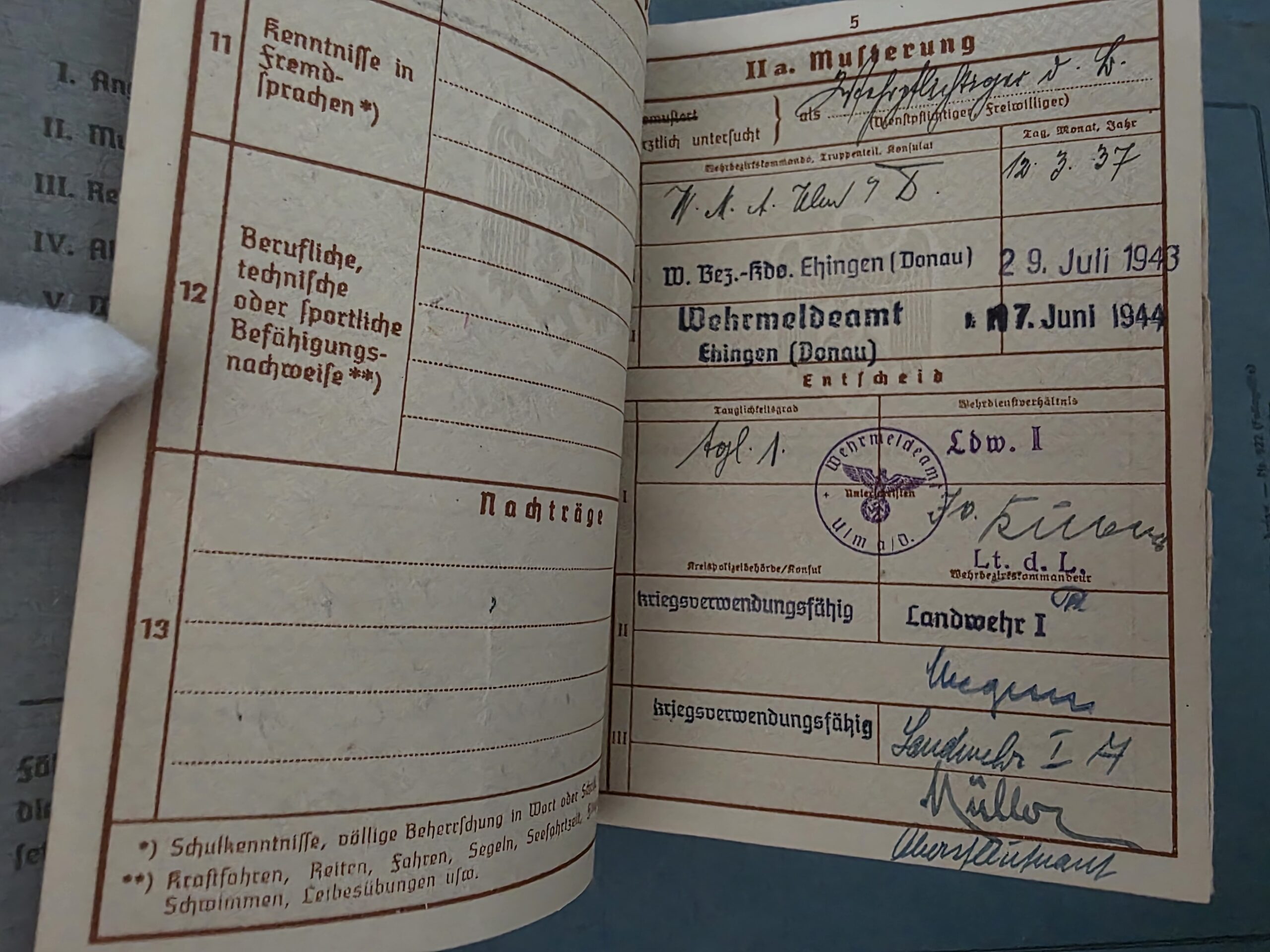
A clear purple marking reads:
W. Bez.-Kdo. Ehingen (Donau)
29. Juli 1943
This refers to the Wehrbezirkskommando Ehingen (Donau), the district military authority responsible for local military administration.
A second stamp reads:
Wehrmeldeamt Ehingen (Donau)
17. Juni 1944
These entries show that Johann Georg Zingler remained within the military-registration system and was still being administratively reviewed during the later stages of the war.
The same page records Landwehr I and the classification “kriegsverwendungsfähig.” In period military terminology, this indicated fitness for wartime employment or active wartime use.
The sequence is therefore especially interesting:
1937 – transfer to Landwehr I
1943 – examination/administrative entry at Wehrbezirkskommando Ehingen
1944 – further Wehrmeldeamt Ehingen entry
For a collector, this chronological continuity gives the Wehrpass more documentary value than an otherwise largely blank example.
Older Reservists and the Wartime Manpower System
The Landwehr system involved older military-liable men who remained available within the wider reserve structure.
Under the 1935 military law, German military liability generally extended to the end of the 45th year, with the Landwehr covering older age classes. The Landwehr I classification was normally associated with trained men within this older group.
When war mobilisation began in 1939, Landwehr formations also contributed to the expansion of the German Army. Bundesarchiv’s digitised Georg Tessin reference material notes that Landwehr formations were incorporated into wartime infantry structures and that many men involved were veterans or older trained personnel.
This broader context helps explain why a man born as early as 1895 could still appear in military administrative documentation during 1943–44.
It does not, however, mean that Zingler necessarily served in combat. The surviving entries shown here establish his classification and continuing military registration, but not a specific operational deployment.
Collector’s Interest
From a collector’s perspective, the appeal of this WWII German Wehrpass lies in its coherent administrative history.
The strongest points are:
- named to Johann Georg Zingler;
- born 13 April 1895;
- occupation recorded as Landwirt;
- Heer designation on the cover;
- transfer to Landwehr I in March 1937;
- military-office entry from Ehingen dated July 1943;
- further Wehrmeldeamt entry from June 1944;
- wartime fitness classification;
- original handwriting, stamps and period paper construction.
This makes the document suitable for collections focused on German military administration, Wehrpass documentation, reserve and Landwehr organisation, WWII-era paperwork or individual military research.
Its interest is different from that of a combat Wehrpass containing medals, campaign lists or famous formations. This example is more useful as a record of mobilisation, reserve classification and wartime manpower administration.
That distinction should be seen as part of the document’s history rather than a weakness.
Condition
The Wehrpass remains in genuine used period condition.
The front cover shows age toning, spotting, rubbing, edge and corner wear and general handling. The cloth spine remains present, while the printed eagle, swastika and Wehrpass title are clearly visible.
Internally, the pages show natural paper ageing, staining and handling marks. Several circular stains or marks are visible across the pages. The handwritten personal information and the principal military stamps remain readily legible.
Later pages show heavier staining, particularly near the rear of the booklet.
No attempt has been made to describe the document as mint or unusually preserved. Its appearance is consistent with an administrative booklet that has survived decades of use and storage.
The photographs form an integral part of the condition description.
Authenticity
Original period German Heer Wehrpass from the 1937–1944 period.
The period printing, paper, binding, handwriting, stamps, administrative structure and visible ageing are consistent with an original used Wehrpass.
The supplied pages document Johann Georg Zingler’s Landwehr status and wartime administrative processing. No specific combat service, military decoration or field-unit assignment is claimed without documentary evidence.
Historical Responsibility Notice
This original document is offered strictly for historical, documentary, educational and collecting purposes.
Autographs & Militaria has no political or ideological affiliation with, sympathy for or endorsement of National Socialism, the Nazi regime or the organisations and symbols represented by this material.
HISTORICAL CONTEXT:
Germany’s 1935 Wehrgesetz re-established a comprehensive compulsory military system and divided men into active and reserve categories according to age and training. The Landwehr formed part of this wider structure, with older trained men remaining subject to military obligations.
COLLECTOR’S INTEREST:
The main interest of this Wehrpass is the documented progression from Landwehr I in 1937 to wartime administrative reviews at Ehingen in 1943 and 1944. It is a useful example of how an older German reservist remained within the Wehrmacht manpower system during WWII.
CONDITION AND AUTHENTICITY NOTE:
Original used period document showing age toning, cover wear, spotting, staining and general handling. Handwriting and important official stamps remain visible. Photographs form part of the condition description.
HISTORICAL RESPONSIBILITY NOTICE:
Offered solely as historical and documentary material. No ideological endorsement is intended or implied.
1. Is this an original WWII German Wehrpass?
Yes. It is an original period German Heer Wehrpass containing handwritten personal details, official military markings and administrative entries dated between 1937 and 1944.
2. Who did this Wehrpass belong to?
The document is named to Johann Georg Zingler, born 13 April 1895 and recorded as a farmer.
3. What does Landwehr I mean?
Landwehr I was a German reserve classification for older trained military-liable men. Under the 1935 military system, it applied broadly to trained men within the older 35–45 age group.
4. Did Johann Georg Zingler serve in combat during WWII?
The photographs supplied do not establish a specific front-line unit or campaign. They confirm Landwehr I status and continued military-administrative registration through 1944, but combat service should not be claimed without further evidence.
5. Can Johann Georg Zingler be researched further?
Potentially. The Bundesarchiv accepts research requests for surviving personnel records connected with members and registrants of the German armed forces up to 1945.
Additional information
| Availability | Available |
|---|
Only logged in customers who have purchased this product may leave a review.
Related products
German Document Archive 1911–1967 – DAF, University and Business Papers
Original price was: 249,00 €.199,00 €Current price is: 199,00 €.
20% Off
WWII German Wehrpass Group – 256th Infantry Division, Ostmedaille & Death Letter
590,00 €
WWII German Document Collection – U-Boat Training, DAF & Arbeitsbuch Archive
Original price was: 490,00 €.440,00 €Current price is: 440,00 €.
10% Off
WWII German Document Archive 1938–1945 – Wehrmacht, IDs & Ration Papers
Original price was: 275,00 €.240,00 €Current price is: 240,00 €.
13% Off
Reviews
There are no reviews yet.