
WWII German Arbeitsbuch – Georg Ziegler Original Work Book
49,00 €
Interested in this item? Please contact us directly by email, WhatsApp or through the enquiry form below for availability or other information. Kindly include the item SKU/reference number in your message so we can identify the piece.
Description
WWII German Arbeitsbuch – Original Labour Record of Georg Ziegler
This WWII German Arbeitsbuch is an original Deutsches Reich employment record book issued to Georg Ziegler, retaining handwritten personal information and period employment-related entries. It is an original civilian administrative document from National Socialist Germany and illustrates the system used by the state and employment offices to record and regulate workers during the 1930s and Second World War period.
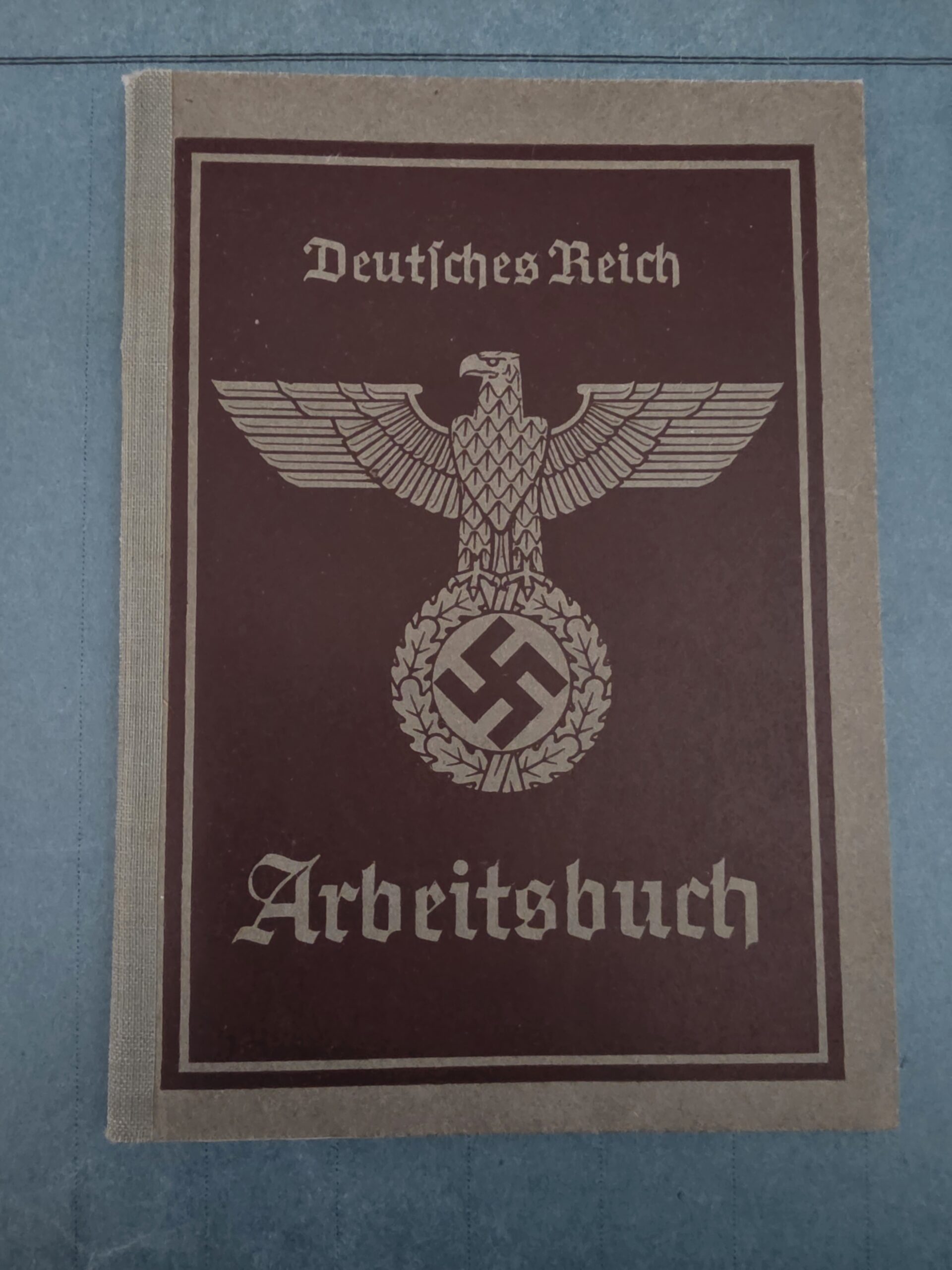
The front cover bears the title “Deutsches Reich – Arbeitsbuch” together with the German state eagle and swastika. Inside, the opening page identifies the document as an Arbeitsbuch established under the law of 26 February 1935, Reichsgesetzblatt I, page 311, exactly matching the legislation through which the German government introduced this form of employment documentation. The historical law is independently preserved in archival sources and was approved by the Reich cabinet on 26 February 1935.
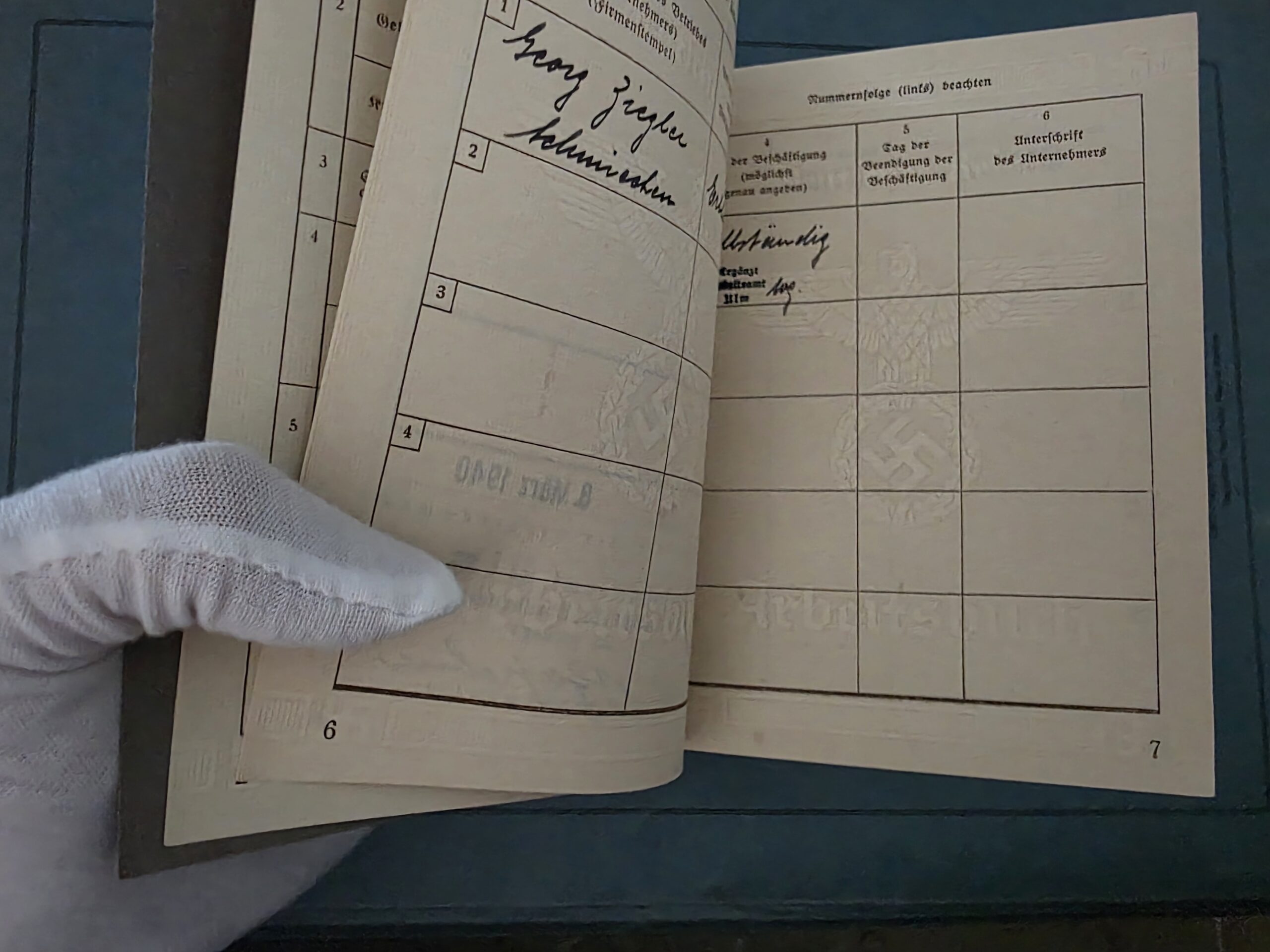
The booklet is named to Georg Ziegler in handwritten script. Subsequent pages contain his personal and family information, residence details and employment-related entries.
What Was a German Arbeitsbuch?
The German Arbeitsbuch was an employment record book rather than a military identity document.
Arolsen Archives explains that German workers were increasingly required to possess these books from 1935 onward. A worker generally had to present the Arbeitsbuch in connection with employment, while employment offices and employers used it to record personal details, professional information and individual jobs. The system formed part of the regime’s wider regulation of the labour market, known as Arbeitseinsatz.
The Reich cabinet documentation surrounding the 1935 law is especially revealing. Bundesarchiv’s published Akten der Reichskanzlei records the approval of the Gesetz über die Einführung eines Arbeitsbuches and notes that the system became connected with the planned management of skilled labour for the expanding armaments economy.
This makes an original Arbeitsbuch more than a simple old employment booklet. It is also surviving evidence of how civilian employment became increasingly subject to central administrative control under the National Socialist state.
Georg Ziegler – A Named Civilian Record
The principal collecting interest of this example is that it remains connected to an identifiable individual.
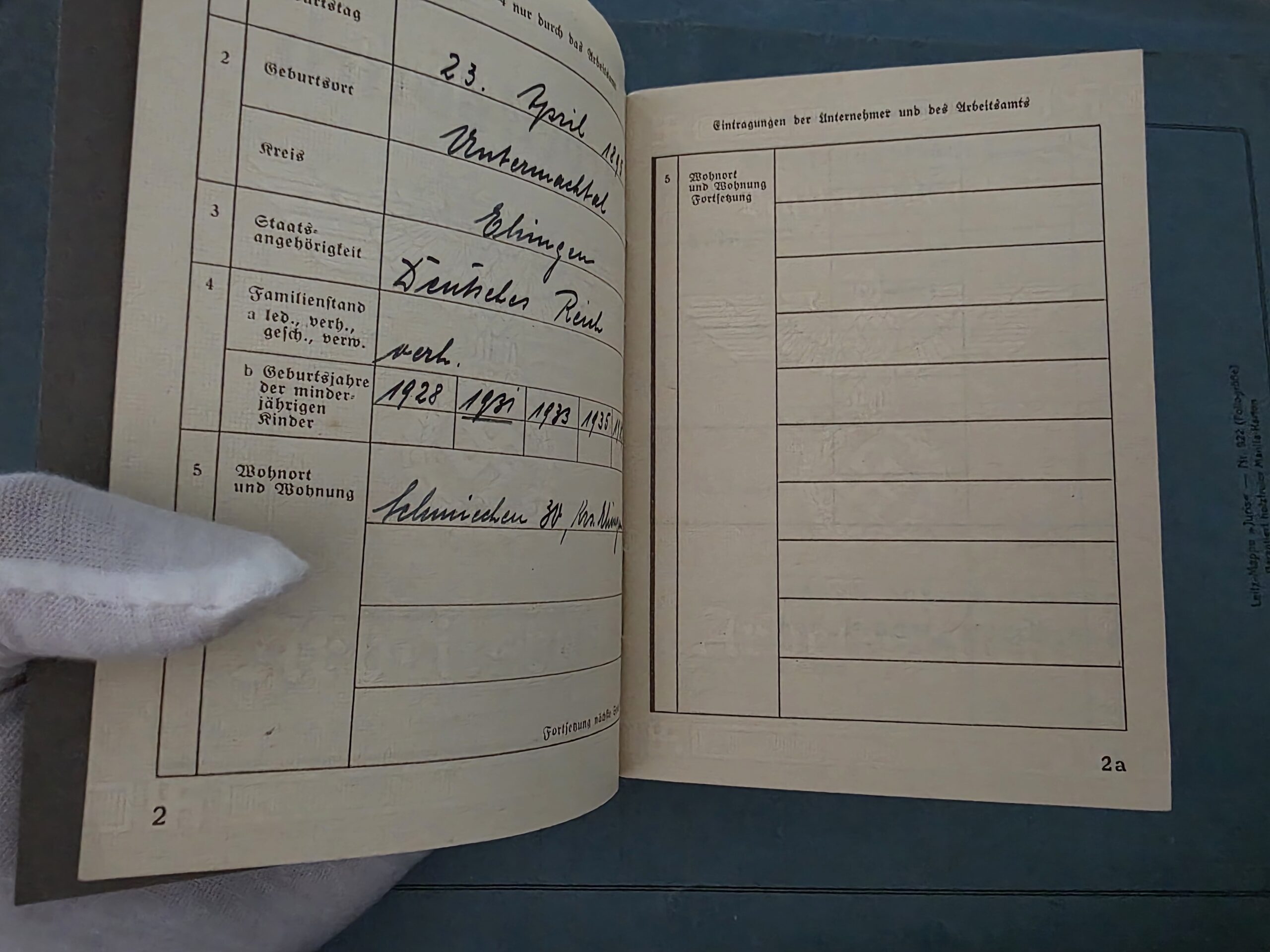
The first page records the name Georg Ziegler. The personal-data pages contain additional handwritten information including a birth date beginning 23 April, references to Kreis Ehingen, marital status and the birth years of several children.
The residence entry appears to reference Schmiechen and the Ehingen district. Because some of the old German handwriting is partially obscured by the curvature of the page, details that cannot be read with confidence have deliberately not been expanded or reconstructed.
This conservative approach is important with historical documentation. Names, locations and dates should only be presented as definitive when the manuscript itself supports the reading.
Family and Personal Information
Arbeitsbücher were not simply registers of employers.
The personal pages could contain information useful for identifying the worker administratively, including:
- full name;
- date and place of birth;
- nationality;
- marital status;
- children;
- residence;
- professional information;
- subsequent employment entries.
On this example, several of these fields remain completed in period handwriting.
The children’s birth-year section appears to include multiple entries, including 1928, 1931, 1933 and 1935, which gives the document an additional personal dimension. Rather than an anonymous piece of Third Reich stationery, the booklet represents part of the administrative history of a specific German civilian and his family.
Employment Documentation Under the Third Reich
The Arbeitsbuch system was designed to allow employment offices to maintain an overview of workers and their occupations.
Arolsen Archives notes that these books contained both personal information and entries relating to individual employment, and that employers and labour offices used corresponding records to keep track of changes in employment. Over time, the requirement was extended to a very broad proportion of the working population.
This administrative function is particularly relevant historically. During the National Socialist period, employment policy increasingly became linked to wider economic planning and the mobilisation of labour resources. The Arbeitsbuch therefore sits at the intersection of everyday civilian life, bureaucracy, employment control and Germany’s expanding wartime economy. The 1935 cabinet records explicitly connect the introduction of the system with the management of labour required by the armaments sector.
The booklet should consequently be understood as civilian labour documentation, not as a Wehrpass, Soldbuch or other military service record.
The Document Itself
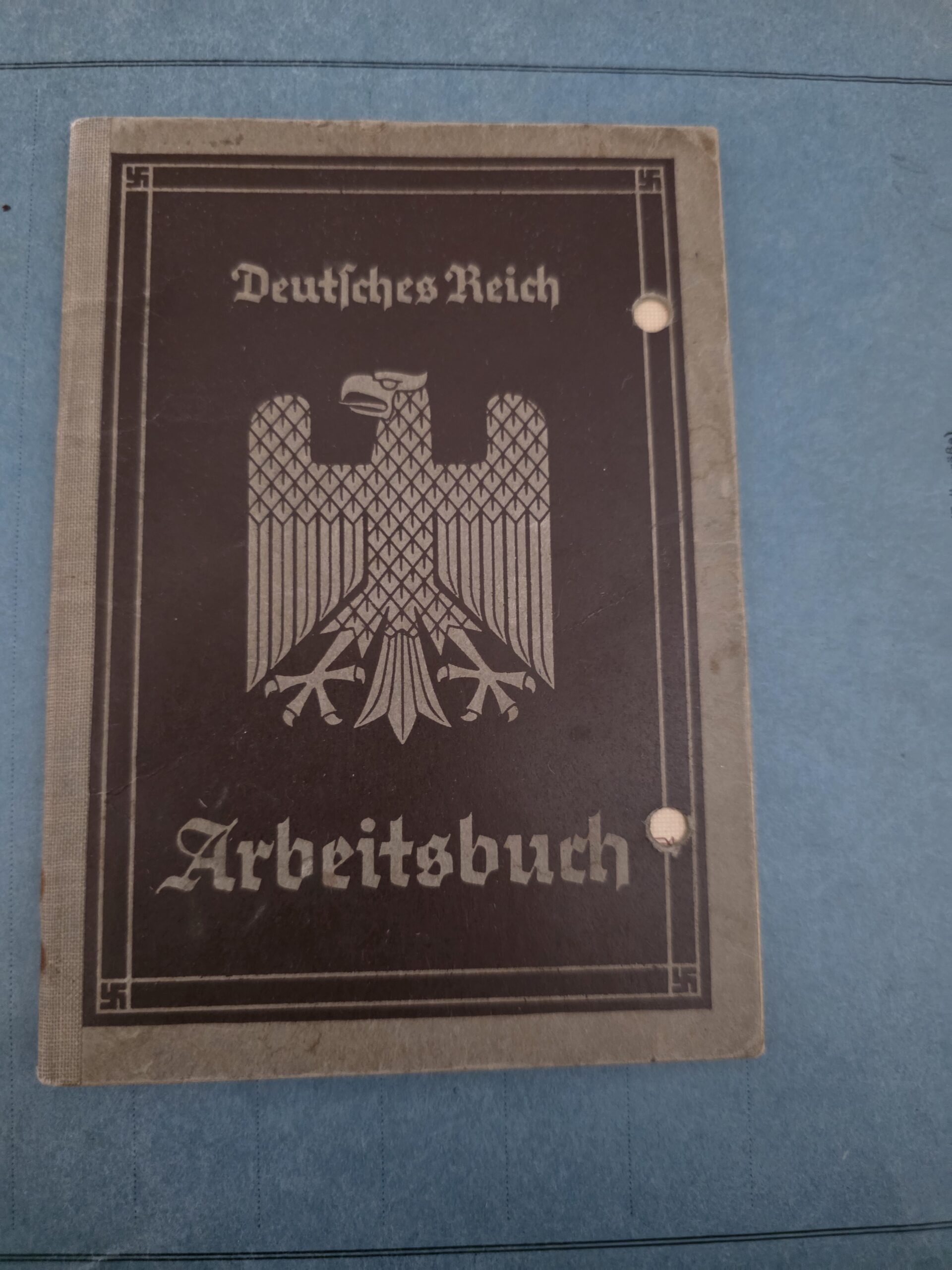
The cover uses the characteristic design associated with these German employment books: a brown and grey card construction with a darker central field, the inscription Deutsches Reich, the state eagle and swastika, and the large word Arbeitsbuch below.
Internally, the pages use a structured printed format for recording the holder’s identity and employment history. The first page bears the legal reference:
“Gesetz vom 26. Februar 1935, RGBl. I S. 311.”
This refers directly to the legislation introducing the system. Contemporary and archival sources confirm this exact law and citation.
The book also retains the distinctive official typography, watermarked or embossed state-emblem design visible through several internal pages, handwritten entries and period administrative markings.
No photograph is present, but this particular format should not be confused with a Wehrpass or Kennkarte where a photographic identification element may form a more central part of the document.
Collector’s Interest
From a collector’s perspective, an original WWII German Arbeitsbuch occupies a different collecting category from military service documents.
Its appeal lies primarily in civilian and social-history documentation. It may be of interest to collectors specialising in:
- Third Reich civilian documents;
- WWII German paperwork;
- German employment records;
- National Socialist administration;
- everyday life in wartime Germany;
- labour history;
- named historical documents;
- German ephemera and identity documentation.
Named books are generally more interesting than unused examples because they preserve traces of an individual life rather than merely demonstrating the printed format.
Georg Ziegler’s personal details and surviving entries provide precisely that documentary element.
The document is also useful when constructing a broader collection showing the different types of paperwork encountered by German civilians and servicemen. A Wehrpass documented military liability and service, while a Kennkarte functioned as civil identification and an Arbeitsbuch documented employment and labour administration.
Together, these document types provide very different perspectives on everyday bureaucracy in Germany during the period.
Condition
The Arbeitsbuch appears to remain in good period condition for its age.
The cover retains strong printed detail and remains visually attractive, with expected surface wear, minor edge rubbing and handling associated with an original paper document of this age.
Internally, the pages show natural ageing, light toning and handling. The handwritten personal details remain legible in the areas visible in the photographs. Some employment pages appear only lightly completed or unused.
There are no claims of mint condition. The signs of use are consistent with a working administrative document rather than an unused surviving booklet.
The supplied photographs form an integral part of the condition description and should be examined carefully.
Authenticity
Original period German Arbeitsbuch from the National Socialist era.
The cover design, internal printing, legal wording, page layout, handwriting, paper ageing and administrative format visible in the supplied photographs are consistent with an original period-issued example.
No provenance or employment history beyond what can actually be established from the visible pages is claimed.
Historical Responsibility Notice
This WWII German Arbeitsbuch is offered strictly as an original historical document for collecting, documentary, educational and research purposes.
Autographs & Militaria has no political or ideological affiliation with, sympathy for or endorsement of National Socialism, the Nazi regime or any organisation represented by the historical symbols appearing on this document.
1. What is a WWII German Arbeitsbuch?
An Arbeitsbuch was a German employment-record book used to document a worker’s personal and professional information. From 1935 onward it became an important part of the National Socialist labour-control system.
2. Is this an original Third Reich Arbeitsbuch?
Yes. The document is an original period example with the characteristic cover, internal legal reference, handwritten personal information and period administrative entries.
3. Who did this Arbeitsbuch belong to?
The opening page records the holder as Georg Ziegler. Additional handwritten pages contain information about his birth, family, residence and employment.
4. Was an Arbeitsbuch a military document?
No. It was fundamentally a civilian employment document, although the labour-control system became increasingly connected with Germany’s economic mobilisation and armaments requirements.
5. Why are original German Arbeitsbücher collectible?
They document everyday civilian administration under the Third Reich and can preserve the personal histories of individual workers. Named and completed examples are particularly useful for collections focused on labour history, bureaucracy and German social history.
Additional information
| Availability | Available |
|---|
Only logged in customers who have purchased this product may leave a review.
Related products
WWII German Wehrpass – Willi Geller, Hannover 1938–44
Original German Arbeitsbuch – Wilhelm Hils, Karlsruhe, 1st Pattern
49,00 €
WWII German Wehrpass – Heinrich Brockmöller UK Exemption Papers 1940–43
99,00 €
WWII German Wehrpass – Heer Landwehr I Johann Georg Zingler 1937–44
99,00 €
Reviews
There are no reviews yet.