
Products on sale
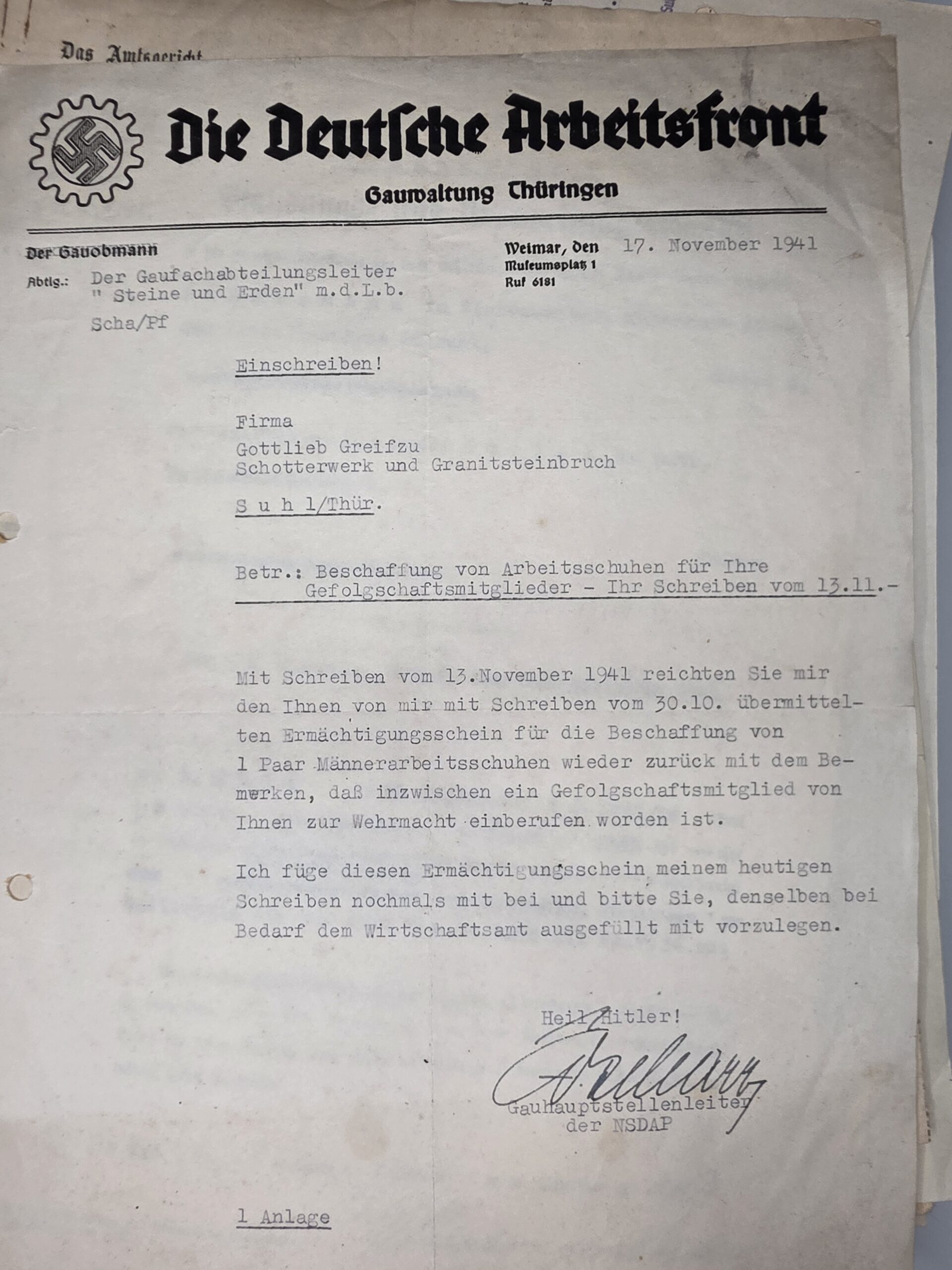
German Document Archive 1911–1967 – DAF, University and Business Papers
Original price was: 249,00 €.199,00 €Current price is: 199,00 €.
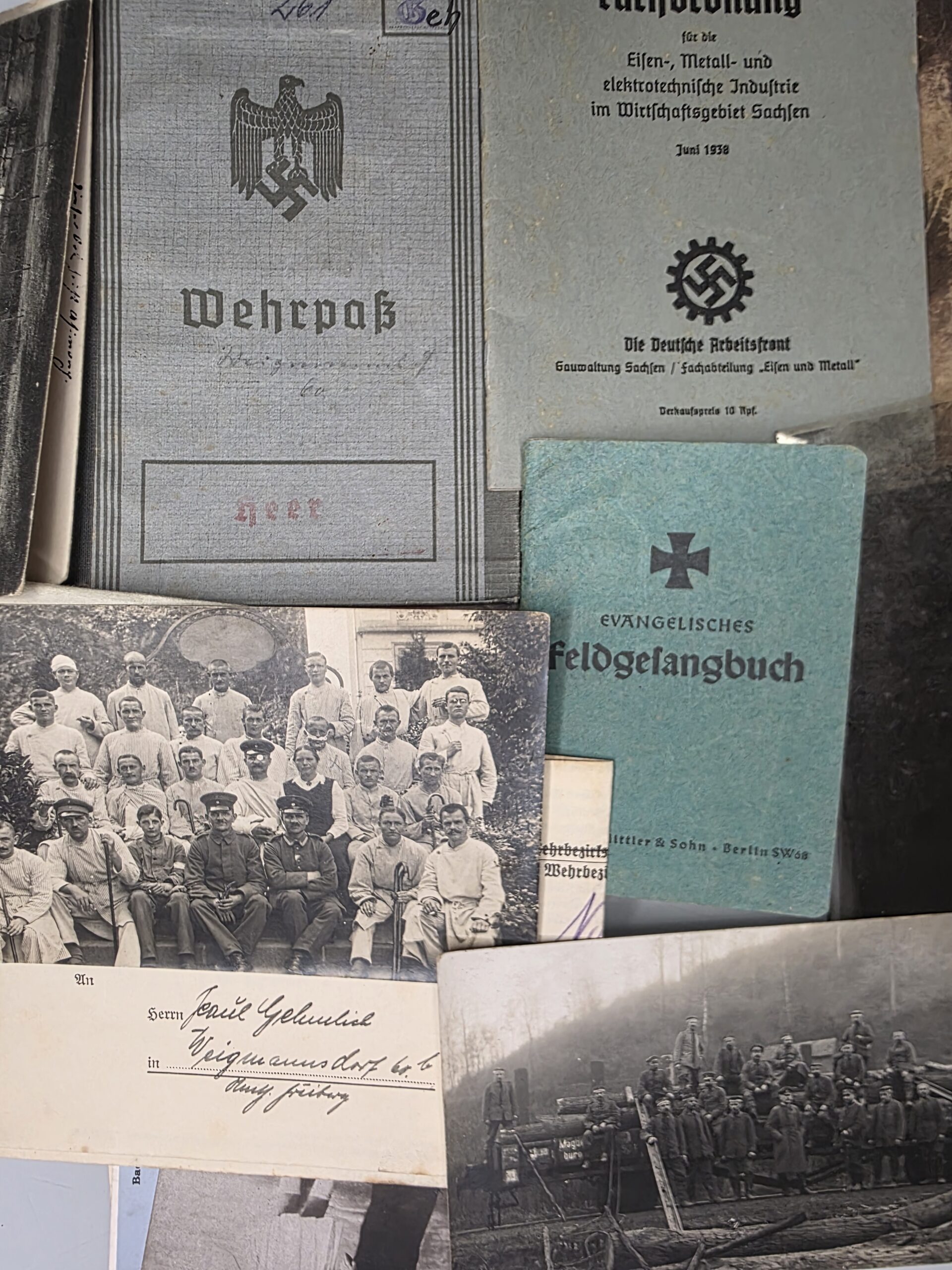
WWII German Wehrpass Group – 256th Infantry Division, Ostmedaille & Death Letter
590,00 €

WWII German Document Collection – U-Boat Training, DAF & Arbeitsbuch Archive
Original price was: 490,00 €.440,00 €Current price is: 440,00 €.
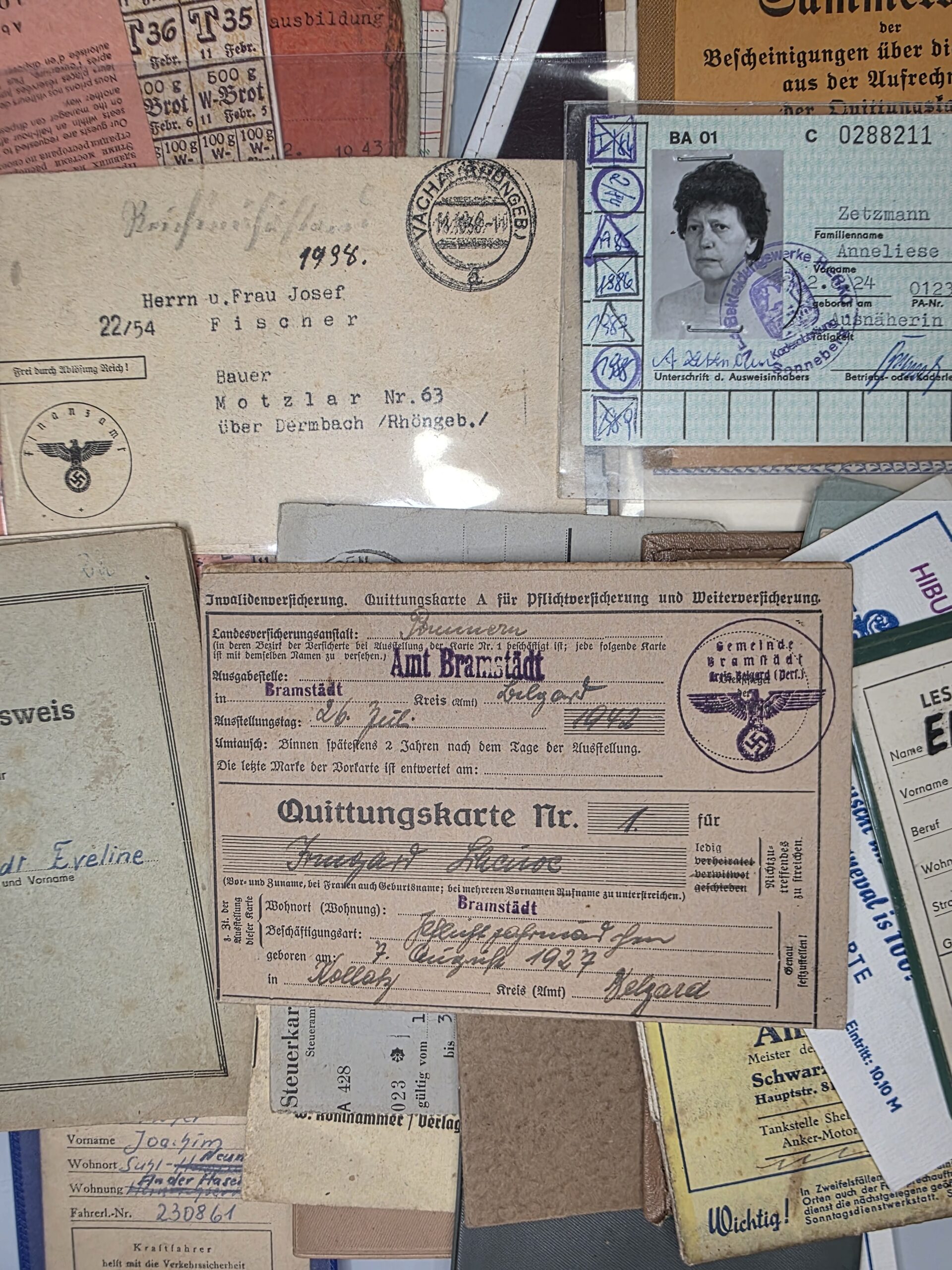
WWII German Document Archive 1938–1945 – Wehrmacht, IDs & Ration Papers
Original price was: 275,00 €.240,00 €Current price is: 240,00 €.
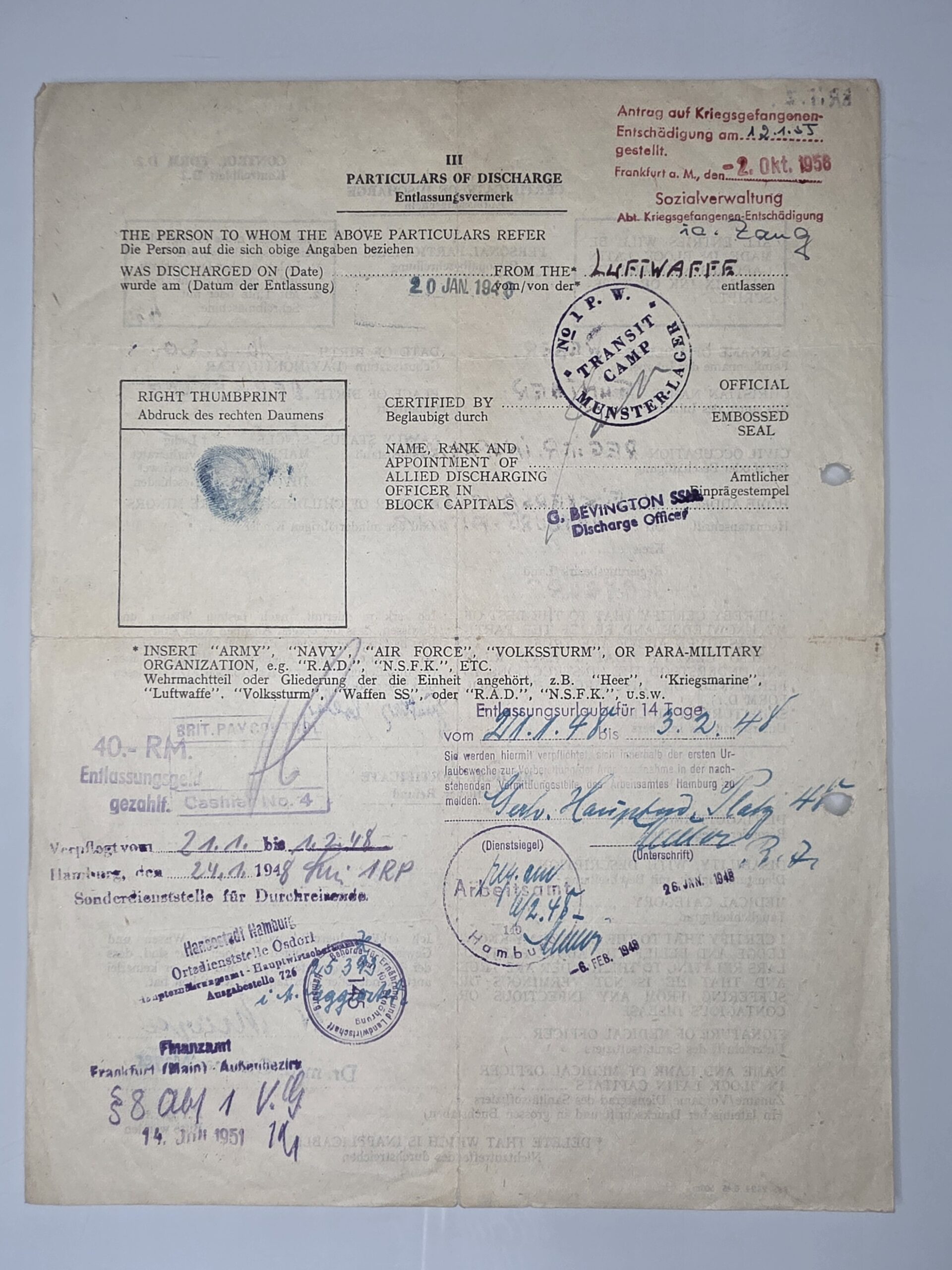


German POW Documents WWII – Original 4-Piece Marbury Hall Archive
Original price was: 225,00 €.190,00 €Current price is: 190,00 €.
16% Off
Interested in this item? Please contact us directly by email, WhatsApp or through the enquiry form below for availability or other information. Kindly include the item SKU/reference number in your message so we can identify the piece.
Description
German POW documents from Marbury Hall and Münsterlager
German POW documents forming a coherent four-piece archive relating to Günther Weber, a German prisoner of war held by the British after the Second World War.
The group covers the final period of Weber’s captivity, his work at Marbury Hall P.O.W. Working Camp, his return to Germany and his formal discharge at Münsterlager in January 1948.
What makes this group interesting from a collector’s point of view is the continuity between the documents. These are not four unrelated pieces of paperwork. Weber’s name, personal details and prisoner number connect the papers, allowing part of one man’s postwar POW history to be followed through several different stages.
British records confirm that Marbury Hall in Cheshire was used as a prisoner-of-war camp, although surviving sources show variations in camp numbering. The testimonial itself explicitly identifies its issuing establishment as “No. 189 (G) P.W. Wkg. Camp, Marbury Hall, Northwich, Ches.” Historic England also records Marbury Hall among Britain’s POW camp sites.
1. Marbury Hall POW Camp testimonial – 10 January 1948
Perhaps the most personal document in the group is headed:
“Certificate and Testimonial”
and was issued at:
No. 189 (G) P.W. Wkg. Camp
Marbury Hall
Northwich, Cheshire
It identifies:
POW No. 576758 – Weber, Guenther – born 10 June 1920
The certificate records that Weber worked as:
“a chief clerk in the camp-leader’s office”
between 2 August 1946 and 10 January 1948.
More unusually, it contains a short assessment of his work, stating that he carried out his duties to the satisfaction of the camp administration and describing him as a hard and conscientious worker.
The document is signed by camp personnel, including the camp administration and the commandant of No. 189 (G) P.W. Working Camp. A German translation of the testimonial appears beneath the English text and is separately signed by an interpreter.
I would not advertise these signatures as famous autographs. Their importance is administrative: they authenticate the document within the functioning POW camp structure.
From a collecting perspective, this is considerably more informative than a simple prisoner number or registration slip because it tells us what Weber was actually doing during almost a year and a half of his captivity.
German POW documents and the return from Britain
German prisoners remained in Britain well after the end of the war. Repatriation began on a larger scale in 1946 and was not completed until 1948. British historical research records that the German POW population in Britain peaked at approximately 402,000 in September 1946.
Weber’s documents fit directly into this late-repatriation period.
2. Allied Control Form D.2 – Certificate of Discharge
The second major element is an original bilingual:
Certificate of Discharge / Entlassungsschein – Control Form D.2
The Imperial War Museums also holds examples of this exact class of Allied Control Form D.2 issued to Germans after the war, confirming its use as an official discharge document.
Weber’s form contains his personal particulars, including:
Surname: Weber
Christian name: Günther
Date of birth: 10 June 1920
Home: Hamburg-Altona
Address: Fischers Allee 36
The reverse is particularly interesting.
It records his formal discharge on 20 January 1948 and identifies the service branch as the:
Luftwaffe
The document carries the circular stamp of:
No. 1 P.W. Transit Camp – Münsterlager
together with several administrative signatures and stamps.
Most visually interesting is Weber’s original right thumbprint, applied directly to the discharge document.
That small detail gives these German POW documents a much more personal character than ordinary military paperwork.
Münsterlager and discharge
Münsterlager served as an important British-controlled processing point for returning German prisoners. Historical research specifically identifies it as an official POW discharge camp during the postwar repatriation process.
Weber’s Control Form therefore appears to document the transition from captivity in Britain through the British repatriation system and back into civilian life in Germany.
The reverse also accumulated later German administrative stamps and annotations, extending the documentary history beyond the simple date of release.
Among them is a 1956 stamp concerning a claim for prisoner-of-war compensation, showing that the document continued to have administrative significance years after Weber returned home.
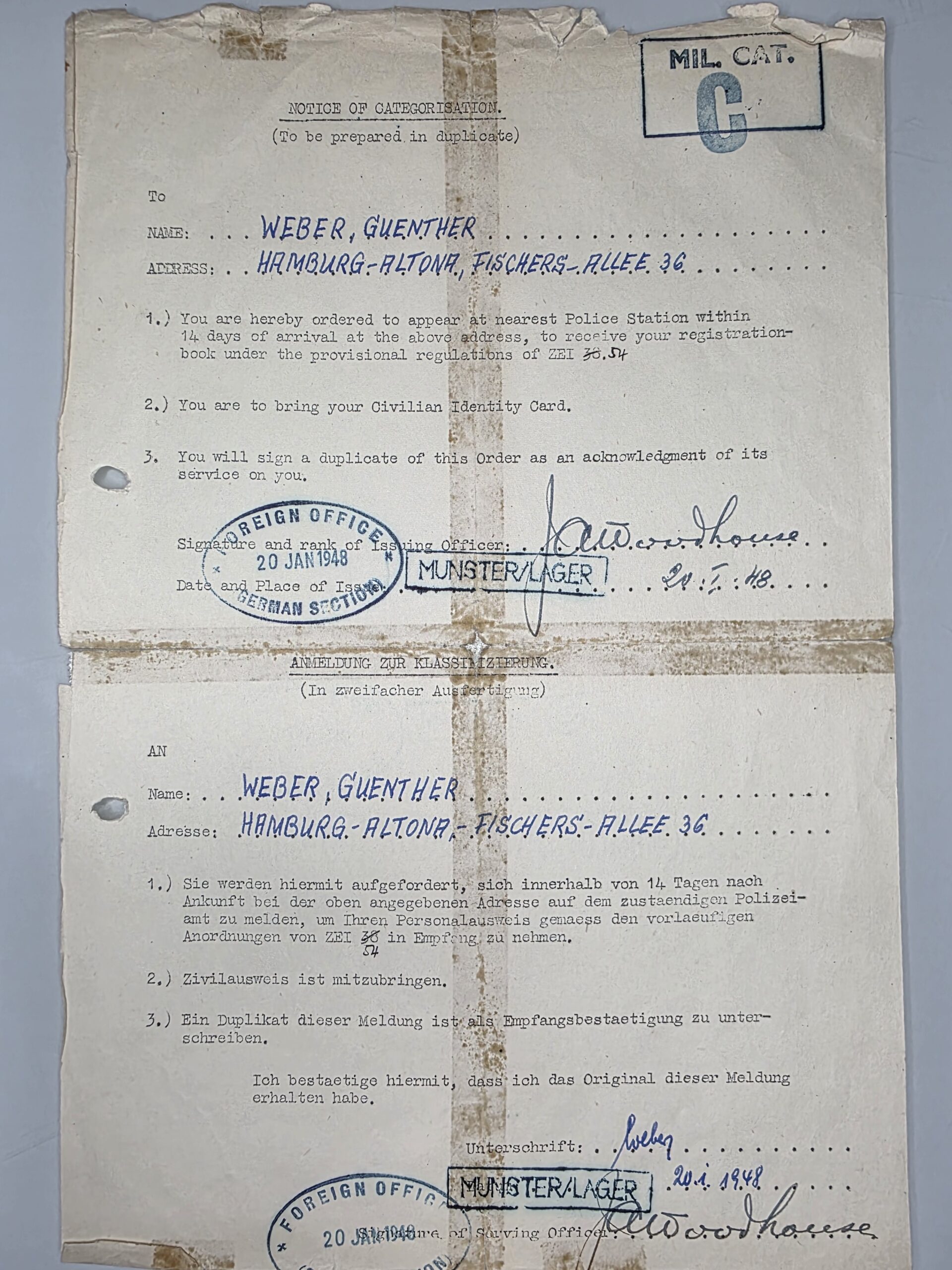
3. British Notice of Categorisation – Military Category C
Another particularly interesting document is the bilingual:
Notice of Categorisation / Anmeldung zur Klassifizierung
issued to:
WEBER, GUENTHER
HAMBURG-ALTONA
FISCHERS-ALLEE 36
It bears the stamp:
FOREIGN OFFICE – GERMAN SECTION
20 JAN 1948
MUNSTER/LAGER
and, prominently:
MIL. CAT. C
This makes it more than a simple release paper.
British authorities carried out extensive political screening of German POWs. Academic research into the system shows that prisoners were classified through categories running broadly from A through C, with Category C ultimately reserved for men regarded by the British authorities as the most strongly committed to National Socialism. Category affected, among other things, the order in which prisoners were repatriated.
It is important to describe this carefully.
The document establishes that British authorities classified Weber as Military Category C. It should not be used to make additional claims about his personal activities or beliefs for which the documents themselves provide no evidence.
The document instructs Weber to report to his nearest police station within fourteen days and to present his civilian identity papers.
For collectors researching POW administration, denazification, political screening and the immediate postwar occupation of Germany, this is arguably one of the strongest pieces in the group.
4. The complete Günther Weber POW archive
Taken together, the German POW documents provide a concise chronological account:
2 August 1946 – 10 January 1948: Weber works as chief clerk in the camp-leader’s office at Marbury Hall.
10 January 1948: Marbury Hall issues his signed Certificate and Testimonial.
20 January 1948: British authorities process him at Münsterlager.
20 January 1948: Notice of Categorisation issued with Military Category C.
20 January 1948: Formal discharge documentation records his release from the Luftwaffe/POW system.
Following years: the discharge document continues to receive German administrative annotations, including material connected with postwar POW compensation.
This progression is the main reason I would keep the archive intact.
Separating the documents would remove much of their historical context.
Historical context
German POWs continued to be held and employed in Britain after May 1945. They were used particularly as a labour force while Britain also undertook political screening and re-education programmes. General repatriation began in 1946 and was completed in 1948.
The German POW documents offered here sit directly within that final phase.
Marbury Hall itself had wartime military and POW use, and surviving historical inventories record the site within Britain’s extensive network of POW camps.
For further research, the Imperial War Museums and The National Archives both maintain material relating to German prisoners held by Britain. The National Archives notes that detailed biographical records for German POWs in British hands can be relatively scarce, which adds interest to surviving named documentary groups such as this one.
Collector’s interest
From a collector’s point of view, I see five strong elements here:
- All four documents belong together.
- They identify a named German POW with prisoner number 576758.
- The Marbury Hall certificate records his actual occupation inside the POW camp.
- The discharge certificate includes his original thumbprint.
- The categorisation paper records the unusual MIL. CAT. C classification.
There is also a clear British/German documentary crossover: British POW administration, German Luftwaffe service, repatriation, occupation-era controls and subsequent German bureaucracy all appear within one small archive.
That is where the value lies—not in trying to turn the administrative signatures into famous autographs.
CONDITION AND AUTHENTICITY
The papers show substantial but honest period use.
Visible characteristics include original folding, age toning, edge wear, small losses, filing holes, tears, staining, old adhesive or tape traces, manuscript additions, official ink stamps and general handling.
The Certificate and Testimonial has particularly noticeable fold and adhesive staining, while the categorisation paper has losses and wear along its upper edge.
These imperfections are part of the archive’s working history and should be assessed carefully from the photographs.
Autographs & Militaria guarantees the documents as original period pieces as described.
The administrative signatures are included as part of the documents. No claim is made that any of them is the autograph of a major political or military personality.
HISTORICAL RESPONSIBILITY NOTICE
These documents are offered strictly as historical, documentary and collecting material.
Any military terminology, organisations, political classifications or wartime references are reproduced solely because they appear on the original documents and are necessary for accurate historical description.
Autographs & Militaria has no political or ideological affiliation with National Socialism, extremist organisations or the political views represented by any historical material offered.
What are these German POW documents?
They are four original documents connected with German prisoner Günther Weber, covering his time at Marbury Hall POW Camp, his British discharge paperwork and his return to Germany in January 1948.
What was Marbury Hall POW Camp?
Marbury Hall near Northwich in Cheshire was used as a wartime military and prisoner-of-war camp. Weber’s own testimonial identifies his establishment as No. 189 (G) P.W. Working Camp, Marbury Hall.
Does the archive contain an original POW fingerprint?
Yes. Weber’s Allied Control Form D.2 contains an original right thumbprint alongside his personal and discharge details.
What does MIL. CAT. C mean on the document?
It is a British POW categorisation. During the late screening system, Category C was used for prisoners whom British authorities regarded as the most strongly ideologically committed. It describes the British administrative assessment made at the time, rather than independently proving Weber’s personal beliefs or actions.
Are any of the documents signed by a famous person?
I would not market any of the signatures as a major historical autograph. The signatures belong to camp, medical, translation and Allied administrative personnel. The archive’s value lies primarily in its provenance and documentary continuity.
Additional information
| Availability | Available |
|---|
Only logged in customers who have purchased this product may leave a review.
Related products
German Document Archive 1911–1967 – DAF, University and Business Papers
Original price was: 249,00 €.199,00 €Current price is: 199,00 €.
20% Off
WWII German Wehrpass Group – 256th Infantry Division, Ostmedaille & Death Letter
590,00 €
WWII German Document Collection – U-Boat Training, DAF & Arbeitsbuch Archive
Original price was: 490,00 €.440,00 €Current price is: 440,00 €.
10% Off
WWII German Document Archive 1938–1945 – Wehrmacht, IDs & Ration Papers
Original price was: 275,00 €.240,00 €Current price is: 240,00 €.
13% Off
Reviews
There are no reviews yet.