Products on sale
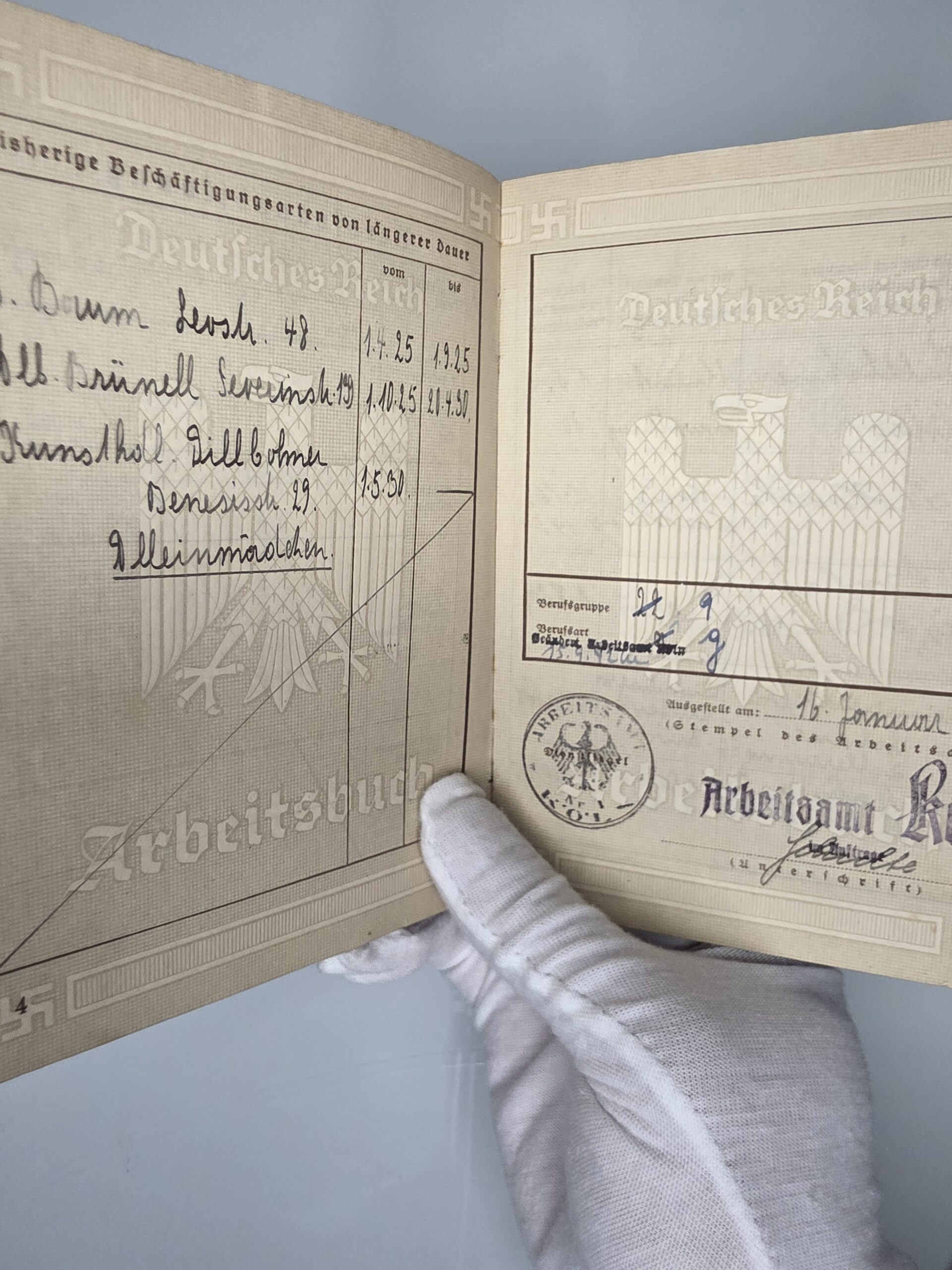
Third Reich Arbeitsbuch – Original German Worker’s Employment Book
30,00 €

WWII German Wehrpass – Rudolf Klinger 1943 Zweitschrift with Photo & Typhus Card
Original price was: 110,00 €.99,00 €Current price is: 99,00 €.

(no title)
Original price was: 299,00 €.245,00 €Current price is: 245,00 €.

Third Reich Tax Documents – 1937 Bavarian Ministry & Nuremberg Archive
Original price was: 150,00 €.99,00 €Current price is: 99,00 €.

German Olympic Decoration Document – 2nd Class to Police Captain, 1937
Original price was: 450,00 €.390,00 €Current price is: 390,00 €.
13% Off
Interested in this item? Please contact us directly by email, WhatsApp or through the enquiry form below for availability or other information. Kindly include the item SKU/reference number in your message so we can identify the piece.
Description
German Olympic Decoration Document – 2nd Class, 1937
This original German Olympic Decoration document was issued in Berlin on 30 January 1937 to Hauptmann der Schutzpolizei Michael Finken, recognising his services in connection with the Olympic Games held in Germany during 1936.
The formal German title of the decoration appears prominently in red as:
Deutsches Olympia-Ehrenzeichen
zweiter Klasse
The recipient’s police rank and name were entered individually in the centre of the certificate:
Hauptmann der Schutzpolizei
Michael Finken
Below the award text appears the printed title “Der Führer und Reichskanzler”, accompanied by a period facsimile signature of Adolf Hitler. This is an important distinction for collectors: the certificate itself is an original period document, but the Hitler signature was mechanically reproduced as part of the official administrative issuing process and is not a handwritten Adolf Hitler autograph.
An embossed German state eagle within a wreath is visible in the lower part of the sheet.
The Deutsches Olympia-Ehrenzeichen
The Deutsches Olympia-Ehrenzeichen was created by decree on 4 February 1936 specifically to recognise contributions to the Olympic Games entrusted to Germany.
The original decree published in the Reichsgesetzblatt established the award in two classes. The First Class was a larger neck decoration, while the Second Class followed the same general design in smaller form and was worn on the breast.
The decoration should not be confused with the later Deutsche Olympia-Erinnerungsmedaille, or German Olympic Commemorative Medal.
That distinction is particularly important for collectors.
The Olympia-Ehrenzeichen represented the higher award structure, whereas the commemorative medal recognised a much broader group of contributors. Collector references record approximately 3,364 awards of the Second Class, making it considerably more restricted in issue than the commemorative medal.
Your existing Autographs & Militaria collection already contains an Olympic Commemorative Medal with its award certificate, so DOC176 provides an excellent opportunity to explain the distinction between these related but separate 1936 Olympic decorations. Autographs & Militaria
Michael Finken – Hauptmann der Schutzpolizei
The recipient is identified directly on the document as Michael Finken, holding the rank of Hauptmann der Schutzpolizei, effectively a captain in the uniformed German police.
This makes the certificate particularly relevant to both Olympic memorabilia collectors and collectors of German police documentation.
Police forces played an important role in the organisation and security infrastructure surrounding the 1936 Games. However, the certificate itself does not identify Finken’s exact duties, location or individual assignment.
For that reason, it would be historically unsafe to claim that he personally guarded the Olympic Stadium, supervised crowds or held a particular Olympic security command without additional documentary evidence.
What can be stated with certainty is that an officer holding the rank of Hauptmann der Schutzpolizei named Michael Finken received the German Olympic Decoration, Second Class, for recognised services connected with the 1936 Games.
The 1936 Olympic Context
Germany hosted both the IV Olympic Winter Games at Garmisch-Partenkirchen and the Games of the XI Olympiad in Berlin during 1936.
The Berlin Summer Games ran from 1 to 16 August and brought athletes from 49 countries to Germany. Contemporary Olympic records document the enormous organisational structure required for venues, communications, transport, accommodation, press facilities, security and administration.
The Games also had a major political dimension.
The National Socialist government used the international event to project a controlled and favourable image of Germany abroad. German historical documentation shows that antisemitic signs and other visible elements of persecution were temporarily reduced or hidden as part of a broader propaganda effort aimed at foreign visitors and international opinion.
That context gives surviving Olympic administrative material an importance extending beyond sports memorabilia alone.
A Named Olympic Award Certificate
From a collector’s perspective, the principal appeal of this German Olympic Decoration document lies in its nominative character.
It is not an anonymous commemorative souvenir.
It records:
Michael Finken
Hauptmann der Schutzpolizei
Deutsches Olympia-Ehrenzeichen 2nd Class
Berlin
30 January 1937
This combination makes the certificate directly researchable.
Named award documents can often provide a starting point for further investigation into the recipient’s career, police service and possible connection with Olympic organisation.
The handwritten recipient information also contrasts clearly with the professionally printed black and red Gothic lettering, giving the document the formal appearance associated with higher-level German award certificates of the period.
Adolf Hitler Facsimile Signature
The signature appearing below Der Führer und Reichskanzler is a facsimile of Adolf Hitler’s signature.
It must not be advertised as an original Hitler autograph.
This format was normal on this type of officially issued certificate. Comparable original 1936 Olympic Decoration documents sold by established specialist militaria houses are specifically described as carrying Hitler facsimile signatures.
For collectors, the significance lies in the document being an original nominative award record issued through the period administrative system rather than in the signature having been individually written.
Embossed State Seal
The lower section retains a large blind-embossed state seal showing the German eagle and wreath.
Because it is embossed directly into the paper rather than printed in colour, the detail is relatively subtle when viewed straight on but becomes more apparent under angled lighting.
This is one of the visually attractive features of the certificate and should be photographed carefully when preparing the website listing.
A close-up taken with oblique light would improve both the product presentation and Google Images indexing by clearly showing the relief.
Collector Interest
The certificate has crossover interest for several collecting fields:
German Olympic memorabilia, Berlin 1936 material, German police history, Third Reich documents, civil decorations, award certificates and interwar European history.
It is also useful as a companion piece to an actual Olympia-Ehrenzeichen 2nd Class decoration.
Unlike the much more common Olympic souvenirs produced for visitors, this was an individually issued official state award document naming the person who received the decoration.
Its January 1937 date is entirely consistent with the post-Games administrative distribution of Olympic honours. Comparable surviving Second Class certificates are known from late 1936 and 1937.
Condition and Authenticity
The document appears in good period condition.
Visible characteristics include natural age toning, light handling and storage marks, minor surface creasing and some wear towards the lower part of the sheet.
The main lettering, handwritten recipient name, date and facsimile signature remain clearly legible.
The embossed seal is present.
This item is offered as an original period German Olympic Decoration 2nd Class award certificate.
The Adolf Hitler signature is explicitly identified as a period facsimile signature and not a handwritten autograph.
The photographs show the actual document offered and form part of the condition description.
Historical Responsibility Notice
This item is offered solely as an original historical and documentary collectible for preservation, research and collecting. Autographs & Militaria does not endorse National Socialism or any political ideology, regime or organisation represented by the object.
Reichsgesetzblatt — 4 February 1936 decree
official decree establishing the German Olympic Decoration
What is this German Olympic Decoration document?
It is an original award certificate for the Deutsches Olympia-Ehrenzeichen 2nd Class, issued to Schutzpolizei Captain Michael Finken in Berlin on 30 January 1937.
Was the German Olympic Decoration an athlete’s medal?
No. The decoration recognised individuals whose work contributed to the organisation and execution of the Olympic Games held in Germany in 1936. It was separate from sporting medals awarded to competitors.
Is the Adolf Hitler signature handwritten?
No. The signature on this certificate is a period facsimile, not a handwritten Adolf Hitler autograph. This is consistent with comparable original Olympic award certificates.
Who was Michael Finken?
The document identifies Michael Finken as a Hauptmann der Schutzpolizei, or police captain. At present, no sufficiently reliable independent source has been located to establish his exact Olympic assignment, so no more specific service claim should be made.
What is the difference between the Olympia-Ehrenzeichen and Olympia-Erinnerungsmedaille?
The Olympia-Ehrenzeichen was the higher decoration created in two classes. The later Olympia-Erinnerungsmedaille recognised a much wider group of contributors. Approximately 3,364 Second Class Olympia-Ehrenzeichen were awarded, compared with tens of thousands of commemorative medals.
Additional information
| Availability | Available |
|---|
Only logged in customers who have purchased this product may leave a review.
Related products
Third Reich Arbeitsbuch – Original German Worker’s Employment Book
30,00 €
WWII German Wehrpass – Rudolf Klinger 1943 Zweitschrift with Photo & Typhus Card
Original price was: 110,00 €.99,00 €Current price is: 99,00 €.
10% Off
(no title)
Original price was: 299,00 €.245,00 €Current price is: 245,00 €.
18% Off
Third Reich Tax Documents – 1937 Bavarian Ministry & Nuremberg Archive
Original price was: 150,00 €.99,00 €Current price is: 99,00 €.
34% Off
Reviews
There are no reviews yet.