Original WWII German Wehrpass Archive – Walter Schirmer, Friedrichshafen Teacher, 1927–1944
Original price was: 300,00 €.240,00 €Current price is: 240,00 €.
Limited-Time OfferListed from a private collection · availability confirmed personally · price as shown
Authentication & Certification
Signatures and documents in this collection are examined by Juan García Nicolás, a qualified graphologist and forensic handwriting examiner, on a coherent set of features rather than a single sign.
Document Authentication & Certification →
Graphology & Signature Analysis →
Authenticity & Provenance policy →
Description
This German Wehrpass archive follows one man, Walter Schirmer, across seventeen years of German history. Born at Neckarsulm on 12 June 1905, he appears here as a student in Frankfurt in 1927, a traveller across Lake Constance to Switzerland in the mid-1930s, a commercial-school teacher in Friedrichshafen, and finally, in the summer of 1944, a man registered for military service yet formally declared indispensable at home. What makes the group so rewarding is that the documents speak to one another: the same name, date and place of birth recur from one paper to the next, and together they build a coherent personal story rather than a set of isolated items.
What Does This German Wehrpass Archive Contain?
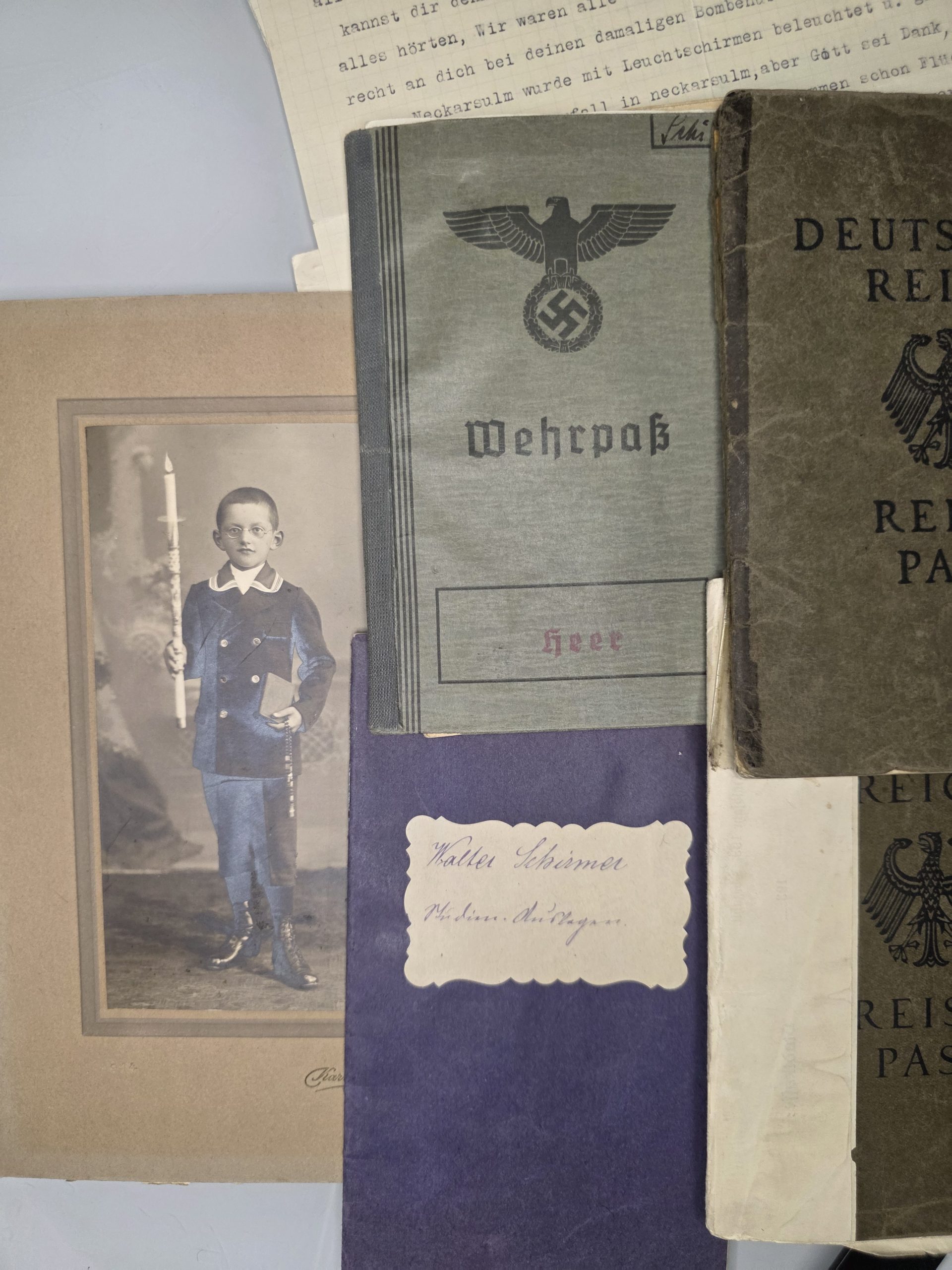
The German Wehrpass archive, offered as photographed, comprises:
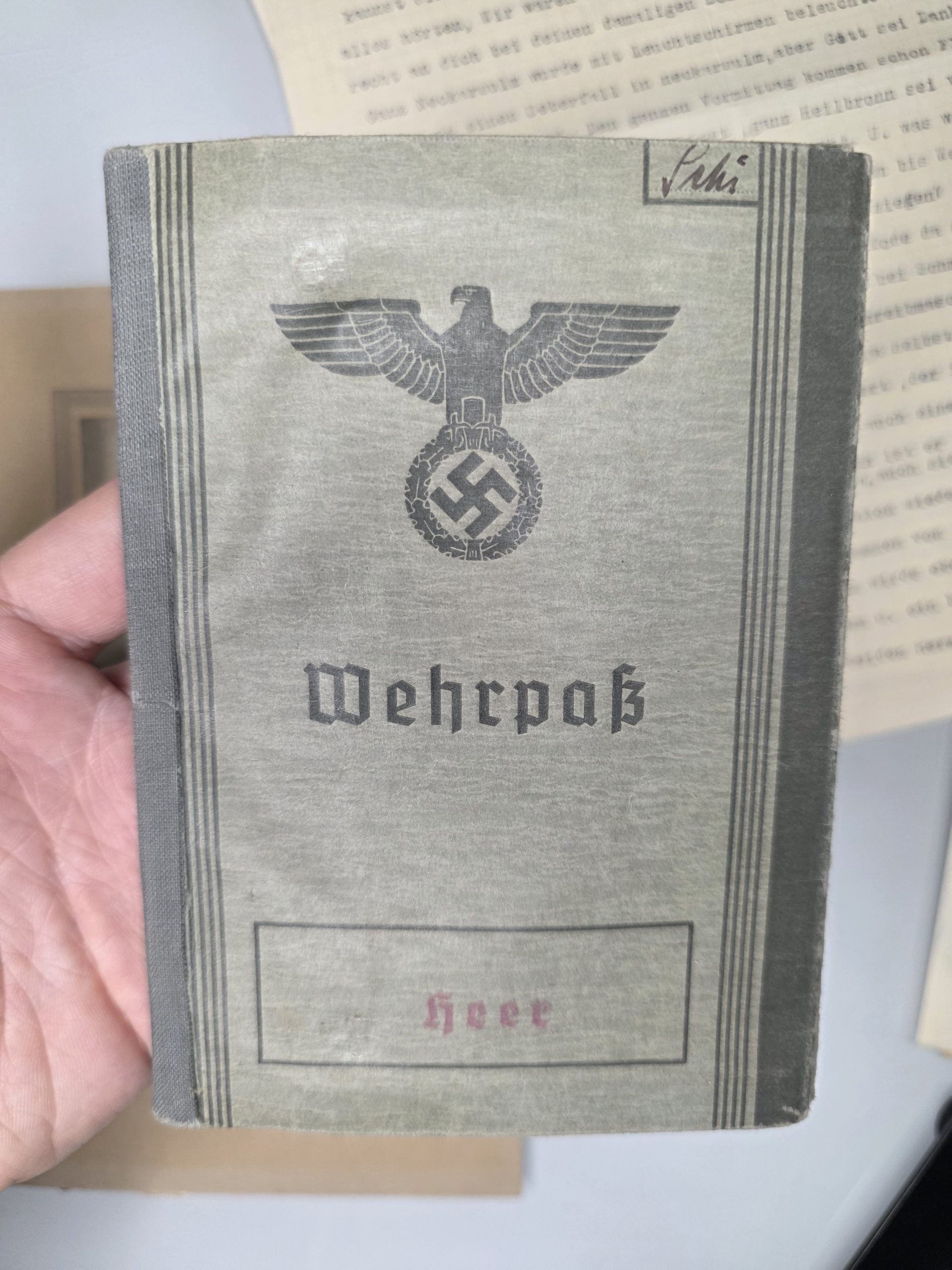
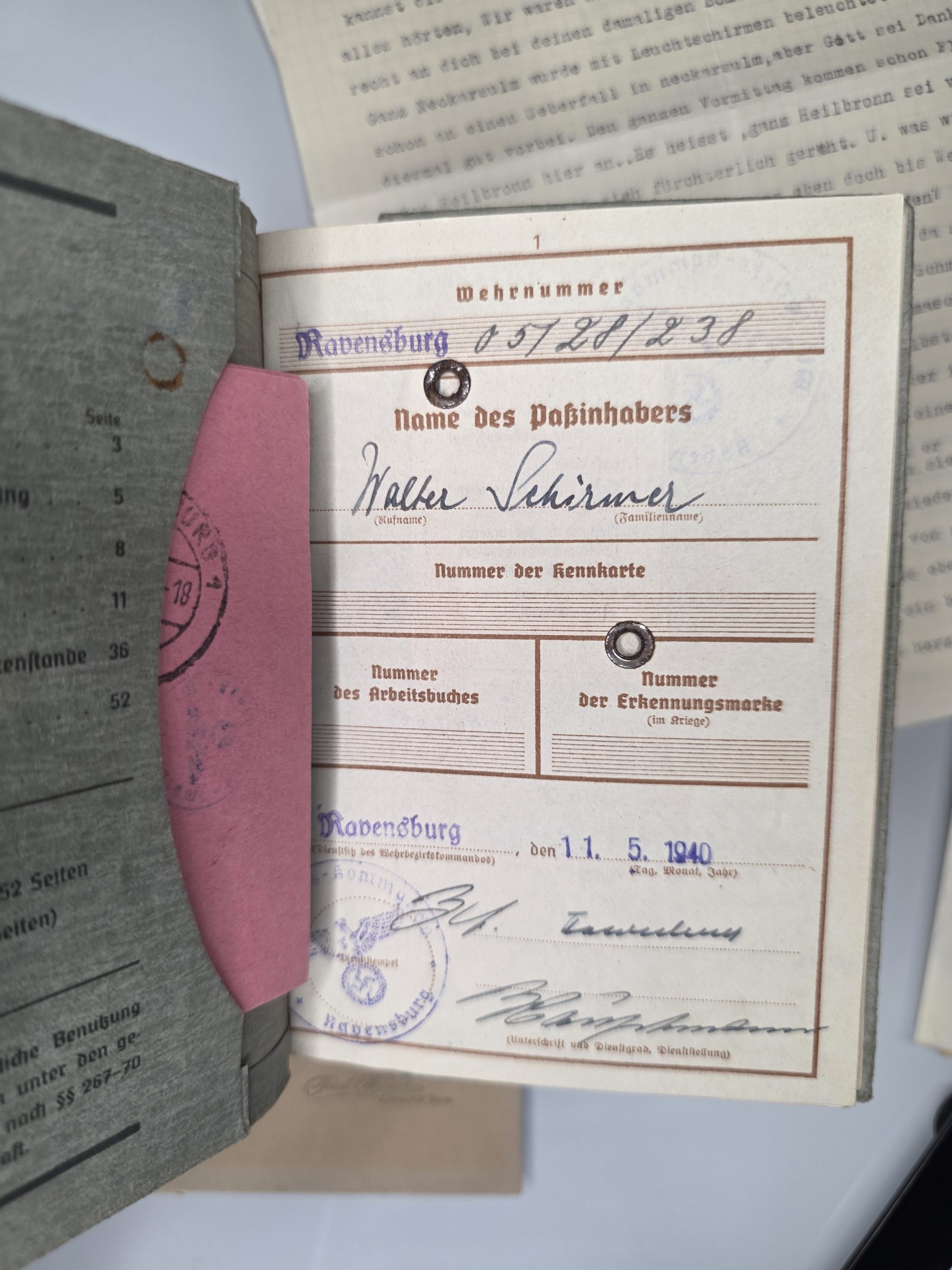
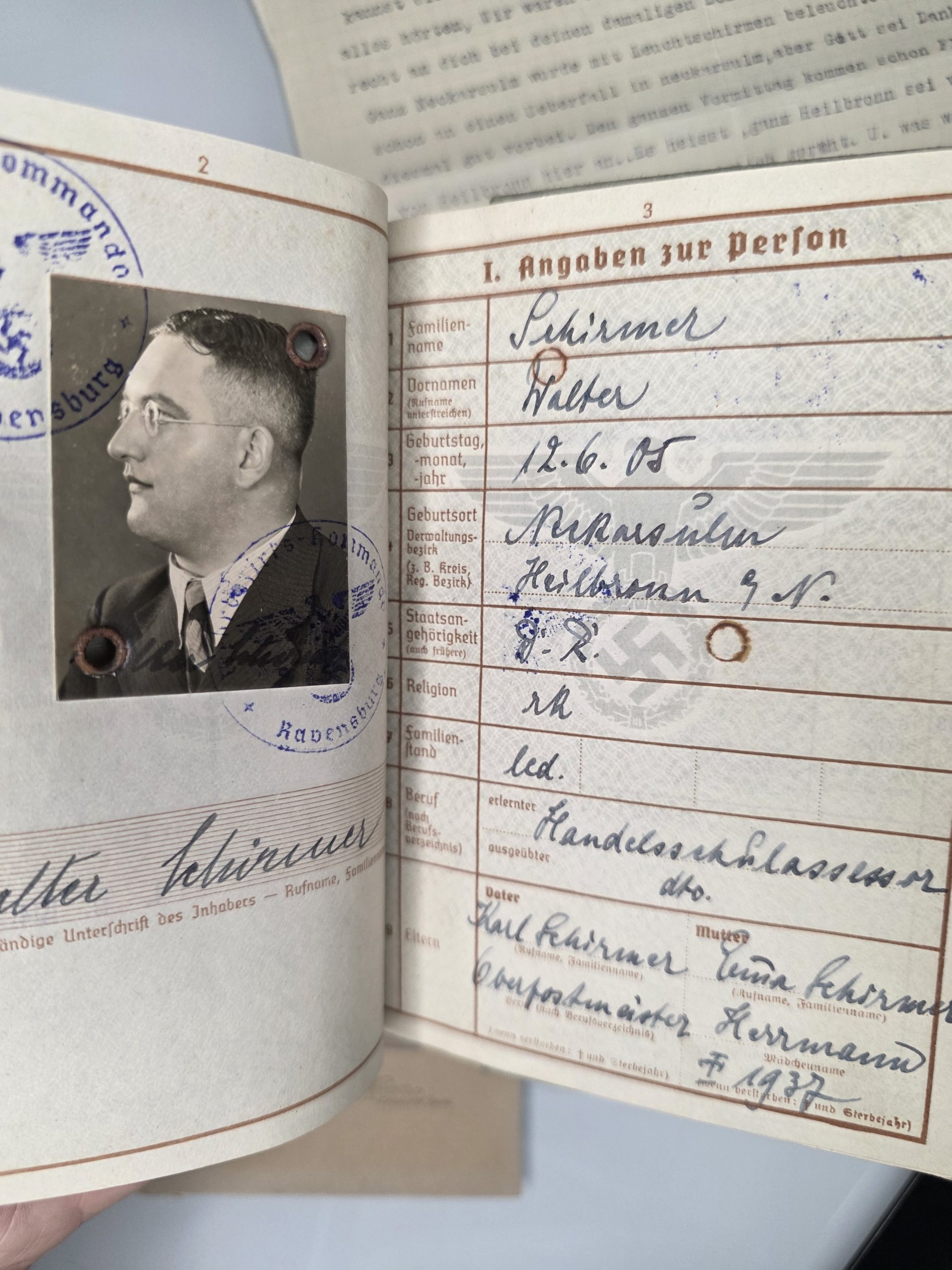
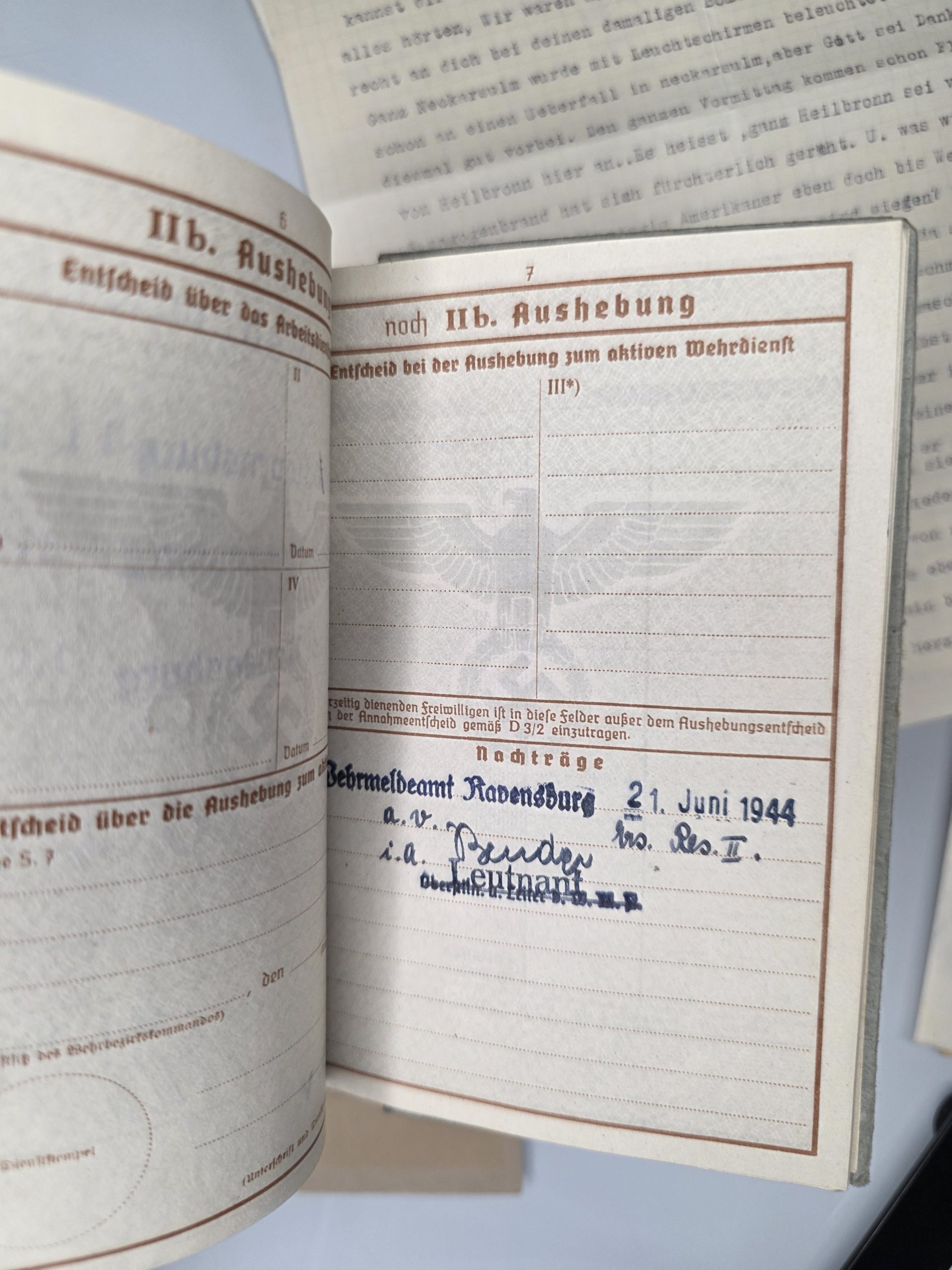
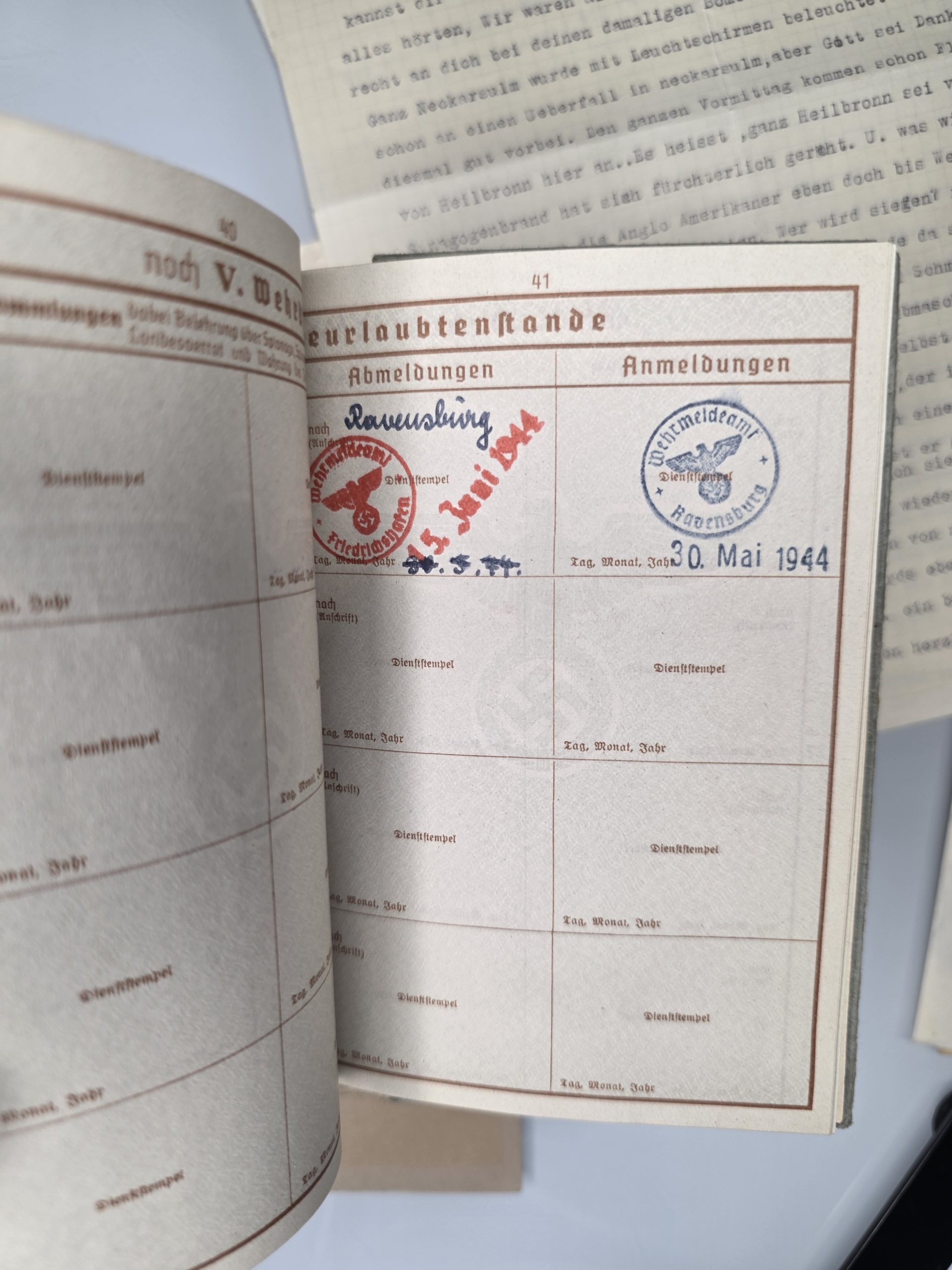
- Heer Wehrpass (army service book) issued at Ravensburg on 11 May 1940 to Walter Schirmer, with portrait photograph, personal details and 1944 entries.
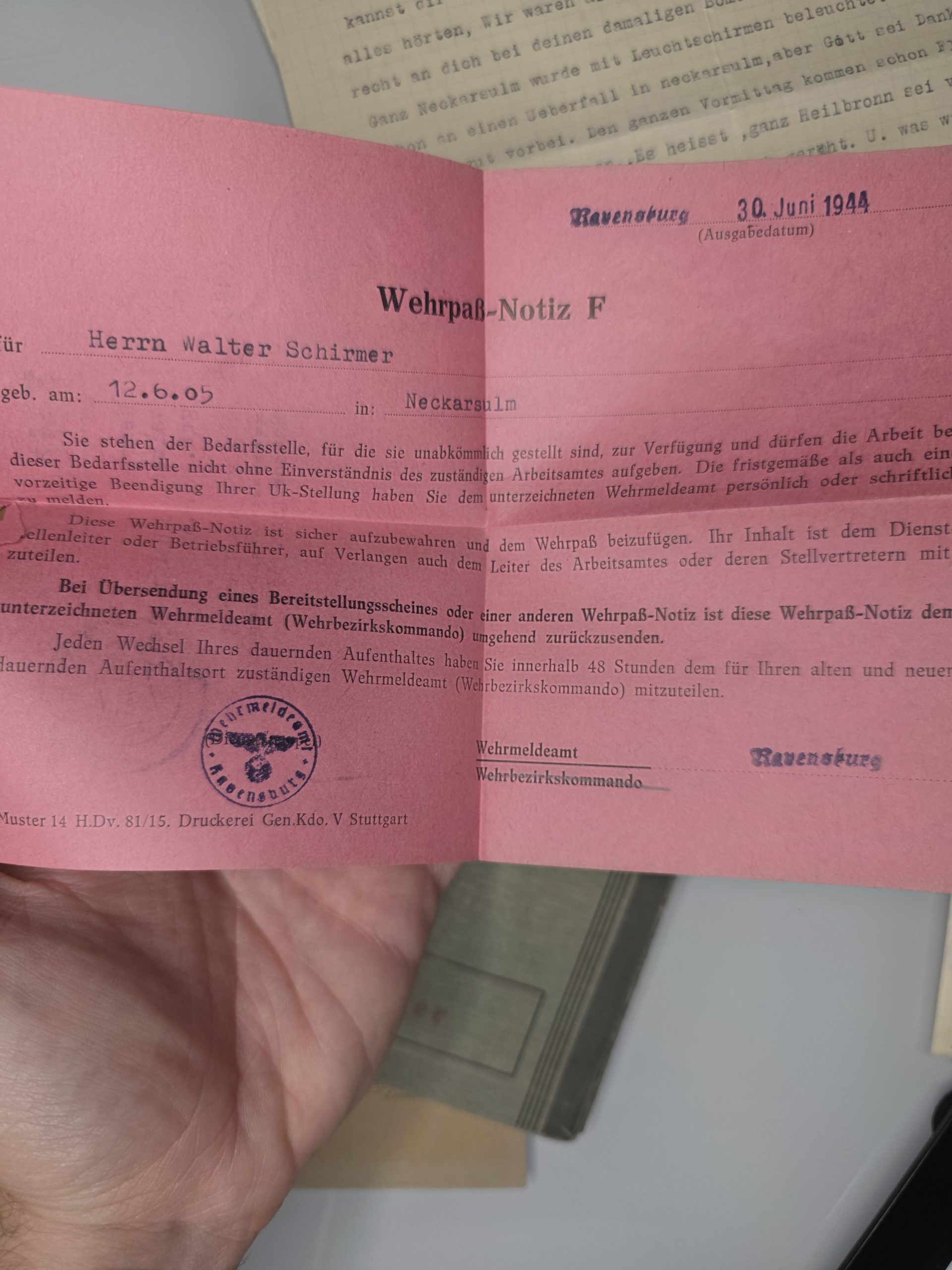
- Wehrpaß-Notiz F (pink form), dated Ravensburg, 30 June 1944, confirming his status as unabkömmlich (exempt from call-up).
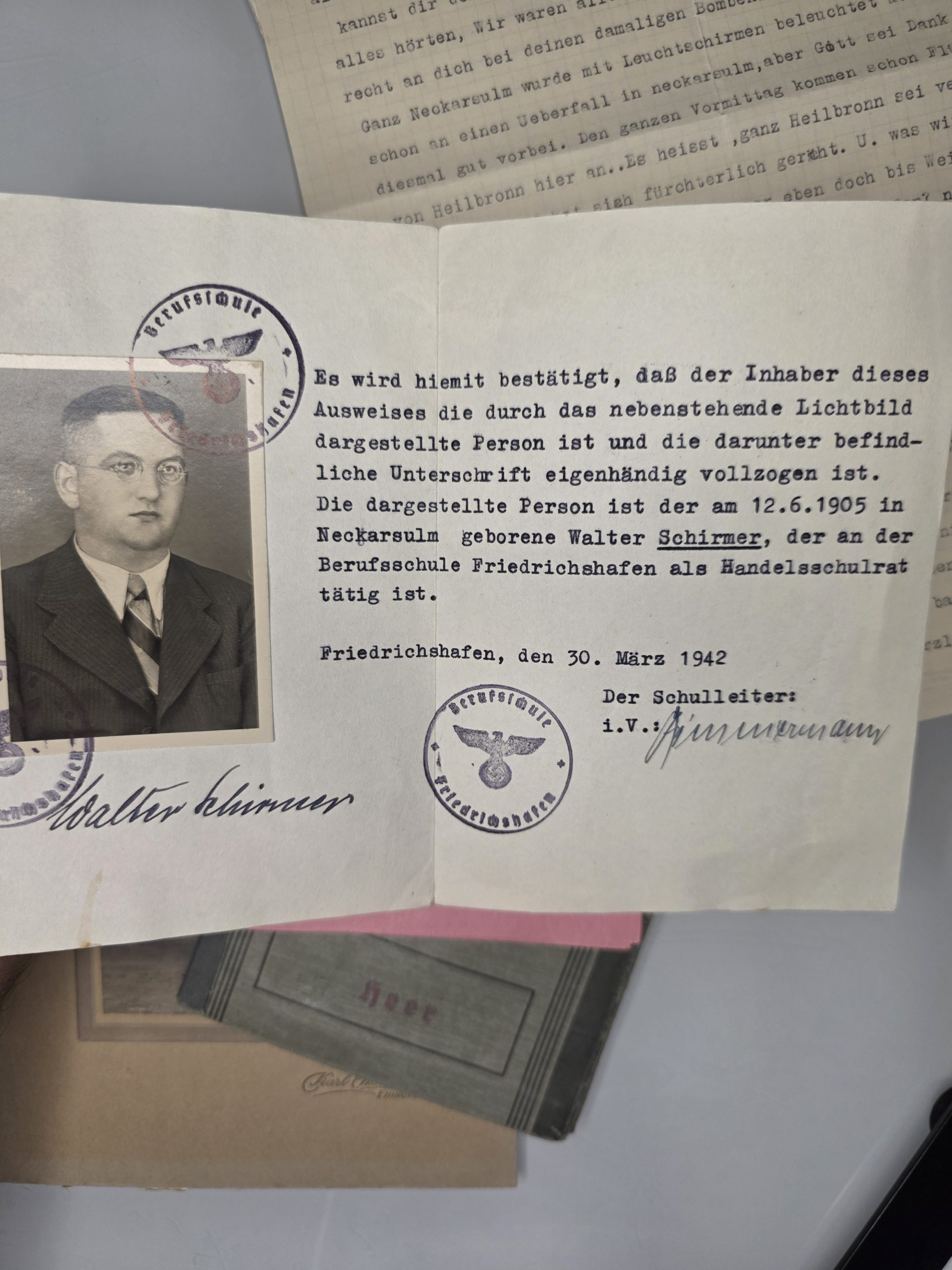
- Berufsschule Friedrichshafen identity document, dated 30 March 1942, with photograph and signature.
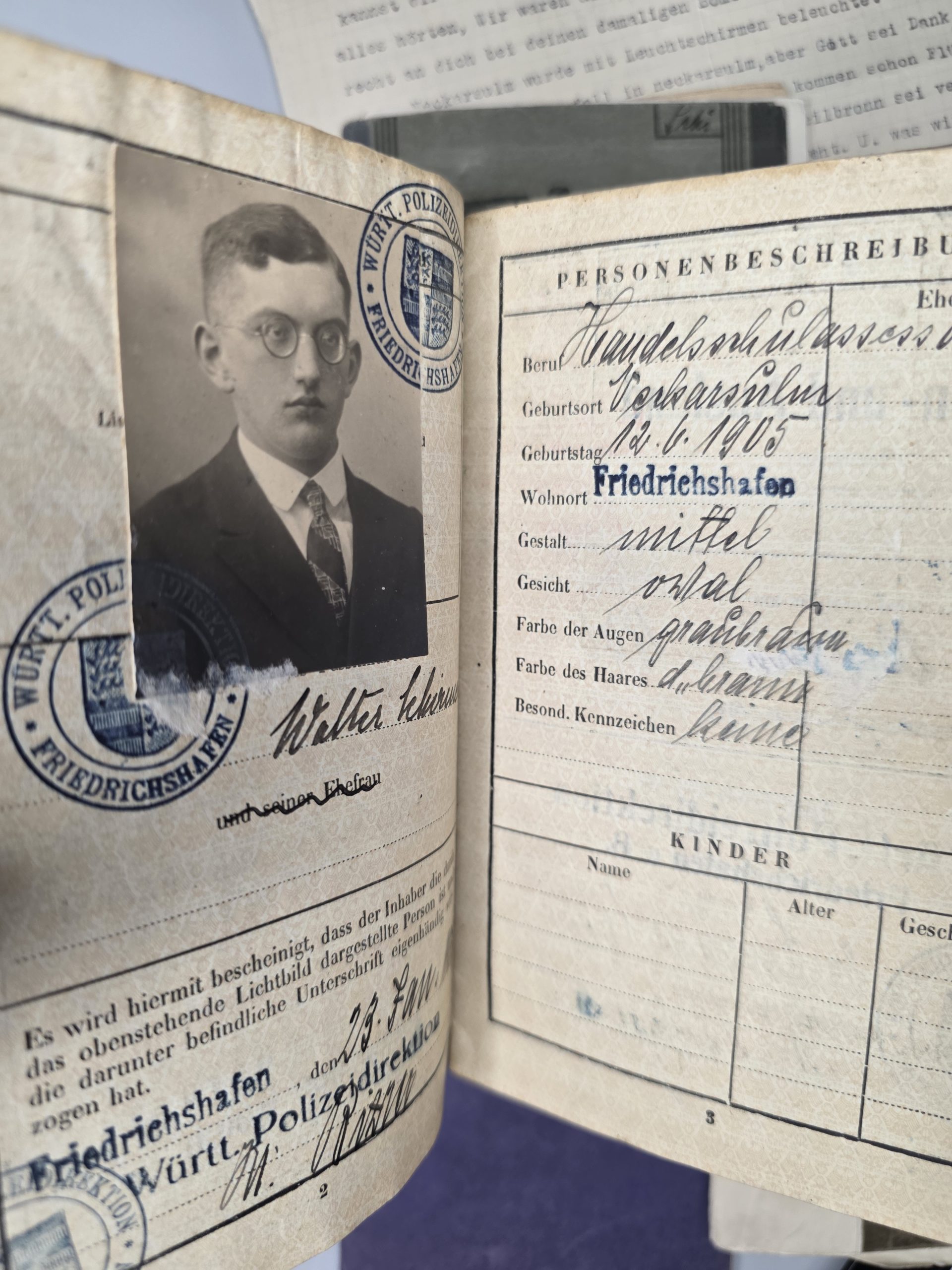
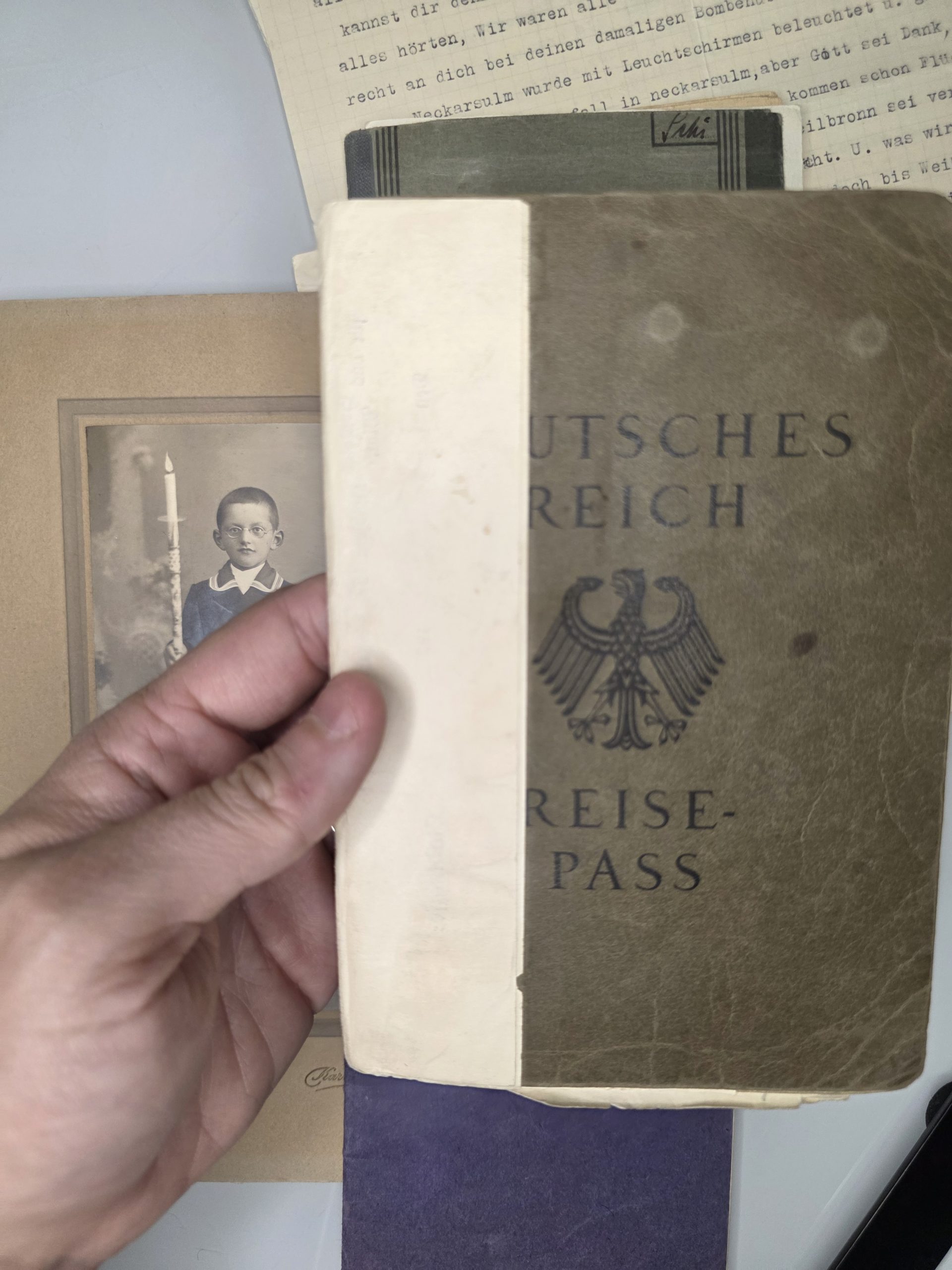
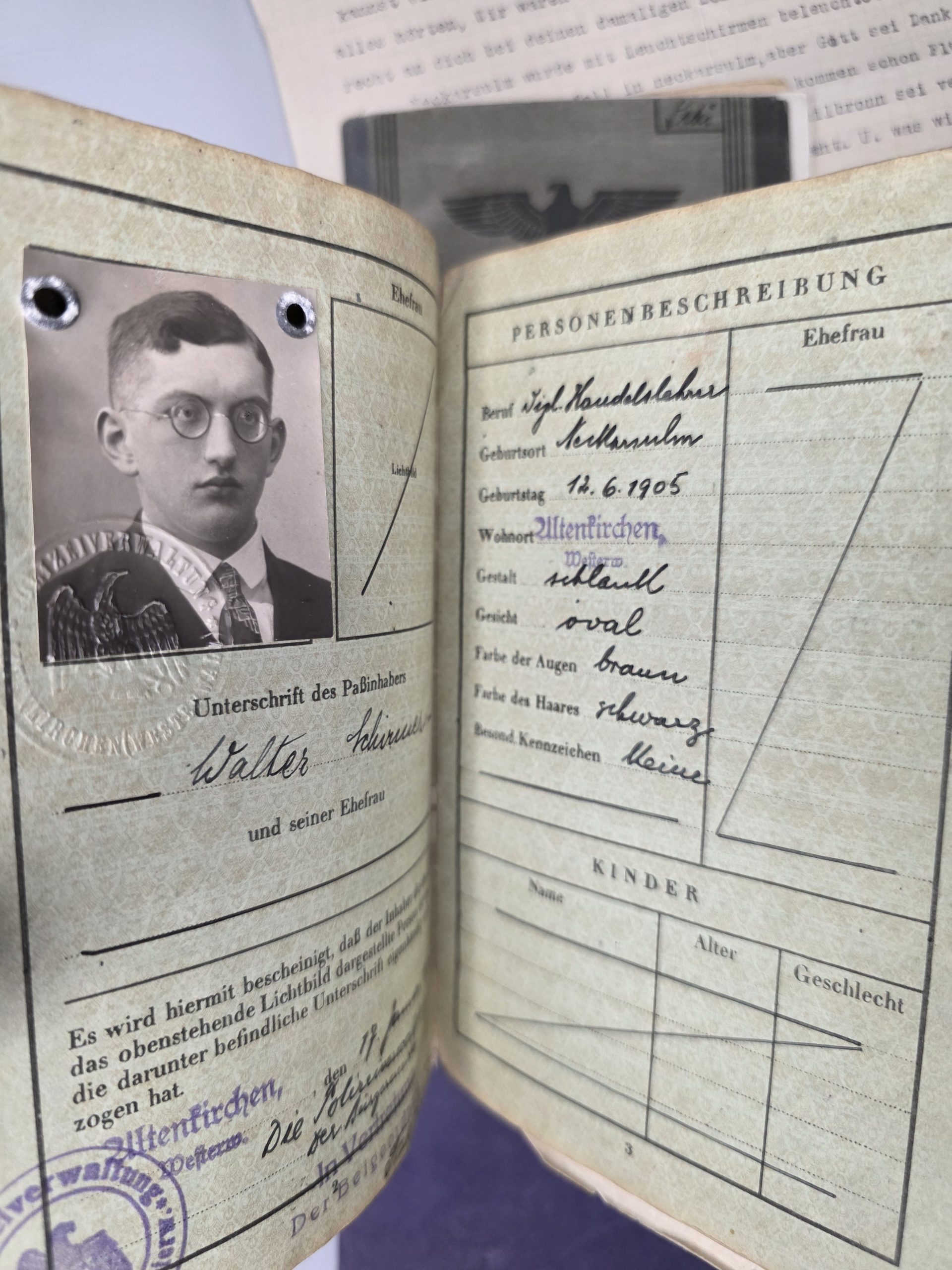
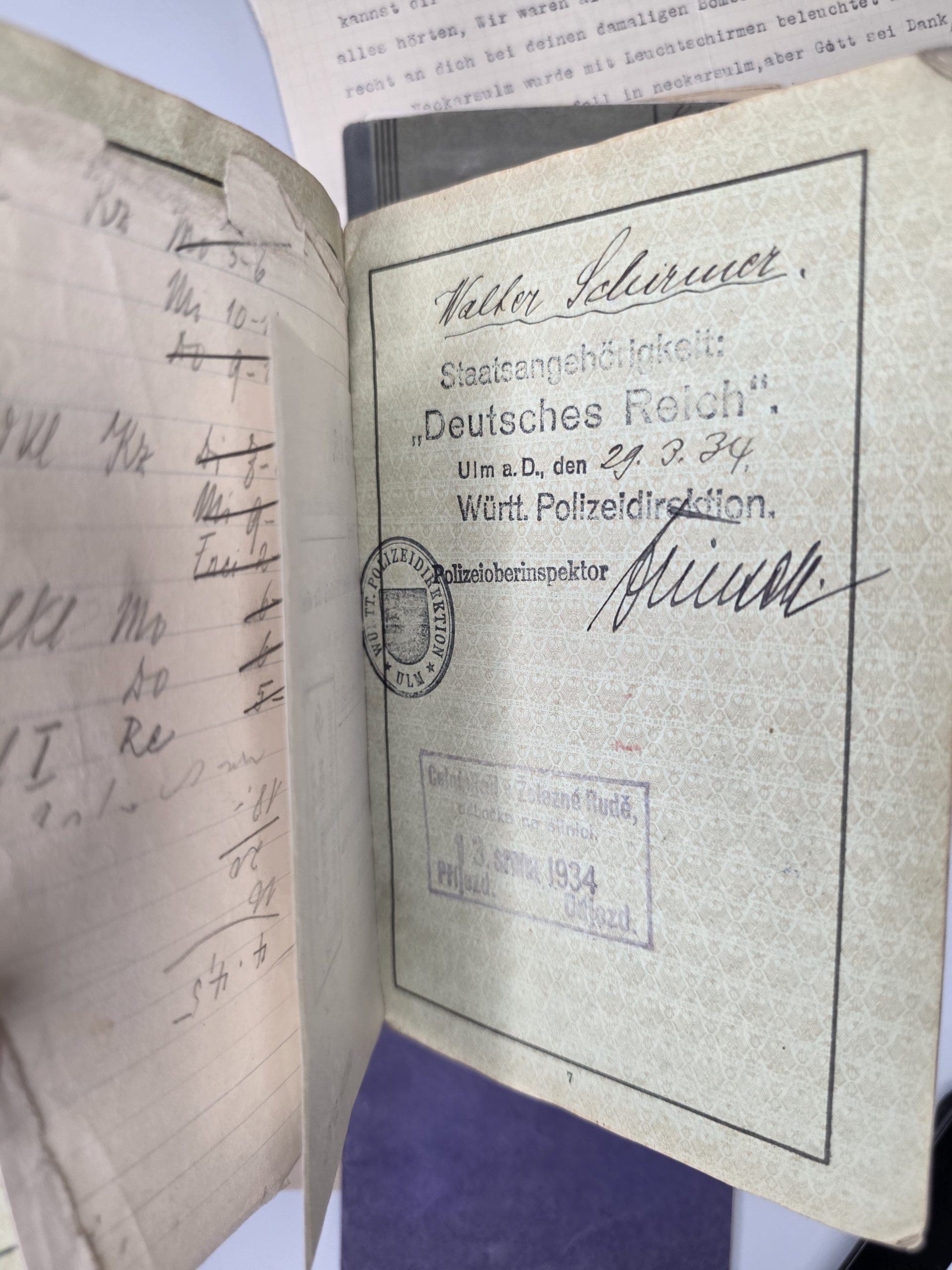
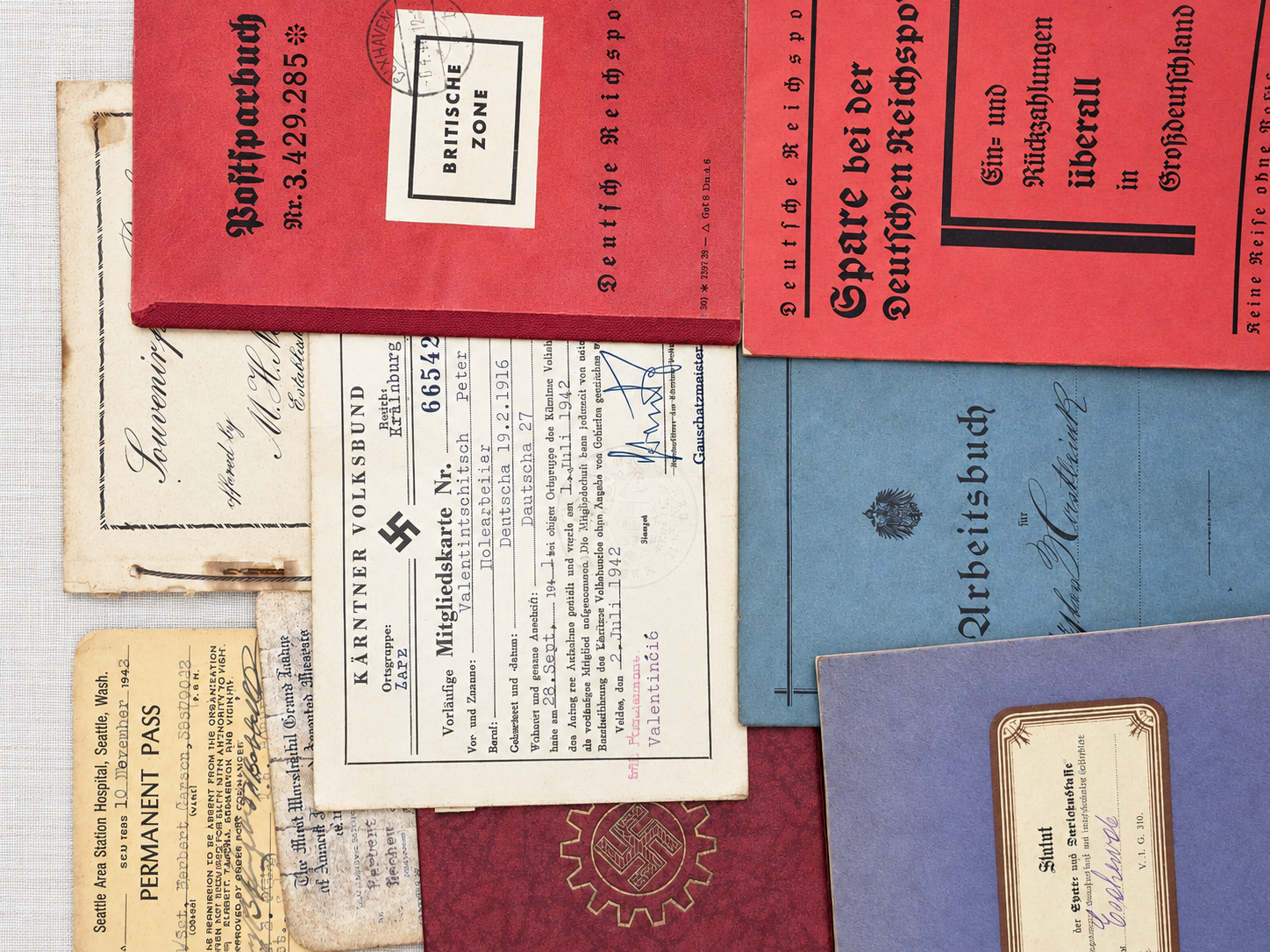
- Two Deutsches Reich passports (Reisepass), with Swiss and German border and currency-exchange stamps from the 1930s.
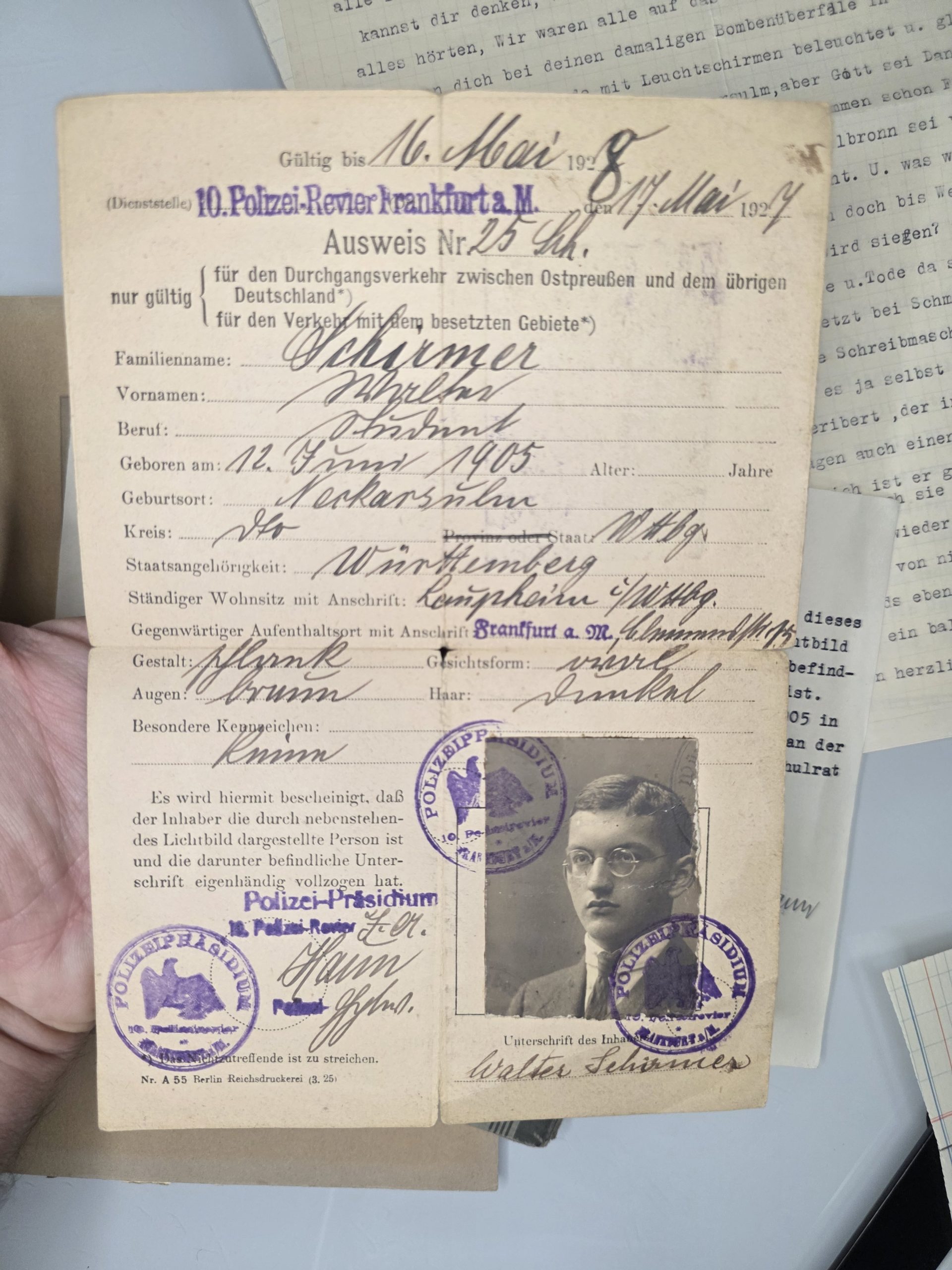
- 1927 police identity card issued by the 10. Polizei-Revier, Frankfurt am Main.
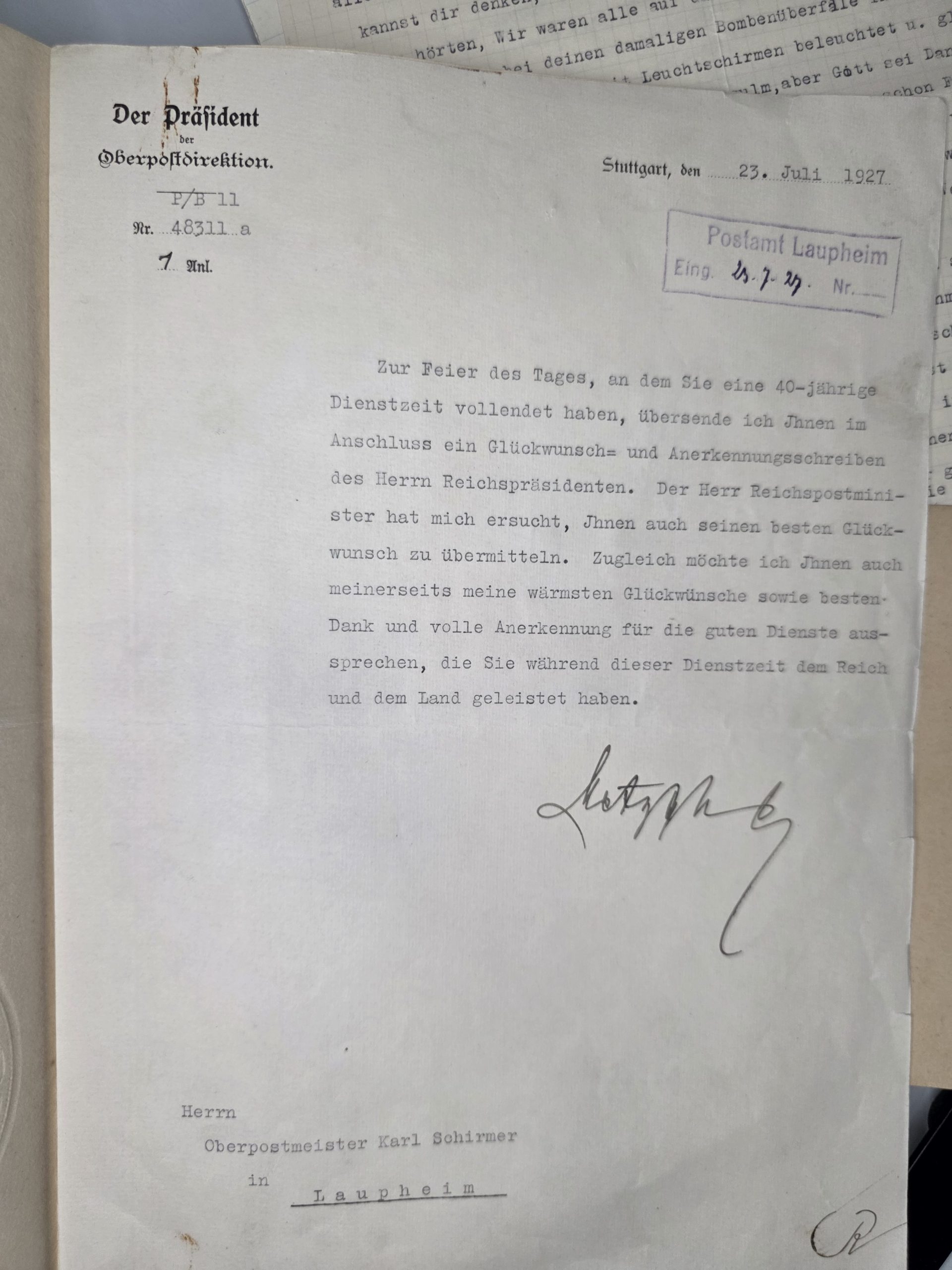
- 1927 letter from the President of the Oberpostdirektion Stuttgart to Oberpostmeister Karl Schirmer at Laupheim.
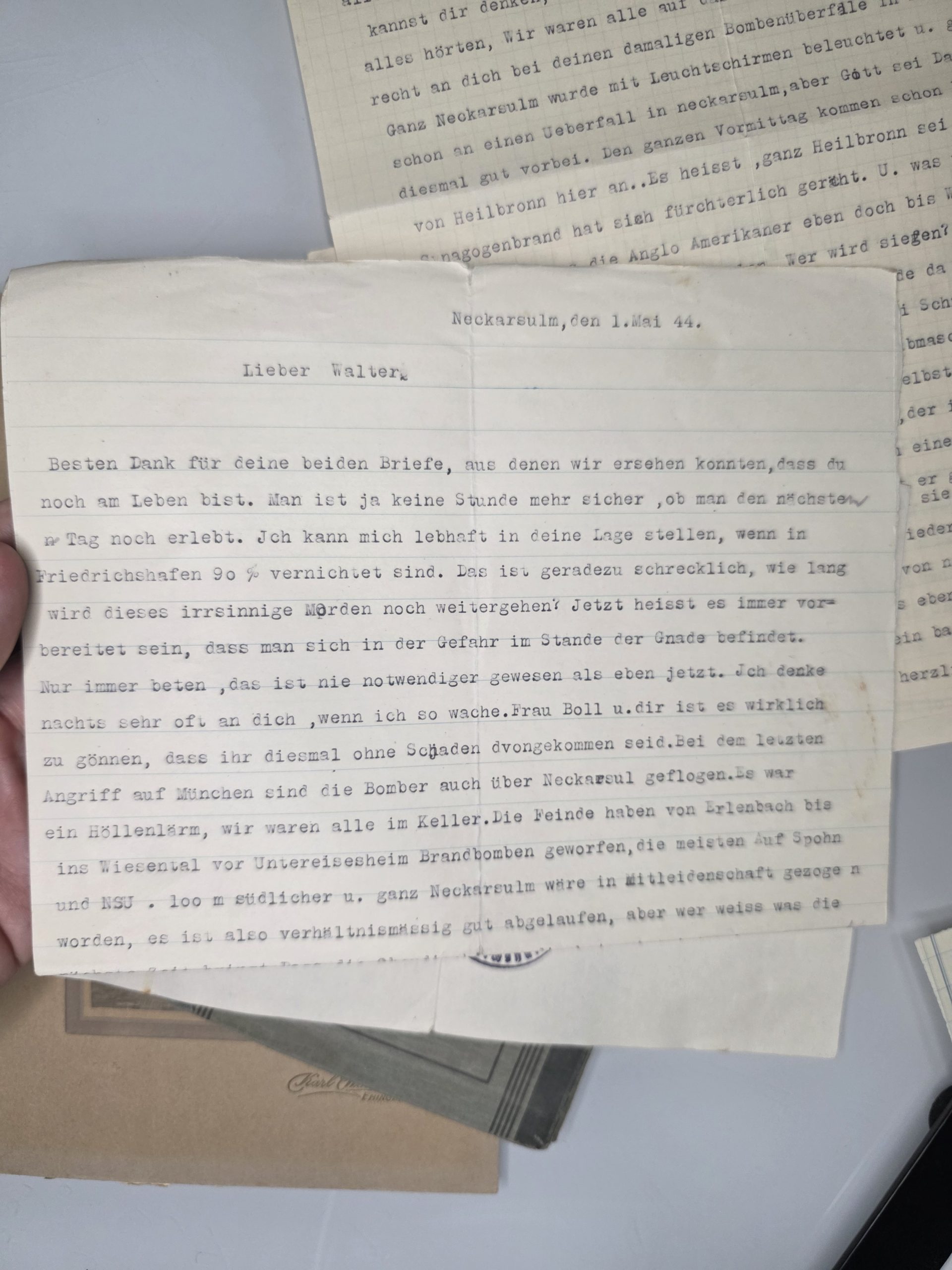
- Typed wartime letter from Neckarsulm, dated 1 May 1944, with further typed correspondence.
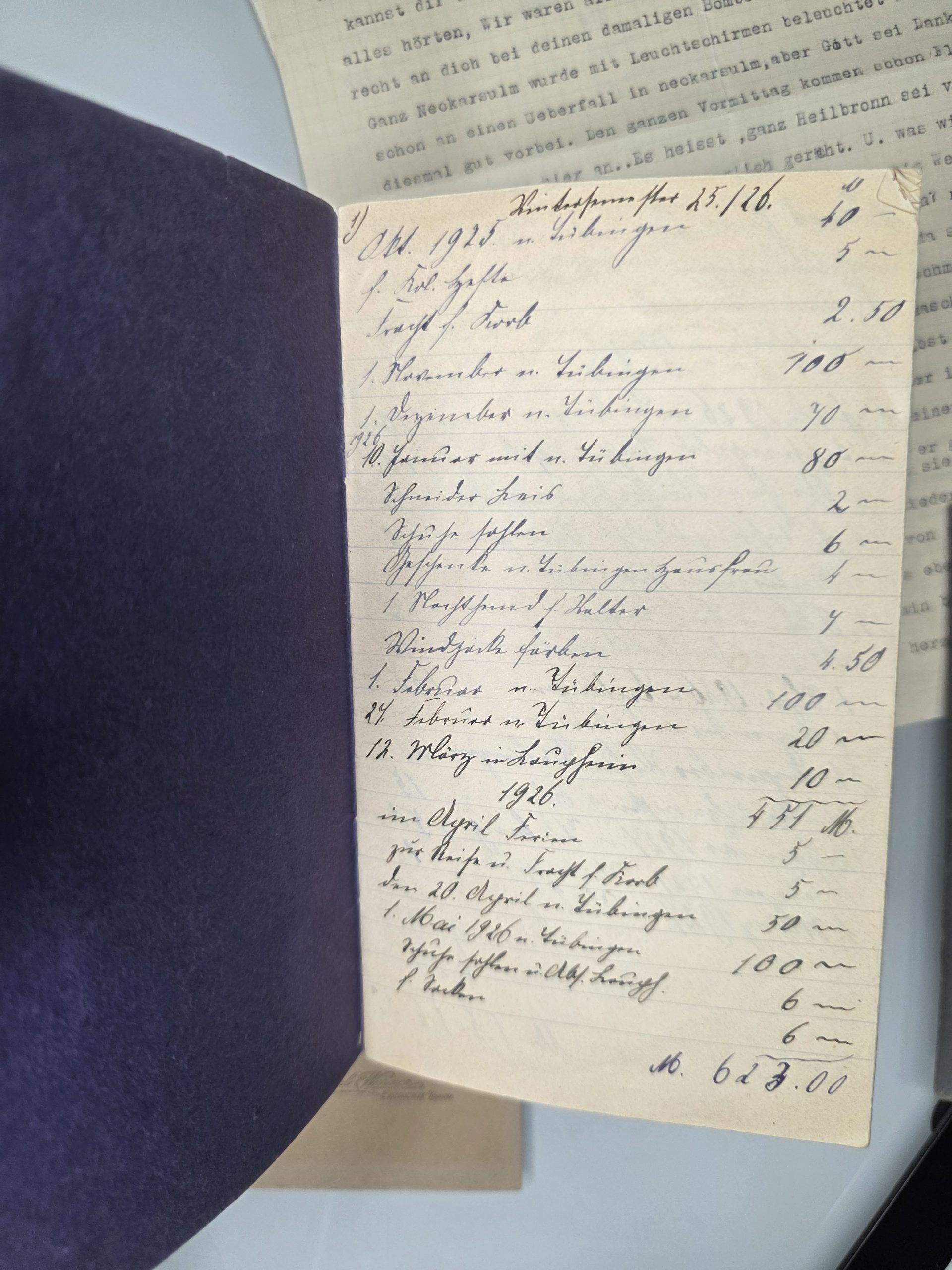
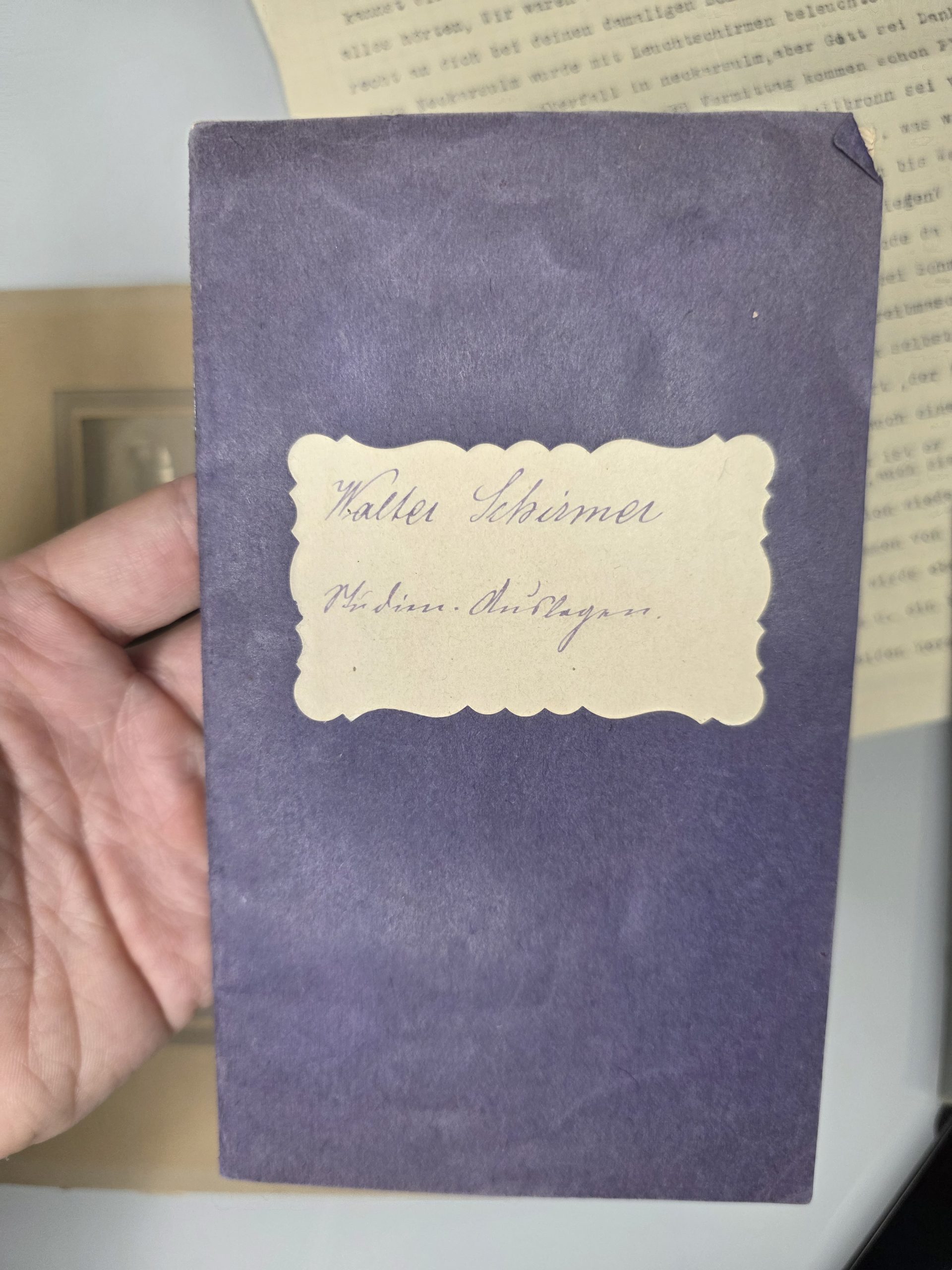
- Purple-covered handwritten notebook with a label bearing Walter Schirmer’s name.
- Early studio photograph of a young boy, mounted on card. The sitter is not identified on the photograph.
For an introduction to these service books, see my Complete Collector’s Guide to the German Wehrpass.
Who Was Walter Schirmer?
The personal page of the Wehrpass records him as Walter Schirmer, born 12 June 1905 at Neckarsulm (district of Heilbronn), Roman Catholic and single. His trained and practised profession is entered as Handelsschulassessor, a junior grade of commercial-school teacher. The 1942 school identity document then describes him as Handelsschulrat at the Berufsschule Friedrichshafen, so the two papers quietly record a step in his teaching career between 1940 and 1942.
The Wehrpass also names his parents. His father is entered as Karl Schirmer, Oberpostmeister, and his mother’s maiden name appears as Herrmann. This links Walter directly to the 1927 letter addressed to Oberpostmeister Karl Schirmer at Laupheim, the same town given as Walter’s permanent residence on his 1927 Frankfurt identity card.
What Does the 1940 Wehrpass Record?
The Wehrpass was issued by the Wehrbezirkskommando Ravensburg on 11 May 1940 and carries a Ravensburg Wehrnummer, a profile portrait and his signature. Two later entries are especially telling:
- An entry by the Wehrmeldeamt Ravensburg dated 21 June 1944 in the supplementary section following the second examination (IIb. Aushebung), signed on behalf of the office by a Leutnant.
- Registration stamps on page 41 showing his record transferred from the Wehrmeldeamt Friedrichshafen and registered with the Wehrmeldeamt Ravensburg on 30 May 1944.
No unit assignments, campaigns or front-line service are entered in the pages photographed. This German Wehrpass archive belongs to a man administered by the military system on the home front, which is exactly why it is historically interesting. If you are comparing paybooks and service books, my article Wehrpass vs Soldbuch explains the difference.
What Is the Wehrpaß-Notiz F?
The pink Wehrpaß-Notiz F (printed Muster 14, H.Dv. 81/15) is dated Ravensburg, 30 June 1944, and made out to Walter Schirmer, born 12.6.05 at Neckarsulm. Its printed text explains its purpose: the holder is placed at the disposal of the employer for whom he has been declared unabkömmlich, may not give up that work without the consent of the labour office, and must report any end of his Uk-Stellung to the Wehrmeldeamt. The form was to be kept with the Wehrpass, and it is still with it. It carries the stamp of the Wehrmeldeamt Ravensburg.
„Sie stehen der Bedarfsstelle, für die sie unabkömmlich gestellt sind, zur Verfügung und dürfen die Arbeit bei dieser Bedarfsstelle nicht ohne Einverständnis des zuständigen Arbeitsamtes aufgeben.“
(“You are at the disposal of the employer for whom you have been declared indispensable and may not give up work there without the consent of the competent labour office.”)
What Do the Passports and the 1927 Identity Card Show?
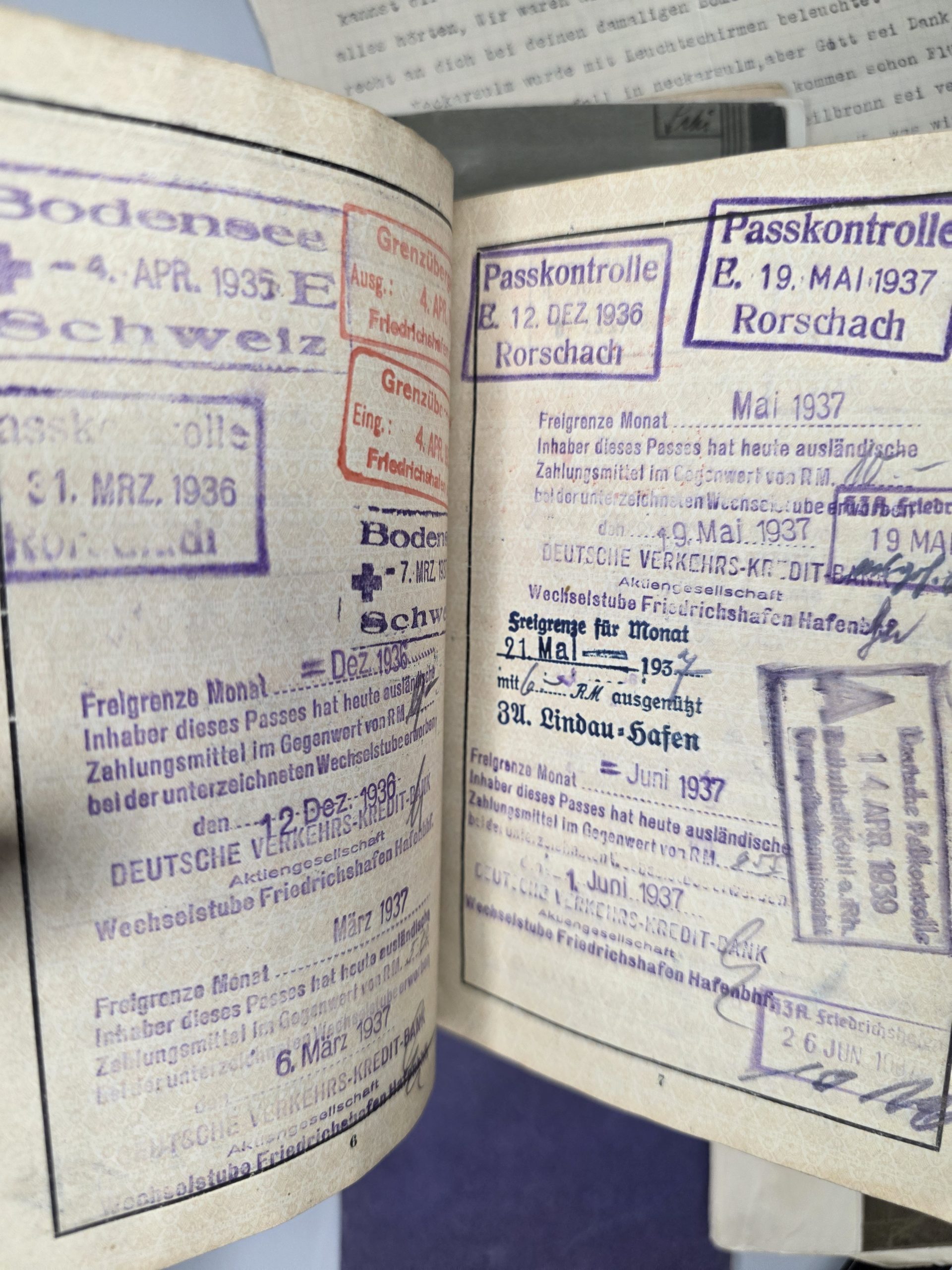
The two Deutsches Reich passports carry a fine sequence of stamps from the Lake Constance crossings: Swiss passport-control stamps at Rorschach (including 31 March 1936, 12 December 1936 and 19 May 1937), German frontier stamps at Friedrichshafen, a Zollamt Lindau-Hafen entry, and the currency-allowance stamps of the Deutsche Verkehrs-Kredit-Bank exchange office at Friedrichshafen harbour. A later German passport-control stamp of April 1939 is also visible. These pages illustrate the strict foreign-currency controls under which German citizens travelled abroad in the 1930s.
The 1927 identity card (Ausweis Nr. 25), issued on 17 May 1927 by the 10. Polizei-Revier Frankfurt am Main and valid until 16 May 1928, records Walter as a Student, with permanent residence at Laupheim (Württemberg) and a current address in Frankfurt. Its printed form covers transit traffic between East Prussia and the rest of Germany and travel to the occupied territories, a direct reminder of the post-Versailles map of the Weimar Republic. It bears a youthful portrait and Polizei-Präsidium stamps.
What Does the Wartime Correspondence Say?
The typed letter from Neckarsulm, dated 1 May 1944 and opening “Lieber Walter”, thanks him for two letters showing that he is still alive. The writer refers to Friedrichshafen as almost entirely destroyed and describes the bombers passing over Neckarsulm during the latest raid on Munich, with incendiaries falling between Erlenbach and the Wiesental near Untereisesheim, mostly on the Spohn and NSU works. The letter was written only days after the Royal Air Force’s heavy night attack on Friedrichshafen of 27–28 April 1944, and it conveys the fear and exhaustion of civilian life in Württemberg at that time. The writer’s figures and descriptions are personal impressions, not official statistics.
The 1927 letter from the President of the Oberpostdirektion Stuttgart, dated 23 July 1927 and received at the Postamt Laupheim, congratulates Oberpostmeister Karl Schirmer on completing forty years of service and refers to an enclosed letter of congratulation and recognition from the Reich President. That enclosure is not part of this archive.
Collector’s Note
From my point of view as a document collector, the strength of this group lies in its internal consistency. The name, the date of birth 12.6.1905 and the birthplace Neckarsulm appear on the 1927 police card, the Wehrpass, the Wehrpaß-Notiz and the 1942 school identity document. The Laupheim residence of 1927 matches the address of the 1927 postal letter, and the Wehrpass names Karl Schirmer as his father. In a German Wehrpass archive, this kind of cross-referencing is far more convincing than any single document on its own. Groups that tell the story of a teacher held back for essential work on the home front are much less common than combat-soldier groups, and they show a side of the war that is often overlooked. For broader context, see my guide to WW2 German documents.
Condition
- Wehrpass with general age and handling wear, light soiling and rust marks from the photo rivets. Covers intact.
- Passports with wear to the covers and edges, as expected from use.
- Wehrpaß-Notiz F folded, with light creasing and edge wear.
- Loose letters and identity papers with age toning, folds and small edge faults.
- The 1927 identity card shows fold wear and some soiling.
- The notebook and studio photograph show age-related wear.
Please study all eighteen photographs of this German Wehrpass archive, which form an essential part of this condition description. The archive is sold exactly as shown.
Frequently Asked Questions
Did Walter Schirmer serve at the front?
Nothing in the photographed pages records front-line service. The documents show military registration and examination in 1944, together with an unabkömmlich exemption from the same year.
Who was Karl Schirmer?
The Wehrpass names Karl Schirmer, Oberpostmeister, as Walter’s father. The 1927 letter congratulates him on forty years of postal service at Laupheim.
Who is the boy in the studio photograph?
The sitter is not identified on the photograph. It may be a family photograph, but this cannot be confirmed.
Is the Reich President’s letter included?
No. The 1927 Oberpostdirektion letter mentions an enclosure from the Reich President, but that enclosure is not present.
Are the items sold together?
Yes. The German Wehrpass archive is offered as one group, which keeps the documentary story intact.
Historical Responsibility Notice
This German Wehrpass archive is offered as a historical artefact for collecting, preservation, education and research. Some documents bear official symbols of the National Socialist period, which are retained because they are an original part of the documents. Autographs & Militaria does not endorse or glorify National Socialist ideology. For our approach to this material, see collecting Third Reich material responsibly.
References & Further Reading
- Original documents in this archive (Wehrpass, Wehrpaß-Notiz F, identity papers, passports and correspondence), as transcribed above.
- RAF Bomber Command, Campaign Diary, April 1944 (raid on Friedrichshafen, night of 27–28 April 1944).
- Dietmar Süß, Erinnerungen an den Luftkrieg in Deutschland und Großbritannien, Bundeszentrale für politische Bildung, 2005.
- Autographs & Militaria, Wehrpass vs Soldbuch.
- Autographs & Militaria, Complete Collector’s Guide to the German Wehrpass.
Additional information
| Availability | Available |
|---|
How to acquire a piece
- Note the reference (SKU) shown on this page.
- Send an enquiry by the form below, email or WhatsApp. I reply personally to confirm availability.
- Once availability is confirmed, I send payment details. The asking price is the one shown.
- The piece is packed with care and dispatched with tracking.
Further reading
Ask about this piece
I reply personally to every enquiry. Ask about availability, shipping to your country, further photographs or any detail of the piece. Please include the reference (SKU).
Other related pieces
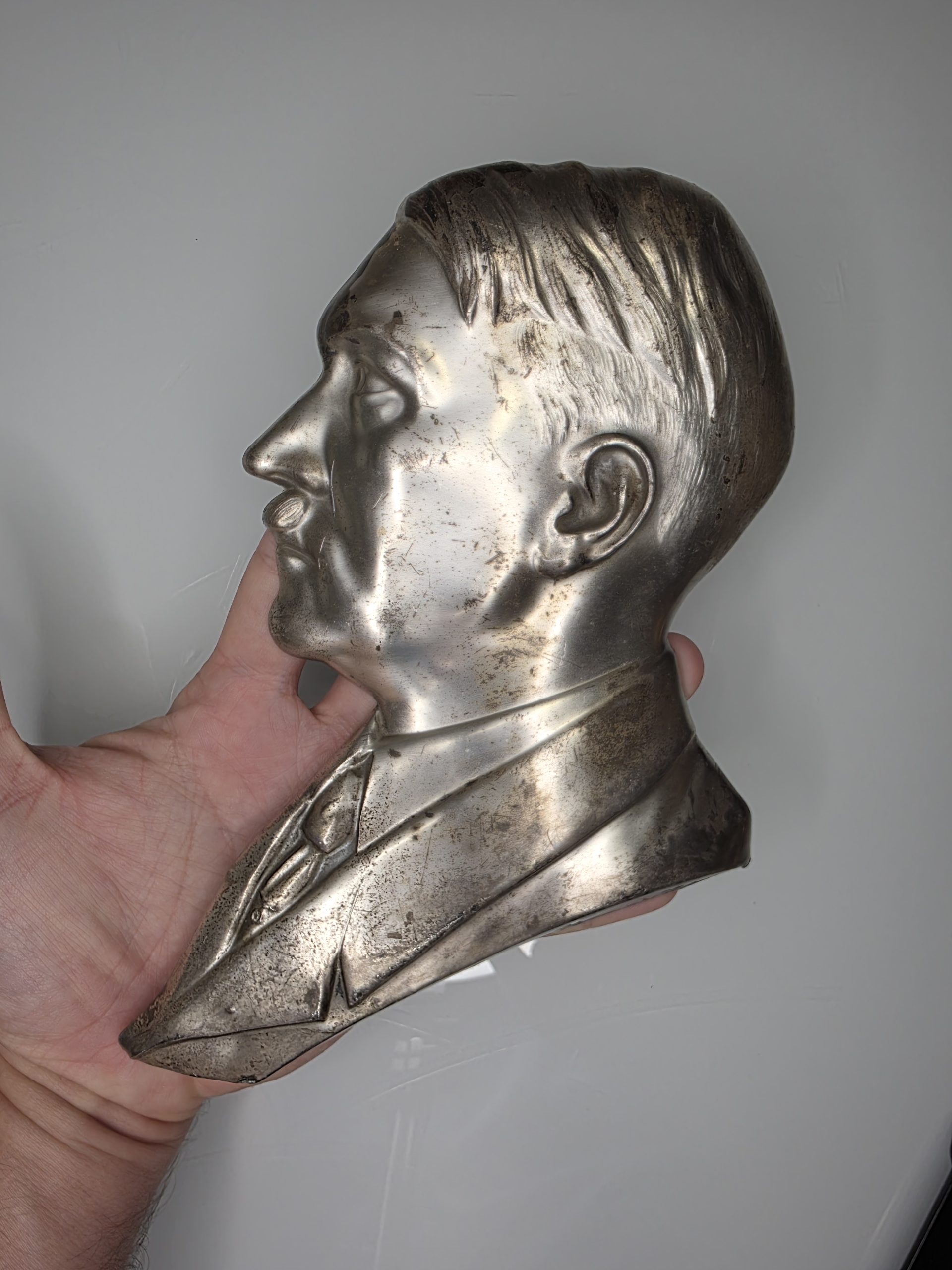
Adolf Hitler Metal Profile Relief – Hollow Wall Portrait, Reverse Marked GES. GESCH.
Original price was: 290,00 €.260,00 €Current price is: 260,00 €.
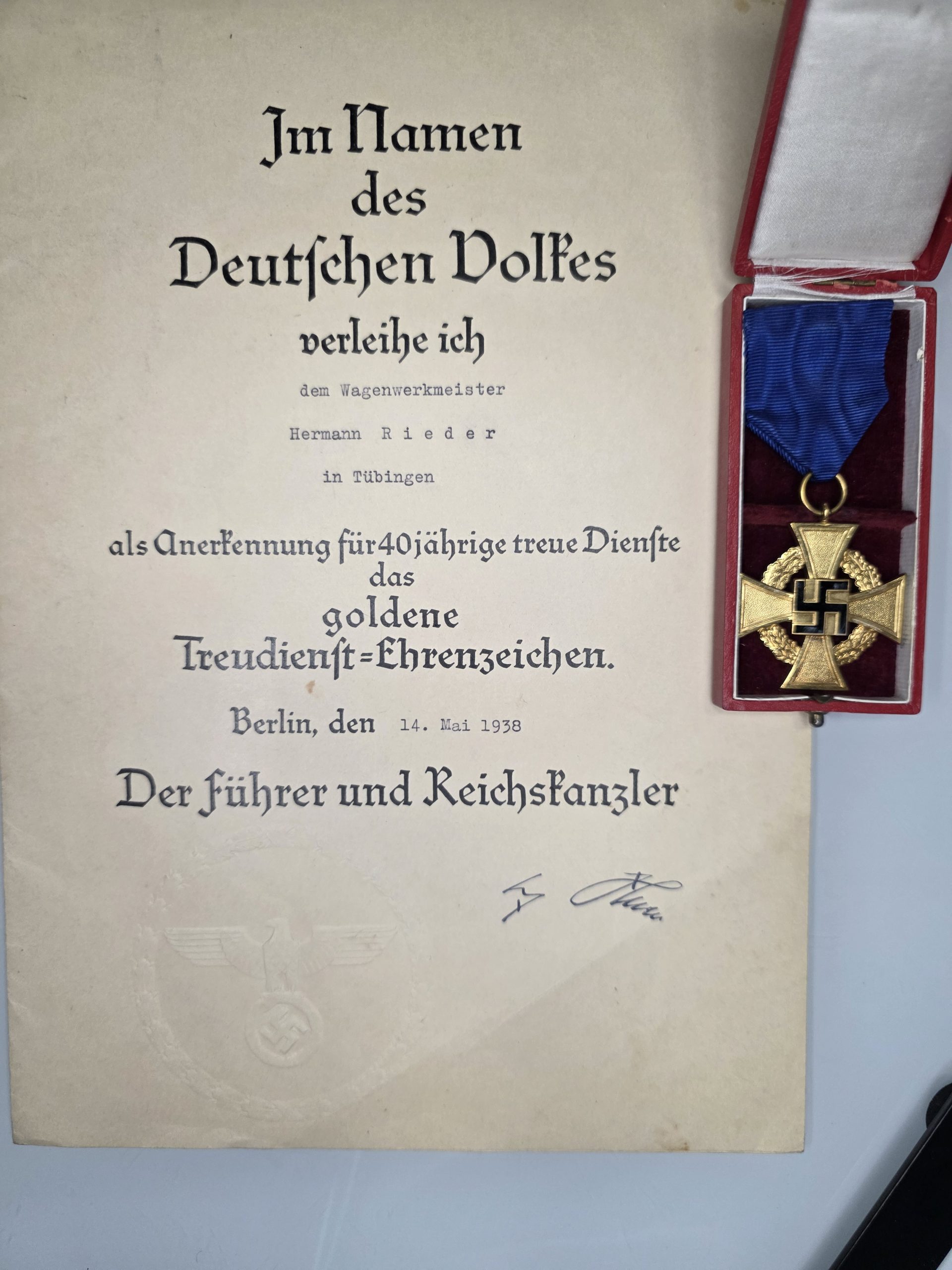
Limited-Time OfferNamed Treudienst-Ehrenzeichen 40 Years with Award Document & Case – Hermann Rieder, Tübingen 1938
Original price was: 700,00 €.590,00 €Current price is: 590,00 €.
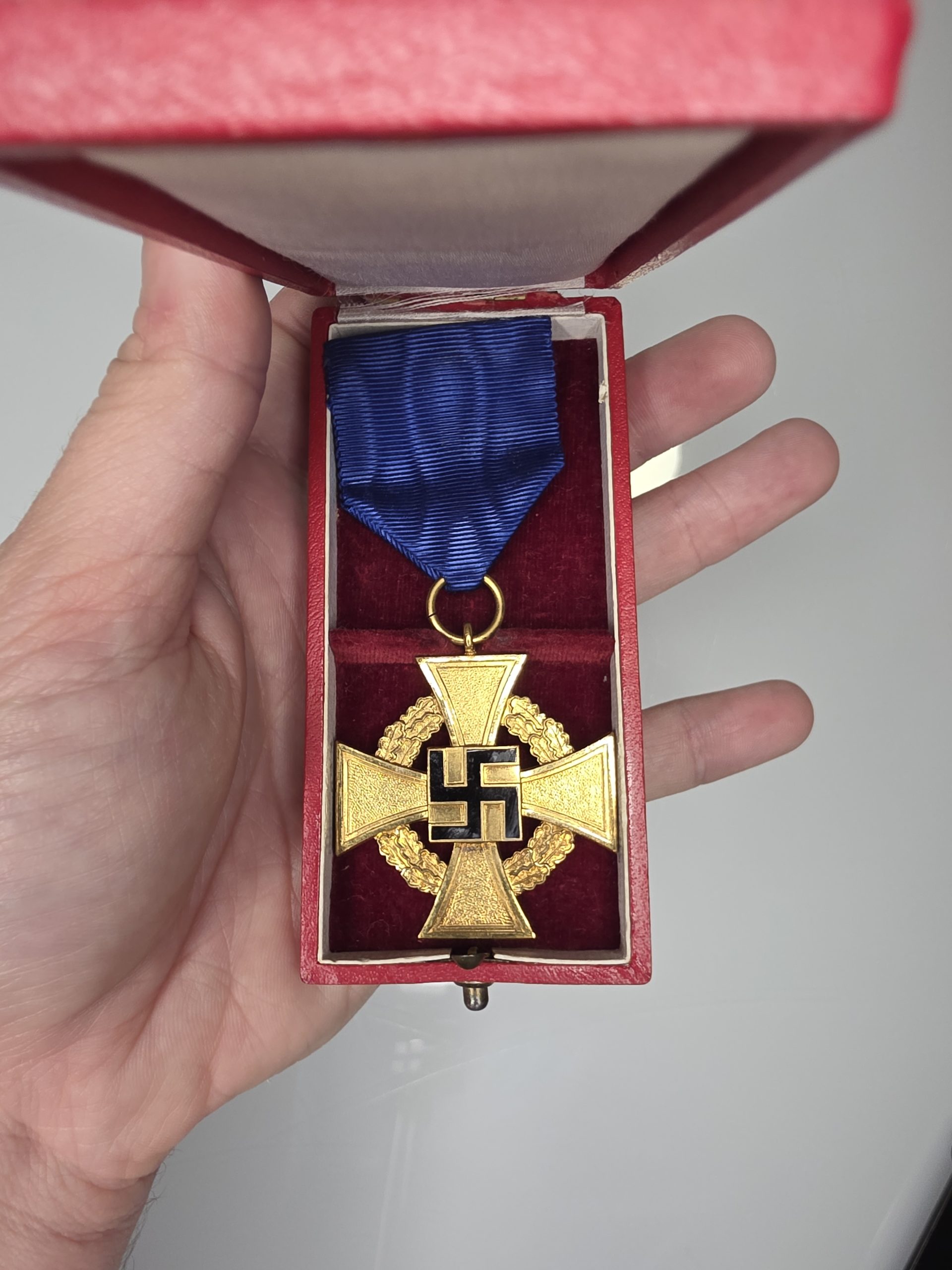
Limited-Time OfferGerman Faithful Service Decoration 40 Years – Treudienst-Ehrenzeichen 1st Class in Gold with Case
Original price was: 175,00 €.149,00 €Current price is: 149,00 €.
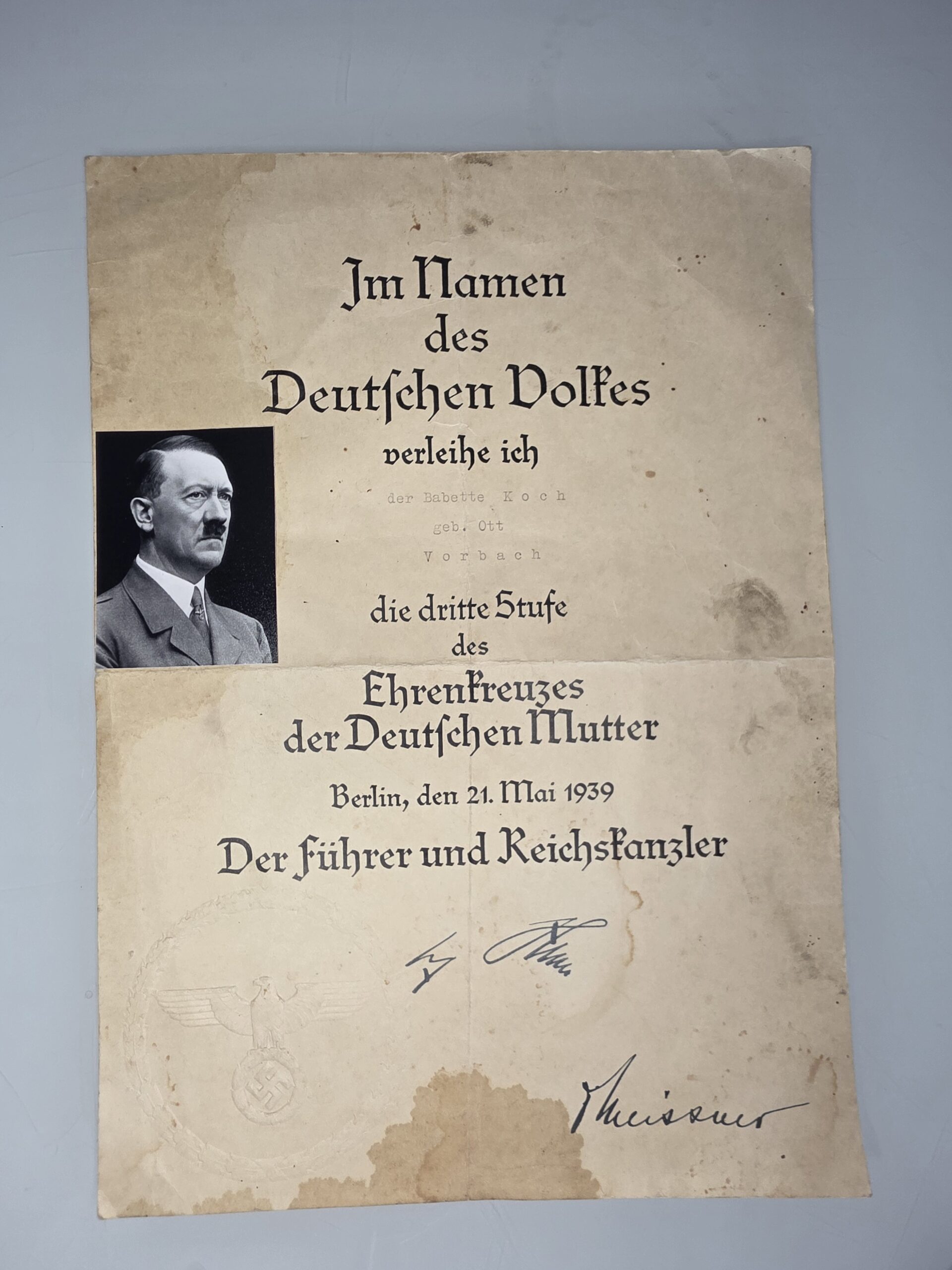
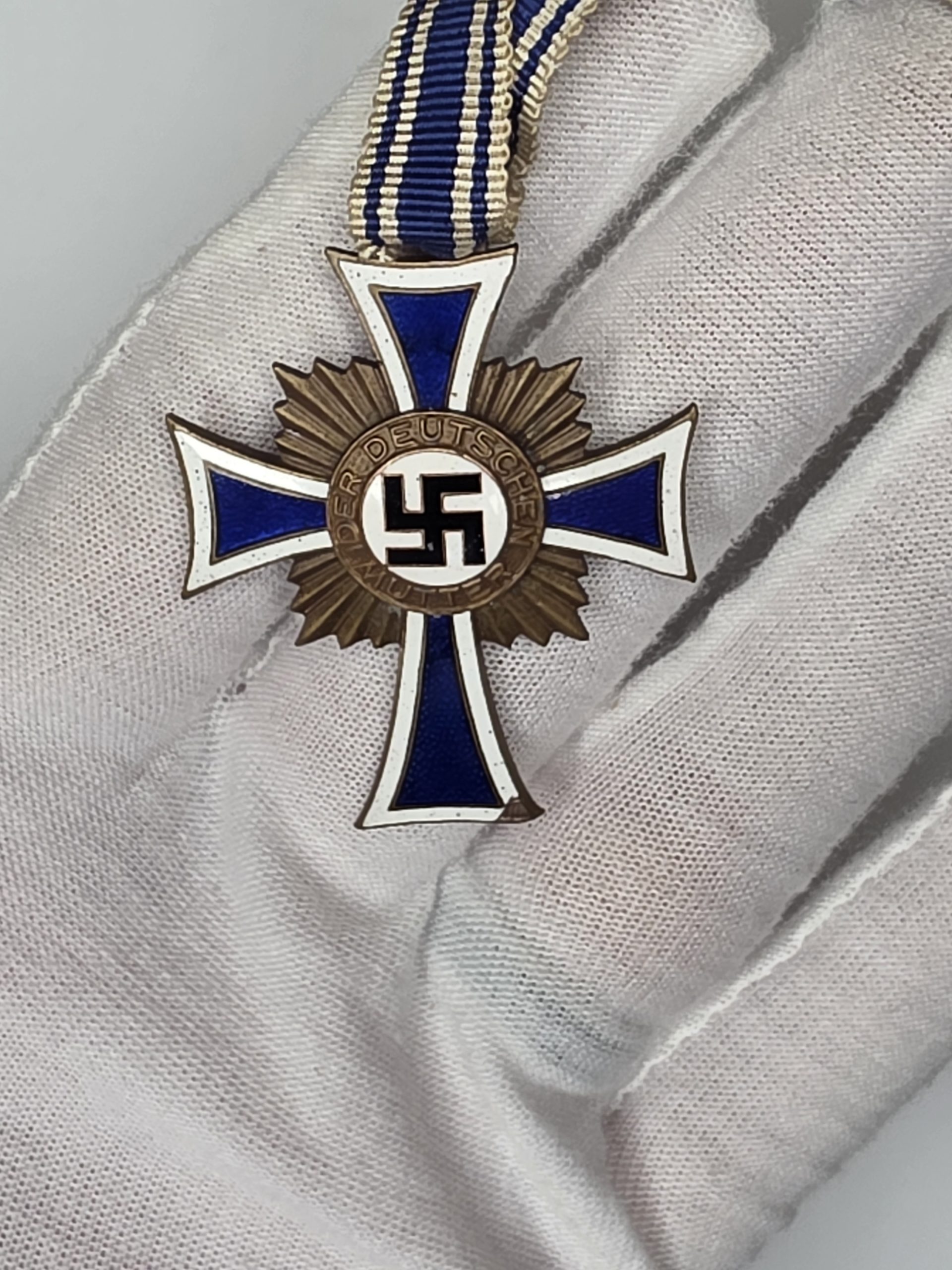
Limited-Time OfferGerman Mother’s Cross in Bronze – Mutterkreuz 3rd Class with Long Ribbon
Original price was: 60,00 €.50,00 €Current price is: 50,00 €.
Limited-Time Offer
Collector Updates
Discover new historical pieces, collector guides and research from Autographs & Militaria. One concise weekly update, only when there is something new.
New collection arrivals · Collector’s Journal · Historical research
Private collection. This piece is listed from the catalogue of a private collection, not an online shop. Please read the description, photographs and condition notes carefully, and contact me to confirm availability or ask any question before purchase. Kindly quote the reference (SKU) in your message.
Historical Responsibility Notice. Material from sensitive historical periods is documented as a historical artefact for collecting, conservation, education and research. Its description does not endorse or glorify any ideology. Buyers are responsible for complying with the laws of their own country on the import, ownership and display of such items.