1938 Anschluss Plebiscite Ballot – Austria, Adolf Hitler & Greater German Reichstag
Original price was: 90,00 €.65,00 €Current price is: 65,00 €.
Limited-Time OfferListed from a private collection · availability confirmed personally · price as shown
Authentication & Certification
Signatures and documents in this collection are examined by Juan García Nicolás, a qualified graphologist and forensic handwriting examiner, on a coherent set of features rather than a single sign.
Document Authentication & Certification →
Graphology & Signature Analysis →
Authenticity & Provenance policy →
Description
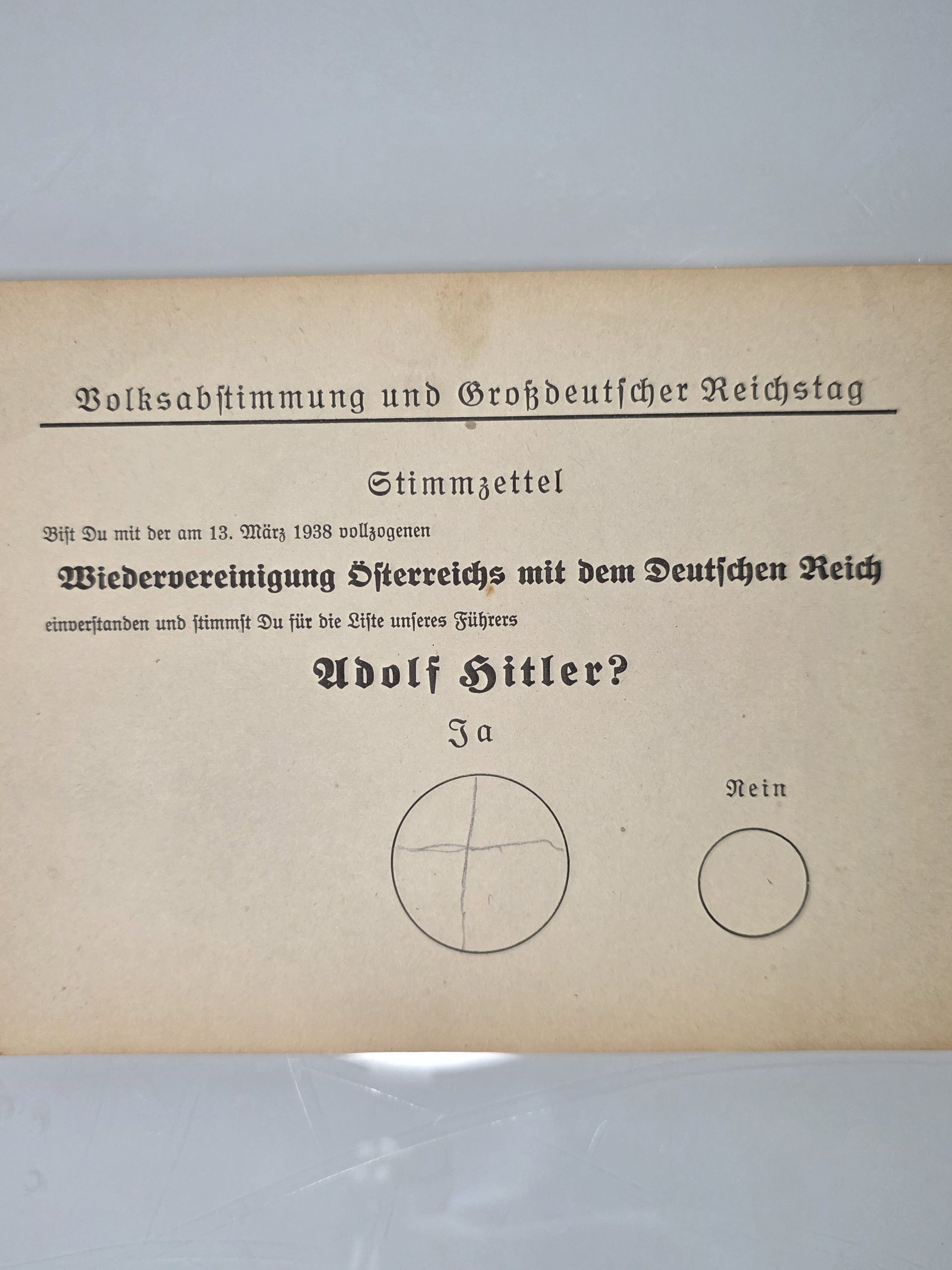
This original-period 1938 Anschluss ballot paper was printed for the combined plebiscite and Greater German Reichstag election of 10 April 1938. It asks a single question tying approval of Austria’s annexation to support for Adolf Hitler’s list, and carries the well-known unequal design of a large “Ja” circle and a small “Nein” circle. A bold pencil cross, drawn freehand and running beyond the edge of the circle, fills the “Ja” field.
What is printed on this Anschluss ballot paper?
Volksabstimmung und Großdeutscher Reichstag
Stimmzettel
Bist Du mit der am 13. März 1938 vollzogenen Wiedervereinigung Österreichs mit dem Deutschen Reich einverstanden und stimmst Du für die Liste unseres Führers
Adolf Hitler?
Ja ◯ Nein ○
In English: “Do you agree with the reunification of Austria with the German Reich carried out on 13 March 1938, and do you vote for the list of our Führer Adolf Hitler?” The regime’s word was Wiedervereinigung, “reunification”; history knows the event as the Anschluss.
Why does a 1938 Anschluss ballot matter?
German troops entered Austria on 12 March 1938 and the law incorporating it into the German Reich followed on 13 March. The vote of 10 April came afterwards, held across the enlarged Reich on a single approved list and after an intense propaganda campaign, with Jewish citizens and others excluded under the racial laws. The regime announced over 99% approval.
The ballot paper records how that consent was staged. Two decisions are fused into one question, Hitler’s name stands at its centre, and the oversized “Ja” circle dominates the lower half of the sheet while the “Nein” circle is pushed aside. It is a document of political design as much as of administration.
Was this ballot cast?
The pencil cross is retained exactly as found. Without provenance it cannot be established whether the sheet was cast at a polling station, marked later, or belonged to the specimens circulated during the campaign, so it is offered as a period ballot paper with a pencil “Ja” mark. No regional or polling-station attribution is made.
Why collect it?
A 1938 Anschluss ballot is one of the most recognisable pieces of political ephemera of the period and an effective display piece: its meaning is clear at a glance. Other examples in the collection allow direct comparison: a ballot with a light “Ja” mark (DOC214) and an unmarked example (DOC216), as well as the 1936 Reichstag ballots DOC217 and DOC215.
See also our Volksabstimmung 1938 ballot (DOC200), unmarked on the front with a pencil cross on the reverse.
Collector’s Note
The marks on surviving ballots vary as much as the hands that made them. Here the cross is large and firm, drawn across and beyond the “Ja” circle, quite unlike the small, light cross on DOC214. Comparing them is a reminder that each ballot was handled by a different person.
Condition
Period condition:
- Overall age toning to a cream-yellow colour.
- Several small age spots and stains.
- Light edge and corner wear and minor handling marks.
- Printing strong and fully legible.
- Pencil cross in and around the “Ja” circle.
No major loss is visible. The photograph shows the actual ballot offered and forms part of this condition description.
Frequently asked questions
When was the vote?
10 April 1938.
Why does it mention 13 March 1938?
That was the date of the law incorporating Austria into the German Reich.
Is it marked?
Yes, with a bold pencil cross in the “Ja” circle.
Was it actually cast?
That cannot be confirmed without provenance.
Is it an Austrian ballot?
The same wording was used across the enlarged Reich; no regional attribution is made.
Historical Responsibility Notice
This ballot is offered exclusively as a historical artefact for collecting, preservation, education and research. Names and wording of the period are reproduced only because they form an inseparable part of the original document. Autographs & Militaria does not endorse or glorify National Socialism or the political system it represents.
References & Further Reading
- United States Holocaust Memorial Museum, Commemorative ballot issued to celebrate the annexation of Austria by Nazi Germany (2004.454.2) – ballot wording and the vote of 10 April 1938.
- Wien Museum, Streuzettel: NS-Volksabstimmung zum “Anschluss” Österreichs an das Deutsche Reich am 10. April 1938 (inv. 309019/2).
Additional information
| Availability | Available |
|---|
How to acquire a piece
- Note the reference (SKU) shown on this page.
- Send an enquiry by the form below, email or WhatsApp. I reply personally to confirm availability.
- Once availability is confirmed, I send payment details. The asking price is the one shown.
- The piece is packed with care and dispatched with tracking.
Further reading
Ask about this piece
I reply personally to every enquiry. Ask about availability, shipping to your country, further photographs or any detail of the piece. Please include the reference (SKU).
Other related pieces
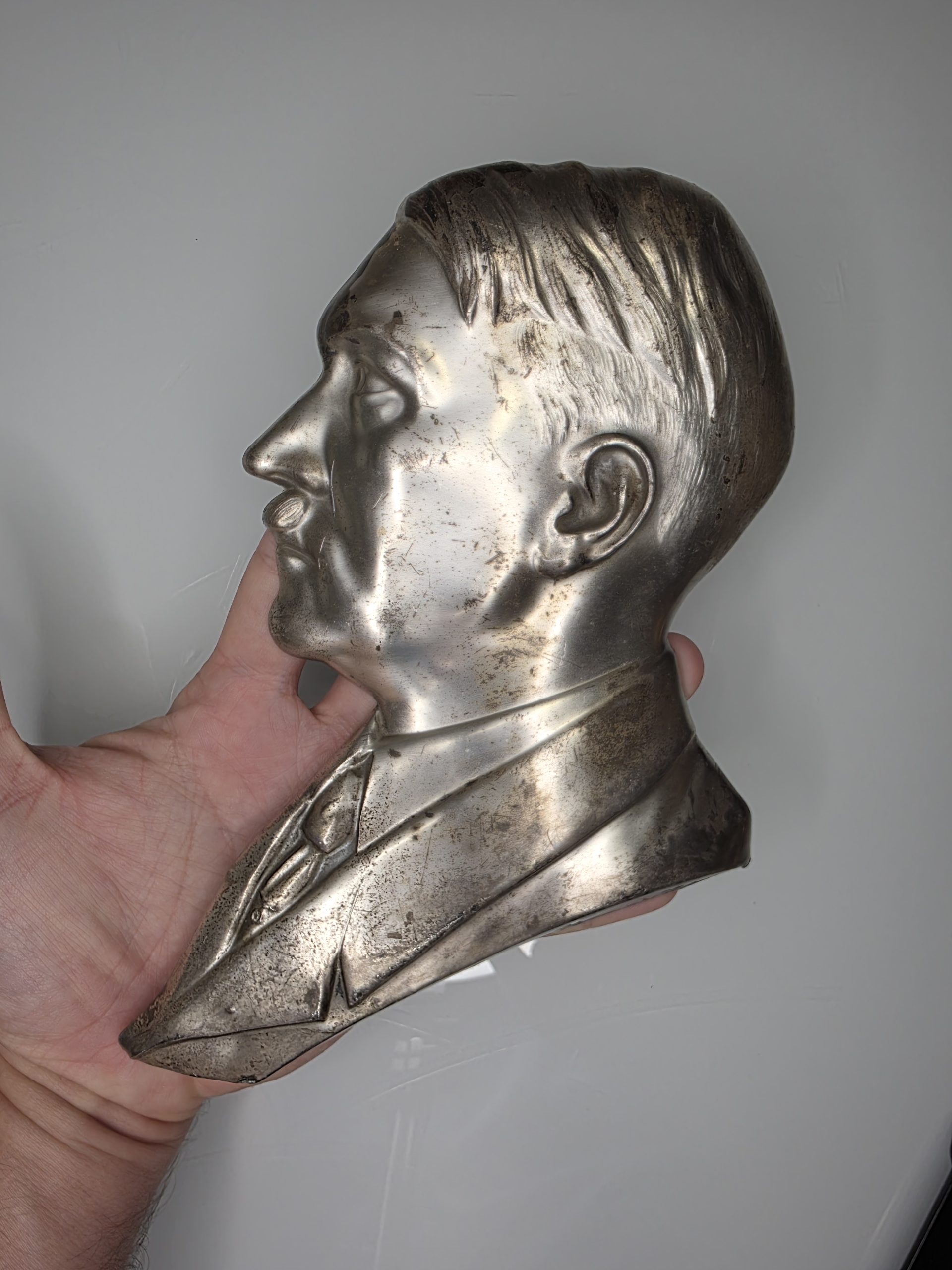
Adolf Hitler Metal Profile Relief – Hollow Wall Portrait, Reverse Marked GES. GESCH.
Original price was: 290,00 €.260,00 €Current price is: 260,00 €.
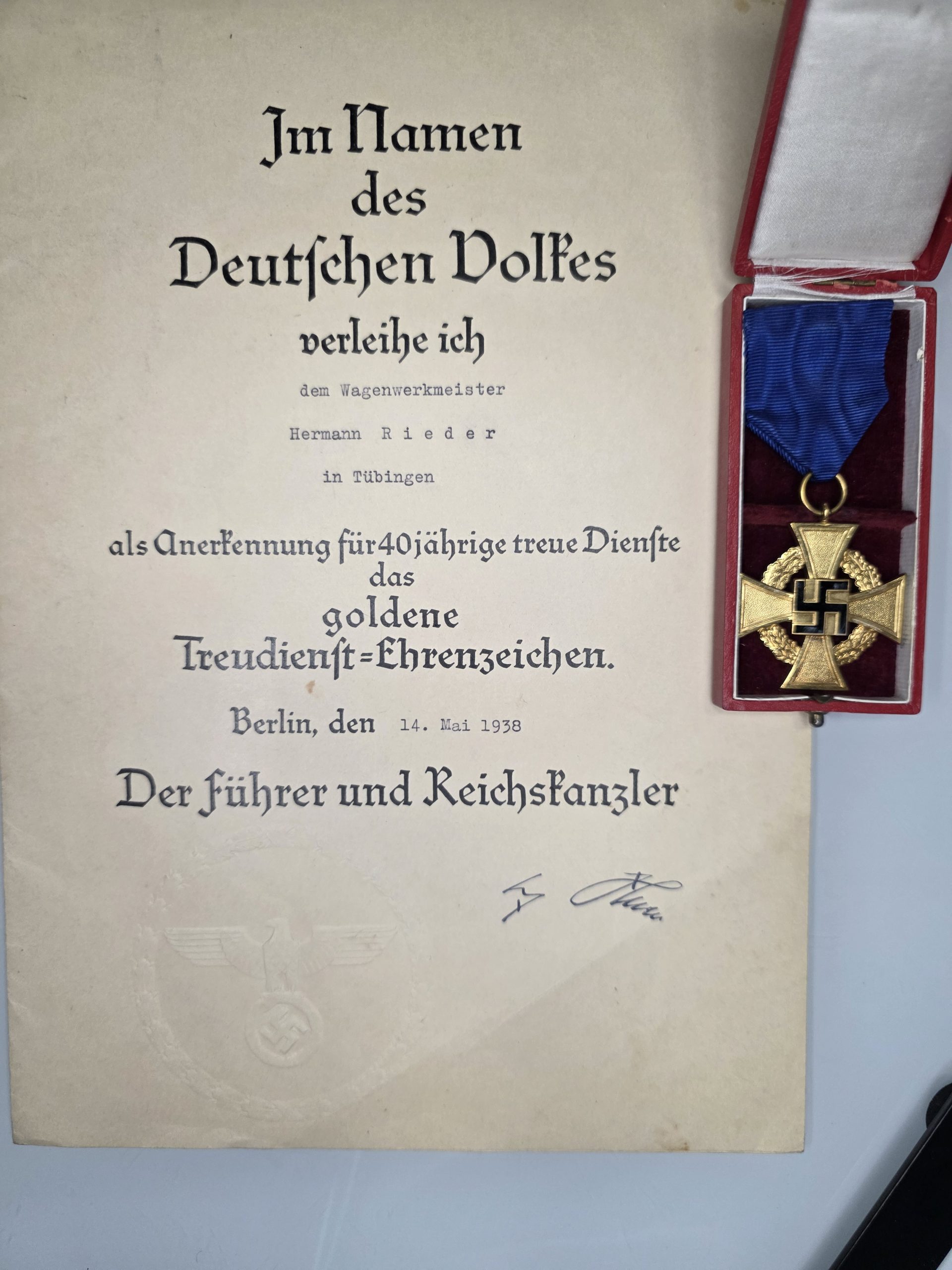
Limited-Time OfferNamed Treudienst-Ehrenzeichen 40 Years with Award Document & Case – Hermann Rieder, Tübingen 1938
Original price was: 700,00 €.590,00 €Current price is: 590,00 €.
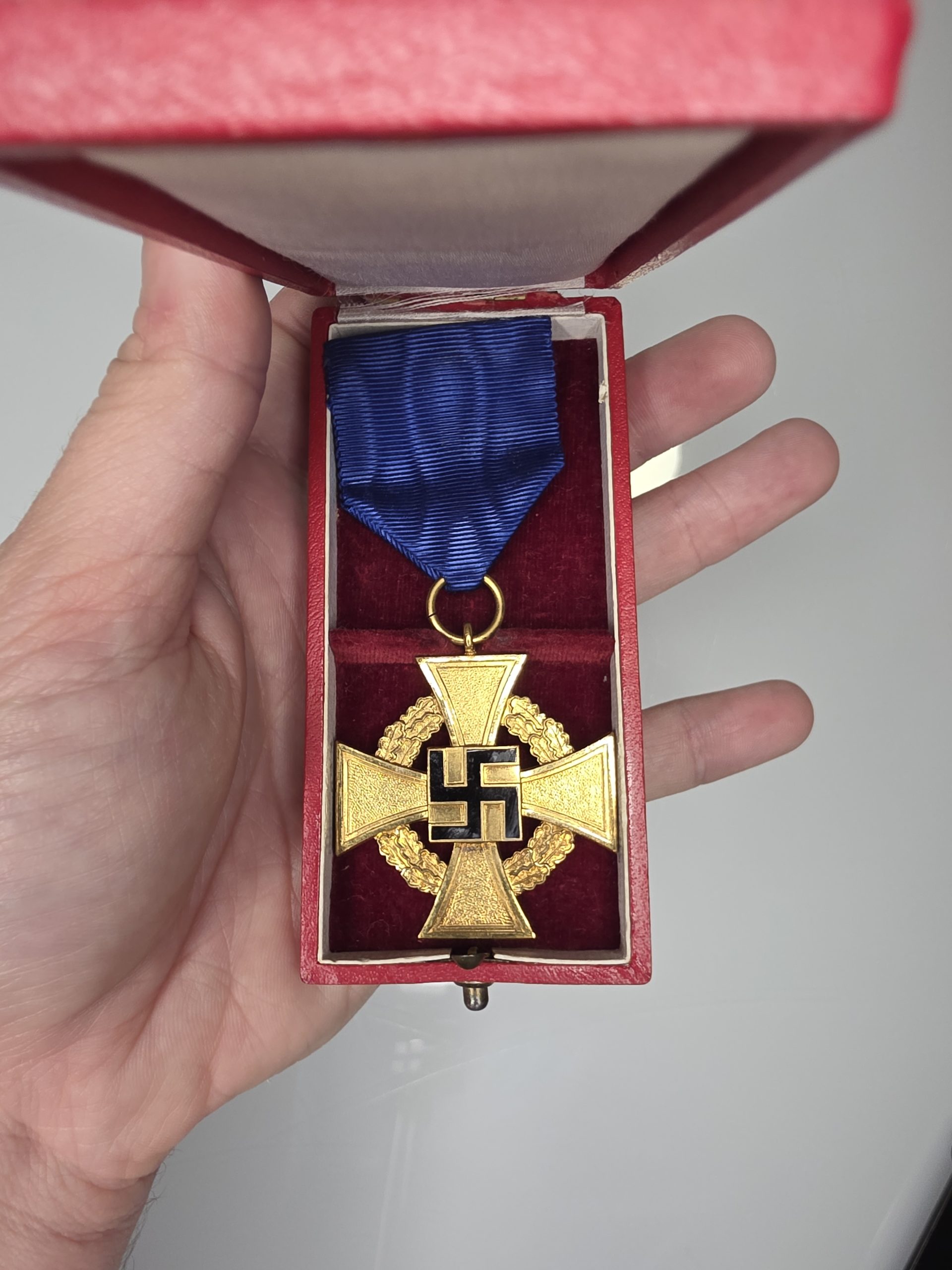
Limited-Time OfferGerman Faithful Service Decoration 40 Years – Treudienst-Ehrenzeichen 1st Class in Gold with Case
Original price was: 175,00 €.149,00 €Current price is: 149,00 €.
Limited-Time OfferGerman Mother’s Cross in Bronze – Mutterkreuz 3rd Class with Long Ribbon
Original price was: 60,00 €.50,00 €Current price is: 50,00 €.
Limited-Time Offer
Collector Updates
Discover new historical pieces, collector guides and research from Autographs & Militaria. One concise weekly update, only when there is something new.
New collection arrivals · Collector’s Journal · Historical research
Private collection. This piece is listed from the catalogue of a private collection, not an online shop. Please read the description, photographs and condition notes carefully, and contact me to confirm availability or ask any question before purchase. Kindly quote the reference (SKU) in your message.
Historical Responsibility Notice. Material from sensitive historical periods is documented as a historical artefact for collecting, conservation, education and research. Its description does not endorse or glorify any ideology. Buyers are responsible for complying with the laws of their own country on the import, ownership and display of such items.