The Collector’s Encyclopaedia · Decorations · Civil awards
Mother’s Cross: History, Grades and Collector’s Guide
| Instituted | 16 December 1938 |
|---|---|
| Grades | Bronze: four or five children; Silver: six or seven; Gold: eight or more |
| Awarded | Annually on Mother’s Day (second Sunday in May), from May 1939 until 1944 |
| First recipient | Magda Goebbels (silver), according to the Australian War Memorial |
| In the collection | 3 pieces currently available (see below) |
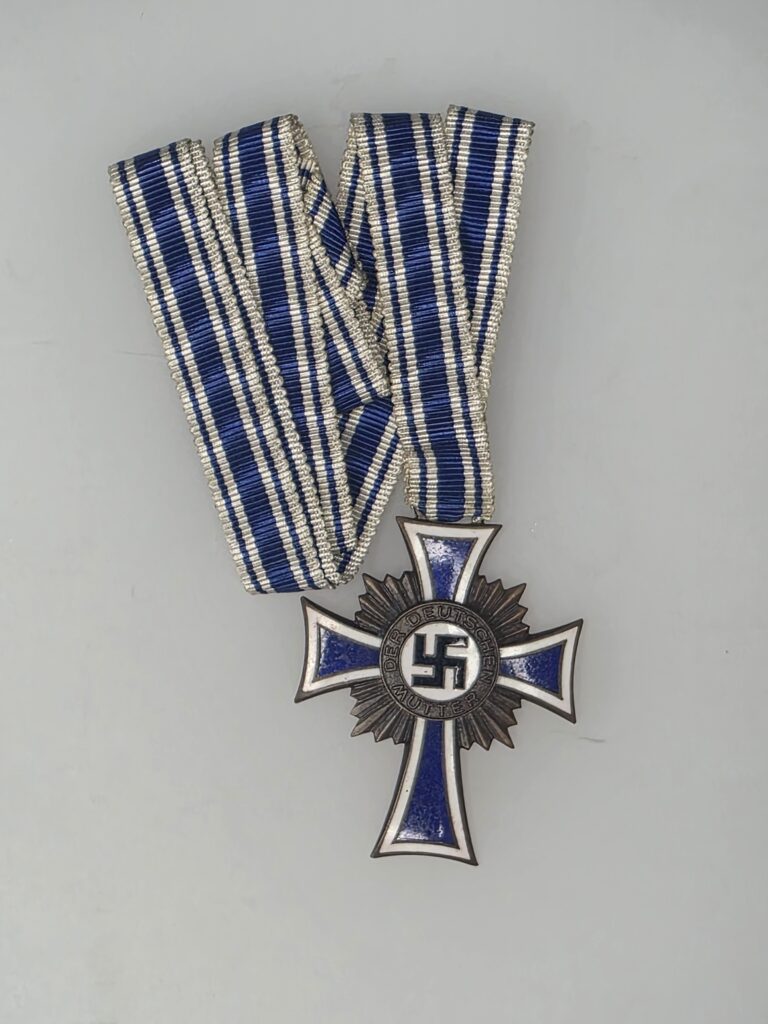
The Cross of Honour of the German Mother was the regime’s reward for motherhood, created to promote a higher birth rate within its racial ideology. It is one of the commonest decorations of the period, and it shows clearly how the state reached into family life.
What Was the Mother’s Cross?
The Mother’s Cross was instituted on 16 December 1938. It was awarded in bronze, silver and gold according to the number of children, and presented each year on Mother’s Day, from May 1939 until 1944. Only women considered of “German blood” were eligible, and the award could be withdrawn for conduct the regime disapproved of. The reverse is dated 16 December 1938 and carries a facsimile of Hitler’s signature.
Who Awarded It, and Which Documents Go With It?
Awards were processed through the party and local authorities. The accompanying document is usually a printed certificate with facsimile signatures; see original signature or facsimile and Magda Goebbels.
What Should Collectors Watch For?
- The Hitler signature on the reverse is a facsimile on every cross, not an autograph.
- Gold crosses are scarcer and more often copied.
- Enamel damage is common and affects value; describe it honestly.
Legal note. In Germany the 1957 Orders and Decorations Act allows Second World War awards to be worn only without National Socialist emblems, which is why “1957 pattern” versions without the swastika exist. The public display of Nazi symbols is restricted in Germany, Austria and several other countries. Owning, buying and selling original decorations as historical objects is treated differently from country to country, so check the law where you live and where you ship.
Collector’s Note
The Mother’s Cross is easy to find and easy to misunderstand. It was not a family keepsake in a neutral sense but an instrument of population policy, and I describe it that way.
Related Entries and Pieces
Pieces in the Collection
Browse the full Collector’s Encyclopaedia →
Frequently Asked Questions
When was the Mother’s Cross instituted?
On 16 December 1938.
How many children were needed for each grade?
Four or five for bronze, six or seven for silver, eight or more for gold.
Is the signature on the reverse genuine?
No. It is a facsimile of Hitler’s signature.
Historical Responsibility Notice: this entry documents historical figures and artefacts of the National Socialist period for collecting, preservation, education and research. It does not endorse or glorify any ideology, and it is written in memory of the victims of the regime.
References & Further Reading
- Australian War Memorial, Cross of Honour of the German Mother, First Class (REL/15462).
- Federal Republic of Germany (1957, as amended) Gesetz über Titel, Orden und Ehrenzeichen (OrdenG), §§ 6 and 15, Bundesministerium der Justiz / gesetze-im-internet.de.