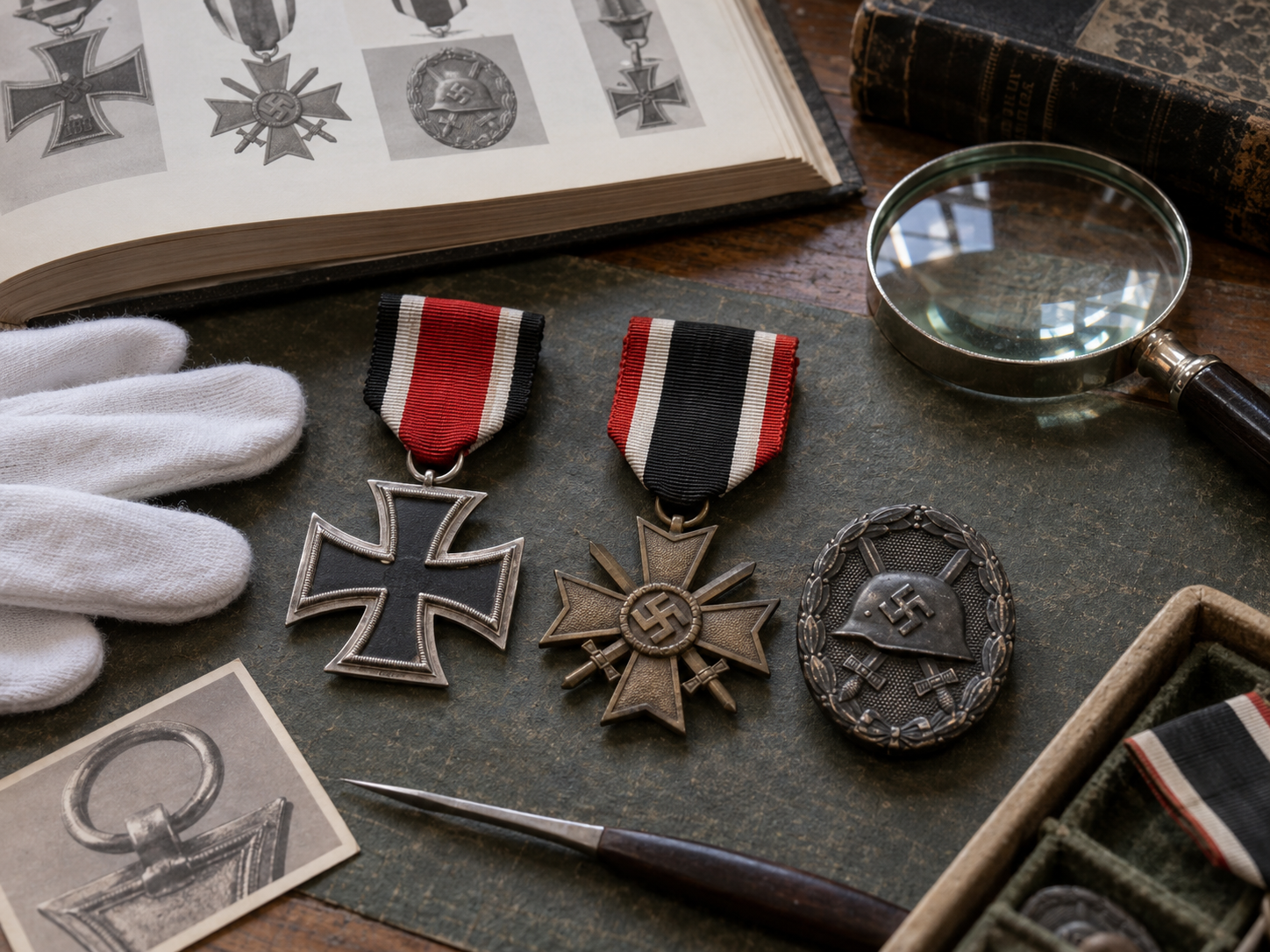
WWII German Medals: Complete Collector’s Guide to Identification, Rarity & Value
Collecting WWII German medals can appear deceptively simple.
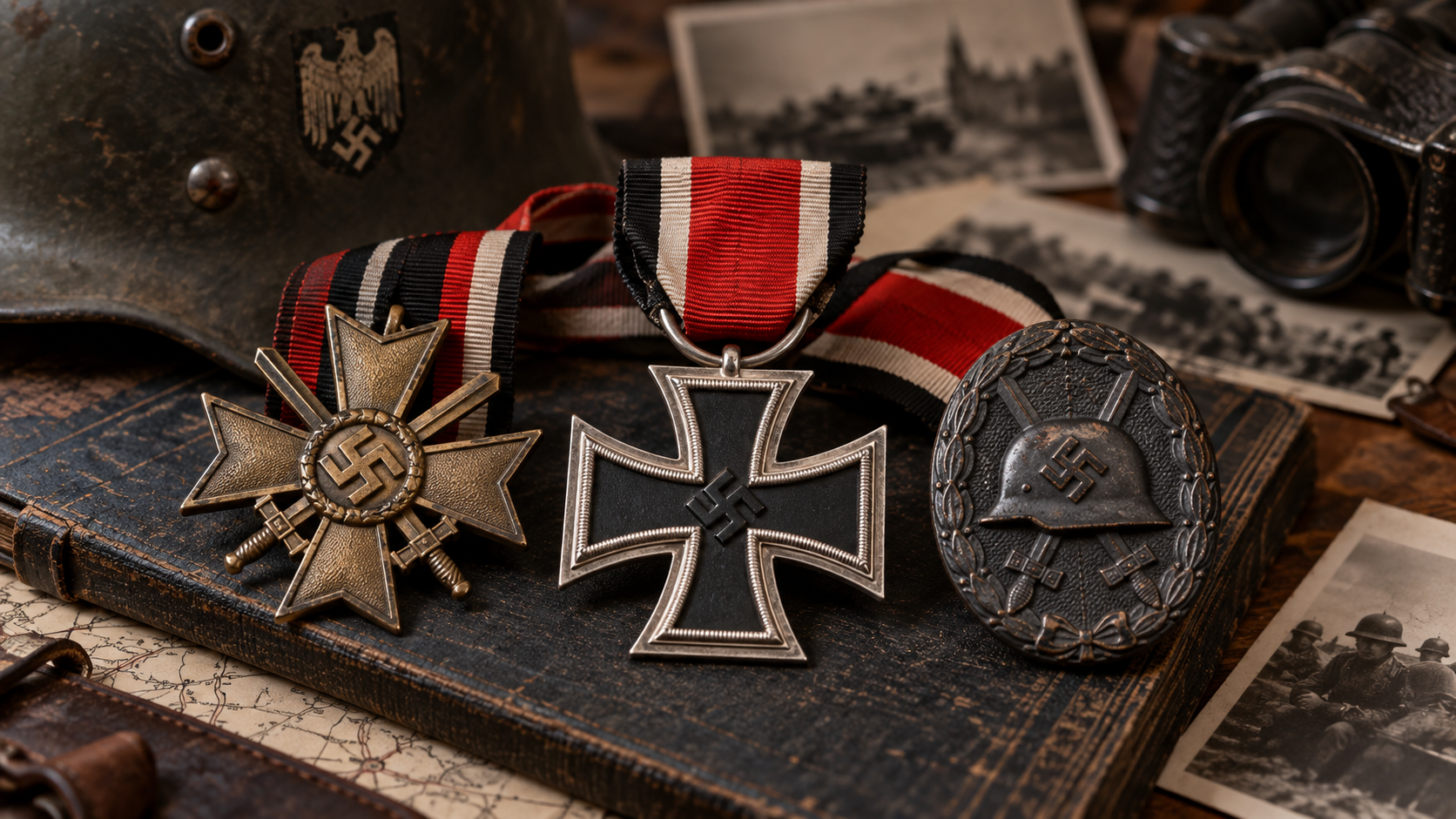
An Iron Cross is immediately recognizable. A War Merit Cross can often be identified within seconds. A Wound Badge or campaign medal may have a design familiar even to someone who has only recently entered the field.
But recognition is not identification.
Two decorations that appear almost identical in photographs may differ in manufacturer, construction, material, finish, hardware, period of production or provenance. Those differences can determine whether an object is common or scarce, period-made or reproduced, anonymous or connected to a documented individual.
For that reason, one of the first lessons in serious militaria collecting is to resist beginning with:
“How much is this medal worth?”
A better question is:
“What exactly am I looking at?”
This guide introduces the main categories of German Second World War medals and awards, explains the characteristics collectors examine when studying them, and looks at authenticity, maker marks, rarity, condition, provenance and preservation.
Throughout this article, the expression WWII German medals is used in the broad collector sense. Technically, the field also includes crosses, badges, qualification awards, campaign decorations and other forms of insignia.
Historical objects associated with National Socialist Germany are presented here exclusively as historical material. Their preservation, study and documentation do not imply endorsement of the regime or its ideology.
WWII German Medals at a Glance
Germany maintained an extensive system of military and civil decorations during the Second World War.
Some recognised acts of bravery. Others commemorated campaign participation, wounds, military qualifications, length of service or merit connected with the wider war effort.
The collector will therefore encounter objects that served very different purposes despite often being grouped together today under the general term “medals”.
| Award or category | General type | Collector interest |
|---|---|---|
| Iron Cross 2nd Class | Military decoration | Very high |
| Iron Cross 1st Class | Military decoration | Very high |
| War Merit Cross | Merit decoration | High |
| Eastern Front Medal | Campaign medal | High |
| Wound Badge | Wound decoration | High |
| Infantry Assault Badge | Combat badge | High |
| General Assault Badge | Combat badge | High |
| Panzer Assault Badge | Combat badge | High |
| Luftwaffe qualification badges | Qualification/combat | Very high |
| Kriegsmarine war badges | Naval combat awards | Very high |
The important point is that even within one award type there can be numerous variations.
Different manufacturers, materials and production periods may all exist.
A relatively common decoration can therefore contain a much less common variant.
That is where identification starts becoming more interesting than simple recognition.

The Iron Cross 1939
The Iron Cross is probably the best-known German military decoration associated with the Second World War.
Its history, however, began long before 1939.
The Iron Cross originated as a Prussian military decoration in 1813 and was renewed for later German conflicts. On 1 September 1939 it was instituted again in a new wartime form. The Deutsches Historisches Museum records that the 1939 system retained the First and Second Classes and introduced the Knight’s Cross as a higher grade.
For most collectors, the two forms encountered most frequently are:
Eisernes Kreuz 2. Klasse — Iron Cross 2nd Class
and
Eisernes Kreuz 1. Klasse — Iron Cross 1st Class.
They share the familiar cross design but were different grades and were worn differently.
Iron Cross 2nd Class — EK2
The Second Class was a ribbon-suspended decoration.
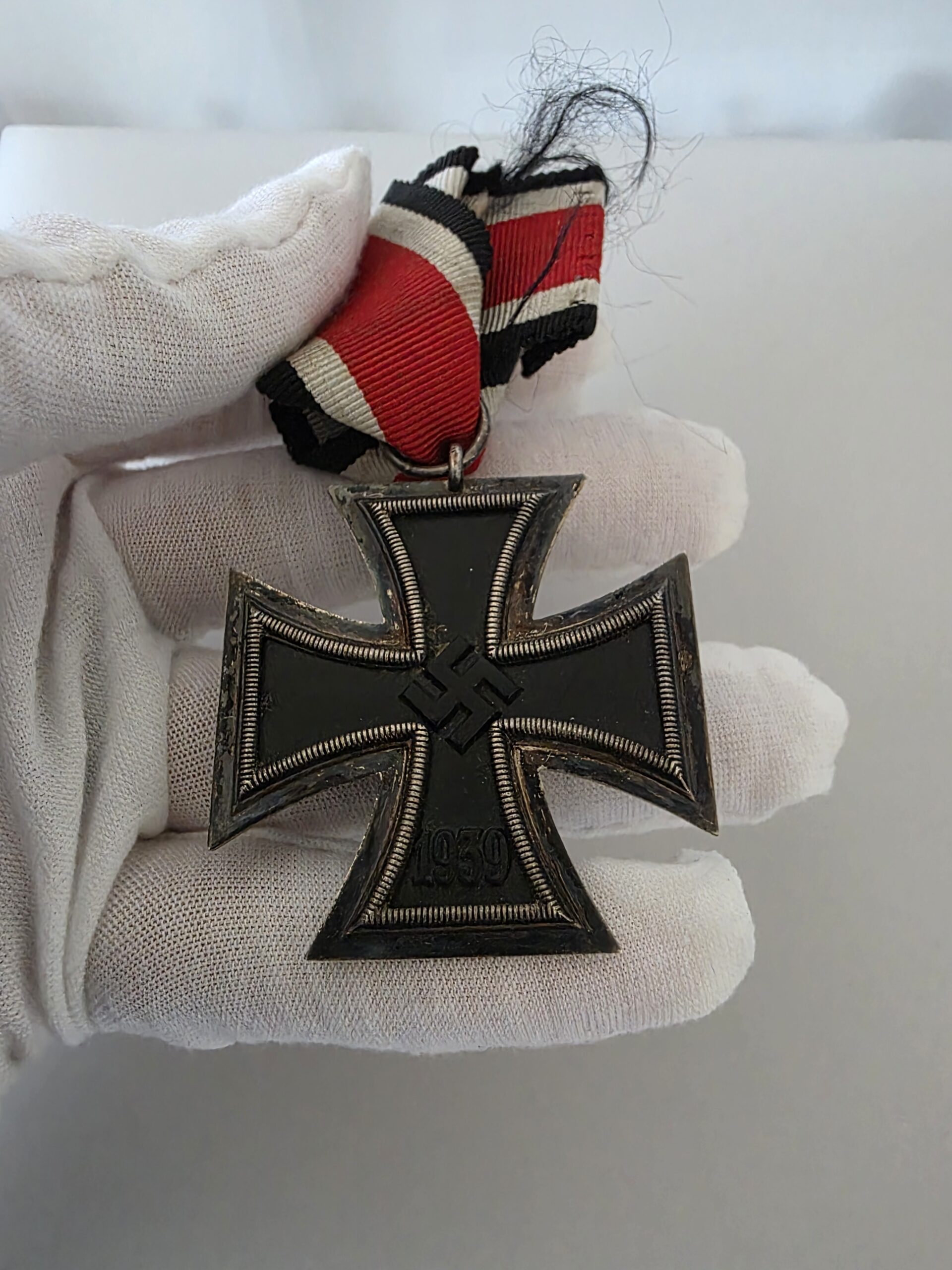
A surviving example in the Smithsonian National Air and Space Museum collection consists of a black cross with silver-coloured edging and a black, white and red ribbon. The museum identifies steel, silver alloy, paint and solder among the materials of one specimen.
For collectors, the EK2 is an excellent award through which to learn basic principles of construction.
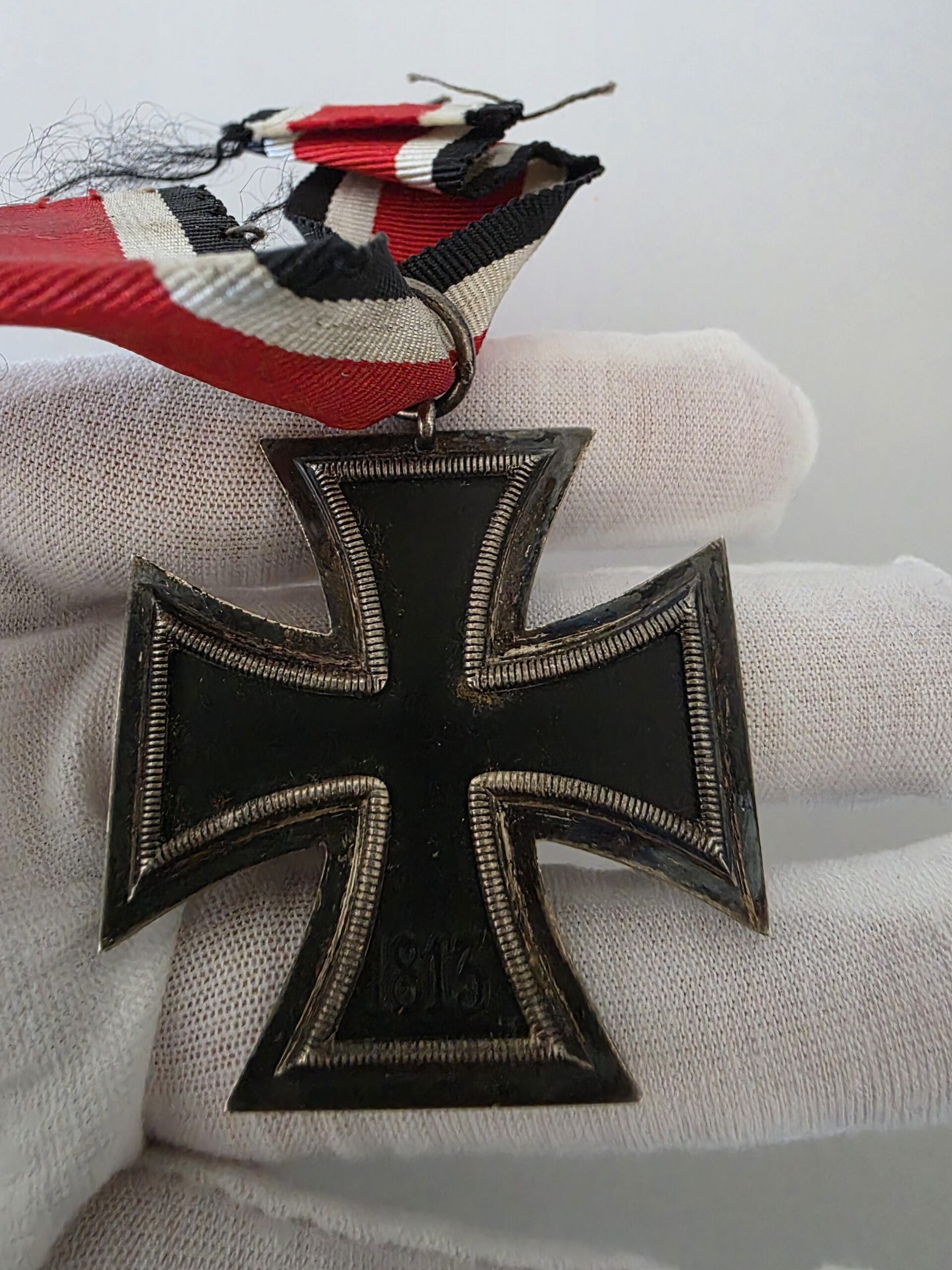
One should examine not only the front face but also the edge, suspension ring, ribbon, central core and frame.
From the Collection
Autographs & Militaria currently catalogues an original Eisernes Kreuz 2. Klasse 1939, reference INS50.
It is useful precisely because it can be studied as a real object rather than through a generic illustration. The catalogue photographs allow the collector to compare the overall design and period characteristics with institutional reference examples.
Iron Cross 1st Class — EK1
The First Class was a breast decoration worn directly on the uniform.
A wartime Luftwaffe officer’s coat preserved by the Smithsonian shows an Iron Cross First Class positioned on the left breast pocket, while the museum also preserves a 1939 First Class example in its medal collection.
This distinction immediately separates the general forms of EK1 and EK2, but it is only the beginning.
Collectors studying an EK1 will pay particular attention to the reverse hardware: pin, hinge, catch, attachment and any manufacturer characteristics.
An object may look convincing from the front while the reverse tells a very different story.
Why Construction Matters More Than First Impressions
Age alone does not authenticate a medal.
Neither does patina.
Neither does a maker number.
Neither does magnetism.
A serious examination asks how the entire object was manufactured.
With a medal or badge in hand, study the relationship between its components.
Look at the edges.
Examine how a suspension loop has been attached.
Study a pin beneath the hinge rather than only viewing it from above.
Consider whether rivets, solder, seams and finishing methods make sense for the award being examined.
Modern reproductions can copy an attractive front design extremely well.
It is much harder for a reproduction to remain convincing across every manufacturing detail.
This is why experienced collectors often spend as much time studying the reverse of an award as the obverse.
The War Merit Cross
The Kriegsverdienstkreuz, or War Merit Cross, is another important category within German WWII collecting.
The Smithsonian preserves several examples of the Second Class, including a copper-alloy example dated 1939 on the reverse. Another museum example shows the version with crossed swords and its characteristic ribbon.
The award existed in different grades and in forms with swords and without swords.
The distinction is important because the swords were not a decorative variation added randomly. They represented a different award context.
From the Collection
Autographs & Militaria has several examples of the Kriegsverdienstkreuz 2. Klasse ohne Schwerter, or War Merit Cross 2nd Class Without Swords.
One example, INS35, retains a heavily aged bronze-toned surface and visible period wear, while another retains its ribbon.
These examples are particularly useful when discussing an important subject in collecting:
condition does not mean perfection.
An original object may exhibit wear, oxidation, darkened areas and loss of finish.
Those characteristics should be documented rather than automatically removed.
Ribbons Matter — But They Do Not Authenticate the Medal
Collectors sometimes treat a ribbon as a secondary detail.
It can actually be very informative.
A correct original ribbon helps show how a decoration was intended to be worn and can make a surviving example more complete.
But ribbons are replaceable.
An old ribbon can be attached to a newer medal.
A reproduction ribbon can be aged.
A genuine ribbon can be paired with the wrong decoration.
The sensible approach is therefore to examine the medal and ribbon independently before deciding whether they form a coherent period combination.
The same principle applies to packets, boxes and presentation cases.
Accessories provide evidence.
They are not authentication certificates.


Eastern Front Medal and Campaign Awards
The decoration commonly called the Ostmedaille belonged to a different category from an award for an individual act of bravery.
It commemorated service connected with the winter campaign of 1941–42 on the Eastern Front.
This distinction is useful because it illustrates how broad the German wartime award system was.
A collector may be examining a bravery decoration, campaign award, wound award, qualification badge or service decoration.
Understanding the purpose of the award is therefore part of identifying it correctly.
Campaign awards are also useful objects through which to study suspension systems, finishes, ribbon combinations and manufacturer differences.
Wound Badges and the Problem of Sophisticated Reproductions
German Wound Badges existed in several grades and are another established collecting field.
One particularly instructive example is the special 20 July 1944 Wound Badge associated with those killed or injured in the failed assassination attempt against Hitler.
The National WWII Museum draws attention to an issue that every collector should understand: sophisticated reproductions of this badge exist that imitate not only the appearance but also details such as weight and maker marks.
This leads to one of the most important principles in this guide:
The more valuable and desirable an award becomes, the less sensible it is to authenticate it using one characteristic alone.
A correct weight is useful evidence.
It is not proof.
A correct maker mark is useful evidence.
It is not proof.
A convincing patina is useful to observe.
It is not proof.
Authentication comes from the relationship between many characteristics.
Combat and Qualification Badges
Collectors often use “WWII German medals” as an umbrella expression that also includes badges.
The field includes Infantry Assault Badges, General Assault Badges, Panzer Assault Badges, Luftwaffe qualification and combat badges, and numerous Kriegsmarine war badges.
Some collectors eventually specialise almost entirely in one award.
There is a good reason for this.
After studying dozens or hundreds of examples of the same badge, subtle manufacturer differences become easier to recognise.
One begins to notice variations in hinges, catches, rivets, die characteristics and finish that a general collector may overlook.
There is consequently a major difference between saying:
“I know what this badge is.”
and saying:
“I understand how this particular version should have been manufactured.”
The second statement requires much deeper knowledge.
How to Identify an Original WWII German Medal
There is no universal test that authenticates every German wartime decoration.
A useful assessment is cumulative.
The objective is to determine whether the physical characteristics of the complete object are consistent with accepted period production.
Start With Exact Identification
Do not begin with “German medal”.
Identify the award as precisely as possible.
For example:
Iron Cross 2nd Class 1939
is a far more useful identification than:
WWII German cross.
The same applies to grade, variant and intended method of wear.
Only after this stage should manufacturer research and valuation begin.
Materials and the Magnetism Myth
German wartime decorations were produced using different metals and alloys.
Materials could also change during wartime production.
This is why the magnet test is regularly misunderstood.
If a collector knows that a particular component of a specific variant is expected to contain iron, magnetism can provide useful information.
But:
magnetic does not mean authentic.
And:
non-magnetic does not automatically mean reproduction.
A magnet is a tool.
It is not a verdict.
Weight and Dimensions
Measurements are another valuable comparative tool.
Museum records can be particularly useful because they often include physical dimensions and material descriptions.
The Smithsonian, for example, records dimensions and materials for surviving Iron Cross and War Merit Cross examples.
A dramatic difference from established dimensions deserves investigation.
But exact weight should not become a ritualistic authentication test.
Manufacturing tolerance, corrosion, repairs, missing components and measuring equipment can all create variation.
Modern reproductions can also be engineered to match published measurements.
Use dimensions as part of the evidence, never as the whole argument.
WWII German Medal Maker Marks
Manufacturer marks are one of the most interesting areas of the hobby.
Depending on the decoration, a collector may encounter numbers, abbreviations, company names or unmarked examples.
A common beginner mistake is:
“It has a maker number, therefore it is original.”
That conclusion is unsafe.
Reproduction manufacturers are fully aware that collectors look for maker marks.
The useful questions are different.
Does this manufacturer belong with this award?
Is the mark positioned correctly?
Does its form and typography correspond with accepted examples?
Does the hardware make sense for the supposed manufacturer?
Does the rest of the construction support the attribution?
Specialist literature becomes particularly important here.
Gordon Williamson’s The Iron Cross of 1939, for example, devotes extensive attention to manufacturers, markings, cases, award documents and individual die characteristics.
A maker mark should therefore create a hypothesis to test, not an automatic conclusion.
Original vs Reproduction
The term “reproduction” covers a very wide spectrum.
Some copies were produced openly as souvenirs or display pieces.
Others are deliberately manufactured to deceive collectors.
Modern ageing techniques can imitate decades of storage and handling.
Artificial patination is possible.
Rust is possible.
Ribbons can be replaced or aged.
Boxes and packets can be reproduced.
Maker numbers can be copied.
Even convincing weight is achievable.
For this reason, the strongest authentication approach is not to search for a magical detail.
It is to ask whether all of the details make sense together.
Provenance: The History Beyond the Object
A medal contains physical evidence.
Provenance adds documentary evidence.
Provenance can include an award certificate, service book, photograph, correspondence, veteran history, family documentation, earlier collection label, dealer record or auction catalogue.
Strong provenance does not rescue an incorrect object.
The medal itself must still withstand examination.
But an authentic decoration associated convincingly with a documented person becomes a very different historical object from an anonymous loose medal.
From the Collection: Richard Anton Christ
A particularly useful example is the Richard Anton Christ archive held within the Autographs & Militaria catalogue.
It is not simply a medal group.
The archive preserves Christ’s Soldbuch with portrait photograph, civil career records, identity documents, correspondence, certificates and medals connected with the same individual.
The importance of such a group lies in the relationships between its components.
A medal can be studied as an award.
A Soldbuch can be studied as a military record.
Together, they can help reconstruct part of a person’s history.
That context should be preserved whenever possible.
Suggested image: medal group together with Soldbuch and documentation.
ALT: WWII German medal group with Soldbuch and original documents
Caption: The Richard Anton Christ archive demonstrates the historical value of preserving medals together with the recipient’s documentation.
What Determines the Value of WWII German Medals?
There is no reliable universal price guide capable of assigning a permanent value to every award.
The market changes.
More importantly, two examples of the same basic decoration may not actually be comparable.
Authenticity comes first.
After that, value can be influenced by exact award, grade, rarity, manufacturer, material variation, condition, original ribbon or case, surviving documentation, provenance and current collector demand.
A worn common medal may remain relatively accessible.
A scarce manufacturer variation can attract specialist interest.
A documented group connected to a named individual may be evaluated very differently from an anonymous example.
This is why a serious valuation should follow identification rather than precede it.
Are WWII German Medals Worth Anything?
Yes.
Original German WWII decorations have an established collector market, but values vary dramatically.
The better process is:
identify → authenticate → determine variant → assess condition → research provenance → compare relevant market evidence
Asking simply “What is a WWII German medal worth?” skips almost every step that determines the answer.
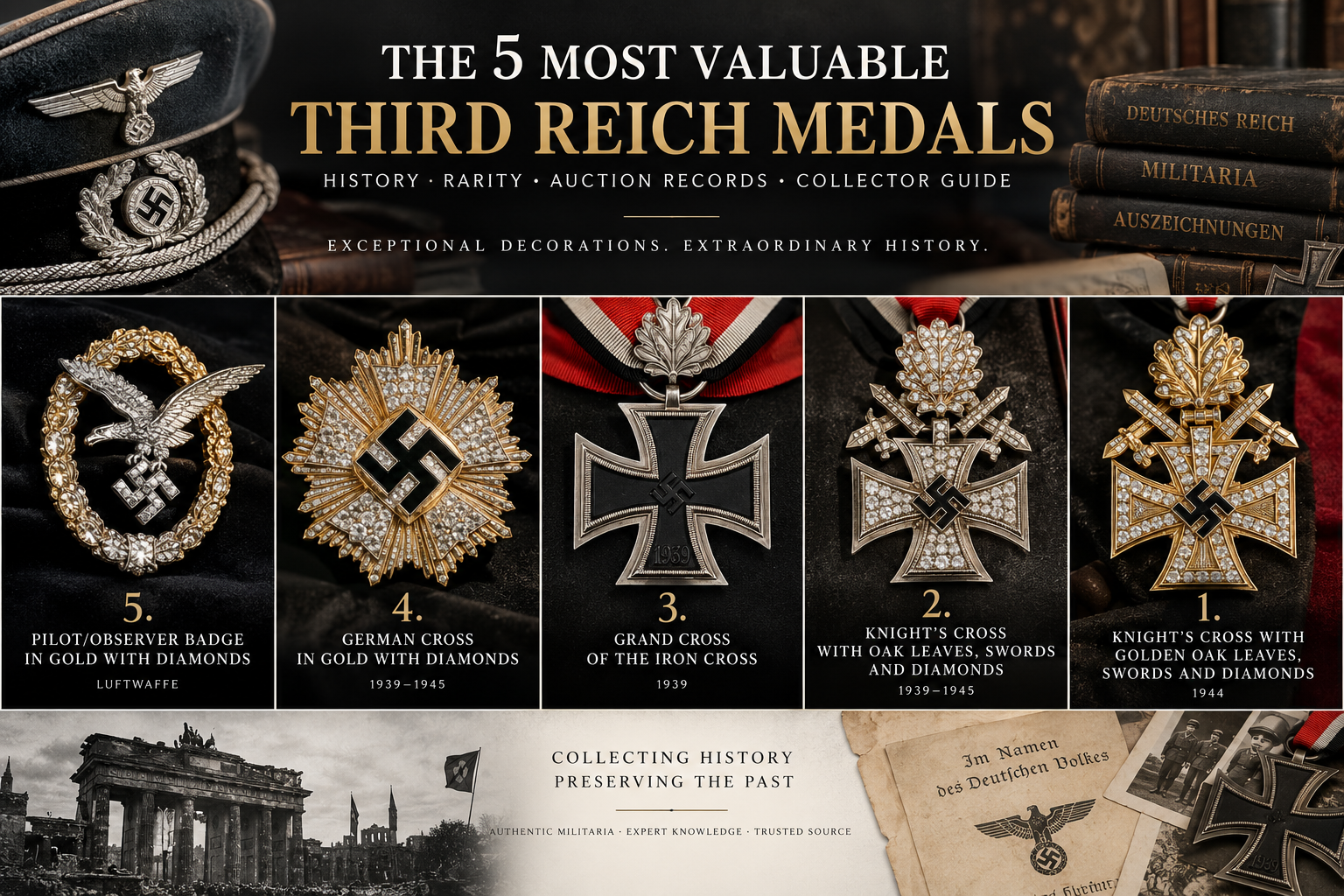
What Are the Rarest WWII German Awards?
At the upper end of the field are decorations issued in extremely small numbers.
The Knight’s Cross hierarchy provides an obvious example.
The Deutsches Historisches Museum records 27 awards of the Knight’s Cross with Oak Leaves, Swords and Diamonds and only one recipient of the final Golden Oak Leaves, Swords and Diamonds grade.
Objects at this level require a very different standard of research from a common campaign medal.
Recipient attribution, documentation, manufacturer or jeweller characteristics, provenance and historical ownership become exceptionally important.
For a deeper examination of this subject, see the Autographs & Militaria guide 5 Most Valuable Third Reich Medals: Ultimate Guide.
Condition: Original Does Not Mean Perfect
Historical objects survive because they were used, stored and handled.
Wear is therefore expected.
This does not mean every damaged object is desirable.
Nor does it mean that every pristine object is suspicious.
The collector should instead distinguish natural historical condition from alteration.
Aggressive polishing can remove original finishes.
A repaired pin should be documented.
Replacement ribbons should be identified when possible.
Corrosion should be monitored rather than disguised.
Condition is part of the object’s history.
Autographs & Militaria follows the same principle in its general condition policy: historical items can carry wear, handling and preservation characteristics resulting from their age and previous history.
How to Store WWII German Medals
Good collecting does not end with identification.
Preservation matters.
The Canadian Conservation Institute notes that high relative humidity accelerates metal corrosion and recommends controlled storage for metal collections. For stable metals within mixed collections, it identifies approximately 35–55% relative humidity as a reasonable general range.
The same institution recommends chemically stable storage materials, protection from dust and pollutants, and careful handling.
For a private collection, this means avoiding unnecessary polishing, direct sunlight, excessive humidity and unsuitable storage materials.
Original ribbons require additional care because textile deterioration and fading can be irreversible.
Packets and award documents also need their own archival protection.
A medal, ribbon and paper document should not automatically be treated as though all three materials require identical storage conditions.
Collector Authentication Checklist
Before buying or cataloguing a German WWII medal, ask:
- What exact award is it supposed to be?
- Which class, grade or variant?
- Is the method of construction appropriate?
- Are the materials plausible for this version?
- Do the dimensions and weight make sense?
- Is a maker mark present, and should it be?
- Does the maker mark agree with the rest of the construction?
- Are the hinge, pin, catch or suspension components appropriate?
- Does the wear appear coherent rather than artificially created?
- Has the medal been repaired, cleaned or altered?
- Are ribbon, packet or case period-correct?
- Does documented provenance exist?
- Can the piece be compared with accepted museum or specialist reference examples?
The purpose of this checklist is not to obtain thirteen individual “yes” answers.
It is to determine whether the evidence tells one coherent story.
Building a Reference Collection Is as Important as Building a Medal Collection
A specialist library should be considered part of the collection.
Reference books often cost far less than the mistakes they prevent.
For the Iron Cross, Gordon Williamson’s The Iron Cross of 1939 is a substantial specialist study covering variants, manufacturers, markings, cases and award documentation.
For a broader historical overview of German decorations, David Littlejohn and C. M. Dodkins’ Orders, Decorations, Medals and Badges of the Third Reich remains a widely cited reference work.
But reference collecting does not need to stop with books.
One of the objectives of Autographs & Militaria is to build its own photographic archive.
Every original medal that passes through a collection can potentially document:
front design, reverse, edge, maker mark, suspension, hinge, catch, ribbon, original packet and associated documents.
Over time, that material becomes a reference resource of its own.
Frequently Asked Questions
What are the most common WWII German medals?
Collectors frequently encounter awards such as the Iron Cross, War Merit Cross, Eastern Front Medal and Wound Badge, together with numerous combat and qualification badges. Availability can vary considerably according to grade, manufacturer and variant.
How can you tell if a WWII German medal is original?
Begin with exact identification and then examine construction, materials, dimensions, hardware, manufacturer characteristics, finish and provenance. No single test is sufficient for every award.
Are WWII German medals magnetic?
Some are, or contain magnetic components, while others do not. Magnetism only becomes meaningful when the expected construction of the specific award is already understood.
Do all original German WWII medals have maker marks?
No. Marked and unmarked originals exist depending on the decoration, manufacturer and production variation.
Does a maker mark prove a German medal is original?
No. Maker marks can be reproduced. They need to agree with the construction and known characteristics of the supposed manufacturer.
How much are WWII German medals worth?
Value depends on authenticity, exact award and grade, rarity, manufacturer, condition, accessories, documentation, provenance and current collector demand. Identification should always come before valuation.
Should old WWII medals be cleaned?
Collectors should be very cautious. Aggressive polishing or cleaning can remove original finish, alter patina and permanently reduce historical integrity.
Final Thoughts
The most interesting part of collecting WWII German medals is not simply owning an old decoration.
It is learning to read the object.
A collector learns to ask why it was awarded, how it was manufactured, which manufacturer may have produced it, what has happened to it since 1945 and whether any documentary history has survived alongside it.
That process transforms recognition into research.
An Iron Cross can be recognised within seconds.
Understanding precisely which Iron Cross is in your hands may require considerably longer.
And that is part of the attraction.
Original historical objects survive as physical evidence of people, institutions, industry and conflict. Preserving them responsibly means preserving not only the object itself, but also the information that gives it meaning.
At Autographs & Militaria, medals, documents, autographs and related historical material are catalogued as objects for collecting, research and historical study, with particular attention to authenticity, provenance and context. The collection can be explored alongside the educational articles in the Collector’s Journal.
References & Further Reading
Deutsches Historisches Museum — LeMO. Das Ritterkreuz des Eisernen Kreuzes. Historical overview of the re-establishment of the Iron Cross in 1939 and subsequent Knight’s Cross grades. Deutsches Historisches Museum — Iron Cross history
Smithsonian National Air and Space Museum. Medal, Iron Cross Second Class. Museum object record with construction, materials and dimensions. Smithsonian — Iron Cross Second Class
Smithsonian National Air and Space Museum. Medal, Iron Cross First Class. Museum collection record for a 1939 First Class example. Smithsonian — Iron Cross First Class
Smithsonian National Air and Space Museum. Medal, Kriegsverdienst Kreuz (War Merit Cross Second Class). Physical and materials reference. Smithsonian — War Merit Cross Second Class
The National WWII Museum. Looting the Reich: German Wound Badge. Particularly relevant to rare Wound Badges and sophisticated reproductions. National WWII Museum — German Wound Badge
Canadian Conservation Institute. Storage of Metals — CCI Notes 9/2. Museum-level preventive conservation guidance for metal objects. Canadian Conservation Institute — Storage of Metals
Canadian Conservation Institute. Caring for Metal Objects. Preventive conservation guidance covering humidity, pollutants, enclosures and handling. Canadian Conservation Institute — Caring for Metal Objects
Williamson, Gordon. The Iron Cross of 1939. R. James Bender Publishing, 2002, 496 pp. Specialist reference on the 1939 Iron Cross, manufacturers, markings, variants, cases and documents. Bibliographic record — The Iron Cross of 1939
Littlejohn, David & C. M. Dodkins. Orders, Decorations, Medals and Badges of the Third Reich. R. James Bender Publishing, 1968. Bibliographic record — Littlejohn & Dodkins
Services & Expertise
Positive Reviews
Authenticity Focused

Document Authentication & Certification
Certificates issued for collector and archival purposes

Graphology & Signature Analysis
Independent professional service
About the Author: Juan García Nicolás

Related posts
Popular products
-
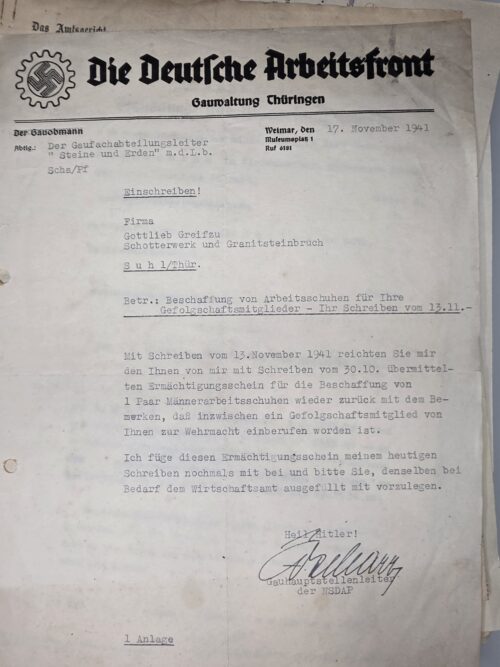 German Document Archive 1911–1967 – DAF, University and Business Papers
Original price was: 249,00 €.199,00 €Current price is: 199,00 €.
German Document Archive 1911–1967 – DAF, University and Business Papers
Original price was: 249,00 €.199,00 €Current price is: 199,00 €.
-
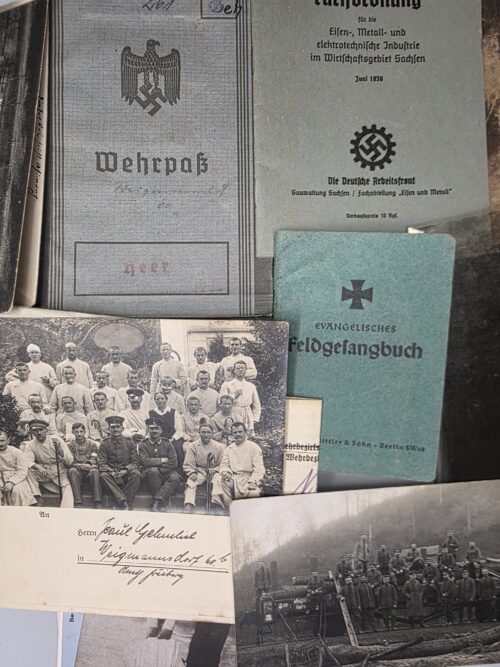 WWII German Wehrpass Group – 256th Infantry Division, Ostmedaille & Death Letter
590,00 €
WWII German Wehrpass Group – 256th Infantry Division, Ostmedaille & Death Letter
590,00 €
-
 Matt Groening Homer Simpson Drawing – Original Signed Sketch with COA
Original price was: 500,00 €.440,00 €Current price is: 440,00 €.
Matt Groening Homer Simpson Drawing – Original Signed Sketch with COA
Original price was: 500,00 €.440,00 €Current price is: 440,00 €.
-
 WWII German Document Collection – U-Boat Training, DAF & Arbeitsbuch Archive
Original price was: 490,00 €.440,00 €Current price is: 440,00 €.
WWII German Document Collection – U-Boat Training, DAF & Arbeitsbuch Archive
Original price was: 490,00 €.440,00 €Current price is: 440,00 €.