Products on sale
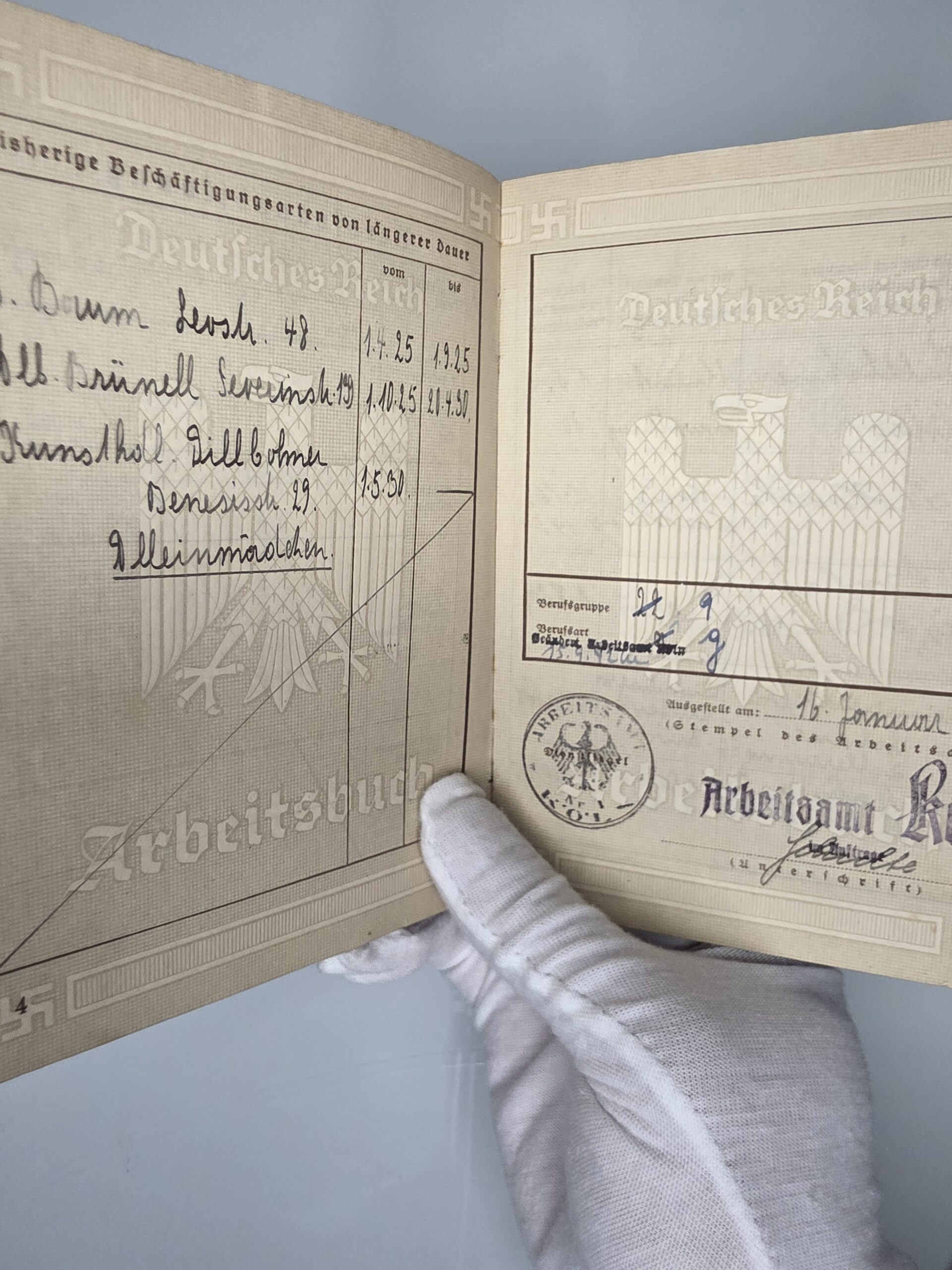
Third Reich Arbeitsbuch – Original German Worker’s Employment Book
30,00 €

(no title)
Original price was: 299,00 €.245,00 €Current price is: 245,00 €.

Third Reich Tax Documents – 1937 Bavarian Ministry & Nuremberg Archive
Original price was: 150,00 €.99,00 €Current price is: 99,00 €.
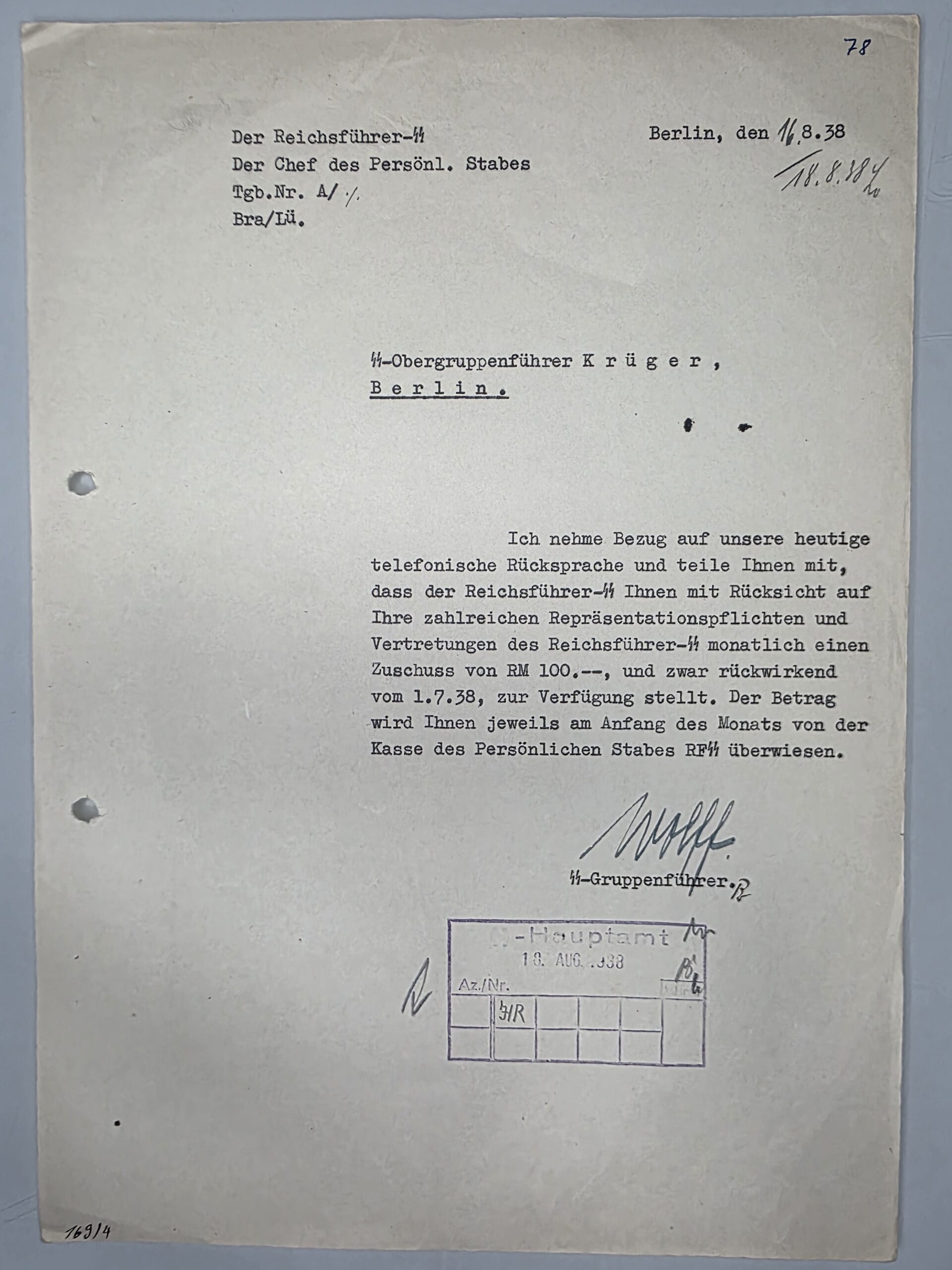
Karl Wolff Signed Letter to Friedrich-Wilhelm Krüger – SS Document, 1938
595,00 €

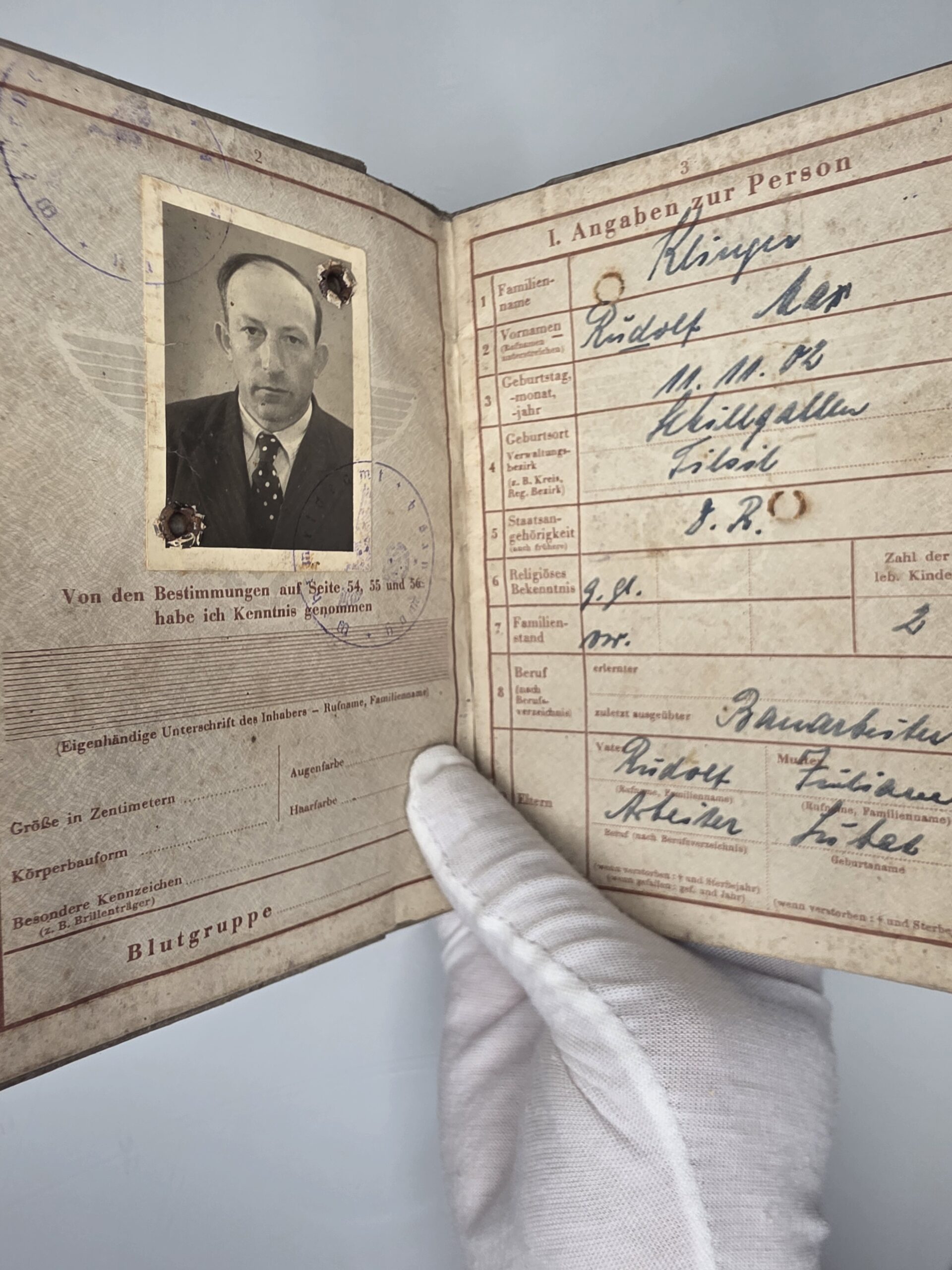

WWII German Wehrpass – Rudolf Klinger 1943 Zweitschrift with Photo & Typhus Card
Original price was: 110,00 €.99,00 €Current price is: 99,00 €.
10% Off
Interested in this item? Please contact us directly by email, WhatsApp or through the enquiry form below for availability or other information. Kindly include the item SKU/reference number in your message so we can identify the piece.
Description
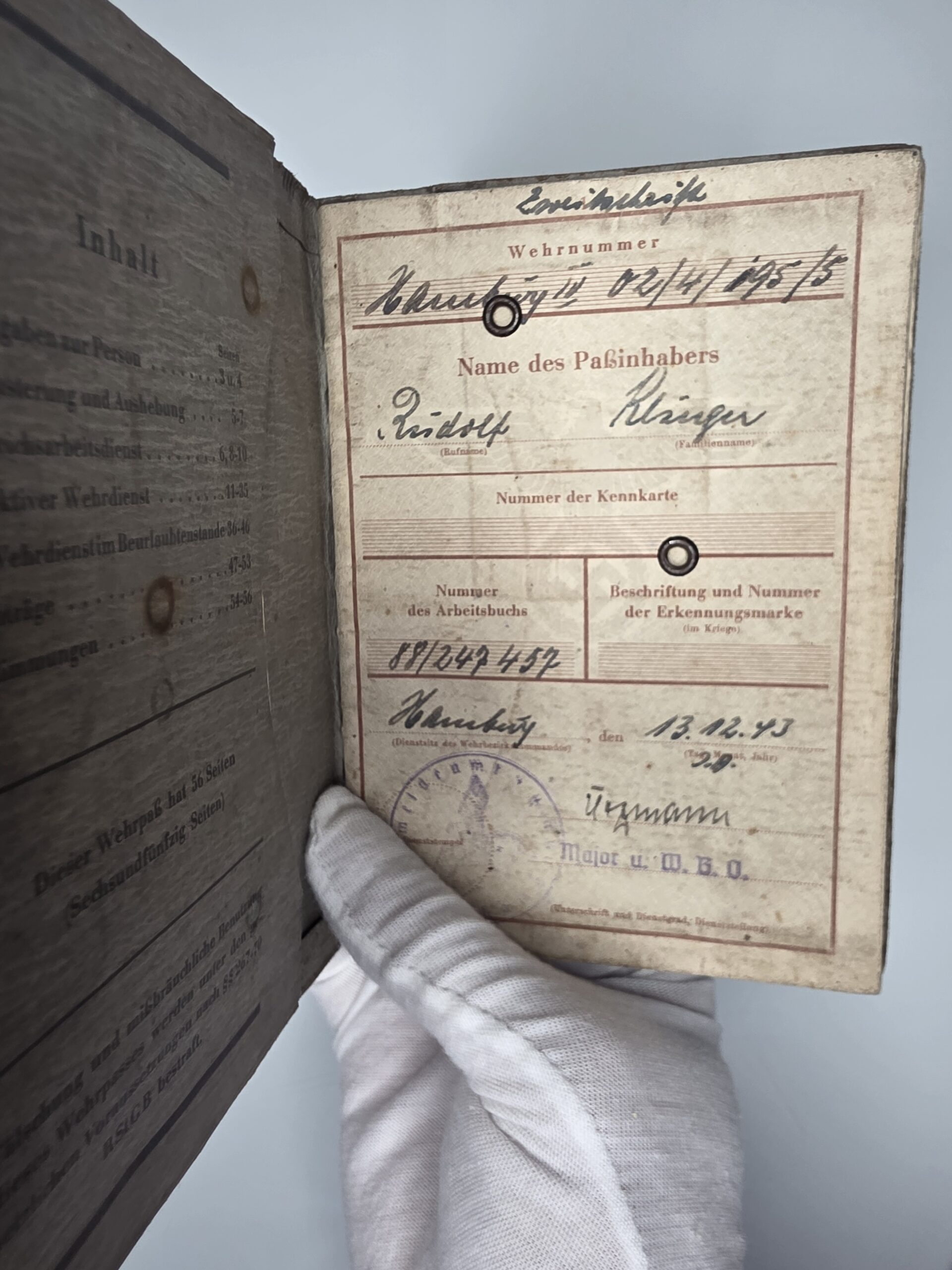
WWII German Wehrpass – Rudolf Klinger, 1943
This original WWII German Wehrpass was issued to Rudolf Klinger, born on 11 November 1913, and survives together with a separate 1943 typhus-vaccination certificate carrying the same name and birth information.
The booklet is particularly identifiable as a:
Zweitschrift
with the word handwritten prominently above the military service-number section.
In German military administration, Zweitschrift indicated a second or replacement copy of a Wehrpass. Such replacement documents were prepared when the original could no longer be used, although the supplied pages do not state why Klinger’s first copy was replaced. Comparable wartime examples are routinely described by specialist document dealers as replacement Wehrpasses.
The replacement Wehrpass was formally dated:
13 December 1943
and carries official military-office markings and the administering officer’s handwritten signature.
What Was a Wehrpass?
The Wehrpass was one of the principal military administrative documents used by the German armed forces following the reintroduction of conscription.
It was not simply a soldier’s everyday identity card.
The Wehrpass recorded a man’s personal information and military obligation and could contain medical assessments, training, postings, units, promotions, operations, wounds and awards depending on his service history.
When a man entered active military service, the Wehrpass was normally surrendered to the responsible military administration or unit and the soldier carried a Soldbuch instead. The Wehrpass continued to function as the longer-term military record. Contemporary surviving examples in archival collections demonstrate this distinction clearly.
That difference is important when cataloguing German military documents.
A Soldbuch was carried during active service and combined identification and pay-record functions; a Wehrpass documented the broader military-service record.
Rudolf Klinger
The personal-information pages identify the holder as:
Familienname: Klinger
Vorname: Rudolf
Geboren: 11.11.1913
An original black-and-white portrait photograph is attached to the facing page.
The image shows Klinger in civilian dress, wearing a jacket, shirt and patterned tie. The photograph is secured through the document and carries period official stamping, linking it administratively to the booklet.
The supplied auction description previously identified his birthplace as “Schlingallen, Kreis Elbing.”
Closer examination of the actual document suggests that the handwritten entry instead reads approximately:
Schillgallen
Tilsit
The East Prussian place name Schillgallen is historically documented, including settlements connected with the broader Tilsit region. Because several locations bore similar names, the safest approach is to preserve the spelling visible in the Wehrpass without forcing an uncertain modern geographical identification.
Occupation – Bauarbeiter
Another useful correction concerns Klinger’s civilian occupation.
The previous catalogue description called him a farm worker.
The visible entry beside:
Beruf / zuletzt ausgeübter
appears instead to read:
Bauarbeiter
or construction worker.
This matters because the purpose of a document listing is not simply to reproduce a former auction description but to record what can actually be read from the surviving object.
A 1943 Zweitschrift
The replacement issue date of 13 December 1943 places this Wehrpass firmly within the wartime period.
Replacement Wehrpasses are not unusual. In many cases information from an earlier record was copied into a new booklet after loss, damage or administrative replacement.
However, we should distinguish what is visible from what is merely typical.
DOC180 itself confirms only that it is a Zweitschrift.
No reason for replacement is visible in the supplied photographs, so the listing should not state that the first document was specifically destroyed in combat or lost at the front.
That conservative approach gives collectors a more trustworthy description.
Associated Typhus Vaccination Certificate
An additional document accompanies the Wehrpass.
The small card is headed:
Typhusschutzimpfung
and is completed for:
Klinger Rudolf
with the birth date apparently matching the Wehrpass.
The first vaccination is recorded on:
20 August 1943
with a later vaccination entry dated:
8 September 1943
and further handwritten information below.
The document has suffered considerable edge loss and wear but remains substantially readable.
More interestingly, the upper-left corner contains the designations:
LS-Abschnitt
LS-Rettungsstelle
The abbreviation LS was used for Luftschutz, Germany’s civil air-defence organisation.
Luftschutz-Rettungsstellen were rescue or first-aid stations established to treat people injured during air attacks before onward transfer where necessary. Contemporary descriptions and surviving German Federal Archives material document these installations and their medical role.
The vaccination certificate therefore appears to associate Klinger with a Luftschutz administrative or medical district.
It would be premature to describe him as a Luftschutz medic, rescuer or employee because his exact function is not stated, but the association itself is genuine and worth recording.
Military Service Information
A Wehrpass can potentially contain extremely detailed military information.
Specialist examples may record:
- unit postings
- weapons training
- rank changes
- campaigns
- combat engagements
- wounds
- hospitalisation
- decorations
- discharge information
Such entries can dramatically affect collector value.
For DOC180, however, those pages have not been supplied.
The responsible description must therefore stop with what the available photographs establish: Klinger’s personal identity, replacement issue, 1943 date, photograph and associated vaccination certificate.
No combat campaign, unit or award is claimed.
Collector Interest
From a collector’s perspective, this WWII German Wehrpass has several attractive features even without documented combat pages.
It is:
- named to an identifiable individual;
- dated during the war;
- explicitly marked Zweitschrift;
- complete with an original portrait photograph;
- officially stamped;
- accompanied by a matching 1943 medical document;
- associated through that document with the Luftschutz system.
A standard unnamed or poorly completed Wehrpass has limited value.
The presence of an accompanying named document gives DOC180 more context and helps preserve the identity of Rudolf Klinger as a real historical individual rather than reducing the object to a generic military booklet.
Condition
The Wehrpass shows substantial but honest period use.
The cover has general surface wear, edge rubbing, small marks and wear to the cloth reinforcement along the spine.
Internally there is age toning, foxing, staining and administrative handling.
The portrait photograph remains present, with visible securing points and period official stamps.
The associated typhus vaccination certificate is in significantly rougher condition. It has:
- heavy age toning;
- multiple folds;
- extensive edge losses;
- tears and missing sections;
- staining;
- handwritten vaccination entries.
Despite this, the name, principal heading and important dated information remain visible.
The photographs show the actual documents offered and form part of the condition description.
The lot is offered as an original period WWII German Wehrpass and associated 1943 vaccination document.
Historical Responsibility Notice
This material is offered strictly for historical, documentary, genealogical and collecting purposes. Political symbols visible on the Wehrpass form part of the original wartime document. Autographs & Militaria does not endorse National Socialism or any ideology, regime or organisation represented by the item.
What is a WWII German Wehrpass?
A Wehrpass was a German military service record used to document a man’s military obligation, personal details, training, postings and, where applicable, campaigns, wounds and awards. During active military service the soldier normally carried a Soldbuch instead.
Zweitschrift means a second or replacement copy. It indicates that this was not Rudolf Klinger’s original first Wehrpass, although the reason for replacement is not stated on the photographed pages.
Who was Rudolf Klinger?
The document identifies him as Rudolf Klinger, born 11 November 1913. His occupation appears to read Bauarbeiter, or construction worker. The supplied pages do not provide enough information to reconstruct his complete military career.
Does this Wehrpass contain an original photograph?
Yes. An original period portrait photograph of Rudolf Klinger remains attached to the personal-data section and is crossed by official document markings.
What is the extra document with the Wehrpass?
It is a 1943 Typhusschutzimpfung certificate recording typhus vaccination. The same name and birth information connect it to Rudolf Klinger.
What does LS-Rettungsstelle mean?
It refers to a Luftschutz-Rettungsstelle, a civil air-raid rescue and first-aid station intended to treat casualties from air attacks.
Does the Wehrpass prove that Rudolf Klinger fought on the Eastern Front?
No. The supplied photographs do not show campaign or unit pages, so no specific combat service should be claimed.
Additional information
| Availability | Available |
|---|
Only logged in customers who have purchased this product may leave a review.
Related products
Third Reich Arbeitsbuch – Original German Worker’s Employment Book
30,00 €
(no title)
Original price was: 299,00 €.245,00 €Current price is: 245,00 €.
18% Off
Third Reich Tax Documents – 1937 Bavarian Ministry & Nuremberg Archive
Original price was: 150,00 €.99,00 €Current price is: 99,00 €.
34% Off
Karl Wolff Signed Letter to Friedrich-Wilhelm Krüger – SS Document, 1938
595,00 €
Reviews
There are no reviews yet.