
Products on sale
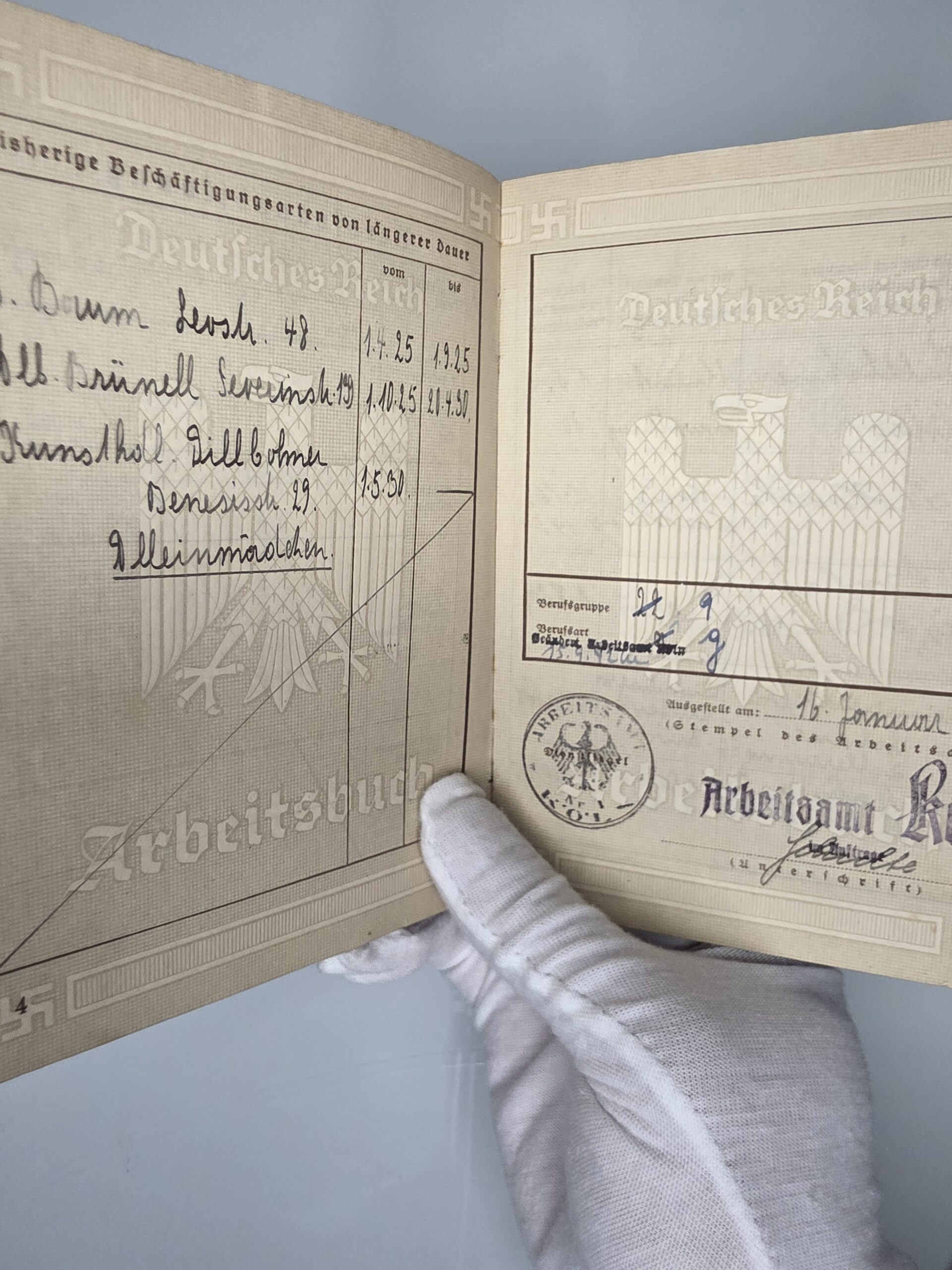
Third Reich Arbeitsbuch – Original German Worker’s Employment Book
30,00 €

WWII German Wehrpass – Rudolf Klinger 1943 Zweitschrift with Photo & Typhus Card
Original price was: 110,00 €.99,00 €Current price is: 99,00 €.

(no title)
Original price was: 299,00 €.245,00 €Current price is: 245,00 €.
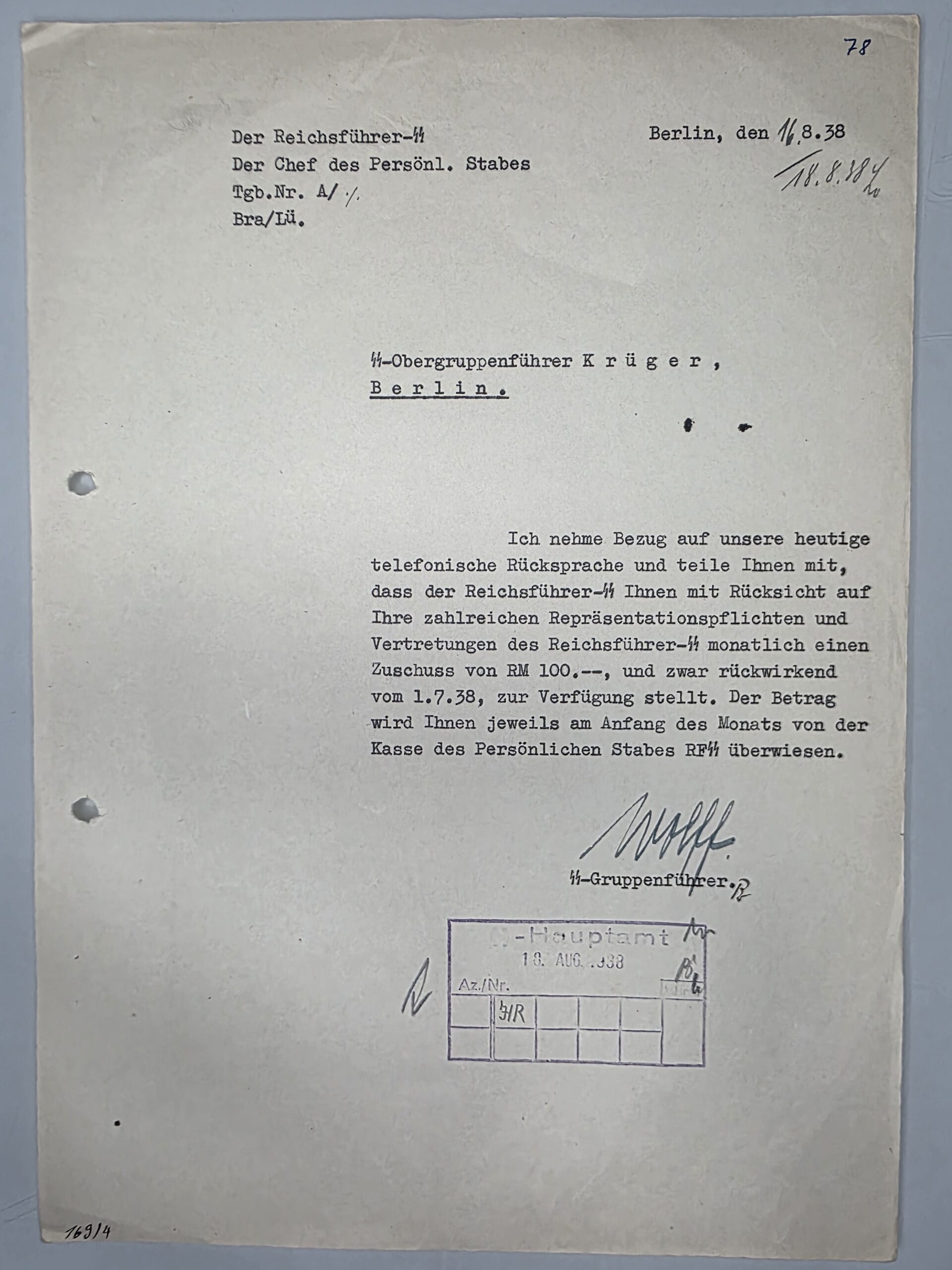
Karl Wolff Signed Letter to Friedrich-Wilhelm Krüger – SS Document, 1938
595,00 €


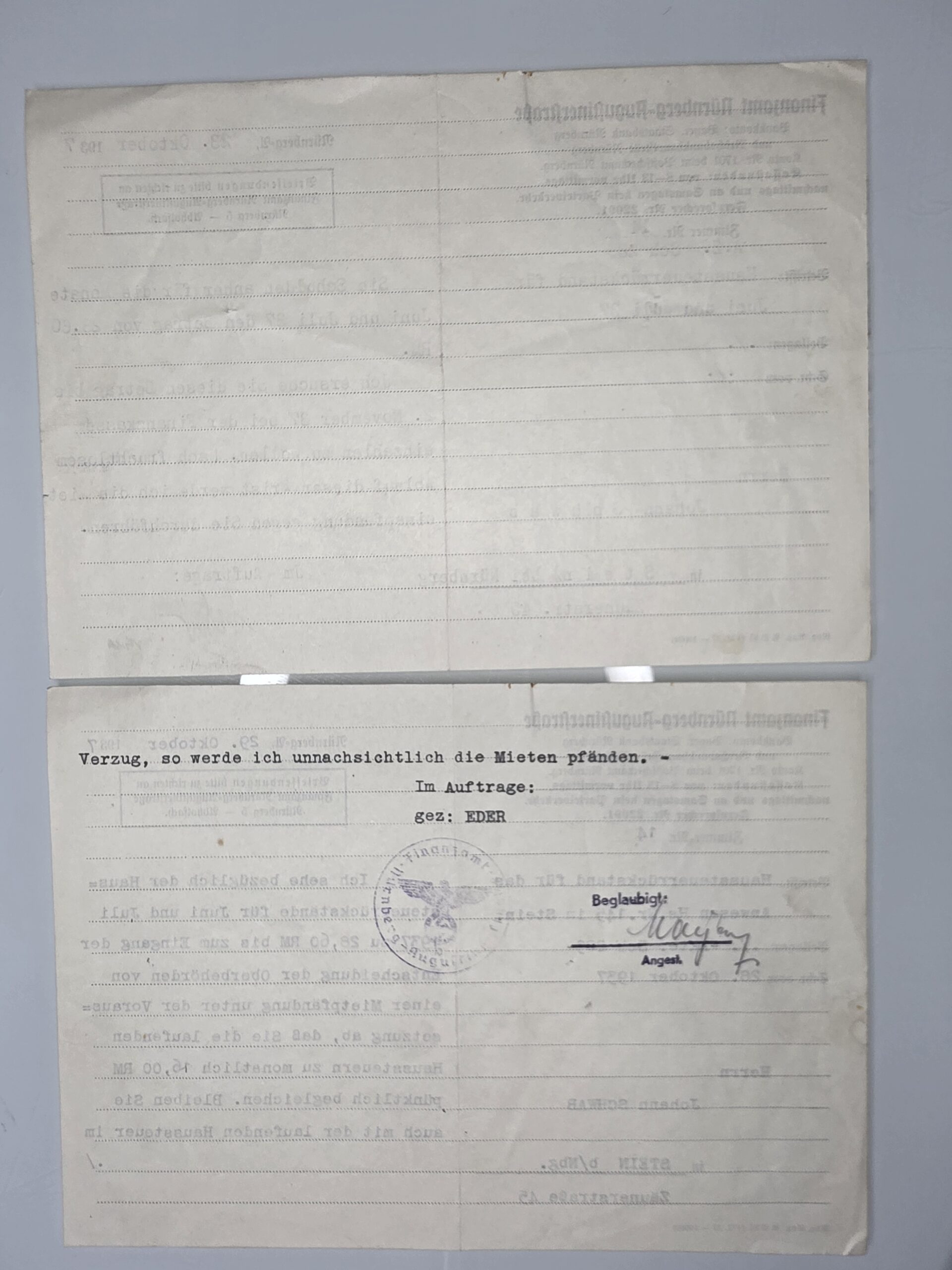
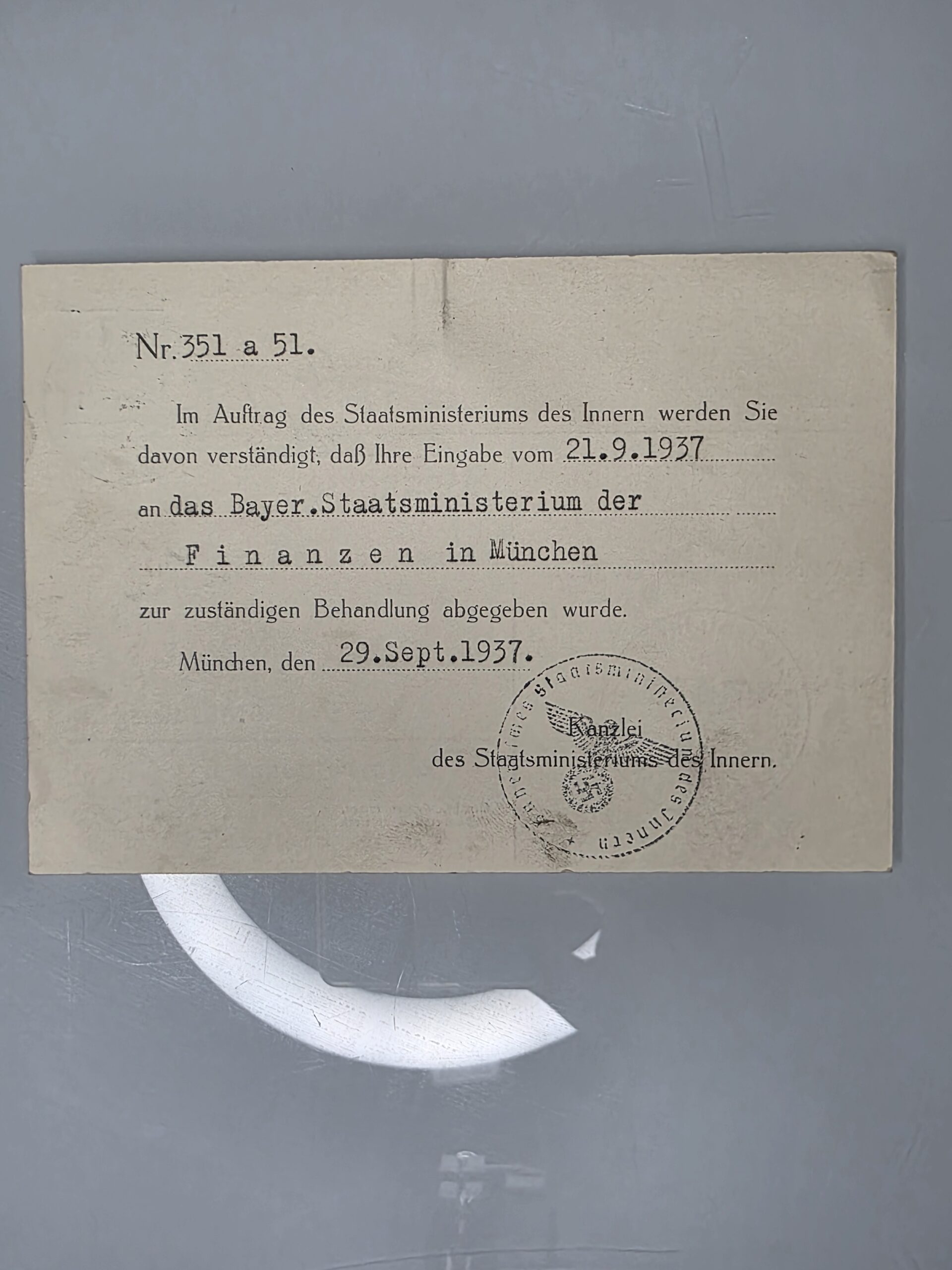
Third Reich Tax Documents – 1937 Bavarian Ministry & Nuremberg Archive
Original price was: 150,00 €.99,00 €Current price is: 99,00 €.
34% Off
Interested in this item? Please contact us directly by email, WhatsApp or through the enquiry form below for availability or other information. Kindly include the item SKU/reference number in your message so we can identify the piece.
Description
Third Reich Tax Documents from Bavaria, 1937
This group of four original Third Reich tax documents dates from September and October 1937 and preserves correspondence between private citizens in Stein bei Nürnberg, the Bavarian State Ministry of the Interior, the Bavarian State Ministry of Finance and the Finanzamt Nürnberg-Augustinerstraße.
Unlike military papers, award certificates or political propaganda, these documents concern one of the most ordinary aspects of daily life: taxation.
The surviving material records house-tax petitions, unpaid taxes, ministerial referrals and threatened enforcement, providing a small but tangible view of how routine German civil administration operated during the pre-war National Socialist period.
The group consists of four physical documents, shown in five photographs.
Bavarian State Ministry of the Interior Postcard
The earliest piece is an official postal card dated:
München, 29 September 1937
It was sent by the:
Kanzlei des Staatsministeriums des Innern
or Chancellery of the Bavarian State Ministry of the Interior.
The message states that a petition submitted on 21 September 1937 had been forwarded to the Bayerisches Staatsministerium der Finanzen in München for the appropriate administrative decision.
This side carries an official circular ministry stamp incorporating the German state eagle and contemporary national emblem.
The address side is equally interesting from a collecting point of view.
It retains the printed ministry sender details, another official eagle device and an original 6 Pfennig Dienstmarke Deutsches Reich, used for government postal business.
The postal card is therefore both a civil-administration document and an original piece of German official postal history.
Bavarian Finance Ministry Correspondence
A second document, dated:
München, 8 October 1937
originates from the:
Bayerisches Staatsministerium der Finanzen
The subject line reads:
Haussteuerniederschlagung
which can broadly be understood as a request for the remission or cancellation of house-tax liabilities.
The letter confirms that the Finance Ministry had received the petition originally addressed to the Ministry of the Interior and subsequently forwarded to it.
The recipient is told that after the necessary investigations had been completed, the decision of the Finance Ministry would be communicated through the competent tax office.
Importantly, the letter also states that the applicant was not relieved of the obligation to continue following the instructions of the Finanzamt while the petition was under consideration.
This is a useful example of the layered administrative procedure connecting ministries, local tax offices and individual citizens.
Finanzamt Nürnberg-Augustinerstraße – Johann Schwab
The other two Third Reich tax documents form a clearer matched pair.
Both originate from:
Finanzamt Nürnberg-Augustinerstraße
and are addressed to:
Johann Schwab
Stein bei Nürnberg
Zäunerstraße 45
The first is dated:
23 October 1937
and concerns:
Haussteuerrückstand für Juni und Juli 37
or house-tax arrears for June and July 1937.
The outstanding sum is given as:
RM 28.60
The Finanzamt asks Schwab to pay the amount to the tax cashier by 2 November 1937.
If payment is not made by the deadline, the office states that it will proceed with a:
Mietzinspfändung
In practical terms, this meant enforcement against rental income.
Although financially modest by modern standards, the notice is interesting because it documents the precise mechanics of everyday tax enforcement: amount owed, months outstanding, deadline and proposed enforcement measure.
Temporary Suspension of Enforcement
Only six days later, on 29 October 1937, the same tax office issued a second notice to Johann Schwab.
This document refers directly to the arrears of RM 28.60 for June and July 1937.
The Finanzamt states that it will temporarily refrain from executing the rent seizure while a decision from the higher authorities remains pending.
However, this concession is conditional.
Schwab is instructed to continue paying his current house tax of:
RM 16.00 per month
punctually.
The text continues onto the reverse, where the office makes clear that if he falls behind with the current tax payments, the rents will be attached without further delay.
The reverse also retains an official Finanzamt ink stamp, an administrative certification and handwritten signature.
Together, these two letters form the most coherent part of the group because they document the same taxpayer, property and dispute within a six-day period.
A Mixed Administrative Group Rather Than a Single Archive
One detail should be made clear for collectors.
The four pieces should not be represented as a perfectly matched personal archive.
The two Finanzamt letters clearly belong to Johann Schwab at Zäunerstraße 45.
The ministry correspondence and official postcard relate to another individual at Zäunerstraße 6, whose surname was previously catalogued by the auction house as Schnock.
For that reason, the group is best understood as a small collection of related 1937 Bavarian civil and tax correspondence from Stein bei Nürnberg, rather than paperwork belonging to one individual.
This distinction makes the description more accurate and avoids creating provenance that the documents themselves do not establish.
Nuremberg and Bavarian Tax Administration
The documents show several levels of government interacting with one another.
At local level was the Finanzamt Nürnberg-Augustinerstraße, dealing directly with taxpayers, arrears and enforcement.
At state level, correspondence was handled by the Bavarian ministries of Finance and the Interior in Munich.
This combination gives the group more variety than a set of four identical tax receipts. It includes ministerial correspondence, local Finanzamt enforcement papers and an officially mailed postal card.
The broader German finance administration of this period maintained extensive documentation relating to taxation, businesses and property. Surviving Bundesarchiv holdings from the Reich finance administration contain large quantities of tax-policy and administrative material from the late 1930s onward. Biblioteca Digital Alemana
Official Symbols and Postal Features
The most visually immediate element is the official postal card.
Its sender side carries the large circular inscription:
Bayerisches Staatsministerium des Innern
surrounding the eagle and period national emblem.
The affixed 6 Pfennig Dienstmarke Deutsches Reich also displays the national emblem and survives with its original postal cancellation.
On these documents the symbols form part of the state stationery and postal system rather than propaganda artwork.
That distinction is relevant when cataloguing historical bureaucratic material.
Collector Interest
From a collector’s perspective, the attraction of this group lies primarily in its completeness as a small cross-section of routine administration.
It contains:
- Bavarian Interior Ministry correspondence;
- Bavarian Finance Ministry correspondence;
- two Nuremberg Finanzamt notices;
- named civilian recipients;
- specific tax amounts;
- an enforcement warning;
- contemporary stamps;
- original signatures;
- an original government service-postage stamp;
- addresses in Stein bei Nürnberg;
- dated correspondence within a short 1937 period.
The material may particularly appeal to collectors of:
- German civil documents
- Nuremberg history
- Third Reich paperwork
- German postal history
- tax and finance documents
- Bavarian administrative history
- pre-war ephemera
- official stamps and seals
It is not a high-value autograph group and contains no major political signature. Its appeal is much more documentary: ordinary paperwork that survived from the functioning civil bureaucracy of 1937 Germany.
Condition and Authenticity
The documents remain in good collectable period condition.
They show normal age-related characteristics including paper toning, folds, minor edge and corner wear, surface marks and small stains.
These characteristics are consistent with documents that were mailed, folded, filed and handled administratively.
Typed text remains substantially clear.
The postal card retains its original stamp and cancellation, while the Finanzamt correspondence retains contemporary ink stamps and handwritten administrative signatures.
The group is offered as four original period German administrative documents dating from 1937.
The photographs show the actual material offered and form part of the condition description.
Historical Responsibility Notice
These documents are offered strictly as original historical, documentary and collecting material. Political symbols appearing on the items are preserved because they form part of the original 1937 state stationery and postal system. Autographs & Militaria does not endorse National Socialism or any ideology represented by the material.
WWII German Document Collection – 10-Piece Saxony Archive
Useful as a broader document-group connection, particularly because that collection also combines civilian and state-issued paperwork across different periods.
What are these Third Reich tax documents?
They are four original Bavarian administrative documents from 1937 concerning house-tax petitions, arrears and enforcement in Stein bei Nürnberg.
Are all four documents connected to the same person?
No. The two Nuremberg Finanzamt notices clearly concern Johann Schwab at Zäunerstraße 45. The ministry papers relate to another resident at Zäunerstraße 6. The group should therefore be described as related Bavarian tax correspondence rather than one personal archive.
What does Haussteuerrückstand mean?
It means arrears in house tax. One document states that Johann Schwab owed RM 28.60 for June and July 1937.
What happened if the tax was not paid?
The Finanzamt threatened a Mietzinspfändung, or attachment of rental income. A subsequent letter temporarily suspended that measure while a higher administrative decision was pending.
Does the group contain original Third Reich stamps?
Yes. The ministry postal card retains an original 6 Pfennig German official-service postage stamp and period postal cancellation. The documents also retain original office seals and administrative stamps.
Are these WWII documents?
No. They date from 1937, approximately two years before the outbreak of the Second World War in Europe. They are more accurately described as prewar Third Reich civil-administration documents.
Are ordinary German tax documents collectible?
Yes, although values are generally modest unless associated with an important person, institution or unusual historical event. Their interest lies mainly in social history, bureaucracy, postal history and the survival of everyday official paperwork.
Additional information
| Availability | Available |
|---|
Only logged in customers who have purchased this product may leave a review.
Related products
Third Reich Arbeitsbuch – Original German Worker’s Employment Book
30,00 €
WWII German Wehrpass – Rudolf Klinger 1943 Zweitschrift with Photo & Typhus Card
Original price was: 110,00 €.99,00 €Current price is: 99,00 €.
10% Off
(no title)
Original price was: 299,00 €.245,00 €Current price is: 245,00 €.
18% Off
Karl Wolff Signed Letter to Friedrich-Wilhelm Krüger – SS Document, 1938
595,00 €
Reviews
There are no reviews yet.