Products on sale

WWII German Wehrpass – Rudolf Klinger 1943 Zweitschrift with Photo & Typhus Card
Original price was: 110,00 €.99,00 €Current price is: 99,00 €.

(no title)
Original price was: 299,00 €.245,00 €Current price is: 245,00 €.

Third Reich Tax Documents – 1937 Bavarian Ministry & Nuremberg Archive
Original price was: 150,00 €.99,00 €Current price is: 99,00 €.
Karl Wolff Signed Letter to Friedrich-Wilhelm Krüger – SS Document, 1938
595,00 €
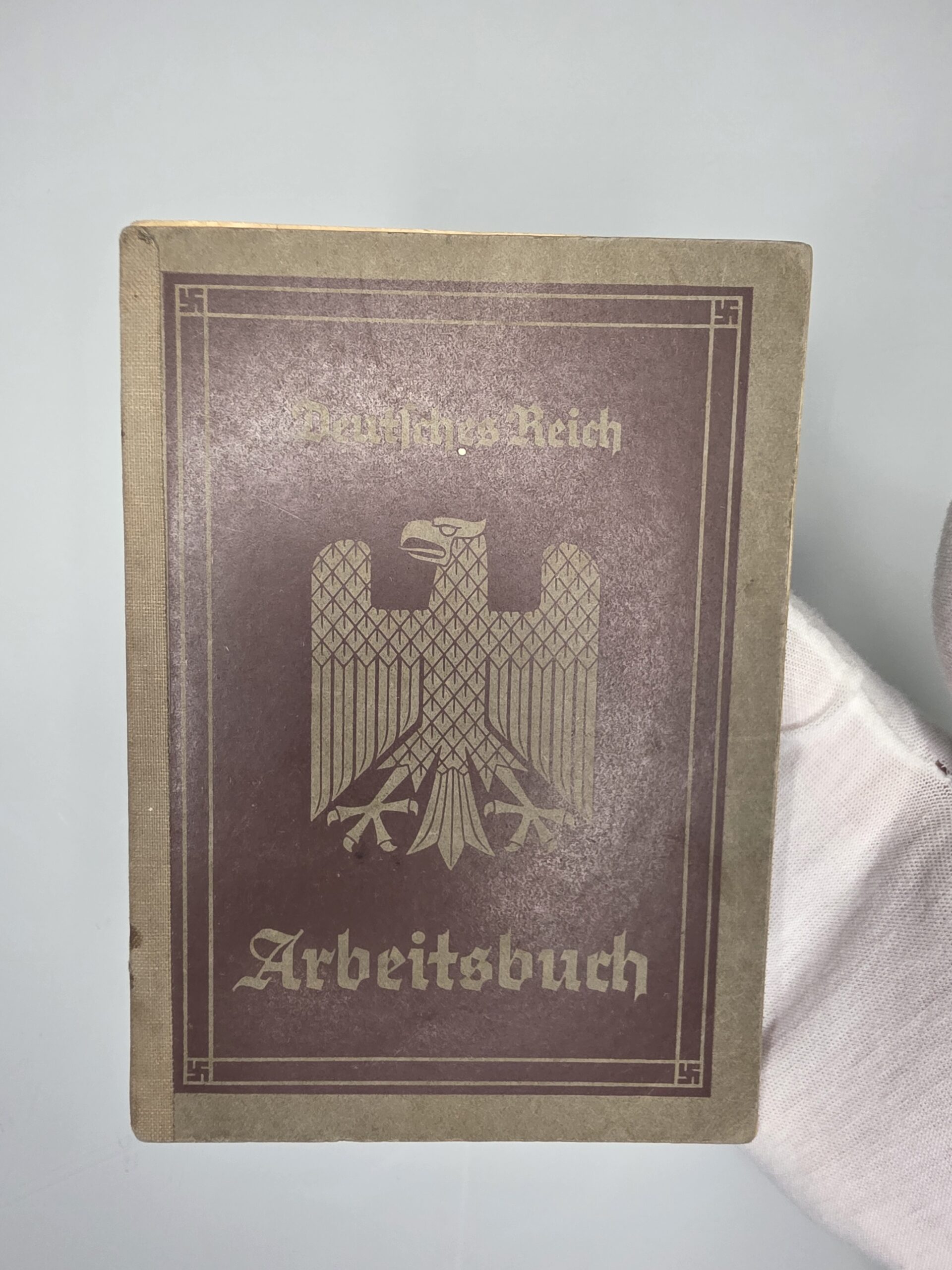
Third Reich Arbeitsbuch – Original German Worker’s Employment Book
30,00 €
Interested in this item? Please contact us directly by email, WhatsApp or through the enquiry form below for availability or other information. Kindly include the item SKU/reference number in your message so we can identify the piece.
Description
Third Reich Arbeitsbuch – Original German Employment Record
This original Third Reich Arbeitsbuch is a German civilian employment record from the mid-1930s, retaining official Arbeitsamt markings and several handwritten entries documenting the holder’s employment history.
The front cover carries the printed designation:
Deutsches Reich
above the German state eagle, with the title:
Arbeitsbuch
below.
Unlike a military Soldbuch or Wehrpass, the Arbeitsbuch belonged to the civilian labour administration. Its purpose was to record a worker’s professional background and successive employment while allowing the German labour offices to supervise and direct the movement of labour within the economy.
The supplied photographs show a genuine used example rather than an unissued blank booklet.
Introduction of the Arbeitsbuch in 1935
The modern Reich Arbeitsbuch system was introduced in 1935.
The Gesetz über die Einführung eines Arbeitsbuches was enacted on 26 February 1935 and came into force on 1 April. Further regulations followed during May concerning the design of the document and the categories of workers required to possess one.
Contemporary reports from May 1935 explained that the first groups included workers in industries such as metals, engineering, construction, retail, banking and insurance. The stated purpose was to provide an official record of professional development and allow the state to direct labour within the German economy.
The requirement expanded rapidly.
Arolsen Archives notes that from May 1935 onward increasing numbers of German workers were obliged to maintain an Arbeitsbuch, and eventually the system encompassed the German working population much more broadly.
Merkblatt für Arbeitsbuchinhaber und Betriebsführer
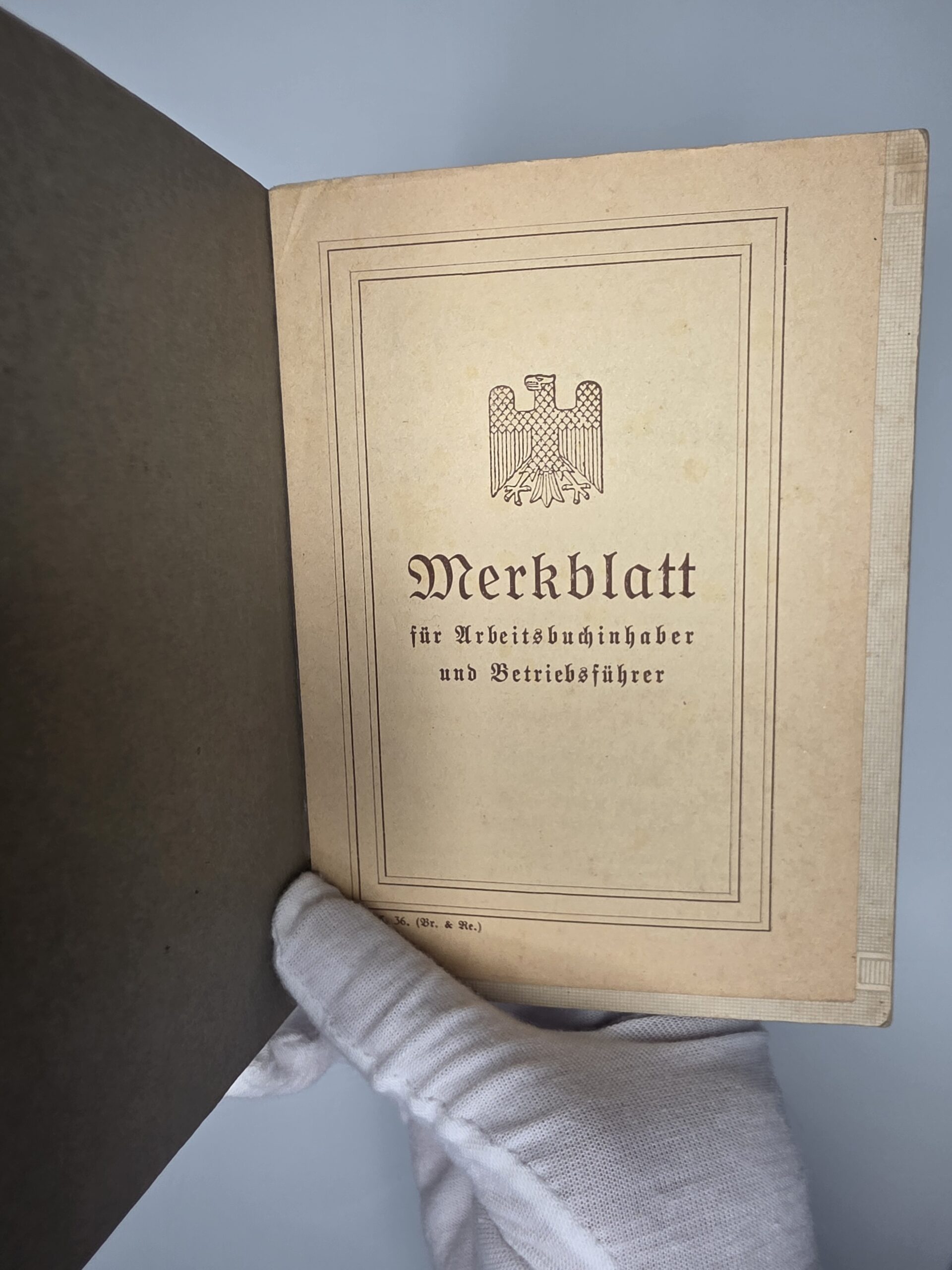
Inside DOC181 is the printed page:
Merkblatt
für Arbeitsbuchinhaber
und Betriebsführer
or:
Information sheet for Arbeitsbuch holders and employers
This was not decorative material. It explained the responsibilities attached to the document for both the employee and the business employing that person.
An archival example of this exact Merkblatt is dated June 1935, placing the format firmly within the first phase of the newly introduced Arbeitsbuch system. Wikimedia Commons
The presence of this page is useful because it helps identify the booklet as the standard German domestic version rather than a later specialised document.
What Information Did an Arbeitsbuch Record?
The Arbeitsbuch functioned as a continuous employment record.
Arolsen Archives explains that these documents recorded:
- personal information;
- professional skills;
- vocational information;
- individual employers;
- periods of employment.
Employment offices maintained corresponding Arbeitsbuch cards in their own files, creating a parallel administrative record.
The system therefore allowed the authorities to follow changes in employment and intervene in labour allocation.
Workers could not simply treat the booklet as a private résumé. It formed part of a centrally administered labour-control structure.
Employment Entries in DOC181
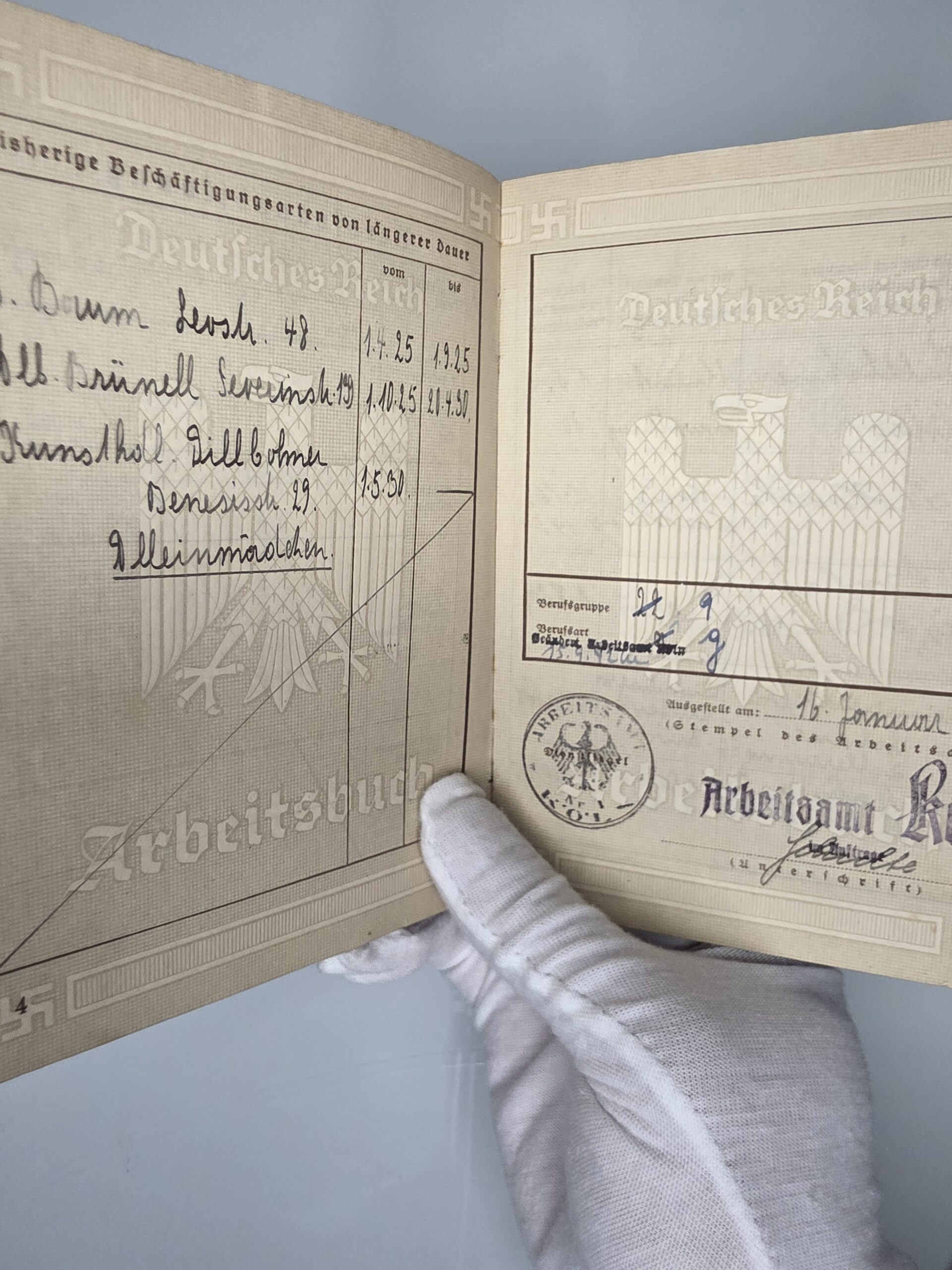
Several handwritten employment entries are visible in this example.
The left-hand page contains employers or workplaces together with columns recording periods:
vom — from
bis — until
The entries appear to date from the mid-1930s and therefore belong to the early years of the Arbeitsbuch system.
Because several lines are handwritten in period cursive and only one employment page is photographed, I would not claim exact company identities without additional close-up photographs.
That is preferable to creating inaccurate searchable information simply by guessing difficult handwriting.
The important fact is that the book was actively used and contains a genuine employment history rather than remaining an unused specimen.
Arbeitsamt Issue and Official Stamps
The opposite page contains the administrative issue section.
Visible elements include:
- occupational group fields;
- occupational-type field;
- circular Arbeitsamt stamp;
- official Arbeitsamt designation;
- administrative signature;
- issue line beginning “Ausgestellt am”.
The handwritten issue date clearly begins:
16. Januar
The year itself is not visible clearly enough in the photographs supplied, so this listing deliberately does not invent a complete date.
The official stamp and signature are more important from a collecting point of view because they confirm the document’s administrative use.
German Arbeitsbuch vs Arbeitsbuch für Ausländer
This example should not be confused with the later:
Arbeitsbuch für Ausländer
issued specifically to foreign workers.
Arolsen Archives documents that foreign workers initially received the same type of Arbeitsbuch as Germans. In May 1943, however, a separate version specifically labelled Arbeitsbuch für Ausländer was introduced.
DOC181 is the normal German Deutsches Reich Arbeitsbuch, not that later foreign-worker form.
This distinction matters for collectors because the two versions represent different administrative categories and usually occupy separate market niches.
Civilian Administration Under the Third Reich
One of the more interesting aspects of an Arbeitsbuch is that it represents everyday government control rather than ceremonial or military history.
It recorded something as ordinary as going to work.
At the same time, the document formed part of a wider policy designed to regulate labour mobility and allocate workers according to economic priorities.
Arolsen Archives describes the books and their corresponding files as instruments used to coordinate the Arbeitseinsatz — the state-directed deployment of labour.
This dual nature gives the object its historical interest.
It is simultaneously:
an ordinary worker’s record
and
a document of centralised labour administration.
Collector Interest
This Third Reich Arbeitsbuch may be of interest to collectors of:
- German civilian documents
- Third Reich paperwork
- employment history
- labour administration
- Arbeitsamt documents
- historical identity and record books
- German social history
- paper militaria and ephemera
Its principal appeal lies in the combination of the recognisable Reich cover, original official markings and handwritten employment entries.
It is not a particularly rare document type, and it should not be marketed as one.
Millions of work books circulated during the period. Their value today depends heavily on completeness, condition, unusual occupations, named employers, foreign or forced-labour associations and accompanying documents.
DOC181 is a solid representative example of the standard German-worker type.
Condition and Authenticity
The booklet shows expected period handling.
Visible condition includes:
- rubbing and fading to the front cover;
- light edge and corner wear;
- natural paper toning;
- minor foxing and staining;
- handwritten period entries;
- official ink stamp;
- administrative signature.
The binding appears intact in the photographed sections.
The internal printing remains clear and the employment entries remain legible to varying degrees.
The item is offered as an original period Deutsches Reich Arbeitsbuch.
No personal name is claimed in this listing because the holder’s personal-data page has not been supplied in the photographs.
The photographs show the actual item offered and form part of the condition description.
Historical Responsibility Notice
This document is offered solely for historical, documentary, educational and collecting purposes. Period political symbols are preserved because they form part of the original government document. Autographs & Militaria does not endorse National Socialism or any ideology represented by the material.
What is a Third Reich Arbeitsbuch?
An Arbeitsbuch was an official employment record introduced under the 1935 German labour legislation. It recorded the holder’s professional information and individual places of employment and formed part of the state system for regulating labour.
When was the German Arbeitsbuch introduced?
The law introducing the Arbeitsbuch was passed on 26 February 1935 and came into force on 1 April 1935. Implementation expanded during the following months and years.
Is an Arbeitsbuch a military document?
No. It is a civilian labour and employment document. It should not be confused with military documents such as the Wehrpass or Soldbuch.
Is this an Arbeitsbuch für Ausländer?
No. DOC181 is the standard Deutsches Reich Arbeitsbuch. A separate Arbeitsbuch für Ausländer was introduced in May 1943 for foreign workers.
Does this Arbeitsbuch contain employment entries?
Yes. Several handwritten employers and periods of employment are visible, together with official Arbeitsamt markings.
Who owned this Arbeitsbuch?
The holder cannot be identified from the three photographs currently supplied because the personal-information page is not visible. No name should be attributed without examining that page.
Are Third Reich Arbeitsbücher rare?
Standard examples are not particularly rare. Their collectability increases when they contain unusual employment histories, named wartime industries, foreign-worker associations, extensive entries or related personal documentation.
Additional information
| Availability | Available |
|---|
Only logged in customers who have purchased this product may leave a review.
Related products
WWII German Wehrpass – Rudolf Klinger 1943 Zweitschrift with Photo & Typhus Card
Original price was: 110,00 €.99,00 €Current price is: 99,00 €.
10% Off
(no title)
Original price was: 299,00 €.245,00 €Current price is: 245,00 €.
18% Off
Third Reich Tax Documents – 1937 Bavarian Ministry & Nuremberg Archive
Original price was: 150,00 €.99,00 €Current price is: 99,00 €.
34% Off
Karl Wolff Signed Letter to Friedrich-Wilhelm Krüger – SS Document, 1938
595,00 €
Reviews
There are no reviews yet.