Products on sale
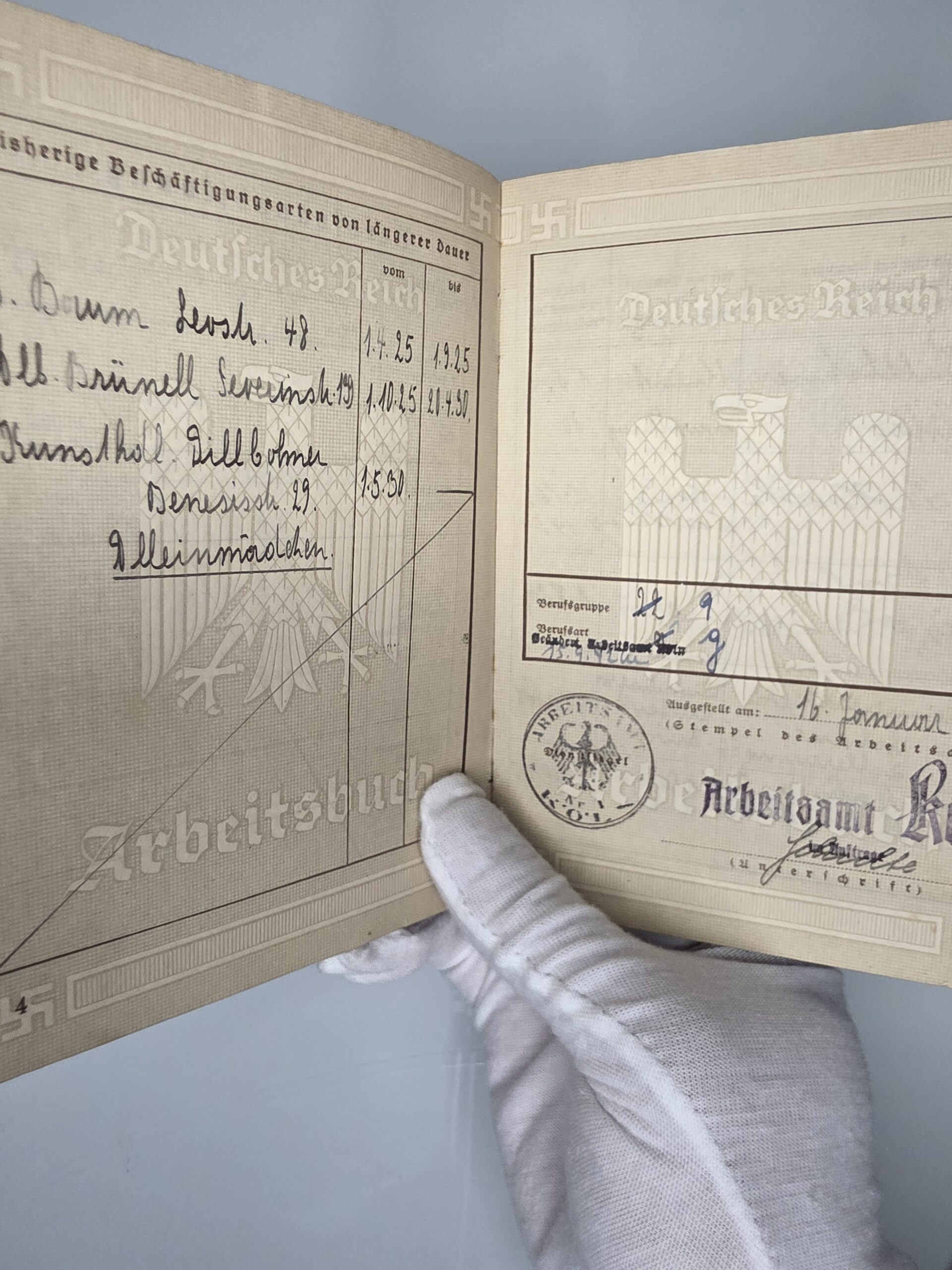
Third Reich Arbeitsbuch – Original German Worker’s Employment Book
30,00 €

WWII German Wehrpass – Rudolf Klinger 1943 Zweitschrift with Photo & Typhus Card
Original price was: 110,00 €.99,00 €Current price is: 99,00 €.

(no title)
Original price was: 299,00 €.245,00 €Current price is: 245,00 €.

Third Reich Tax Documents – 1937 Bavarian Ministry & Nuremberg Archive
Original price was: 150,00 €.99,00 €Current price is: 99,00 €.
Original 1940 Otto Kortschak Death Sentence and Hitler Clemency Document
Original price was: 300,00 €.190,00 €Current price is: 190,00 €.
37% Off
Interested in this item? Please contact us directly by email, WhatsApp or through the enquiry form below for availability or other information. Kindly include the item SKU/reference number in your message so we can identify the piece.
Description
Original 1940 Hitler Clemency Document
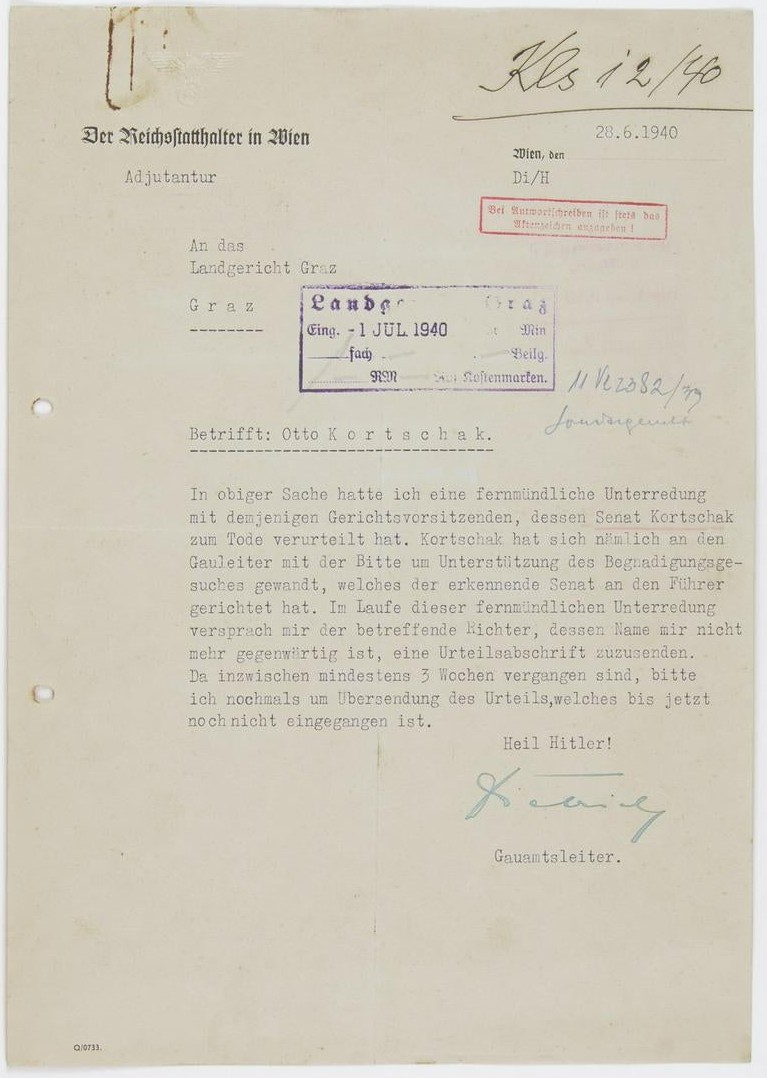
This original 1940 Hitler clemency document is a rare German-language judicial and administrative letter directly connected with a death sentence issued by the Special Court in Graz during the Second World War.
The document was typed in Vienna on 28 June 1940 on official stationery headed:
“Der Reichsstatthalter in Wien – Adjutantur”
It was addressed to the:
“Landgericht Graz” — Graz Regional Court
The subject line identifies the case as:
“Betreff: Otto Kortschak”
The letter is signed in coloured pencil or ink by an official identified in specialist auction and dealer catalogues as the Gauamtsleiter “Dietrich.” Other specialist cataloguing has described him as one of the adjutants attached to the office of the Reich Governor of Vienna.
Otto Kortschak’s Death Sentence
The text explains that the writer had held a telephone conversation with the presiding judge whose judicial panel had sentenced Otto Kortschak to death.
It continues by stating that Kortschak had contacted the Gauleiter and requested his support for a petition for clemency that the sentencing panel had addressed to Adolf Hitler.
The writer had been promised a copy of the judgement, but after at least three weeks it had still not arrived. The present letter therefore asks the Graz court to send the missing copy.
A translation of the principal text reads:
“In the above matter, I had a telephone conversation with the presiding judge whose panel sentenced Kortschak to death. Kortschak had approached the Gauleiter with a request for support for the petition for clemency which the adjudicating panel had addressed to the Führer.
During this telephone conversation, the judge concerned, whose name I no longer remember, promised to send me a copy of the judgement.
Since at least three weeks have now passed, I once again request that the judgement, which has not yet arrived, be sent to me.”
The letter closes with the political salutation customary in official correspondence of the period and the handwritten signature above the typed position:
“Gauamtsleiter.”
Official Reply from the Graz Special Court
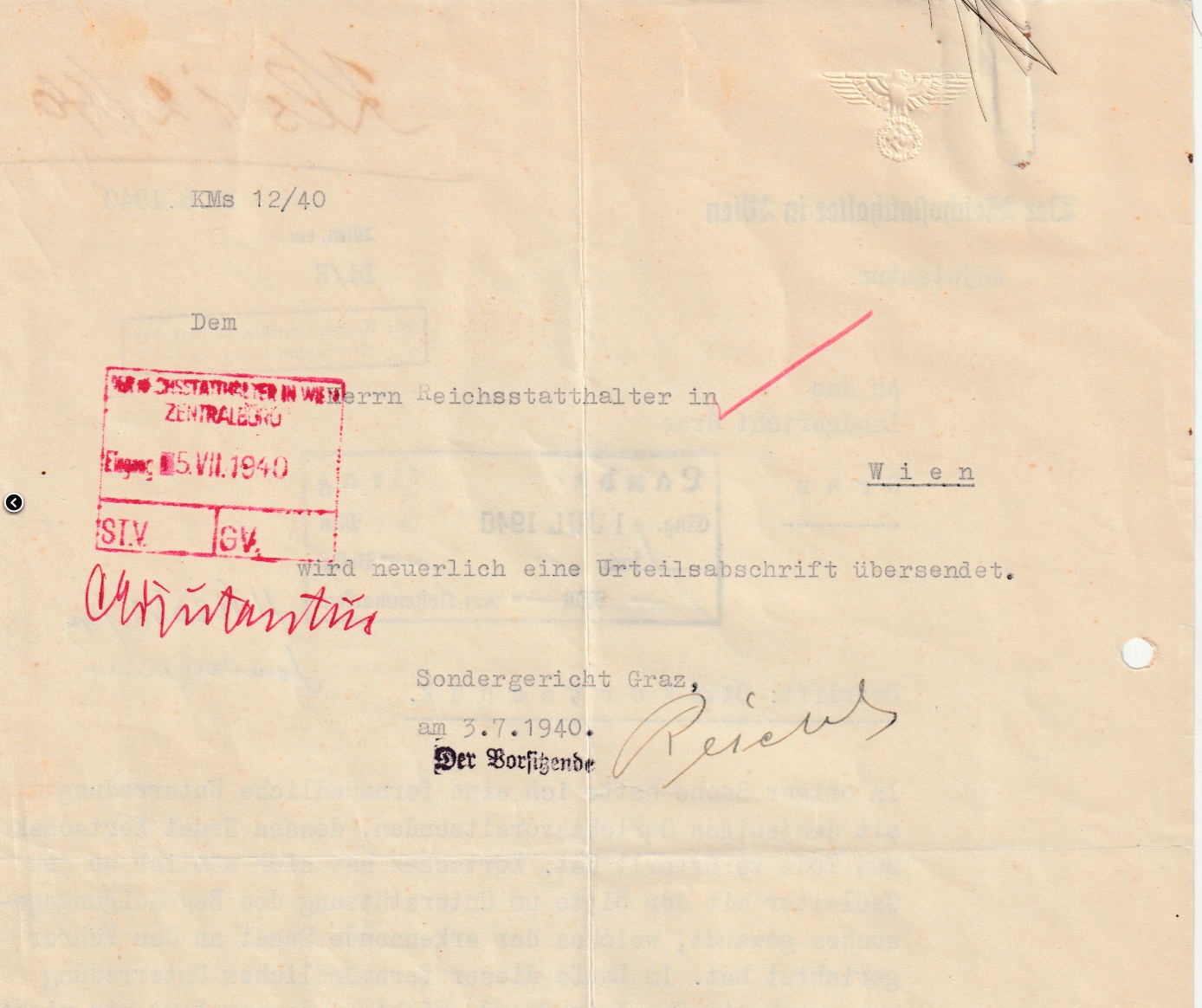
The reverse contains a short typed response dated 3 July 1940.
It states:
“A copy of the judgement will be sent again to the Reich Governor in Vienna.”
The response is headed “Sondergericht Graz”, or Special Court Graz, and is signed by the presiding official.
This correspondence therefore preserves both sides of the administrative exchange: the request from Vienna and the subsequent response from Graz.
The Final Outcome of the Case
Archival research concerning the Graz Special Court records Otto Kortschak among those sentenced to death. The judgement was issued on 27 April 1940.
The same archival list records that the death sentence was not carried out. Kortschak was granted clemency and the punishment was commuted to 15 years’ imprisonment.
This gives the document considerably greater historical importance. It is not merely a routine request for paperwork but surviving correspondence from the clemency procedure surrounding a death sentence that was ultimately commuted.
The Reich Governor’s Office in Vienna
At the time the letter was produced, the office of Reich Governor and Gauleiter in Vienna was held by Josef Bürckel. He remained in that position until he was replaced by Baldur von Schirach during the summer of 1940.
The document is not signed by Bürckel himself. It was issued from his Adjutant’s Office and signed by a subordinate official acting within the Reich Governor’s administration.
This distinction is important for accurate cataloguing: the item is connected institutionally with Bürckel’s office, but the handwritten signature belongs to the official identified as “Dietrich.”
Nazi Judicial Administration in Wartime Austria
The Special Courts were part of the judicial machinery used by the National Socialist state. They operated with accelerated procedures and increasingly severe sentencing practices, including extensive use of capital punishment.
The present correspondence illustrates how a condemned individual’s request for clemency could pass through the judicial panel, regional political authorities and finally the central leadership.
The document is especially relevant to collectors and researchers interested in:
- Judicial history in Nazi-controlled Austria
- Sondergericht Graz documentation
- Death sentences and clemency procedures
- Vienna administrative records
- Josef Bürckel’s Reich Governor administration
- Original WWII political and judicial documents
- German and Austrian militaria
- Second World War paper ephemera
Previous Specialist Cataloguing
The same document and photographs have appeared in specialist auction and dealer catalogues under titles referring to an Austrian death sentence appealed to Hitler.
Alexander Historical Auctions recorded the item as sold for $40, against an estimate of $80, in a 2020 auction. The document was subsequently catalogued by other specialist dealers and autograph auction houses, including an out-of-stock dealer listing that repeats the date, content, reverse reply and condition details.
This earlier market appearance supports the identification of the document, although it should not be interpreted as a modern certificate or independent forensic authentication.
Condition
The sheet displays general age toning, scattered foxing or small brown spots, light folds and handling wear.
Two archive perforations are visible along the left margin. A rust-coloured stain and impression remain in the upper-left area where a metal paperclip was formerly attached.
The official stamps, handwritten annotations, typed text and signature remain clearly visible. The reverse shows fold lines, administrative stamps, an embossed official eagle and the signed response from the Graz court.
The photographs form an essential part of the condition description.
The document is offered strictly as an original historical collectable for preservation, education, documentation and research. Its sale does not endorse the political regime, judicial system or ideology represented by the correspondence.
Additional information
| Availability | Available |
|---|
Only logged in customers who have purchased this product may leave a review.
Related products
Third Reich Arbeitsbuch – Original German Worker’s Employment Book
30,00 €
WWII German Wehrpass – Rudolf Klinger 1943 Zweitschrift with Photo & Typhus Card
Original price was: 110,00 €.99,00 €Current price is: 99,00 €.
10% Off
(no title)
Original price was: 299,00 €.245,00 €Current price is: 245,00 €.
18% Off
Third Reich Tax Documents – 1937 Bavarian Ministry & Nuremberg Archive
Original price was: 150,00 €.99,00 €Current price is: 99,00 €.
34% Off
Reviews
There are no reviews yet.