
Products on sale
Third Reich Arbeitsbuch – Original German Worker’s Employment Book
30,00 €

WWII German Wehrpass – Rudolf Klinger 1943 Zweitschrift with Photo & Typhus Card
Original price was: 110,00 €.99,00 €Current price is: 99,00 €.

(no title)
Original price was: 299,00 €.245,00 €Current price is: 245,00 €.

Third Reich Tax Documents – 1937 Bavarian Ministry & Nuremberg Archive
Original price was: 150,00 €.99,00 €Current price is: 99,00 €.

German Arbeitsbuch 1935 – Heinz Ramsbrock, Bielefeld Commercial Apprentice IIWW
30,00 €
Interested in this item? Please contact us directly by email, WhatsApp or through the enquiry form below for availability or other information. Kindly include the item SKU/reference number in your message so we can identify the piece.
Description
German Arbeitsbuch 1935 – Heinz Ramsbrock of Bielefeld
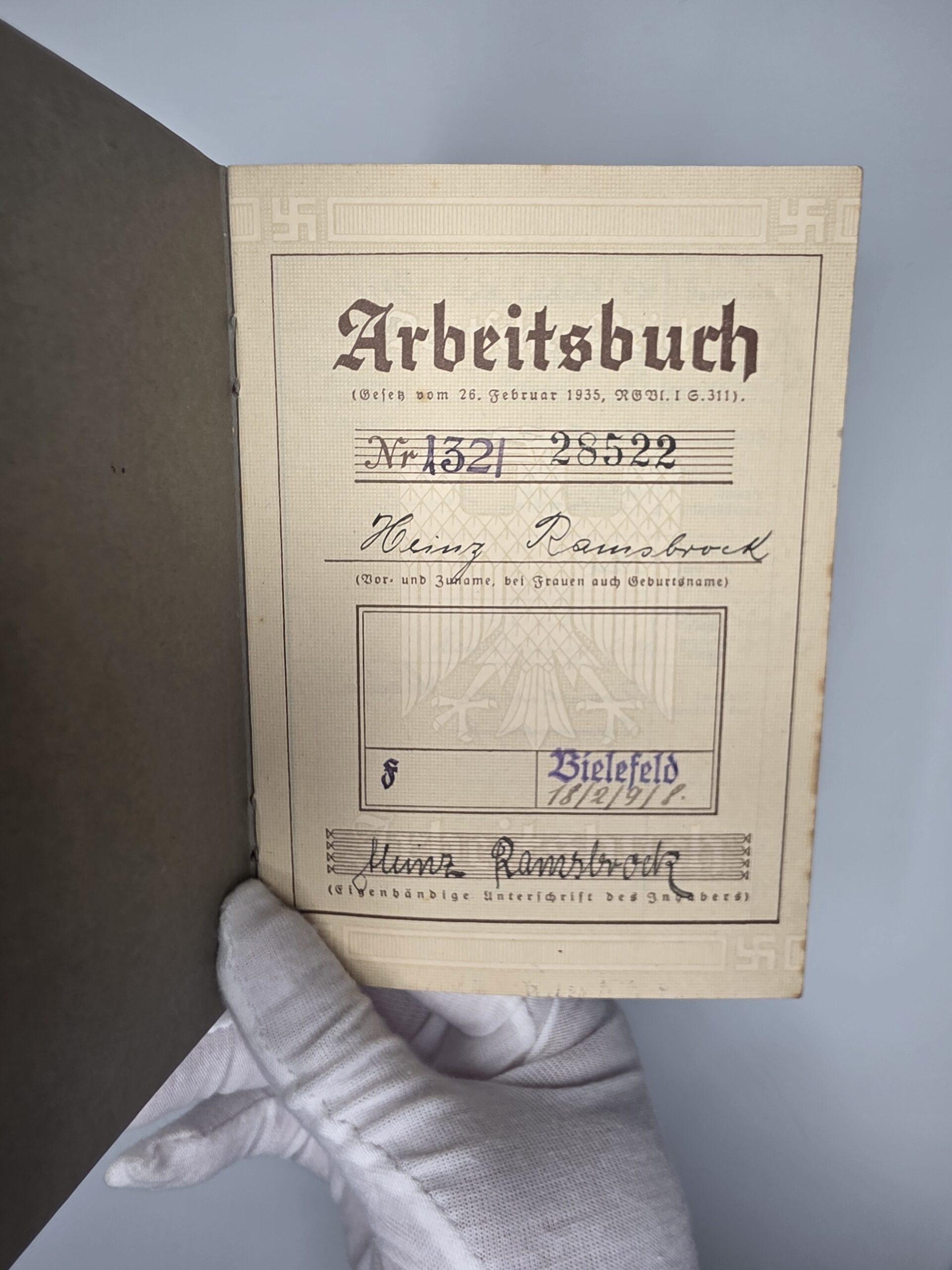
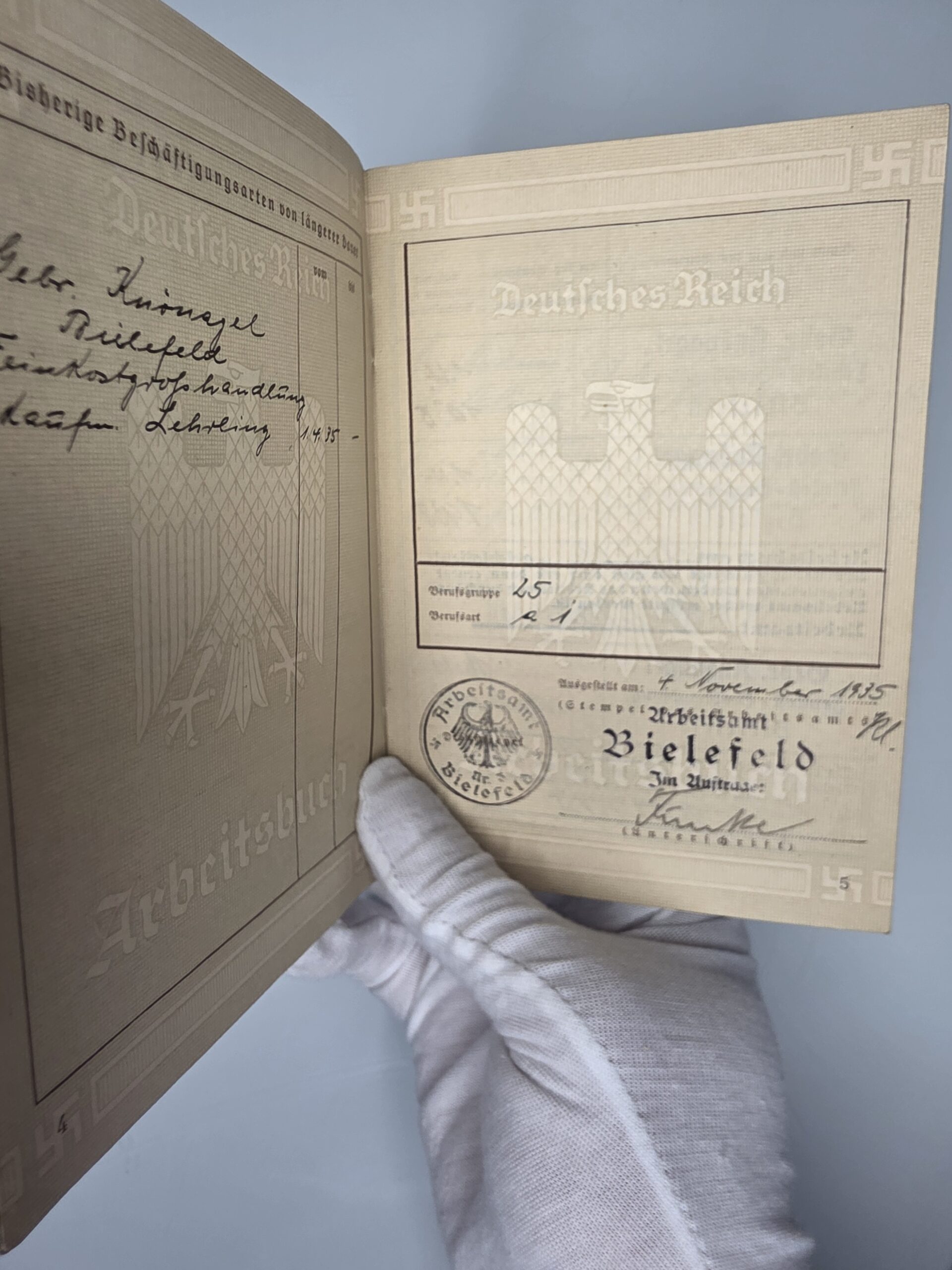
This original German Arbeitsbuch 1935 was issued by the Arbeitsamt Bielefeld on 4 November 1935 to Heinz Ramsbrock.
The booklet survives with Ramsbrock’s original handwritten signature, official Arbeitsamt markings and a series of employment entries documenting his professional development with a Bielefeld food wholesaler.
Unlike an unused or minimally completed Arbeitsbuch, DOC183 provides a coherent employment narrative extending from Ramsbrock’s period as a commercial apprentice into his subsequent work as a salaried commercial employee.
The cover carries the standard:
Deutsches Reich
designation, state eagle and the title:
Arbeitsbuch
and belongs to the first generation of work books introduced during 1935.
The Introduction of the Arbeitsbuch in 1935
The date of DOC183 is particularly relevant.
The German government enacted the Gesetz über die Einführung eines Arbeitsbuches on 26 February 1935. The system came into force on 1 April and was progressively expanded during the following months. Wikipedia
The purpose went beyond simply giving workers proof of employment.
Arolsen Archives describes Arbeitsbücher as part of the state regulation of the labour market. Local employment offices issued them and maintained corresponding Arbeitsbuch cards, while employers entered the details of individual jobs. e-Guide
The books could record:
- personal information
- professional qualifications
- occupation
- employers
- dates of employment
- changes of workplace
By controlling this documentation through the Arbeitsämter, the state gained substantially greater oversight of labour mobility.
DOC183 was issued in November 1935, placing it within the very first year of operation of this system.
Heinz Ramsbrock
The holder is identified on the opening page as:
Heinz Ramsbrock
His name is handwritten clearly beneath the Arbeitsbuch number.
At the bottom appears his original personal signature:
Heinz Ramsbrock
The same surname is independently documented in period Bielefeld address material, demonstrating that Ramsbrock was an established local family name in the city, although the currently located directory reference does not provide enough information to identify this Heinz Ramsbrock personally with certainty. Genealogía DES
The responsible catalogue description should therefore rely on the Arbeitsbuch itself rather than attempting to construct an unverified genealogy.
Arbeitsamt Bielefeld
The issue page is dated:
4 November 1935
and bears the circular:
Arbeitsamt Bielefeld
stamp together with the printed Bielefeld employment-office designation and an administrative signature.
The book therefore provides a clear local administrative origin.
This is useful for collectors because named Arbeitsämter can add regional interest to otherwise common employment records.
The occupational coding visible on the issue page appears to include:
Berufsgruppe 25
Berufsart A1
I would retain these codes exactly as written but would not expand their precise meaning without a contemporary classification table specific to this edition.
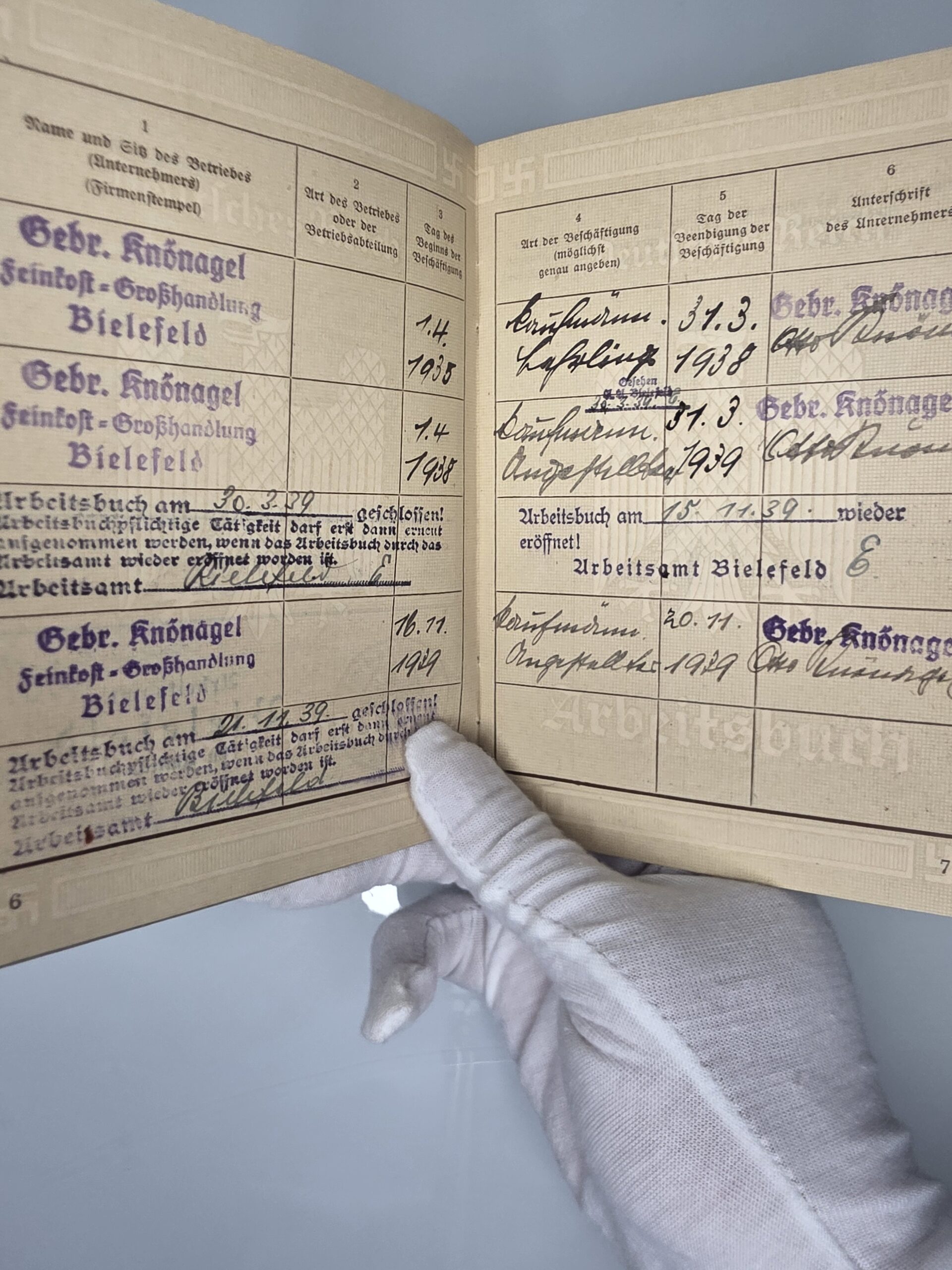
Gebr. Knöngel – Feinkost-Großhandlung Bielefeld
The employment pages carry repeated purple company stamps reading approximately:
Gebr. Knöngel
Feinkost-Großhandlung
Bielefeld
Feinkost-Großhandlung can be translated as a delicatessen / speciality-food wholesale business.
This is considerably better from a collector perspective than a book containing only generic employment-office entries because the actual employer remains identifiable.
The handwriting shows that Ramsbrock’s relationship with the firm extended across several employment stages.
Commercial Apprenticeship, 1935–1938
The earliest visible employment period begins:
1 April 1935
The occupation is recorded as:
Kaufmann – Lehrling
which corresponds to a commercial apprentice.
The entry appears to end:
31 March 1938
This represents approximately three years of commercial training.
The timing is particularly interesting because Bielefeld’s own 1935 administrative reporting discusses apprentices and the newly introduced Arbeitsbuch system. The city noted that the existence of the new work books was encouraging workers to obtain formal trade qualifications so that their trained professional status could be recorded. Stadtarchiv Bielefeld
DOC183 therefore provides a physical individual example from precisely that historical context.
From Apprentice to Employee
The next employment period begins:
1 April 1938
at the same company.
Ramsbrock’s status changes from Lehrling to:
Kaufmann / Angestellter
or a commercial salaried employee.
The visible end date appears to be:
31 March 1939
The transition is one of the strongest features of the book:
apprentice → commercial employee
within the same Bielefeld company.
That gives the document significantly more narrative value than an Arbeitsbuch containing isolated unrelated job entries.
Closure and Reopening in 1939
The Arbeitsbuch was subsequently marked:
geschlossen
or closed, around 30 March 1939.
The printed warning explains that employment subject to Arbeitsbuch requirements could only be resumed after the booklet had been reopened by the Arbeitsamt.
The book was later formally:
wieder eröffnet
by Arbeitsamt Bielefeld on 15 November 1939.
A further employer entry with the same Gebr. Knöngel stamp begins on approximately:
16 November 1939
and again records Ramsbrock as a commercial employee.
The following date appears to be 20 November 1939.
This administrative sequence demonstrates another important characteristic of the Arbeitsbuch system: employment status was not simply privately recorded between employer and employee. Changes could require direct intervention by the local labour office.
Employment Control Under the Third Reich
The Arbeitsbuch increasingly became part of a wider system of labour management.
Arolsen Archives notes that German employees could only change jobs under increasingly regulated conditions and that employment offices could direct labour where authorities considered workers more urgently needed. e-Guide
The individual Arbeitsbuch therefore served two simultaneous functions:
it documented a worker’s actual career
and
it enabled government oversight of that career.
DOC183 illustrates this clearly through its employer entries, Arbeitsamt stamps, closure and later official reopening.
Not a Military Document
Although the cover bears German state symbolism, this is not a Wehrmacht document.
An Arbeitsbuch concerns civilian employment.
It should not be confused with:
- Wehrpass — military service record
- Soldbuch — active military pay/identity book
- DAF membership book — organisational membership
- Kennkarte — civilian identity card
Correct terminology is important both historically and for SEO.
Standard German Arbeitsbuch – Not Arbeitsbuch für Ausländer
DOC183 is the standard form used for German workers.
Arolsen Archives notes that a dedicated Arbeitsbuch für Ausländer was only introduced in May 1943 for foreign workers. e-Guide
DOC183 predates that version by almost eight years.
Nothing visible in the supplied pages suggests foreign or forced-labour status.
Collector Interest
The strengths of this German Arbeitsbuch 1935 are not rarity alone.
Standard Arbeitsbücher survive in considerable quantities.
DOC183 is attractive because it combines:
- first-year 1935 issue
- named holder
- holder’s original signature
- clear Arbeitsamt Bielefeld origin
- identified Bielefeld employer
- repeated company stamps
- commercial apprenticeship
- transition to salaried employee
- several dated entries
- document closure and reopening
- coherent local employment history
It therefore works well as an example of commercial apprenticeship and civilian employment administration in 1930s Germany.
It may appeal particularly to collectors of Bielefeld history, labour documents, commercial history, German civilian paperwork and Third Reich-era social history.
Condition and Authenticity
DOC183 remains in good used period condition.
Visible characteristics include:
- light rubbing to the cover
- minor edge and corner wear
- natural paper toning
- occasional spotting
- original handwriting
- repeated employer stamps
- Arbeitsamt Bielefeld stamps
- official signatures and administrative markings
The binding appears sound in the supplied photographs.
The principal employment information remains clearly visible.
The item is offered as an original period German Arbeitsbuch issued in 1935.
The photographs show the actual document offered and form part of the condition description.
Historical Responsibility Notice
This item is offered solely for historical, documentary, educational and collecting purposes. Political symbols visible on the document form part of its original 1935 administrative design. Autographs & Militaria does not endorse National Socialism or any ideology represented by the item.
Additional information
| Availability | Available |
|---|
Only logged in customers who have purchased this product may leave a review.
Related products
Third Reich Arbeitsbuch – Original German Worker’s Employment Book
30,00 €
WWII German Wehrpass – Rudolf Klinger 1943 Zweitschrift with Photo & Typhus Card
Original price was: 110,00 €.99,00 €Current price is: 99,00 €.
10% Off
(no title)
Original price was: 299,00 €.245,00 €Current price is: 245,00 €.
18% Off
Third Reich Tax Documents – 1937 Bavarian Ministry & Nuremberg Archive
Original price was: 150,00 €.99,00 €Current price is: 99,00 €.
34% Off
Reviews
There are no reviews yet.