
Products on sale
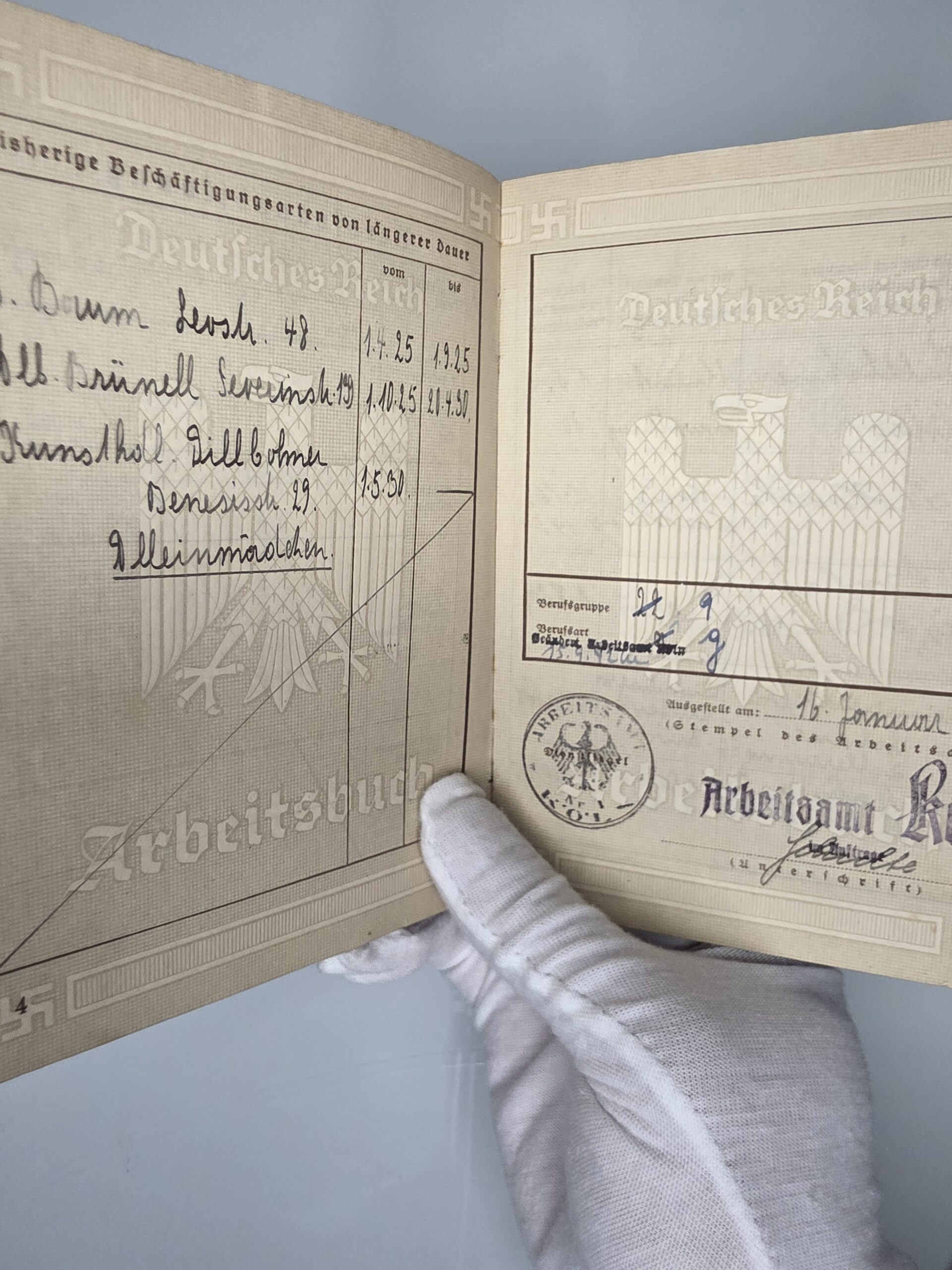
Third Reich Arbeitsbuch – Original German Worker’s Employment Book
30,00 €

WWII German Wehrpass – Rudolf Klinger 1943 Zweitschrift with Photo & Typhus Card
Original price was: 110,00 €.99,00 €Current price is: 99,00 €.

(no title)
Original price was: 299,00 €.245,00 €Current price is: 245,00 €.

Third Reich Tax Documents – 1937 Bavarian Ministry & Nuremberg Archive
Original price was: 150,00 €.99,00 €Current price is: 99,00 €.

Original Franz von Papen Signed Postcard 1933 – German Vice Chancellor
Original price was: 490,00 €.390,00 €Current price is: 390,00 €.
20% Off
Interested in this item? Please contact us directly by email, WhatsApp or through the enquiry form below for availability or other information. Kindly include the item SKU/reference number in your message so we can identify the piece.
Description
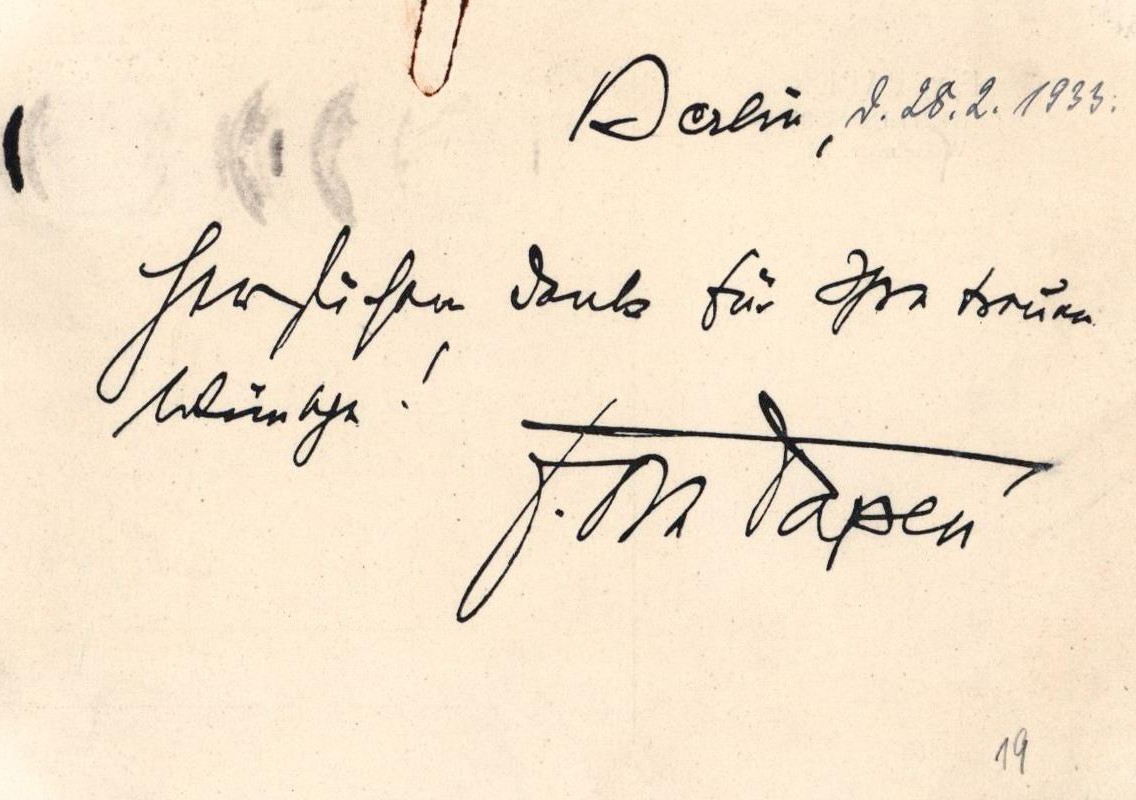
Original Franz von Papen Signed Postcard Dated 1933
This Franz von Papen signed postcard is an original German postal item handwritten and signed in Berlin on 28 February 1933, during one of the most decisive months in modern German political history.
The postcard carries Papen’s printed sender details in the upper-left corner:
“F. v. Papen
Berlin W 8
Wilhelmstr. 74”
On the reverse, Papen wrote a short message of thanks and concluded it with a large handwritten signature:
“F. v. Papen”
The message appears to read:
“Berlin, d. 28.2.1933.
Herzlichen Dank für Ihre treuen Wünsche.
Aufrichtig,
F. v. Papen.”
English translation:
“Berlin, 28 February 1933.
Heartfelt thanks for your loyal good wishes.
Sincerely,
F. v. Papen.”
The postcard was addressed to Dr. Hartmeyer in Hamburg and retains its original six-pfennig postage stamp, cancellation, postal advertising slogan, administrative marks and a red notice indicating that delivery had been delayed because of an insufficient address.
Signed During Papen’s First Month as Vice Chancellor
Franz von Papen had served as Chancellor of Germany during 1932. In January 1933, he played a major role in the negotiations that removed Chancellor Kurt von Schleicher and persuaded President Paul von Hindenburg to appoint Adolf Hitler as Chancellor.
Papen entered the new government as Vice Chancellor on 30 January 1933. He and other conservative politicians believed that they could restrict Hitler’s power by surrounding him with non-Nazi cabinet ministers. Instead, the arrangement helped place Hitler in control of the German government and contributed to the rapid destruction of the Weimar democratic system.
This postcard was written less than one month after that government was formed. It therefore represents an early autograph from Papen’s vice-chancellorship rather than a later post-war signature or retrospective piece of correspondence.
The Important Date: 28 February 1933
The date gives this Franz von Papen signed postcard particular historical significance.
On the evening of 27 February 1933, the Reichstag building in Berlin was damaged by fire. The following day, 28 February, President Hindenburg signed the emergency decree commonly known as the Reichstag Fire Decree.
The measure suspended fundamental civil liberties and due-process protections and provided the government with greatly expanded powers against political opponents. It became one of the principal legal instruments used during the transition from the Weimar Republic to dictatorship.
There is no evidence that Papen’s short personal thank-you note relates directly to the fire or the decree. Nevertheless, the postcard was physically written and dispatched in Berlin on that exact date, while Papen was serving as Vice Chancellor.
This contemporary dating makes it far more historically evocative than an undated autograph or a signature obtained decades later.
Official Address and Prussian State Ministry Stamp
The printed address Wilhelmstrasse 74 places the card within Berlin’s government district and corresponds with the address used by Papen during this political period.
The postal side also retains a large violet circular stamp associated with the Prussian State Ministry in Berlin. The stamp contains a central eagle and provides an additional institutional connection with Papen’s government responsibilities.
Other surviving postal features include:
- Original German postage stamp
- Circular Berlin cancellation
- “Fernsprecher spart Zeit und Geld” postal slogan
- Recipient’s handwritten address
- Red postal delay marking
- Blue postal annotations
- Original handwritten message and signature
These elements make the postcard appealing not only to autograph collectors but also to collectors of postal history, government correspondence and German political ephemera.
Franz von Papen and the Third Reich
Papen’s historical importance extends beyond the early months of 1933.
After leaving the vice-chancellorship in 1934, he was appointed German envoy and later ambassador in Vienna. In 1939, shortly before the Second World War, he became ambassador to Turkey and remained involved in German diplomacy during much of the conflict.
He was prosecuted at the International Military Tribunal after the war but was acquitted. A later German denazification tribunal sentenced him to imprisonment, although he was released before completing the sentence.
His career links the final crisis of the Weimar Republic, the appointment of Hitler, the early consolidation of the Third Reich, German policy toward Austria and wartime diplomacy.
Condition
The postcard presents general age toning, light stains, small surface marks and normal handling wear.
A paperclip remains attached or has left oxidation and pressure marks near the upper edge of the written side. Additional postal and collector annotations appear in pencil or coloured crayon.
The postage stamp, cancellation, institutional stamp, printed sender address, handwritten message and signature remain clearly visible.
The handwritten signature is large and prominent, with the characteristic extended horizontal stroke passing across the surname.
The photographs form an essential part of the condition description.
Historical Autograph for Collectors
This Franz von Papen signed postcard would be particularly suitable for collections focused on:
- Franz von Papen autographs
- German political signatures
- The collapse of the Weimar Republic
- The formation of Hitler’s government
- Third Reich political history
- Pre-WWII German documents
- Second World War personalities
- German diplomatic history
- Government postal history
- Original 1933 correspondence
Unlike a detached signature, the card preserves the full message, date, sender’s printed address, postage, official stamp and postal journey.
The item is offered strictly as a historical collectable for preservation, documentation, research and education. Its sale does not endorse the political system or subsequent actions associated with the period.
Additional information
| Availability | Available |
|---|
Only logged in customers who have purchased this product may leave a review.
Related products
Third Reich Arbeitsbuch – Original German Worker’s Employment Book
30,00 €
WWII German Wehrpass – Rudolf Klinger 1943 Zweitschrift with Photo & Typhus Card
Original price was: 110,00 €.99,00 €Current price is: 99,00 €.
10% Off
(no title)
Original price was: 299,00 €.245,00 €Current price is: 245,00 €.
18% Off
Third Reich Tax Documents – 1937 Bavarian Ministry & Nuremberg Archive
Original price was: 150,00 €.99,00 €Current price is: 99,00 €.
34% Off
Reviews
There are no reviews yet.