Products on sale
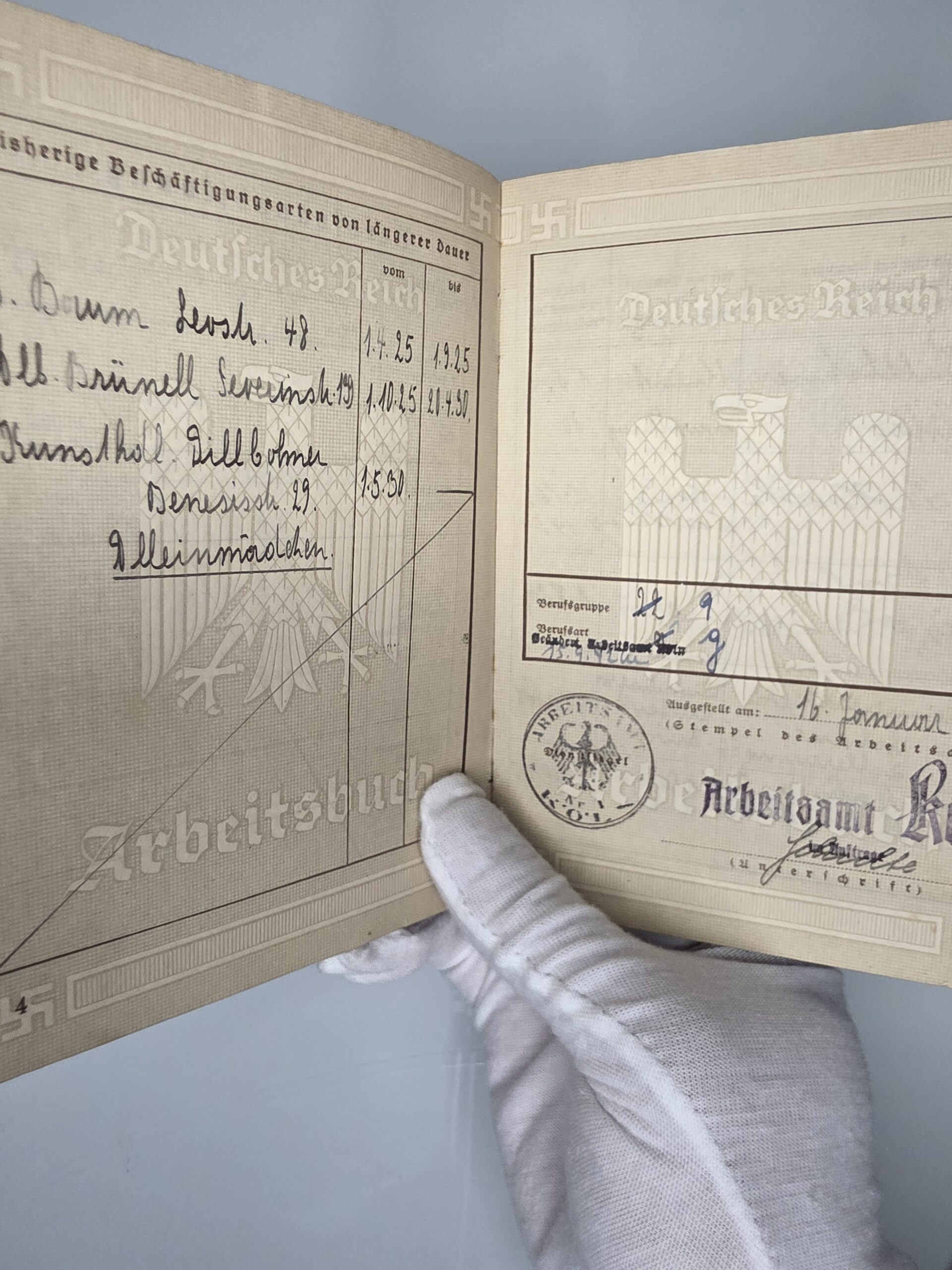
Third Reich Arbeitsbuch – Original German Worker’s Employment Book
30,00 €

WWII German Wehrpass – Rudolf Klinger 1943 Zweitschrift with Photo & Typhus Card
Original price was: 110,00 €.99,00 €Current price is: 99,00 €.

(no title)
Original price was: 299,00 €.245,00 €Current price is: 245,00 €.

Third Reich Tax Documents – 1937 Bavarian Ministry & Nuremberg Archive
Original price was: 150,00 €.99,00 €Current price is: 99,00 €.


Adam Opel Arbeitsbuch – Rüsselsheim Welder & Factory Worker, 1930s IIWW
30,00 €
Interested in this item? Please contact us directly by email, WhatsApp or through the enquiry form below for availability or other information. Kindly include the item SKU/reference number in your message so we can identify the piece.
Description
Adam Opel Arbeitsbuch – Rüsselsheim Factory Worker
This original Adam Opel Arbeitsbuch belonged to Peter Fellner, a skilled German industrial worker whose employment history includes repeated work with Adam Opel A.G. in Rüsselsheim.
The booklet is an early or pre-war type of Deutsches Reich Arbeitsbuch and retains Fellner’s original handwritten name and signature, official Arbeitsamt Frankfurt markings, detailed occupational entries and several original Adam Opel company stamps.
Its particular collector interest lies in the combination of German labour administration and pre-war automotive industrial history.
Rather than being an anonymous employment record, DOC184 documents a named skilled metalworker connected directly with one of Germany’s most important automobile factories.
An Early-Type German Arbeitsbuch
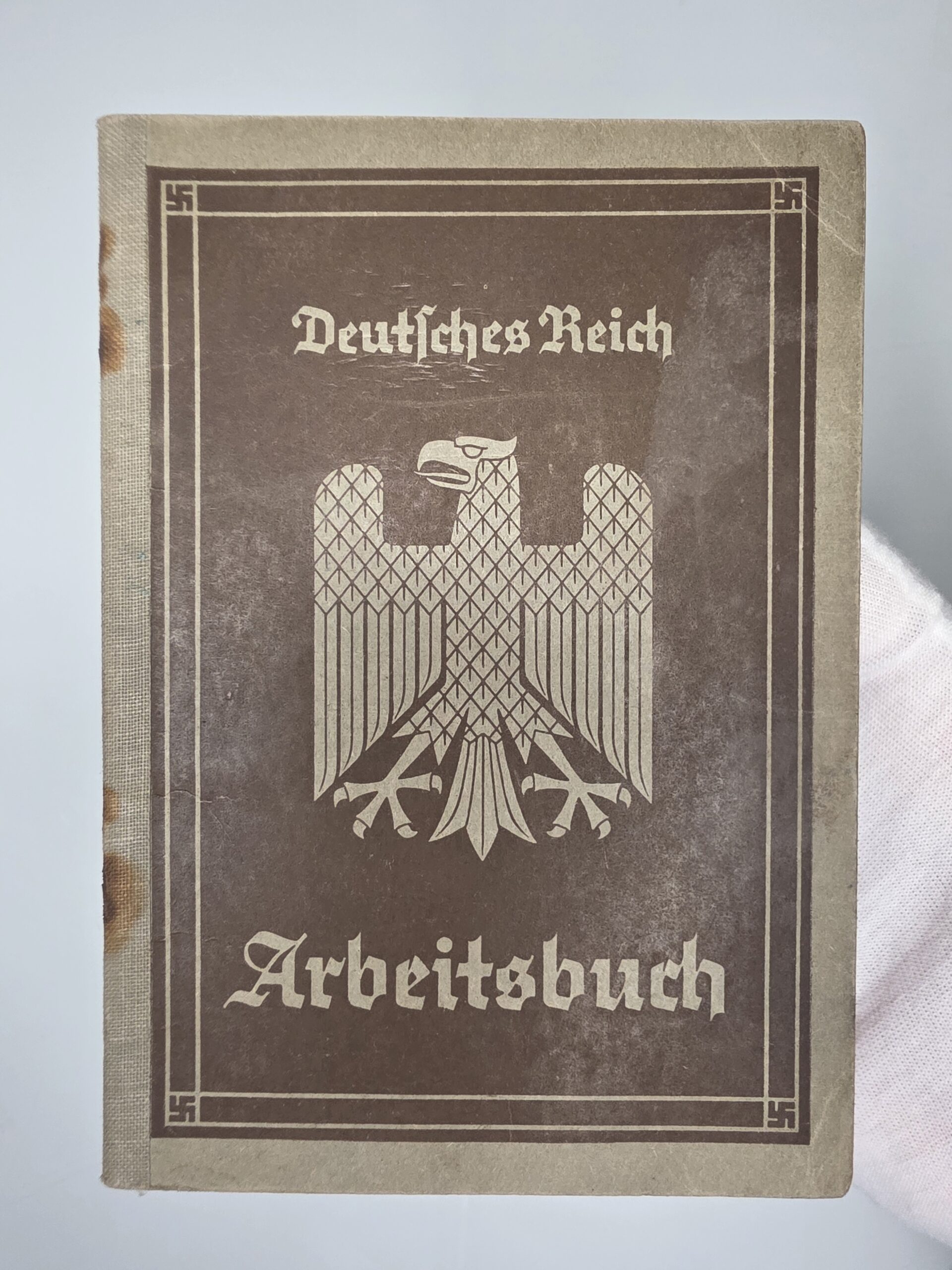
DOC184 uses the early Arbeitsbuch cover design.
The front displays:
Deutsches Reich
above a stylised German eagle with downward-pointing wings, followed by:
Arbeitsbuch
Small period political emblems appear in the corners of the decorative border, but unlike the later version, the eagle itself does not carry the prominent wreath-and-swastika device beneath it.
Specialist militaria dealers describe this form as a pre-war or first-type Arbeitsbuch, distinguishing it from later variants with different eagle designs. mbertram.de
That visual difference is useful both historically and commercially.
Peter Fellner
The opening page identifies the holder as:
Peter Fellner
and retains what appears to be his original personal signature at the bottom of the page.
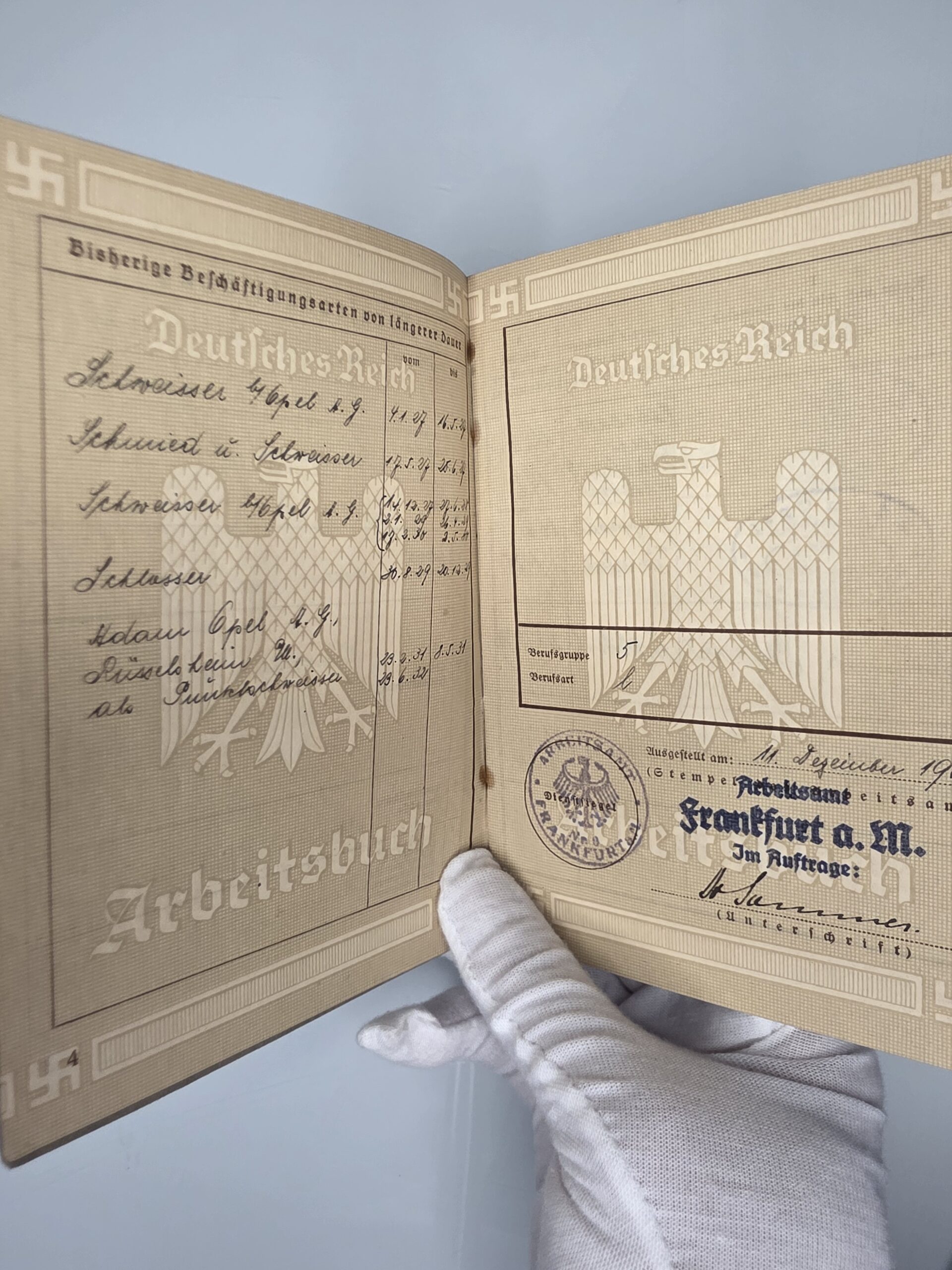
The booklet was administered through:
Arbeitsamt Frankfurt a.M.
whose circular official seal and large office marking remain clearly visible.
The issue line reads:
11. Dezember 19…
The final digits of the year are outside the supplied photograph and should therefore not be invented.
The document itself nevertheless belongs to the first generation of Arbeitsbücher created after the introduction of the system in 1935.
What Was an Arbeitsbuch?
The Reich government introduced the Arbeitsbuch by law on 26 February 1935.
Its stated purpose was to assist in the planned distribution of labour throughout the German economy. Workers falling under the regulations could only be legally employed if they possessed a properly issued Arbeitsbuch. Wikipedia
The system rapidly became an important instrument for controlling employment.
Arolsen Archives explains that Arbeitsbücher contained both personal and professional information, particularly the individual’s successive workplaces. Local Arbeitsämter maintained corresponding record cards and employers were required to report changes in employment. e-Guide
In practical terms, the document served both as a worker’s employment history and as an administrative mechanism enabling government supervision of labour mobility.
Skilled Metalwork and Welding
The retrospective occupational-history page preserved in DOC184 is particularly informative.
Several entries refer to skilled metalworking trades, including:
Schweißer
or welder,
Schmied und Schweißer
or blacksmith and welder,
and:
Schlosser
a term that in this industrial context is better understood as fitter, mechanic or metalworker rather than simply the modern English sense of locksmith.
Repeated references to Opel A.G. appear among these entries.
The chronology extends back into the late 1920s and early 1930s, indicating that Fellner already possessed substantial industrial experience before the Arbeitsbuch system itself was introduced.
This is important.
The book was issued under the 1935 administrative system, but employers and earlier professional experience could be entered retrospectively in order to document a worker’s established qualifications.
Adam Opel A.G., Rüsselsheim
The strongest visual and historical feature is the presence of several large oval employer stamps from:
Adam Opel A.G.
Rüsselsheim
The associated employment columns identify activity in the automotive manufacturing environment, including references to Fahrzeugbau and specialised welding work.
One entry appears to describe an Autogen- / Rohrschweißer type of occupation, consistent with gas or pipe welding, although the handwriting should not be expanded beyond what can be read confidently.
For collectors, the repeated Opel stamps are considerably more desirable than an Arbeitsbuch associated only with an unknown small local employer.
Opel in 1935
The timing is especially relevant.
In June 1935 the Rüsselsheim Opel works completed its 50,000th vehicle of the year, and contemporary historical records describe strong production and export activity. LAGIS
The company’s Rüsselsheim operation was running at such high capacity that during 1935 Opel planned and rapidly constructed a separate truck factory at Brandenburg an der Havel.
The historical record links the creation of that branch directly with German rearmament policy and the production of the Opel standard military truck that would become associated with the Opel Blitz. LAGIS
DOC184 should nevertheless be catalogued carefully.
It proves that Peter Fellner worked at Adam Opel A.G. in Rüsselsheim.
It does not prove that he personally manufactured Opel Blitz trucks, military vehicles or any specific model.
That distinction makes the listing both historically stronger and more credible.
A Physical Record of German Automotive Labour
One reason DOC184 is more interesting than a standard Arbeitsbuch is that it sits at the intersection of two collecting fields:
historical German documents and automotive industrial history.
The entries record not simply where Fellner worked but the type of skilled labour he performed.
They document the people behind large-scale German automobile production: welders, fitters and metalworkers whose labour rarely survives in traditional corporate histories.
The document therefore has potential appeal beyond conventional militaria collectors.
It may also interest collectors of:
Opel, Rüsselsheim, automotive history, industrial documents, factory history, labour history and German social history.
Employment Entries and Adam Opel Stamps
The later employment pages retain prominent purple oval stamps identifying Adam Opel A.G. Rüsselsheim.
Several periods of work are entered.
The surviving pages indicate employment spanning portions of the 1930s, followed by later entries reaching approximately 1940.
Because some individual dates and handwritten occupational descriptions are difficult to read with absolute certainty, the safest catalogue method is to preserve their overall meaning without inventing exact transcriptions.
The essential points are secure:
Peter Fellner was the holder; he had extensive welding/metalworking experience; Adam Opel A.G. appears repeatedly as an employer; Rüsselsheim is visible in the company stamps; and the book continued to be actively updated over several years.
Arbeitsbuch and Labour Control
The Arbeitsbuch was more than a private employment résumé.
From 1935 onward, German employment offices used these books and their parallel card indexes to manage labour deployment. Workers could increasingly be restricted in their ability to change employment without official involvement.
A historical study of labour relations in Hessen specifically notes that the introduction of the Arbeitsbuch in spring 1935 allowed authorities to determine where a worker’s labour was considered necessary. LaGIS Hessen
This is particularly relevant to an industrial worker such as Fellner because skilled metalworkers were economically important occupations.
DOC184 therefore records both an individual career and the broader state system in which that career was administered.
First-Type Format
Collector terminology distinguishes the early Arbeitsbuch design visible here from later examples.
A specialist archive describes the early pre-war version as having an eagle with downward wings and without the central swastika device in its talons, while small swastikas remain integrated into the border. mbertram.de
That description closely matches DOC184.
The first-type format is not extraordinarily rare, but it gives the piece more visual and chronological character than the later, more frequently encountered design.
Collector Interest
DOC184 combines an unusually useful group of attributes: first-type pre-war Arbeitsbuch format; identified owner Peter Fellner; original owner signature; Arbeitsamt Frankfurt administration; extensive professional history; skilled welding and metalworking trades; multiple Adam Opel A.G. Rüsselsheim stamps; and employment entries extending through a major period in Opel’s industrial development.
That combination makes it considerably more marketable than an ordinary anonymous Arbeitsbuch.
Condition and Authenticity
The document remains in good original used condition.
The cover displays natural rubbing, surface wear and some brown staining along the cloth spine.
The edges and corners show expected handling.
Internally, the paper retains natural toning, occasional marks and normal administrative wear.
The original handwritten entries, company stamps, Arbeitsamt markings and holder signature remain clearly visible.
The binding appears intact in the photographed sections.
The photographs show the actual document being offered and form part of the condition description.
The article is offered as an original period German Arbeitsbuch with documented Adam Opel A.G. employment.
Historical Responsibility Notice
This document is offered exclusively for historical, documentary, industrial-history and collecting purposes. Political symbols visible on the document form part of its original administrative design. Autographs & Militaria does not endorse National Socialism or any ideology represented by the item.
Who owned this Adam Opel Arbeitsbuch?
The name and signature appear to identify the holder as Peter Fellner.
Where did Peter Fellner work?
Several surviving employer stamps show that he worked for Adam Opel A.G. at Rüsselsheim.
What type of work did he perform?
The entries repeatedly refer to skilled metal trades including Schweißer (welder), Schmied und Schweißer and Schlosser. Later Opel entries also appear to refer to specialised automotive welding.
Is this connected with Opel Blitz production?
The document proves employment at Opel Rüsselsheim, but it does not identify the exact vehicle models on which Fellner worked. Opel’s truck programme became heavily connected with German rearmament during this period, but it would be incorrect to claim that Fellner personally built Opel Blitz military trucks without additional evidence. LAGIS
Is this a first-type Arbeitsbuch?
Yes, in collector terminology its cover corresponds to the early pre-war type with the downward-wing eagle and without the later central wreath-and-swastika device under the eagle. mbertram.de
When was the Arbeitsbuch issued?
The visible issue date reads 11 December, but the final year digits are cut off in the supplied photograph. It belongs to the early Arbeitsbuch period beginning in 1935.
Is it a military document?
No. It is a civilian employment record, although the company that employed Fellner became important to German wartime vehicle production.
Are Opel employee Arbeitsbücher collectible?
Yes. Standard Arbeitsbücher are common, but a document with a recognised industrial employer such as Adam Opel A.G., repeated factory stamps and specialised employment history generally has better collector appeal than a generic example.
Additional information
| Availability | Available |
|---|
Only logged in customers who have purchased this product may leave a review.
Related products
Third Reich Arbeitsbuch – Original German Worker’s Employment Book
30,00 €
WWII German Wehrpass – Rudolf Klinger 1943 Zweitschrift with Photo & Typhus Card
Original price was: 110,00 €.99,00 €Current price is: 99,00 €.
10% Off
(no title)
Original price was: 299,00 €.245,00 €Current price is: 245,00 €.
18% Off
Third Reich Tax Documents – 1937 Bavarian Ministry & Nuremberg Archive
Original price was: 150,00 €.99,00 €Current price is: 99,00 €.
34% Off
Reviews
There are no reviews yet.